





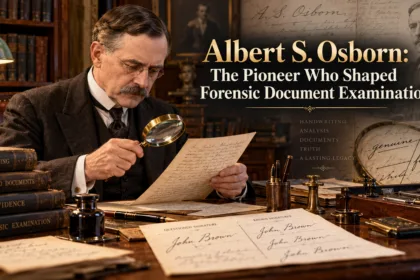
Albert S. Osborn: The Pioneer Who Shaped Forensic Document Examination
Explore Albert S. Osborn's 1910 Questioned Documents, his scientific approach to disputed records, and his role in founding the ASQDE.

Forensic Ink and Paper Examination: Methods, Interpretation and Limitations
Understand forensic ink and paper examination using spectroscopy, TLC, GC-MS, microscopy, watermarks and physical-fit methods, with practical examples and scientific limitations.

Differentiating Forensic Handwriting Examination and Graphology
Explore the fundamental differences between forensic handwriting examination and graphology, and understand their distinct methodologies and applications.

Examination of Questioned Documents
Deciphering Authenticity: An Overview In the realm of forensic analysis, the examination of questioned documents holds paramount significance. This process delves into the intricate world…

Forensic Handwriting Analysis: Unveiling Truth in Documents
Discover how forensic handwriting analysis aids criminal investigations & legal proceedings. Expert insights on document authentication & signature verification. Learn more!
The Importance of Careful Handling and Preservation of Questioned Documents
Questioned documents are any documents that are subject to investigation in a legal or forensic context. These documents may include handwriting samples, signatures, contracts, wills,…
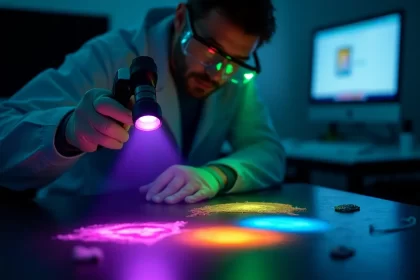
The Hidden Power Of Forensic Light Source In Forensic Science
Explore how Forensic Light Sources aid in evidence detection, from fingerprints to body fluids. Learn the key applications of this forensic science tool.

Sub-surface imaging technology can expose counterfeit travel documents.
New research reveals that Optical Coherence Tomography (OCT) can accurately detect counterfeit travel documents in seconds. This breakthrough in forensic science offers a non-destructive, high-resolution…