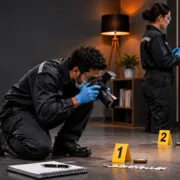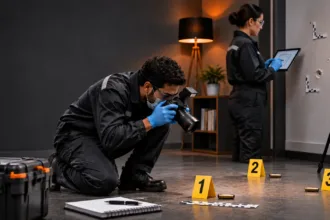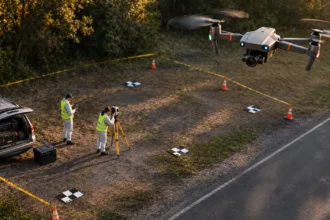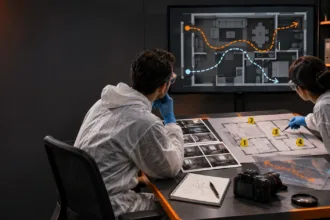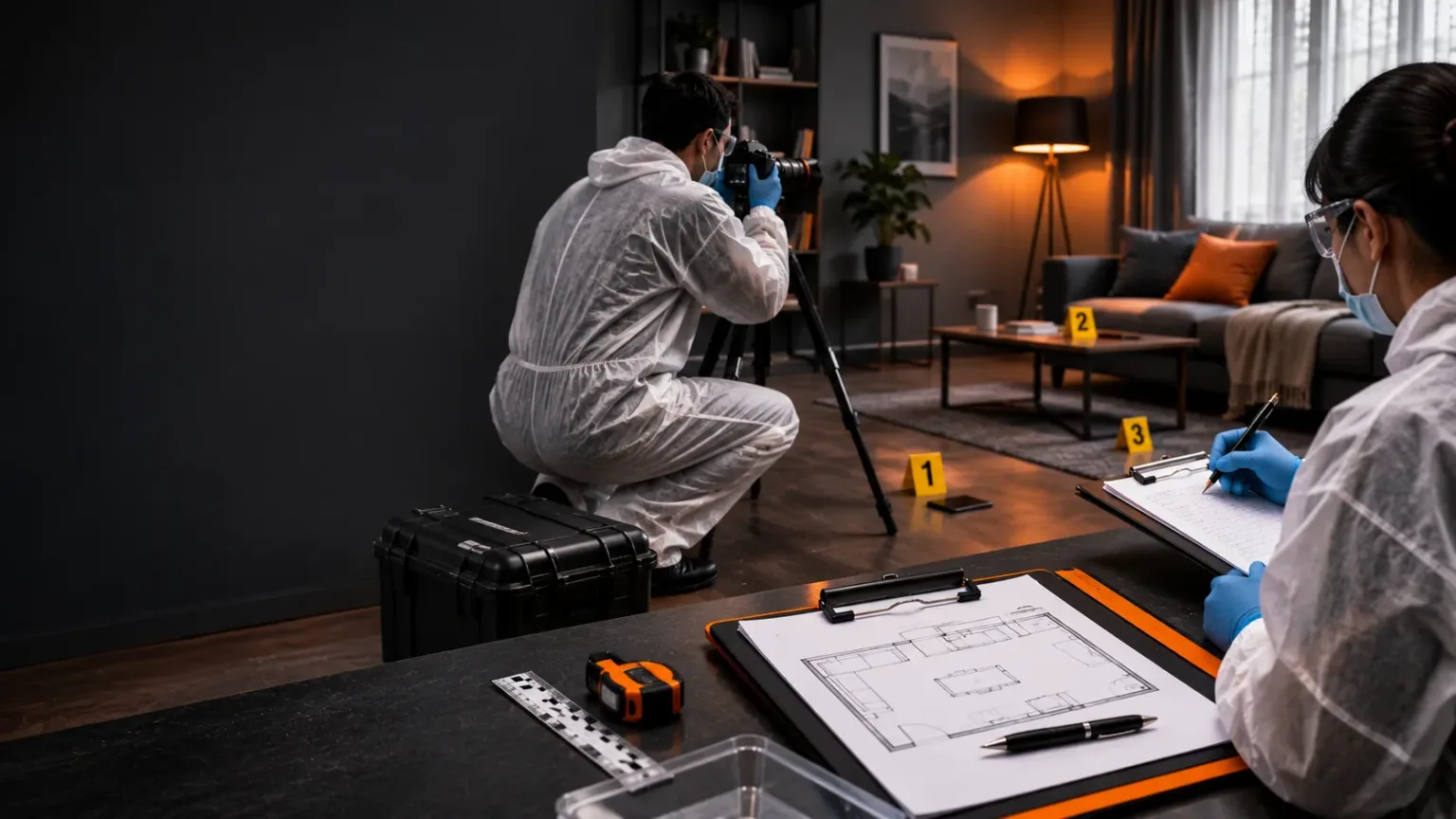
Homicide scene investigation is a coordinated examination of a death and its surrounding circumstances when an unlawful killing may be suspected. At the outset, investigators may not know whether a death is natural, accidental, self-inflicted, due to another person’s actions, or undetermined. The role of forensic investigation is therefore to protect people and evidence, record what can actually be observed, evaluate plausible explanations, and provide scientifically supportable findings—not to assume homicide because a scene looks unusual.
- What is homicide scene investigation?
- Who is responsible? Police, scene examiners and medicolegal investigators
- Step 1: First response, life safety and securing the scene
- Step 2: Make a joint scene and body examination plan
- Step 3: Document the body and surrounding scene before disturbance
- Step 4: Recognize multiple sources of forensic evidence
- Step 5: Plan evidence-recovery sequence and contamination controls
- Step 6: Coordinate lawful body recovery and postmortem examination
- Step 7: What is forensic homicide scene reconstruction?
- How should competing reconstructions be tested?
- Specialist reconstruction: bloodstains, shooting scenes and digital chronology
- Time since death: why a precise clock time is often unjustified
- Worked example 1: An apparent fall versus an inflicted injury
- Worked example 2: Cartridge cases near a doorway
- Worked example 3: A body recovered outdoors after rain
- Worked example 4: An apparent contact association with mixed DNA
- Common misconceptions about homicide scene investigation
- Final scene-to-autopsy and laboratory handover checklist
- Frequently asked questions
- References and authoritative sources
In serious or unexpected deaths, law enforcement investigators, crime scene examiners, the medical examiner or coroner, medicolegal death investigators, forensic pathologists and laboratory specialists can have different but interdependent responsibilities. A high-quality investigation preserves those distinctions while coordinating the timing of scene examination, body recovery, specimen collection, postmortem examination and later reconstruction.[1][2][3]
This guide covers initial response, scene and body documentation, forensic evidence and contamination controls, pathology liaison, reconstruction, competing hypotheses, worked examples, a scene-to-autopsy handover checklist and frequently asked questions. It is a teaching resource for forensic science students, investigators and legal professionals; it does not replace local authority, specialist training or laboratory procedures.
Key Takeaways
A suspected homicide requires an open investigation in which forensic observations, medicolegal findings and legal conclusions remain distinct.
- Protect life, control hazards and document emergency interventions before or alongside preserving vulnerable evidence.
- Coordinate scene examination, body recovery, postmortem assessment and laboratory submissions with clear responsibilities and traceable records.
- Evaluate plausible alternatives and distinguish original scene conditions, later changes, scientific interpretations and reported accounts.
- Do not treat DNADNA, or Deoxyribonucleic Acid, is the genetic material found in cells, composed of a double helix structure. It serves as the genetic blueprint for all Read Full Definition associations, bloodstain appearances, postmortem changes or cartridge-case locations as proof of an offender's activity or an exact event sequence.
Scientific caution
What is homicide scene investigation?
A homicide in medicolegal manner-of-death classification generally means that death resulted from the actions of another person. It is a different concept from murder, a legal offence requiring proof of elements established by the applicable criminal law. The medical examiner or other authorized medicolegal authority typically determines cause and manner of death within that jurisdiction’s procedures; a police investigator determines investigative lines and presents evidence for legal decisions. A medically classified homicide is not automatically criminal murder.[1][2][11]
Cause of death is the disease or injury process responsible for death, such as a particular traumatic injury or poisoning. Manner of death is a broader classification, usually including natural, accident, suicide, homicide and undetermined in systems using those categories. Mechanism of death is the physiological disturbance through which the cause produces death; it should not be substituted for the underlying cause. These distinctions matter when scene information is passed to pathologists and later communicated to courts.[1][11]
The scene is not limited to the site where the body was discovered. It may include an incident location, disposal or transport location, vehicle, approach route, residence, outdoor area or digital environment. EvidenceEvidence is any form of proof, such as objects, materials, or scientific findings, presented to establish or disprove a fact in a legal proceeding. It Read Full Definition from different sites must remain independently identified. A location where remains are found is not necessarily the location where injury or death occurred.
Who is responsible? Police, scene examiners and medicolegal investigators
Law enforcement generally manages investigative leads, witness and digital records and the lawful securing of potentially relevant scenes. Forensic scene examiners document and recover material under an agreed examination strategy. Medicolegal death investigators and forensic pathologists focus independently on the body, medical history, death circumstances and evaluation of cause and manner. Jurisdictional structures vary; some agencies combine functions while others mandate independent medical examiner or coroner authority.[1][2][3]
The NIJ Death Investigation: A Guide for the Scene Investigator (2024) emphasizes an independent yet collaborative medicolegal investigation. The 2025 guidance for England and Wales similarly describes briefing between the senior investigating officer, scene manager, forensic pathologist and relevant specialists, while retaining specialist responsibilities and examination records. Neither guidance should be represented as universal legal procedure.[1][2]
Scene management, witnesses, chronology, exhibits, digital sources and investigative alternatives
Independent examination of the body, injuries, postmortem changes, medical history, cause and manner of death
Exchange facts and questions while retaining distinct responsibilities, decisions and original records
Role titles and legal authority vary. Collaboration does not require the medicolegal examiner to adopt a police hypothesis.
Step 1: First response, life safety and securing the scene
Initial responders must assess hazards and provide or arrange urgent medical assistance. Possible weapons, electrical hazards, chemical exposure, traffic and unstable environments require appropriate competence and risk controls. Legitimate rescue or efforts to preserve life take precedence over creating a pristine scene. Subsequent records should explain who entered, what was moved, and what clinical or emergency actions changed the body or surroundings.[5][6]
Establish appropriate access controls, a scene log and designated routes when reasonably practicable. Identify emergency personnel and other people known to have entered. Avoid assuming that a cordon placed by police precisely defines the later forensic examination boundary. The UK Forensic ScienceDiscover the fascinating field of Forensic Science, the application of scientific principles to legal matters. This post delves into its many disciplines, from DNA analysis Read Full Definition Regulator’s August 2026 guidance distinguishes the two and calls for documenting changes to examination boundaries and preservation arrangements.[3]
Witness information should be recorded as reported, not incorporated immediately into a single assumed event sequence. Control access to connected spaces when justified, but do not infer that every neighboring room was involved. Identify areas of urgent vulnerability such as exposed outdoor traces, heat, rain, flowing water or approaching equipment.
Step 2: Make a joint scene and body examination plan
A high-stakes scene benefits from an early briefing that states what is known, what is uncertain, what has changed and which specialists are needed. The medical examiner or coroner should be informed of relevant medical history, reported circumstances, known interventions, body position as found, and expected risks. The scene leader and forensic pathologist should decide under their respective authority how documentation, recovery and authorized movement will be coordinated.[1][2]
Do not begin collecting visible trace items from the body or changing its position merely to accelerate scene examination. If an item is at immediate risk of loss or contamination, obtain the appropriate authorizations and document the action. Different activities—postmortem examination, bloodstain pattern analysis, firearms examination, digital recovery and trace-material examination—may require separate specialists and a sequence that preserves competing evidence opportunities.
| Role | Main questions and duties | Communication point |
|---|---|---|
| First responder / scene guard | Urgent response, access control, original observations and interventions | Entry log, safety report and changes caused by rescue |
| Scene investigator / manager | Scene strategy, documentation, exhibit recovery and specialist coordination | Agreed search and collection plan; decisions and deviations |
| Medicolegal death investigator | Independent death history, body-related scene assessment and authorizations | Body position, changes, postmortem observations and body transfer |
| Forensic pathologist | Postmortem examination and medical interpretation | Relevant scene records, possible trace hazards, additional tests and findings |
| Laboratory / specialist examiner | Validated analysis within field-specific competence | Sample selection, treatment history, limitations and results |
Step 3: Document the body and surrounding scene before disturbance
Record scene-level photographs, notes, diagrams, measurements and relevant environmental conditions. Where appropriate, take overall, intermediate and detailed photographs to communicate the original location and condition of the body and surrounding objects. Maintain an accurate original-image record and note later changes to objects or scene conditions. Do not stage, reposition or remove items to produce a more compelling photograph.[1][6]
The medicolegal death investigator or other authorized examiner should document body position, clothing and its condition, visible injuries and stains, adjacent objects, entomological activity if present, and postmortem changes relevant to the case. The NIJ 2024 guide covers assessment and recording of lividity, rigor, temperature and decomposition. These features are observations that may assist later analysis; they are not independent clocks that give an exact time of death.[1]
Document body-related material with appropriate dignity and privacy restrictions. Distinguish interventions performed for rescue or certification from features observed upon first attendance. If clothing was cut by medics, that fact matters for later interpretation. If the body has already been moved, document the changed position and the source of any account of the original position.
Safety and medically required actions
Notes, body position, photographs, scene log
MDI, scene lead and specialist examinations
Unique exhibits, sample maps and custody
Outstanding tests, scene changes and limitations
The steps may overlap. Urgent care and hazards take priority. Any body movement should follow applicable authority and be documented.
A preliminary injury description must remain observational. Investigators should not label an external wound as an entry or exit wound, a particular toolmark, or proof of a specific weapon based solely on appearance without suitable specialist examination. Photographs and preliminary notes help preserve information for the pathologist and other experts.
Step 4: Recognize multiple sources of forensic evidence
Potentially relevant materials include body-associated biological traces, marks on clothing, bloodstains, fingerprintsFingerprint, impression made by the papillary ridges on the ends of the fingers and thumbs. Fingerprints afford an infallible means of personal identification, because the Read Full Definition, footwear impressions, trace particles, possible projectiles or cartridge cases, damaged objects, toxicological substances and digital records. Their relevance depends on propositions to be investigated, not on whether the item appears dramatic. An absence of visible blood, defensive injuries or a weapon does not establish that the death was natural or that no third party was involved.[1][6]
| Evidence category | Potential information | Important limitation |
|---|---|---|
| Body position and injury documentation | Location and observed condition at a defined time | Position or appearance may have changed before attendance |
| Biological material and DNA | Contributor information; possible biological association | DNA does not prove timing, transfer route, violence or culpability |
| Bloodstain patterns | Distribution and features that may inform mechanisms | Pattern mechanisms can be ambiguous and analyst expertise matters |
| Fingermarks / trace particles | Possible contact, association or material comparison | Original deposition time and mechanism may remain unknown |
| Firearms-related material | Potential discharge and comparison information | Cartridge locations alone do not fix shooter position or intent |
| Digital records | Communications, device events and some location-related records | Device data need provenance, authenticationVerifying the identity of a user, process, or device, often as a prerequisite to allowing access to resources in an information system. Read Full Definition and time-source checks |
| Clinical, witness and activity records | Independent timelines and alternative explanations | Accounts and timestamps may be incomplete, mistaken or offset |
Step 5: Plan evidence-recovery sequence and contamination controls
Recovery should consider how one examination could compromise another. Swabbing, moving an object, treating a latent fingermark or lifting small particles can alter nearby traces or their spatial relationships. In some cases, collecting a portable item intact for coordinated laboratory examination retains more options than processing it at the scene. The scene manager should record the order, purpose, locations and specialists consulted.[6][10]
Maintain separate collection tools and packaging when necessary, change gloves according to contact risk and protect unused consumables. Avoid moving between locations associated with different individuals while carrying contaminated equipment or clothing. Document exceptions and suspected transfer incidents. For detailed interaction between DNA, fingermarks, trace and impression evidence, see the relevant Simply Forensic companion once it is published; until then, the published DNA Evidence Collection guide is available.
Evidence packaging depends on substrate and condition: damp biological items commonly need prompt controlled drying; appropriate liquid samples require leak-proof containment; volatile chemical evidence may require approved airtight materials; fragile items need protection against movement. Preserve original sample IDs and custody links between recovered scene items and later pathology or laboratory subsamples.[9]
Step 6: Coordinate lawful body recovery and postmortem examination
The body is not an ordinary exhibit that can be moved solely for examiner convenience. Local medicolegal authority determines who may authorize examination, movement, release and transport. Before movement, the responsible professionals should consider photographic documentation, position and orientation, apparent clothing or body-associated traces and any hazards. After authorized movement, document relevant surfaces previously obscured, as appropriate, while retaining the separation between observed original scene and newly exposed areas.[1][2]
Document the persons and times involved in transfer, body identification information, sealing or covering where applicable, property separated from the body, preservation requirements and receiving facility. The postmortem briefing should identify interventions, injuries seen, pending forensic tests, suspected hazards, possible sample conflicts and uncertain facts. A medical examiner may require further independent information rather than accepting a police reconstruction as established fact.
Postmortem examination may include gross and microscopic pathology, toxicology, imaging, injury documentation and evidence recovery as appropriate. These are specialized examinations with their own quality and authority requirements. An autopsy’s conclusions must take the known scene and medical history into account without becoming circular—scene assumptions must not be treated as proof of the same assumptions.[2][11]
Step 7: What is forensic homicide scene reconstruction?
Scene reconstruction is an attempt to evaluate how selected events could have occurred by examining the compatibility of observations with clearly defined hypotheses. It does not require a single complete narrative or re-enactment of every action. A reconstruction may conclude that several explanations remain plausible or that important elements cannot be determined scientifically.[3][4]
Distinguish three layers of reasoning: observations (for example, a measured mark and recorded specimen), analytical findings (for example, a source comparison or examination result), and interpretation (what those findings might mean under specified competing explanations). A laboratory result that a person may be a contributor to DNA does not, by itself, establish that the person assaulted or killed someone. The circumstances of deposition, possible legitimate contact and transfer routes require separate evaluation.
ANSI/ASB Standard 159-24 provides published foundational principles for scene investigation and reconstruction. The UK FSR 2026 scene-examination guidance explicitly calls for an impartial strategy that considers reasonable alternative hypotheses and records decisions about reconstruction activities, including when objects may be repositioned for examination.[3][4]
Scene records, pathology, laboratory results, digital and witness information
Proposed accidental event
Proposed inflicted injury
Insufficient information / other explanation
Seek tests capable of discriminating explanations; revise if new evidence arises
Hypothetical alternatives, not case conclusions. Do not infer legal guilt from a scene model.
How should competing reconstructions be tested?
Begin by stating the question and proposed alternatives without assuming the answer. For each alternative, identify what would be expected, which observations are consistent or inconsistent, and what remains unknown. Seek independent evidence capable of distinguishing explanations rather than selecting only results that confirm the original account. A disconfirmed hypothesis should be revised or rejected within the evidence and assumptions available.
Some propositions concern source (who could have deposited material), while others concern activity (how or when it was deposited). They are not interchangeable. An analyst should communicate the level of the question addressed, the limits of the method and any case information that materially affects interpretation.
| Question | Example competing explanations | Discriminating information to consider |
|---|---|---|
| Was an object moved after an injury? | Position unchanged; movement during emergency care; earlier or later movement | First-responder records, photographs, transfer documentation, reliable witness observations |
| Did a visible stain arise from a single mechanism? | Different formation processes may create similar appearances | Qualified BPA, substrate tests, contemporaneous images, alternative scenarios |
| Was DNA deposited during the event? | Event-related contact; earlier legitimate contact; indirect transfer | Distribution, substrate, controls, activities, alternate sources, validated interpretation |
| Where did a shooting-related item originate? | Different positions and scene changes may explain final location | Measured impacts, relevant geometry, independent traces and expert reconstruction |
Specialist reconstruction: bloodstains, shooting scenes and digital chronology
Bloodstain pattern analysis
Bloodstain pattern analysis examines the location, size, shape and distribution of bloodstains in relation to physical principles. A qualified specialist may assess whether observed features are consistent with proposed mechanisms and identify important uncertainty. Pattern appearances can overlap, and underlying surfaces, subsequent movement or transfer can alter the scene. Do not equate a single stain with a unique weapon, number of blows or identity of a participant. The UK FSR issued specialist BPA guidance in July 2025.[7]
Shooting-related scenes
Scenes involving suspected discharge require safe handling by qualified personnel and documentation of possible impacts, cartridge cases, projectiles, objects and spatial relationships. ANSI/ASB Standard 196-26 is a published standard for documentation and processing of shooting scenes. It concerns obtaining adequate scene information; it is not a promise that final positions alone will uniquely reconstruct a projectile or person’s movements.[8]
Specific firearm-handling, impact evaluation and trajectory techniques are specialist work. A recorded projectile path through one surface does not inherently establish the complete muzzle position, discharge distance, timing or shooter’s identity. Avoid presenting illustrative trajectories as actual measured findings.
Digital chronology
Messages, device records, access-control logs, security-camera files and medical/emergency dispatch records may constrain event sequences. They require lawful acquisition and careful attention to time zones, clock drift, system synchronization, edits and whether an apparent device event reflects human use. Correlating independent records is stronger than assuming every timestamp has the same clock accuracy or significance.
Time since death: why a precise clock time is often unjustified
Postmortem changes—including lividity, rigor, body temperature, decomposition and insect activity—may contribute to estimating an interval or evaluating whether observed conditions are compatible with a timeline. Their expression depends on individual and environmental circumstances. A single body-temperature reading or rigor assessment does not establish an exact time of death. The NIJ 2024 guide requires careful documentation of the observations and conditions relevant to their interpretation.[1]
Keep independently documented timestamps separate from reported events and scientifically estimated intervals. If an eyewitness reports seeing someone at 20:00, that is a reported observation; if the responding officer arrived at 21:18, that is an operational timestamp; and if postmortem assessment supports a broad interval, it should not be rewritten as a precise time. Disagreement may reflect uncertainty, reporting errors or an incomplete hypothesis rather than proof of deception.
Dispatch, responder arrival, photograph, sample collection
Last observed alive, heard sounds, device use; source and reliability assessed
Postmortem change considered with scene conditions and uncertainty
Do not substitute an estimated postmortem intervalThe post-mortem interval (PMI) is the time that has elapsed since an individual's death. When the time of death is not known, the interval may be Read Full Definition for a known clock time. Environmental conditions, method and uncertainty matter.
Worked example 1: An apparent fall versus an inflicted injury
Hypothetical scene: An adult is found near a staircase with a head injury. A chair is overturned, but first responders report moving furniture during care.
Competing explanations: An accidental fall, a third-party assault or another event followed by a fall may all initially warrant investigation. Photograph and measure the environment; preserve the first responders’ statements and times; note the original body position as reported versus the position documented by investigators. Ask the medical examiner to evaluate the injury pattern and any relevant medical history independently. Other evidence, such as footwear or digital records, may constrain possibilities.
Scientific limitation: One injury or an overturned chair does not prove an assault. Conversely, a plausible fall scenario does not exclude other causes without suitable evaluation. A drawing that reproduces a proposed movement is illustrative unless supported by measurement and independent findings.
Worked example 2: Cartridge cases near a doorway
Hypothetical scene: Several fired cartridge cases are documented near an interior doorway and one apparent impact is found elsewhere in the room.
Competing explanations: More than one plausible arrangement of people, movements and firearm discharge could produce similar end positions. Document the original locations and conditions before movement, obtain appropriate expert assessment and preserve relevant trace, impression and other evidence. Consider whether responding personnel have altered the site.
Scientific limitation: The location of a cartridge case alone does not establish the shooter’s exact position or identity; the number of recovered cases alone does not prove the number of people or complete sequence of discharges. Specialist investigation must follow applicable protocols.[8]
Worked example 3: A body recovered outdoors after rain
Hypothetical scene: Human remains are located outdoors after heavy rainfall. Nearby impressions are degraded, and a relative reports that the person was last seen several days earlier.
Response: Plan safe scene access; document weather and substrate conditions, apparent body position and changes, and feasible trace or environmental evidence with specialist input. Coordinate with the medicolegal death investigator about postmortem change and the possibility that conditions changed after death. Preserve reliable digital or witness information independently from the pathological assessment.
Scientific limitation: Rain and exposure can change trace recovery and postmortem findings. A broad estimated interval or degraded impression should not be described with false precision, and the location of discovery may not be the site where death occurred.
Worked example 4: An apparent contact association with mixed DNA
Hypothetical scene: A portable object near a body contains a mixed DNA profile, and one contributor is a person known to have visited the property.
Question: Does this finding establish that the visitor took part in the death?
Evaluation: The profile may support contributor-related propositions under a suitable statistical framework. Determine the item’s ordinary use, prior contacts, possible transfer, collection controls and other independent evidence. Do not fold the police allegation into the forensic conclusion or assume the mixed profile reveals the timing of deposition.
Scientific limitation: DNA identification does not itself establish homicide, a particular activity, the time of contact or culpability. Other explanations must be considered with the evidence actually available.
Common misconceptions about homicide scene investigation
Myth
Every suspicious or unexplained death is a homicide.
Reality
The circumstances must be investigated without prejudging the manner of death. Natural, accidental, suicidal, homicidal and undetermined explanations may need consideration.
Myth
A medicolegal classification of homicide is legally equivalent to murder.
Reality
Homicide as a manner-of-death classification and murder as a criminal-law finding answer different questions and have different decision-makers.
Myth
The position in which a body is found proves where or how death occurred.
Reality
Emergency aid, movement and later scene changes may affect the observed position. Document what is known, what was reported and what remains uncertain.
Myth
Rigor, lividity or a body-temperature reading gives the exact time of death.
Reality
Postmortem signs may inform an estimated interval under specialist assessment but are influenced by individual and environmental factors.
Myth
A person's DNA on an exhibit shows they committed the killing.
Reality
A contributor-related finding does not itself determine when or how material was deposited, whether violence occurred or who bears legal responsibility.
Myth
A bloodstain or cartridge-case location uniquely reconstructs the event.
Reality
Patterns and recovered positions can have multiple explanations. Reconstruction must consider scene changes, competent methods, alternatives and limitations.
Final scene-to-autopsy and laboratory handover checklist
Educational self-review only: checking an item does not establish laboratory QC acceptance.
Frequently asked questions
Frequently Asked Questions
What is the first priority at a suspected homicide scene?
Protecting life and managing immediate hazards take priority over evidence recovery. Legitimate rescue and medical interventions should be documented because they may change the scene.
Is every suspicious or unexplained death a homicide?
No. Investigators begin with an open assessment. Medical and investigative findings may support natural, accidental, suicidal, homicidal or undetermined explanations depending on the jurisdiction.
Who determines cause and manner of death?
The responsible medical examiner, coroner, forensic pathologist or other authorized medicolegal authority acts under local law. Police conclusions and a legal verdict are separate matters.
Is medicolegal homicide the same as legal murder?
No. Homicide as a manner-of-death category generally means death caused by the actions of another person; murder is a criminal-law conclusion with jurisdiction-specific elements.
Should a body be moved before scene photography?
Only when necessary for life safety or another legally authorized purpose. Otherwise the responsible professionals should coordinate documentation and movement according to local medicolegal procedures.
Can postmortem changes establish the exact time of death?
No. Rigor, lividity, temperature, decomposition and insect activity may inform an estimated interval, but are affected by conditions and require appropriate specialist interpretation and uncertainty.
Can DNA identify a killer at a homicide scene?
DNA can inform the identity of possible contributors to material. It cannot, by itself, establish a violent act, timing of deposition or a person's legal responsibility for death.
Does bloodstain pattern analysis reveal exactly what happened?
Not necessarily. Qualified BPA may evaluate pattern features and possible mechanisms, but similar patterns can arise from different processes. Interpretation requires scene context, limitations and alternate explanations.
Do cartridge cases show where a shooter stood?
Not reliably on their own. Final positions can be affected by firearm mechanics, scene geometry and later movement. Shooting-scene reconstruction requires specialist analysis and documentation.
What is the difference between scene investigation and reconstruction?
Investigation documents and recovers relevant evidence; reconstruction evaluates how particular events might explain it, using testable alternatives and uncertainty. They are connected but not interchangeable.
Why is a 2024 medicolegal death investigation guide important?
The NIJ 2024 guide updated scene-investigation practice, including documentation, body assessment and collaboration, while emphasizing independent medicolegal responsibilities.
Is the UK Forensic Science Regulator's 2026 guidance mandatory worldwide?
No. Its legal and operational scope is specific to the regulated forensic activities and jurisdiction in England and Wales. Other organizations may use it as technical reference while following applicable local requirements.
Related Simply Forensic Articles
References and authoritative sources
Research review: 14 November 2026. Technical standards, medicolegal guidance and jurisdiction-specific police/forensic instructions are distinguished by their original source and scope. References support investigation principles, not case-specific verdicts.
References & Sources
Show referencesHide references
- National Institute of Justice (2024). Death Investigation: A Guide for the Scene Investigator, NCJ 308955. Source
- UK College of Policing / National Police Chiefs' Council (2025). Practice Advice: The Medical Investigation of Suspected Homicide (Version 3; applies to England and Wales). Source
- UK Forensic Science Regulator (2026). Incident Scene Examination, FSR-GUI-0006, Issue 2 (August 2026). Source
- ANSI/ASB Standard 159-24. Scene Investigation and Reconstruction — Foundational Principles (published 2024; NIST/OSAC standards library). Source
- ANSI/ASB Standard 195-25. Scene Response: Initial Response by Scene Investigators (published 2025; NIST/OSAC standards library). Source
- National Institute of Justice (2013). Crime Scene Investigation: A Guide for Law Enforcement, NCJ 243598. Source
- UK Forensic Science Regulator (2025). Bloodstain Pattern Analysis, FSR-GUI-0021, Issue 1. Source
- ANSI/ASB Standard 196-26. Documentation and Processing of Shooting Scenes (published 2026; NIST/OSAC standards library). Source
- NIST/NIJ (2013). The Biological EvidenceBiological evidence - physical evidence such as bodily fluids that originated from a human, plant or animal. Read Full Definition Preservation Handbook: Best Practices for Evidence Handlers, NISTIR 7928. Source
- UK Forensic Science Regulator (2023). ContaminationContamination - The unwanted transfer of material from another source to a piece of physical evidence. The inadvertent touching of a weapon, thereby adding fingerprints Read Full Definition Controls: Scene of Crime, FSR-GUI-0016. Source
- National Institute of Justice (2024). Overview of Forensic Pathology. Source
- UK College of Policing. Investigation: Scene Strategy, Authorised Professional Practice. Source
Educational limitation: The guide does not replace specialist forensic pathology, accident/shooting reconstruction validation, legal authority, local scene management SOPs or evidence submission requirements. Hypothetical scenarios are examples, not descriptions of actual crimes.