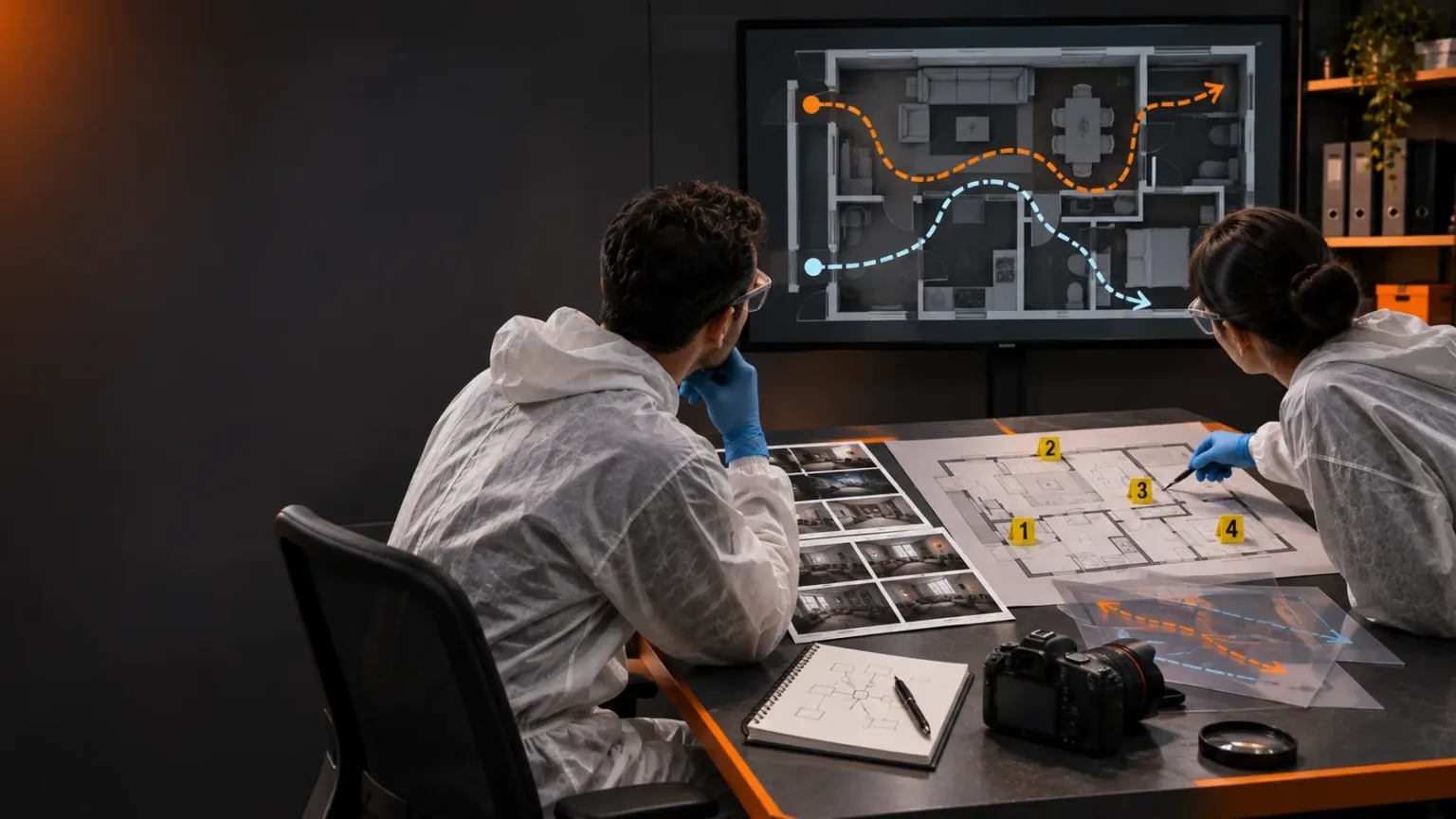
Crime scene reconstruction is the systematic use of scene observations, physical evidence, scientific examinations and relevant information to evaluate how events might have occurred. It is not a storytelling exercise in which an investigator chooses a suspect and arranges facts to make the preferred account appear convincing. Reliable reconstruction requires testable explanations, competing hypotheses, transparent decisions and acknowledgment of unresolved uncertainty.
- What is reconstruction, and how is it different from scene investigation?
- Current standards: what applies in 2026?
- Start with observations, not a preferred explanation
- Building reasonable competing hypotheses
- Investigative scenarios versus evaluative propositions
- An evidence-to-hypothesis matrix: how to use it without false scoring
- Test predictions, contradictions and uncertainty
- Worked example 1: Broken glass and a disputed entry route
- Worked example 2: Touch DNA on an object near the point of interest
- Worked example 3: A bloodstain and an overturned chair
- Worked example 4: Rapid scene testing influences the search
- Cognitive bias in crime scene reconstruction
- Context management and bias mitigation
- A reconstruction review checklist and decision record
- Peer review: more than confirming the same story
- Distinguishing observation, interpretation and legal decision
- Reconstructions using 3D scans, animations and simulations
- Common misconceptions about crime scene reconstruction
- Ten-point checklist before finalizing a reconstruction
- Frequently asked questions
- References and authoritative guidance
A scene rarely supplies every piece of information needed to establish a complete sequence. Some traces have changed, evidence has been lost or transferred, witnesses have incomplete memories, and measurements contain error. A defensible result may be limited to a few observations, a constrained event interval, the incompatibility of a specific claim, or a finding that more than one explanation remains plausible.
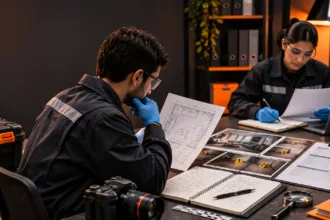
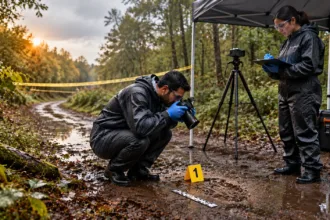
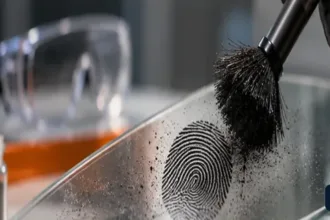
This advanced guide explains how to move from documented observations to alternative explanations, how to distinguish investigative reconstruction from formal evaluation of forensic findings, how cognitive bias influences search and interpretation, and how to produce a reviewable record. It includes four explanatory figures, evidence and bias-control matrices, four hypothetical scenarios, a reporting example, FAQs and references to published standards and research.[1][2][3][4]
Key Takeaways
Crime scene reconstruction tests explanations against documented findings rather than fitting evidence to a preferred story.
- Keep original observations, analytical results, interpretations and legal conclusions clearly separated.
- Develop relevant alternative hypotheses, identify their predictions and assess contradictory as well as supporting findings.
- Do not equate a source-level DNADNA, or Deoxyribonucleic Acid, is the genetic material found in cells, composed of a double helix structure. It serves as the genetic blueprint for all Read Full Definition association or compatibility with an activity hypothesis with proof of when or how an event occurred.
- Document assumptions, measurement uncertainty, contextual information, cognitive-bias safeguards and independent technical review.
Core reconstruction principle
What is reconstruction, and how is it different from scene investigation?
Scene investigation involves recognizing, documenting, processing, collecting and preserving evidence of potential relevance. Scene reconstruction uses physical evidence, scientific methods and reasoning to gain explicit knowledge about events associated with a scene. These terms are formally defined in the published ANSI/ASB Standard 159-24, which also addresses legal considerations, scientific reliability, evidence integrity, transparency and bias management.[1][9]
Investigation and reconstruction overlap, because early scene hypotheses influence what an examiner searches for and later findings may change the search strategy. They should nevertheless remain distinguishable in the record. An original photograph shows the state of the scene at a documented time. A reconstruction diagram depicts an inference or hypothesis created using that record and other information. A computer animation is a derived visualization, not an original observation of the event.
Neither a reconstructionist’s professional experience nor a 3D model can cure absent measurements or unverified assumptions. A qualified examiner must know the scientific basis and limitations of each specialist discipline used; complex pathology, trajectory, digital, bloodstain and DNA interpretations may require independent expert contributions rather than broad assertions by one scene examiner.[1][2]
Current standards: what applies in 2026?
ANSI/ASB 159-24 is a published standard for foundational scene investigation and reconstruction. It replaced the older OSAC 2021-N-0015 proposal on the OSAC Registry in April 2024; that proposal should not be presented as the current governing document. The UK Forensic ScienceDiscover the fascinating field of Forensic Science, the application of scientific principles to legal matters. This post delves into its many disciplines, from DNA analysis Read Full Definition Regulator issued FSR-GUI-0006, Issue 2 in August 2026, addressing scene examination, impartial strategies, alternative reasonable hypotheses and technical records in its jurisdiction.[1][2][10]
ISO 21043-4:2025, Forensic sciences—Part 4: Interpretation, is a published international standard applicable to the interpretation of forensic observations, including work at scenes. The UK regulator’s FSR-GUI-0004, Version 2, updated March 2026, distinguishes investigative, evaluative, analytical and categorical opinions from factual reporting. Its statutory and operational applicability is specific to England and Wales; other jurisdictions must consider their own adoption and legal requirements.[3][4]
The existence of a published standard does not mean every reconstruction technique or hypothesis has been validated. Competence, the scope of the work, the supporting studies, the case circumstances and the quality of documentation still determine what can be concluded.
Start with observations, not a preferred explanation
A scene record should distinguish observed facts, reported information, laboratory results and inferences. For example, “three glass fragments were documented on the floor” is an observation at the time of examination; “the window was broken from outside” is a hypothesis about an earlier event. One does not logically entail the other.
Record relevant conditions before alteration wherever practicable: item position, access routes, state of locks, measurable damage, weather, lighting, witness or responder movements, and material that may be lost during processing. Identify the origin and reliability of reported information rather than copying allegations into the scene notebook as established facts. The NIJ crime-scene guide supports contemporaneous notes, systematic searching and evidence preservation.[8][11]
Equally, a negative observation must be precisely framed. “No visible footwear impression was located in the examined area under the documented conditions” is different from “the person left no impression.” Visibility, substrate and examination scope may explain non-detection.
Building reasonable competing hypotheses
A hypothesis is a proposed explanation that can be examined against available and potentially obtainable evidence. It should describe a specific event or mechanism clearly enough to generate expectations. Alternatives need not be treated as equally plausible or given artificial parity, but reasonable competing explanations should be considered, particularly when they imply different evidence-collection decisions.[1][2]
A useful early question is: If this explanation were true, what would we expect to observe, and what evidence would be more surprising or inconsistent with it? List assumptions explicitly. A hypothesis that cannot be assessed with the available methods should be labeled speculative, not silently treated as supported. New observations may require modifying earlier proposals.
For example, a damaged entrance might reflect forced entry at the reported time, prior damage unrelated to that event, or damage created during emergency access. These alternatives suggest different relevant records: responder reports, maintenance history, toolmarks, photographs before police arrival, or contemporaneous camera footage. All should be acquired only with appropriate legal authority and suitable examination procedures.
Capture original observations and scene changes without forcing an explanation.
Develop reasonable competing explanations from task-relevant information.
Ask what each explanation would and would not lead investigators to expect.
Examine discriminating traces and independent information, including contradictions.
Revise, retain, reject or leave hypotheses unresolved; document uncertainty.
This is an educational reasoning framework, not an algorithm that automatically establishes which event occurred.
Investigative scenarios versus evaluative propositions
The terms scenario and proposition can refer to related ideas but should not be confused across interpretative frameworks. An investigative interpretation begins with observations and proposes explanations to guide further work. Under the UK regulator’s 2026 guidance it does not, by itself, express the probative value or strength of evidence between competing propositions.[3]
An evaluative interpretation instead considers the probability of the findings under appropriate, explicitly stated mutually exclusive propositions—often opposing accounts on an important issue. When a validated method and suitable data permit, the strength may be expressed using a likelihood ratio. Do not assign numerical LRs or verbal odds to a scene merely because a hypothesis matrix has several apparently supportive entries.[3][4]
Also distinguish source level questions (for example, who may have contributed DNA) from activity level questions (how biological material was deposited) and offence level questions (whether the legal elements of a crime were committed). A DNA association does not by itself establish the activity, timing, intent or guilt. Read the Simply Forensic hierarchy of forensic propositions guide for formal source/activity/offence distinctions.
An evidence-to-hypothesis matrix: how to use it without false scoring
A matrix can organize observed information, competing explanations and proposed discriminating tests. It should include findings that appear inconsistent with a favored hypothesis as well as findings that seem supportive. Importantly, counting consistent observations is not a likelihood ratio. Two correlated observations can reflect the same mechanism, and ten weakly relevant facts are not automatically stronger than one carefully validated discriminating observation.
| Observed information | H1: forced entry during reported event | H2: earlier breakage; separate entry |
|---|---|---|
| Glass fragments inside and outside | Possible under some mechanisms | Possible under some mechanisms |
| Door found ajar at first attendance | Possible | Possible |
| Contemporaneous recording of breaking sound | Could help discriminate if authenticated and time-aligned | Could challenge H2 if unequivocally linked |
| Trace or toolmark detail at the damage location | Requires specialist interpretation | Requires specialist interpretation |
No arbitrary plus/minus scores or counts: “consistent with” is not the same as discriminating support. Which explanation is better supported depends on actual observations, valid methods, conditions and alternatives.
The matrix is an aid to transparency, not a formula or proof that one hypothesis is true. A neutral reviewer should be able to see where the observations originated, whether relevant alternatives were overlooked and what further work could meaningfully distinguish them. If all alternatives predict the same observations, those findings may not resolve the dispute even if they are scientifically reliable.
Test predictions, contradictions and uncertainty
For each proposed explanation, identify observations that would be compatible, inconsistent or non-discriminating under the conditions assumed. Favor independent checks where possible. An observed mark may be compatible with more than one mechanism; not all missing traces have the same detection probability. Avoid describing a search as exhaustive unless the coverage and relevant detection limitations justify it.
Testing sometimes involves experimental comparison, validated geometry, material transfer studies or specialist analysis. Before relying on an experimental demonstration, examine whether it reasonably represents the case substrate, material, conditions and measurement limitations. A single demonstration is not a statistical error-rate study. Scene events may also involve several independent or interacting processes rather than one simple chain.
Revisit the original notes when new results arrive. A hypothesis developed before laboratory results may need revision, but the initial evidence should not be rewritten retrospectively to appear as if it always supported the final explanation. Preserve time-stamped decisions and alternate possibilities considered at each stage.[2][8]
Worked example 1: Broken glass and a disputed entry route
Hypothetical scene: A shop window is damaged and glass is documented on both sides. A door is open when police arrive. The initial report alleges forced entry through the window.
Possible explanations: H1—damage and entry occurred together; H2—the window was previously damaged and access occurred by another route; H3—emergency response changed the scene after the incident. These should be refined based on actual circumstances rather than treated as an exhaustive list.
What to examine: Time-verified earlier photographs, authenticated surveillance footage, door condition, relevant toolmark or fracture observations by competent specialists, responder actions and material distribution. The presence of glass on both sides may arise under multiple mechanisms and does not establish direction of breakage without qualified analysis.
Finding and limit: A consistent arrangement can be useful for defining further tests, but no illustrative distribution in this scenario proves the breaking direction, the person’s route or the time of entry. The absence of a discovered trace must be reported within the actual search conditions.
Worked example 2: Touch DNA on an object near the point of interest
Hypothetical scene: A cup recovered from a room gives a mixed autosomal DNA profile, including material that may be attributable to a person who regularly visited the location. Investigators suggest the person must have attended during the reported incident.
Competing explanations: Contact during the event, earlier legitimate handling, secondary transfer, or an alternative source history may be relevant. The DNA result can inform contributor-related questions but generally cannot date the deposition or distinguish all routes of transfer on its own.
What to examine: Document item history, its ordinary use, access to the area, collection and contamination records and independent timing information. Ask the laboratory what source-level inference is supported and whether a valid activity-level framework is possible. Do not transform an inclusion or a strong source-level statistic into a claim about violent action.[3][4]
Finding and limit: Even an accurately identified contributor can be compatible with more than one activity. The expert should not report unsupported probabilities of guilt or reconstruct a definite event solely from the presence of DNA.
Worked example 3: A bloodstain and an overturned chair
Hypothetical scene: A small bloodstain is visible near an overturned chair. One witness says a person fell; another suggests an assault. Medical personnel report moving furniture to give treatment.
Possible explanations: A fall, an inflicted injury, or a different event followed by movement may warrant consideration. A qualified pathologist or bloodstain specialist may assess injuries or stain features, but those assessments require case-specific observations and methods. Investigators should preserve the state of the room as found by each responder and record which objects changed.
What to examine: Contemporaneous photographs, measurements, medical intervention records, object damage, relevant injury findings and independent digital or witness information. The location of the chair alone does not establish the movement sequence. If the original chair position is uncertain, any reconstruction using an assumed original position must acknowledge that assumption.
Finding and limit: An illustration that depicts an assault is not evidence that an assault occurred. The reconstruction may only be able to exclude particular geometries or conclude that the available information does not distinguish the reported accounts.
Worked example 4: Rapid scene testing influences the search
Hypothetical scene: A provisional field screening result suggests that a stain contains a biological component. The team considers focusing only on objects close to the stain and ending the search elsewhere.
Potential problem: Screening results are method-limited and may change the examiners’ expectations. The resulting search strategy could neglect traces relevant to competing activities. A positive screen is not necessarily a confirmatory identification; a negative screen may not rule out a target material.
Better decision: Document the field result as preliminary, identify its validation and limitations, review the existing scene search plan and independently consider whether other areas remain relevant. The 2026 scoping literature review on crime-scene decision-making describes how new rapid information can shape what investigators attend to and collect, while noting that empirical evidence remains limited.[6]
Finding and limit: Rapid testing may help triage work, but cannot replace method-specific confirmation or justify quietly omitting alternate search objectives without documenting the reasons.
Every scenario above is fictional and educational, not an actual case finding or a demonstration that any specific hypothesis is true.
Cognitive bias in crime scene reconstruction
Cognitive bias describes systematic tendencies in human attention, expectation, memory and judgment. It does not mean an investigator is dishonest. Scene examination involves judgment under incomplete information, so the early description of the event can influence which objects receive attention, which traces appear relevant and how subsequent results are interpreted. The Forensic Science Regulator’s 2020 cognitive-bias guidance and ANSI/ASB 159-24 recognize the need to manage such influences.[1][5]
Several recurring patterns matter in reconstruction:
- Confirmation bias: seeking or giving disproportionate weight to information that fits the favored explanation.
- Anchoring: allowing an initial claim or preliminary interpretation to dominate later judgments, even when new information arrives.
- Contextual bias: interpretation influenced by potentially irrelevant case details such as an alleged confession or criminal history.
- Tunnel vision: narrowing the search to one person, route, item or event sequence before reasonable alternatives have been examined.
- Outcome or hindsight bias: judging earlier decisions as obvious or inevitable because a later result is now known.
BiasThe difference between the expectation of the test results and an accepted reference value. Read Full Definition can affect what gets collected as well as how results are assessed. If an initial account shapes the search too strongly, investigators may never recover potentially contradictory traces. This makes contemporaneous strategy and change logs important forensic records, not mere administrative forms.[2][6]
Context management and bias mitigation
Some context is essential. Scene examiners need safety hazards, the type of incident, known interventions, the question under investigation and reasonable hypotheses to plan an appropriate examination. A rigid rule to withhold all case context can harm search quality. The more defensible aim is to provide necessary task-relevant information while controlling exposure to information that may bias a particular interpretation without helping the scientific task.[3][5]
Specimen type, substrate, known scene changes, measurements, question asked, necessary collection history
Unsupported suspect confession claims, alleged criminal history, case publicity, unsupported investigator certainty
Record information exposure • delay nonessential details when feasible • preserve initial observations • independent review
Task relevance is contextual. Scene examiners may need more case information than a laboratory comparison analyst; information management must not impair safety or appropriate search planning.
Practical measures include recording initial observations before receiving further allegations when feasible; separating scene notes from later interpretive reports; documenting which case information was available at important decisions; considering reasonable alternatives; requesting additional task-relevant information; and using appropriate independent technical review. At sensitive comparison stages, information management procedures may delay irrelevant claims until after an initial evaluation.
Linear sequential unmasking and related methods can order information exposure, but their effectiveness is not universal. A 2026 analysis of LSU-E discusses situations in which the strength of contextual information may overwhelm the sequencing safeguard. The intervention must therefore be proportional to the decision and supported by additional controls, not presented as a perfect way to make experts bias-free.[7]
Making a list of alternate scenarios is helpful for explicit reasoning, yet it has not been established by high-quality scene-level experiments as a guaranteed bias-removal technique. The 2026 scoping review found that empirical research into how scene investigators actually search and decide remains limited, particularly regarding rapid testing. Present controls as scientifically justified safeguards with acknowledged evidence gaps rather than validated cures for every bias.[6]
A reconstruction review checklist and decision record
A reconstruction should have a record that permits a technically competent reviewer to follow the evidence, the assumptions and the reasoning without needing to recreate the original analyst’s memory. The review should consider whether contrary evidence was recognized, the limits of specialist disciplines and whether new findings require earlier interpretations to be revised.
| Review question | What should be documented |
|---|---|
| Scope and authority | Who requested reconstruction, what question, which scene and relevant limitations |
| Original record | Photos, notes, measurements, scene changes, log, exhibit locations |
| Information exposure | Task-relevant details supplied, when received, irrelevant contextual exposure |
| Competing hypotheses | Reasonable explanations and assumptions, including those later rejected |
| Evidence-to-hypothesis relationship | Expected, observed, absent, contradictory and non-discriminating information |
| Methods and constraints | Qualified specialist inputs, validation scope, uncertainty and detection limits |
| Decisions during examination | Why searches, samples, treatments or priorities were changed |
| Alternative tests | Unperformed tests, reasons and likely interpretative consequences |
| Independent review | Reviewer identity, disagreement, corrective actions and final disposition |
| Reporting status | What is fact, specialist opinion, inference, hypothetical illustration or unresolved |
Peer review: more than confirming the same story
A technical reviewer should not merely approve the investigator’s wording. Review the source documents, item measurements, logical claims, assumptions, evidence-selection decisions and the adequacy of the alternatives. Where appropriate, consider whether the reviewer can perform an initial assessment without learning the original conclusion, and record substantive differences.
Completely blind review is not always practicable for an integrated multi-evidence scene, but a reviewer may still identify unsupported leaps: a source-level DNA conclusion presented as proof of an activity; an inferred original body position represented as measured; or a numerical estimate presented without reference data or uncertainty. Material disagreement should be resolved transparently or communicated as unresolved where relevant.[1][3][4]
Review should occur before releasing a final interpretation whenever the method and organization require it. If later evidence changes the opinion, preserve the earlier report and record the reason for an amendment instead of silently replacing it.
Distinguishing observation, interpretation and legal decision
A reconstruction report should be clear about what was observed directly, what was derived by laboratory analysis, what was inferred and what remains unknown. The 2026 UK interpretation guidance distinguishes factual communication from investigative and evaluative opinions, and cautions that an investigative narrative does not itself convey the strength of evidence under balanced propositions.[3]
A mark is documented at a stated location and time.
A competent examiner assesses material or geometry using a stated method.
Findings are considered under explicit conditions and alternatives.
The court or other authorized decision-maker applies the relevant legal standard.
A reconstructionist may report only conclusions supported by competence, methods and available data. Source associations cannot automatically answer activity or legal-offence questions.
Example: avoiding an overstatement in a report
Overstated: “The suspect broke the window, entered the room and left the DNA-bearing object at the scene.”
More defensible: “A damaged window and an object bearing a mixed DNA profile were documented. The profile is reported separately by the DNA laboratory. The available scene findings do not, by themselves, establish the direction or time of the window damage, the route by which any person entered, or when and how the biological material was deposited.”
When an appropriate evaluative framework exists, the expert may provide a properly supported assessment against defined propositions. Otherwise, the report should convey descriptive findings, limited investigative possibilities or the inability to distinguish explanations—not invented numerical support or a categorical finding of guilt. Terms such as “consistent with” require explanation of their limited implications and should not be treated as proof.[3][4]
Reconstructions using 3D scans, animations and simulations
Measured diagrams, 3D scanning and animations can communicate scene geometry, but visualization is not a substitute for evidence. A point cloud may omit surfaces hidden during scanning. A digital figure can include inferred furniture positions or movement pathways that were never observed. A simulation depends on inputs and physical assumptions, which should be described and checked by specialists.
Distinguish an evidentiary visualization accurately derived from verified measurements from a hypothetical demonstration intended to show a possible event. A colored path drawn on a floor plan can help explain competing routes but cannot validate those routes without independent observations. The source of each modeled position, constraint and assumption should be traceable.[1][2]
Keep original photographs, scanning data, processing software settings and derived versions distinct. Never present a moving 3D sequence as a video of the actual crime.
Common misconceptions about crime scene reconstruction
Myth
EvidenceEvidence is any form of proof, such as objects, materials, or scientific findings, presented to establish or disprove a fact in a legal proceeding. It Read Full Definition consistent with an account proves the account is correct.
Reality
The same finding may be consistent with multiple explanations. Its significance depends on competing predictions, detection limits and evidence reliability.
Myth
An evidence-to-hypothesis matrix is equivalent to a likelihood ratio.
Reality
A qualitative matrix organizes predicted findings; a valid likelihood ratio requires defined propositions and defensible probability models.
Myth
Detecting a person's DNA proves when they attended the scene.
Reality
A source association does not by itself establish the timing, mechanism of transfer or the activity that produced the DNA.
Myth
A detailed 3D reconstruction proves exactly what happened.
Reality
A digital model is a derived representation of measurements and assumptions. It may contain gaps and hypothetical elements.
Myth
Information-management techniques eliminate cognitive bias.
Reality
They can reduce some bias risks when appropriate, but do not replace alternative testing, documentation or meaningful independent review.
Ten-point checklist before finalizing a reconstruction
Educational self-review only: checking an item does not establish laboratory QC acceptance.
Frequently asked questions
Frequently Asked Questions
What is crime scene reconstruction?
It is the use of physical evidence, scientific processes, reasoning and relationships among observations to examine events associated with a scene. It can support limited conclusions or leave several explanations unresolved.
How is reconstruction different from crime scene investigation?
Investigation focuses on recognizing, documenting, collecting and preserving evidence; reconstruction evaluates explanations of how selected events may have occurred using that information and other valid analyses.
Must an investigator consider alternative hypotheses?
Reasonable competing explanations should be considered, especially when they affect evidence-search and interpretation decisions. The alternatives should be testable and relevant, not invented to give every imaginable story equal weight.
Does finding evidence consistent with a hypothesis prove it?
No. Evidence may be equally compatible with other explanations. The strength of an inference depends on what the competing explanations would predict, the reliability of the finding and the available data.
Is a scene-hypothesis matrix a statistical likelihood ratio?
No. A matrix helps document possibilities and expected observations. A valid likelihood ratio requires well-defined propositions and a defensible model or knowledge base for the probabilities of the observations.
What is confirmation bias in crime scene work?
It is a tendency to seek, interpret or retain information that fits an existing expectation while overlooking or discounting contrary information. It can affect both evidence collection and interpretation.
Can information be withheld to reduce cognitive bias?
Some potentially biasing details can be delayed or restricted, but scene work requires safety, task-relevant circumstances and hypothesis information. Controls must not remove information necessary for competent examination.
Does linear sequential unmasking eliminate forensic bias?
No. It can help manage information exposure in suitable decisions but is not universally effective and does not replace review, documentation, alternatives and other contextual controls.
Can a DNA profile establish when a person was at the scene?
Usually not by itself. A contributor result generally concerns biological source, not the exact timing, mechanism of transfer or legal responsibility. Activity-level interpretation requires additional defensible information.
Does a 3D reconstruction prove a specific sequence of events?
No. Models are derived from recorded data and assumptions, with measurement, coverage and interpretation limitations. A hypothetical animation should be clearly distinguished from observed events.
What is the most important element of a reconstruction report?
Transparent separation of observed facts, supported technical analysis, interpretive reasoning, reasonable alternatives and uncertainties, enabling an independent review of what the evidence can actually establish.
Which current standards address scene reconstruction and interpretation?
ANSI/ASB Standard 159-24 covers foundational scene reconstruction principles, and ISO 21043-4:2025 covers forensic interpretation. The UK regulator's 2026 guidance offers additional jurisdiction-specific interpretation and scene-examination expectations.
Related Simply Forensic Articles
References and authoritative guidance
Technical review: 15 November 2026. Published ISO and ANSI/ASB standards, UK regulator guidance and peer-reviewed empirical research are distinguished by source and applicable scope. The former OSAC 2021-N-0015 proposed standard was superseded by ANSI/ASB 159-24. The guidance of a particular national regulator is not a universal legal requirement.
References & Sources
Show referencesHide references
- ANSI/ASB Standard 159-24 (2024). Standard for Scene Investigation and Reconstruction—Foundational Principles. NIST/OSAC Standards Library. Source
- UK Forensic Science Regulator (2026). Incident Scene Examination, FSR-GUI-0006, Issue 2. Source
- UK Forensic Science Regulator (2026). Forensic Science Activities: Interpretation and Communication, FSR-GUI-0004, Version 2, updated March 2026. Source
- ISO 21043-4:2025. Forensic sciences—Part 4: Interpretation. International Organization for Standardization. Source
- Forensic Science Regulator (2020). Cognitive BiasSystematic influence on perception or judgment from expectations, prior beliefs or contextual information rather than from the relevant evidence alone. Effects Relevant to Forensic Science Examinations, FSR-G-217, Issue 2. Source
- Decision-making at the Crime Scene: A Scoping Literature Review on the Cognitive Aspects of Crime Scene Examination and the Influence of Rapid Testing (2026). Open-access research review, N=32. Source
- Navigating the Bias Danger Zone: Evaluating the (in)Efficiency of Linear Sequential Unmasking (LSU-E) as a Bias Countermeasure. Forensic Science International: Synergy 12 (2026):100657. Source
- National Institute of Justice (2013). Crime Scene Investigation: A Guide for Law Enforcement. Source
- NIST/OSAC (2024). Standard for Scene Investigation and Reconstruction—Foundational Principles: Standard Details and Registry Status. Source
- NIST/OSAC (2024). OSAC 2021-N-0015 archive entry, superseded by ANSI/ASB 159-24. Source
- NIST/OSAC (2025). ANSI/ASB Standard 195-25: Standard for Scene Response—Initial Response by Scene Investigators. Source
- UK College of Policing. Authorised Professional Practice: Scene Strategy. Source
- ISO 21043-5:2025. Forensic sciences—Part 5: Reporting. International Organization for Standardization. Source
Educational notice: This article explains reasoning and quality safeguards. It does not replace validated specialist methods, independent technical review, local evidence procedures, legal rules or the role of the court in resolving guilt.