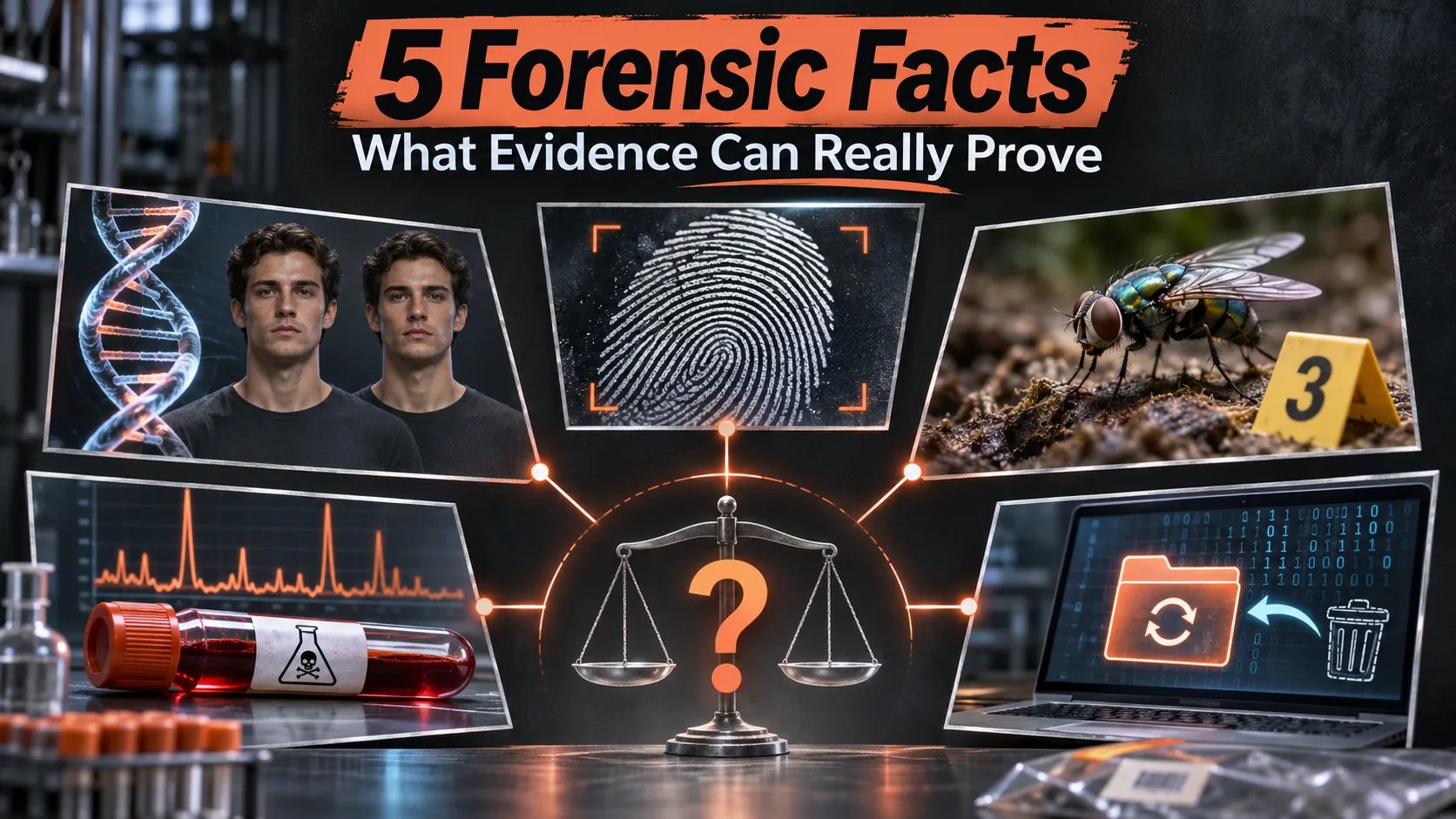
Two identical twins can share a routine forensic DNA DNA, or Deoxyribonucleic Acid, is the genetic material found in cells, composed of a double helix structure. It serves as the genetic blueprint for all living organisms. Read Full Definition profile yet have different fingerprintsFingerprint, impression made by the papillary ridges on the ends of the fingers and thumbs. Fingerprints afford an infallible means of personal identification, because the ridge arrangement on every finger of every human being is Read Full Definition. A deleted file can be recovered from a computer without revealing who put it there. Both examples show why forensic findings need careful interpretation: a test may answer one question very well while leaving another unanswered.
- 1. A routine DNA profile may not distinguish identical twins
- 2. Identical twins still have different fingerprints
- 3. Insects can help date colonisation, not pinpoint death
- 4. Postmortem drug levels are not a snapshot of the moment of death
- 5. A recovered file does not identify the person who created it
- What should a forensic result actually tell us?
- References
1. A routine DNA profile may not distinguish identical twins
Conventional forensic DNA profiling DNA profiling, also known as DNA fingerprinting, is a significant technique in forensic science that identifies individual's unique DNA patterns for various purposes such as establishing familial relationships or tracing genealogical roots. The technique, which Read Full Definition examines short tandem repeats (STRs) at selected locations in the genome
 A genome is the complete set of an organism's genetic material, while genomics is the study of genomes, investigating their evolution, structure, and function. Read Full Definition. These markers are highly useful for distinguishing most individuals, but monozygotic twins generally have the same alleles
 Alleles are different forms of a gene resulting from mutations or variations in the DNA sequence or gene expression. They can be dominant (expressed with one copy) or recessive (expressed only with two copies). Read Full Definition at the loci
 A locus is the precise position of a gene on a chromosome. Different alleles of the same gene occupy the same locus. Read Full Definition used in routine testing. If a biological stain matches both twins, the STR result alone cannot establish which twin contributed it.
There are ways to look further. Mutations can arise as an embryo develops, leaving small genetic differences between identical twins. In 2022, the Netherlands Forensic Institute reported a criminal case in which whole-genome sequencing helped distinguish twin brothers. The scientists identified and verified informative mutations, then examined the evidential DNA for those differences.
That approach cannot be assumed to work in every case. It requires a detectable difference, suitable evidence Evidence is any form of proof, such as objects, materials, or scientific findings, presented to establish or disprove a fact in a legal proceeding. It is used to reconstruct events and link or exclude individuals Read Full Definition and a validated analytical approach. Our guide to identical and fraternal twins explains the underlying genetics.
2. Identical twins still have different fingerprints
Fingerprint development begins before birth. Genes Genes are DNA segments (or RNA in some viruses) that dictate cellular processes, traits, and hereditary information, promoting genetic diversity and evolution in living organisms. Read Full Definition influence the general pattern, but the fine arrangement of ridges also depends on conditions during fetal development. Even identical twins do not develop matching ridge details.
A 2008 study by Srihari and colleagues found that twins’ fingers shared the same broad fingerprint classification more often than fingers from unrelated people: 42% compared with 25%. When the researchers examined finer features, however, they could distinguish the twins’ prints.
The condition of the recovered impression still matters. A clear print may contain enough ridge detail for comparison; a partial or smudged mark may not. Different fingerprints do not guarantee that every crime-scene impression will support a reliable distinction. See our visual guide to fingerprint patterns for the basic classifications.
3. Insects can help date colonisation, not pinpoint death
Forensic entomologists examine insects recovered from human remains, particularly their species and stages of development. Because insect growth is affected by temperature, developmental data Information in analog or digital form that can be transmitted or processed. Read Full Definition and the scene’s temperature history can help estimate when colonisation began.
Consider a hypothetical case in which a body remained wrapped and inaccessible to insects before being exposed. The oldest larvae could be much younger than the time elapsed since death. An insect-based estimate would then describe the period of insect activity, not the entire postmortem intervalThe post-mortem interval (PMI) is the time that has elapsed since an individual's death. When the time of death is not known, the interval may be estimated, and so an estimated time of death is established. Read Full Definition.
Rain, burial, restricted access and errors in insect collection can also complicate the estimate. As Byrd and Sutton (2020) explain, information about the scene and the possible delay before colonisation is essential to interpreting insect evidence.
4. Postmortem drug levels are not a snapshot of the moment of death
Suppose a toxicology report gives the concentration of a drug in blood collected during an autopsyAn autopsy, also known as a post-mortem examination or necropsy (when performed on animals), is a thorough and systematic medical procedure that involves the examination of a deceased person's body, typically to determine or confirm Read Full Definition. It is tempting to treat that number as the concentration circulating just before death. That may be incorrect.
Following death, drugs may move between tissues and blood. Concentrations can also be affected by degradation and other postmortem changes. This is known as postmortem redistribution, and its extent differs among substances and sampling sites. Blood collected from a peripheral site may not have the same concentration as blood collected centrally.
A 2023 review by Drummer and Gerostamoulos examines these interpretive problems. Experimental research on morphine redistribution also illustrates how concentrations can change after death.
Forensic toxicologists therefore consider the drug involved, specimen collection site, autopsy findings and case circumstances. A concentration measured after death cannot, by itself, establish the dose taken, the person’s level of impairment or the cause of deathThe cause of death refers to the specific injury, disease, or underlying condition that directly leads to an individual's demise. It is a critical determination made by medical professionals, such as Medical Examiners or Coroners, Read Full Definition.
5. A recovered file does not identify the person who created it
When someone deletes a file, recoverable data or traces of its existence may remain on a storage device. Whether they survive depends on the technology, file system and what has happened to the device since deletion.
Imagine investigators recover an image from a laptop. Its presence may be established, but several questions remain. Was it downloaded by a user, copied from another device or saved automatically by an application? Did anyone open it? Which account or person was responsible?
The file alone may answer none of those questions. Investigators need to examine relevant activity records and other artifacts, while accounting for the possibility that timestamps or file metadataStructured descriptive information associated with a file or its management, such as timestamps, size, type or embedded attributes. have been altered or misinterpreted.
In NISTIR 8354 (2022), the National Institute of Standards and Technology notes that deleted-file recovery may return extraneous material and that software updates can change what digital artifacts mean. Our digital forensics overview covers the wider field.
What should a forensic result actually tell us?
When reading a forensic report, ask two separate questions: What was observed or measured, and what conclusion can reasonably be drawn from it? The distinction is often where the most important limitations appear. A carefully qualified result is more useful in an investigation than a confident claim the evidence cannot support.
References
- Netherlands Forensic Institute. (2022). NFI reports on distinguishing twins using DNA analysis.
- Srihari, S. N., Srinivasan, H., & Fang, G. (2008). Discriminability of fingerprints of twins. Journal of Forensic Identification, 58(1), 109–127.
- Byrd, J., & Sutton, L. (2020). Forensic entomology for the investigator. WIREs Forensic Science
 Discover the fascinating field of Forensic Science, the application of scientific principles to legal matters. This post delves into its many disciplines, from DNA analysis to crime scene investigation, its importance in the justice system, Read Full Definition, 2, e1370.
- Drummer, O. H., & Gerostamoulos, D. (2023). Post-mortem redistribution of drugs and other factors affecting interpretation: A review. WIREs Forensic Science, 5(3), e1480.
- Gleba, J., & Kim, J. (2020). A mechanism-based forensic investigation into the postmortem redistribution of morphine. Journal of Analytical Toxicology, 44(3), 256–262.
- Lyle, J., et al. (2022). Digital Investigation Techniques: A NIST Scientific Foundation Review. NISTIR 8354.