Forensic hair examination combines the recovery and microscopic assessment of hairs with carefully selected DNA DNA, or Deoxyribonucleic Acid, is the genetic material found in cells, composed of a double helix structure. It serves as the genetic blueprint for all living organisms. Read Full Definition testing and context-based interpretation. A hair on a garment, vehicle seat or weapon may help investigators evaluate contact, transfer or possible common origin. Yet hair microscopy cannot identify one person to the exclusion of all others, and a DNA result does not by itself establish when or how a hair arrived. This guide explains what hair can reveal, how it is examined, when nuclear or mitochondrial DNA testing is appropriate, and how scientifically defensible conclusions are reported.
- 1. Why Hair Matters as Trace Evidence
- 2. Hair Anatomy and Growth Cycle
- 3. Collection, Packaging and Preservation
- 4. What Can Microscopy Actually Show?
- 5. Comparison Microscopy: Association Is Not Individualization
- 6. Hair Roots, Shafts and DNA Testing
- 7. Choosing an Examination Sequence
- 8. Four Hypothetical Case Examples
- Scenario A: Similar head hairs on a jacket
- Scenario B: Rootless shaft from a vehicle
- Scenario C: Bleached hair and an apparent mismatch
- Scenario D: Hair found on a shared sofa
- 9. Quality Assurance and Reporting
- 10. Lessons from the FBI Microscopic Hair Review
- 11. Common Misconceptions
- 12. Frequently Asked Questions
- 13. Related Simply Forensic Guides
- 14. References and Sources
The distinction matters because historical microscopic hair testimony frequently exceeded what the science could support. ASTM E3316-22 explicitly states that microscopic hair comparisons are not a means of individualization. The FBI and US Department of Justice later documented extensive overstatements in older cases. Modern practice requires transparent limitations, appropriate reference sampling, method validationValidation, often referred to as method validation, is a crucial process in the laboratory when introducing a new machine, technology, or analytical technique. It involves a series of systematic steps and assessments to ensure that Read Full Definition and, where suitable, DNA analysis.
Key Takeaways
Hair is useful trace evidenceTrace evidence - Physical evidence that results from the transfer of small quantities of materials (e.g., hair, textile fibers, paint chips, glass fragments, gunshot residue particles). Read Full Definition, but microscopic similarity is not personal identification.
- Examine and document morphology, condition and transfer context before choosing destructive testing.
- A questioned hair can be microscopically similar to a known sample without being unique to that donor.
- Root-associated tissue may support conventional nuclear STR profiling; rootless shafts often favor mtDNA, although specialized nuclear methods are emerging.
- An mtDNA match generally cannot distinguish individuals sharing the same maternal lineage and may also occur in unrelated people.
- Report exclusion, non-exclusion and inconclusive outcomes within the validated method's limits; do not assert an unsupported probability of microscopic uniqueness.
1. Why Hair Matters as Trace Evidence
Hair is common, durable and readily transferred through direct or indirect contact. A recovered strand can provide information about its likely biological origin, body-area characteristics, cosmetic treatment, damage and possible association with another sample. Its evidential value depends on where it was found, whether transfer was expected, what alternative sources exist and the strength of any DNA or microscopic results. Hairs can also persist after the contact that deposited them, so a recovery location is not a reliable clock.
Hair evidence Evidence is any form of proof, such as objects, materials, or scientific findings, presented to establish or disprove a fact in a legal proceeding. It is used to reconstruct events and link or exclude individuals Read Full Definition should be interpreted as part of the wider case: a strand on a routinely shared seat may have limited value, while an unusual hair on an item with documented restricted access may justify more focused examination. The latter still does not establish direct transfer or the timing of deposition without additional evidence.
Forensic Definition
- Term
- Microscopic hair comparison
- Plain-language explanation
- A comparison of observable hair characteristics between questioned and known samples.
- Example
- A recovered head hair may share observable characteristics with hairs in a representative reference collection.
- Limitation
- Similarity does not establish that the two hairs originated from one individual; the method cannot individualize a donor.
2. Hair Anatomy and Growth Cycle
The hair shaft is composed primarily of keratinized cells and is typically described in three structural regions: the cuticle (outer protective scales), cortex (bulk of the shaft, containing pigment) and medulla (central region, which may be continuous, interrupted, fragmented or absent). Hair is produced by a follicle in the skin; the root end can carry tissue or cellular material that influences the choice of DNA analysis. Appearance varies within a person’s hair and along the length of a single strand.
Original educational schematic. Individual hairs vary; this drawing does not represent a real microscopic specimen.
Growth stages and root appearance
Follicles cycle through anagen (active growth), catagen (transition) and telogen (resting and eventual shedding). A naturally shed telogen hair may have a club-shaped root with little attached tissue. A forcibly removed growing hair may retain follicular tissue, but root appearance alone is not a reliable test of violent pulling. Root morphology can be altered by handling, environmental exposure and damage; a definitive account of how the hair was removed is often not possible.
3. Collection, Packaging and Preservation
Trace recovery should follow scene documentation and an evidence recovery sequence that minimizes cross-transfer. Photograph hairs in situ where practical, record their exact location and relationship to the substrate, and recover each relevant item with clean, controlled tools. A hair embedded in adhesive or tape may require specialized recovery that preserves the location and associated trace material. Always consider whether other evidence types on the same item need examination first.
- Use clean forceps or another validated method; avoid mixing questioned hairs from unrelated locations.
- Package individual hairs in a suitable paper fold or other approved secure container, placed inside a labeled outer package.
- Keep reference hairs separate from questioned material, with separate tools, work areas and appropriate contaminationContamination - The unwanted transfer of material from another source to a piece of physical evidence. The inadvertent touching of a weapon, thereby adding fingerprints to it is an example of evidence contamination. Read Full Definition controls.
- Document the root and tip orientation if useful, the number of strands, their apparent condition and any visible adherent material.
- Record custody, transfers, storage conditions and any destructive sampling; retain remaining material where possible.
Reference collections should represent natural variation within the relevant body area and, where appropriate, different regions of the scalp. A single reference hair is not generally a satisfactory basis for evaluating the full range of a person’s head-hair morphology. The laboratory should determine the number and location of samples through its validated procedures and case requirements, not an arbitrary universal count.
4. What Can Microscopy Actually Show?
A stereomicroscope helps assess gross morphology and adherent debris; transmitted-light and comparison microscopy allow closer examination of shaft features. Examiners may record color, length, diameter variation, pigment density and distribution, medullary appearance, cuticle characteristics, root form, tip shape, artificial treatment, damage and environmental alteration. Not every feature is reliable for every specimen, and the evidential significance of a feature depends on the variability of the relevant reference hairs.
| Feature | Potential observation | Interpretive caution |
|---|---|---|
| Color and pigment | Pigment granules, density and distribution | Lighting, cosmetics and intra-person variation affect appearance |
| Medulla | Continuous, interrupted, fragmented or absent | Not a unique individual characteristic; varies along a shaft |
| Diameter and shape | Thickness and changes along length | Overlapping distributions across people and body areas |
| Root | Growth-related morphology and possible tissue | Cannot reliably determine forced removal or identify a donor |
| Tip | Cut, tapered, split or weathered end | Does not reliably date cutting or exposure |
| Cosmetic change | Bleaching, dye bands, heat or chemical damage | Treatment can be shared, repeated or modified over time |
| Adherent material | Particles, fibers, residue or biological material | May reflect secondary transfer or later contamination |
Human, animal and body-area assessment
Some microscopic features can support a classification as human or non-human hair, and some patterns may be more typical of head, pubic or other body areas. However, classification may be uncertain for damaged or unusual hairs, and the appearance of animal hair varies greatly by species and body region. A simple medullary index threshold is not a universal species-identification rule. Where species identification is important, appropriate comparative material and validated molecular or morphological methods should be considered.
5. Comparison Microscopy: Association Is Not Individualization
A comparison microscope permits side-by-side evaluation of a questioned hair and representative known hairs under comparable optical conditions. Meaningful differences may support an exclusion within the method’s scope. Where features overlap, the examiner may report that the hairs are microscopically similar or not distinguishable by the features examined. This does not mean the hairs came from the same person, nor does it quantify how many other people might have similar hairs.
A key limitation is the absence of sufficiently characterized population frequencyFrequency is a fundamental concept in physics and wave theory. It refers to the number of times a specific point on a wave, such as a crest or trough, passes a fixed reference point in Read Full Definition data Information in analog or digital form that can be transmitted or processed. Read Full Definition for combinations of microscopic hair characteristics. Without a validated statistical model, an examiner should not invent odds such as “one in a million,” assign a percentage of certainty or claim that a particular hair is unique. ASTM E3316-22 specifically rejects individualization through microscopic hair comparison.
Critical reporting limitation
6. Hair Roots, Shafts and DNA Testing
DNA strategy depends on the presence and condition of cellular material, the examination question and the laboratory’s validated methods. A hair with follicular tissue can be a candidate for conventional nuclear STR profiling. A rootless hair shaft commonly contains highly degraded nuclear DNA, so mitochondrial DNA sequencing has traditionally been important for source comparison. Specialized short-fragment nuclear approaches and massively parallel sequencingA sequencing approach that reads many DNA targets or fragments in parallel, often called next-generation sequencing. have expanded what may be recoverable from some rootless shafts, but they are not universally successful or equivalent to routine STR typing.
Hair DNA Analysis: Method Comparison
| Criterion | Nuclear DNA (STRs or validated sequence methods) | Mitochondrial DNA sequencing |
|---|---|---|
| Typical target | Nuclear genome A genome is the complete set of an organism's genetic material, while genomics is the study of genomes, investigating their evolution, structure, and function. Read Full Definition; often root-associated tissue, or suitable shaft DNA with specialized methods | Mitochondrial genome; often useful for hair shafts |
| Discrimination | Can provide high individual discrimination with sufficient informative loci A locus is the precise position of a gene on a chromosome. Different alleles of the same gene occupy the same locus. Read Full Definition | Usually lower; individuals sharing maternal lineage may have matching haplotypes |
| Main challenge | Low quantity, degradation, inhibitors and background DNA | HeteroplasmyThe presence of more than one mitochondrial DNA sequence variant within an individual or sample, including sequence or length heteroplasmy., mixture interpretation, population frequencies and lineage sharing |
| Result limitations | Partial profiles and stochastic effects may reduce value | An mtDNA match does not uniquely identify one person |
| Case selection | Use when expected template quality and validated methods support it | Consider when nuclear DNA is unsuitable or unsuccessful and a maternal-lineage comparison is relevant |
A root does not guarantee a successful nuclear DNA profile, and a rootless shaft does not guarantee that nuclear testing will fail. Recent research describes simultaneous nuclear and mitochondrial genotyping from rootless hairs, but results depend on extraction chemistry, fragmentation, sample age, sequencing platform and interpretation rules. In particular, nuclear DNA detected on a hair surface could originate from contact rather than the hair donor, making decontamination and attribution critical.
Mitochondrial DNA is inherited predominantly through the maternal line. A matching mtDNA haplotype is therefore compatible with a shared maternal lineage and may also be found among unrelated people in the population. A sequence difference may support exclusion, subject to heteroplasmy, mutation, contamination and the laboratory’s interpretation criteria. Reporting should follow validated population database and nomenclature practices rather than treating an mtDNA match as a personal identification.
7. Choosing an Examination Sequence
Forensic Hair Examination Workflow
1. Define the question
Document where the hair was found, relevant transfer alternatives, legal scope and available reference material.
Do not assume the recovered hair belongs to a suspect.
2. Preserve and characterize
Photograph, count, orient and document morphology, adherent material and packaging.
Prioritize non-destructive methods before consuming material.
3. Compare where justified
Use representative reference hairs and trained microscopy methods; document similarities and differences.
Microscopic similarity is not individualization.
4. Select DNA strategy
Assess root-associated tissue, shaft condition, material availability and validated nuclear/mtDNA methods.
Record consumption and potential external DNA.
5. Interpret and review
Integrate microscopic and DNA findings with transfer context, limitations and quality review.
Separate observed results from activity-level inferences.
6. Report and retain
State the exact scope, findings, exclusions or non-exclusions, uncertainty and remaining material.
Preserve images, notes, profiles and relevant controls.
8. Four Hypothetical Case Examples
Scenario A: Similar head hairs on a jacket
A single brown hair is recovered from the exterior of a jacket. The questioned hair and representative known hairs share multiple microscopic characteristics. Appropriate interpretation: they are not distinguishable by the observed features, and further testing may be useful. Inappropriate interpretation: the jacket wearer definitely contacted the known donor, or that the hair belongs to the known donor with near certainty. Routine contact, environmental transfer and unrelated individuals with similar hair must remain possible.
Scenario B: Rootless shaft from a vehicle
A short shaft lacks visible root tissue. Conventional nuclear STR testing may have limited prospects, so a validated mtDNA method is considered. The questioned hair’s mtDNA sequence matches a reference sampleReference sample - material from a verifiable/documented source which, when compared with evidence of an unknown source, shows an association or linkage between an offender, crime scene, and/or victim. Read Full Definition. Appropriate interpretation: the reference donor cannot be excluded as a possible source, while other people with that mtDNA haplotype—including maternal relatives—may also be possible sources. A population-based evaluation and limitations should accompany the result.
Scenario C: Bleached hair and an apparent mismatch
A recovered hair is light-colored near the tip and darker at the root, while the reference collection appears uniformly dark. The examiner considers bleaching, dyeing, regrowth, and sampling at different times rather than treating color differences as definitive proof of different sources. Chemical treatment may complicate microscopy and DNA recovery. Outcome: the findings may remain inconclusive without a representative comparison and further testing.
Scenario D: Hair found on a shared sofa
A questioned hair yields a partial nuclear DNA profile consistent with a known individual. The sofa is used by multiple residents and visitors. The source-level DNA result may be informative, but the observation does not independently establish when, where or by which transfer pathway the hair reached the sofa. Activity-level caution: secondary transfer, prior visits and persistence should be assessed using the case facts.
9. Quality Assurance and Reporting
A competent hair examination program requires defined collection and comparison procedures, suitable microscopes, representative reference material, contamination controls, method validation, proficiency testing, documented training and technical reviewExamination of analytical documentation, data, interpretation and conclusions by a qualified reviewer according to laboratory policies.. Where DNA testing is performed, the laboratory’s DNA quality system governs extraction, amplification/sequencing, controls, interpretation and reporting. Evidence consumption and sequencing decisions should be recorded because microscopic comparison and genetic testing may compete for limited material.
| Finding | Suitable reporting approach | Avoid |
|---|---|---|
| Microscopic similarities | “The questioned hair was not distinguishable from the examined reference hairs by the microscopic features assessed.” | “The hair came from this individual.” |
| Microscopic differences | “Observed differences support exclusion from the compared reference hairs, subject to sample adequacy and method scope.” | “All hairs from that person are excluded in every circumstance.” |
| Insufficient characteristics | “The available features were insufficient for a meaningful comparison.” | “A match was established despite insufficient data.” |
| mtDNA sequence agreement | “The donor cannot be excluded; others sharing this mtDNA haplotype may also be possible sources.” | “The mtDNA sequence uniquely identifies the donor.” |
| DNA detected on hair | “The tested material yielded the reported DNA result.” | “The DNA necessarily originated within the hair rather than from surface transfer.” |
10. Lessons from the FBI Microscopic Hair Review
In 2015 the FBI and Department of Justice publicly acknowledged erroneous testimony in a large proportion of the older trial transcripts they had reviewed. The review concerned scientific overstatements by FBI examiners, not a finding that every microscopic observation was invalid. The FBI’s 2019 root-cause analysis identified insufficiently specific reporting and testimony guidance as a major contributor. This history demonstrates why standardized terminology, independent review, explicit limitations and appropriate DNA follow-up matter.
A microscopic non-exclusion may have investigative value, particularly when the recovered location and reference material are relevant, but it should never be presented as a unique source identification. Nor should a later DNA result be stretched into an unsupported narrative about direct contact or timing. Strong reporting keeps the level of the proposition aligned with what the testing actually examined.
11. Common Misconceptions
Hair Evidence: Myth vs Fact
Myth
A hair match under the microscope identifies one person.
Evidence-based correction
Microscopic similarity does not individualize a donor.
The method lacks a validated individualization basis.
SourceMyth
Hair without a root contains no DNA.
Evidence-based correction
Rootless shafts can provide mtDNA and, with specialized methods, sometimes nuclear DNA.
Recovery depends on fragmentation, sample condition and method.
SourceMyth
An mtDNA match proves two hairs came from the same person.
Evidence-based correction
Matching mtDNA may be shared among maternal relatives and unrelated individuals.
Population frequency and heteroplasmy require consideration.
SourceMyth
Hair on an object proves direct contact during the crime.
Evidence-based correction
Transfer and persistence may create alternative explanations.
The recovery context is essential.
Source12. Frequently Asked Questions
Frequently Asked Questions
Can forensic hair analysis identify an individual?
Microscopic comparison cannot uniquely identify a person. A sufficiently informative nuclear DNA profile may offer strong discrimination, but interpretation depends on the profile and case context.
What is the difference between hair root and hair shaft DNA?
Root-associated tissue can contain cells suitable for nuclear DNA profiling DNA profiling, also known as DNA fingerprinting, is a significant technique in forensic science that identifies individual's unique DNA patterns for various purposes such as establishing familial relationships or tracing genealogical roots. The technique, which Read Full Definition. The keratinized shaft generally contains more degraded DNA and often favors mitochondrial DNA analysis, although specialized nuclear approaches exist.
Can DNA be obtained from hair without a root?
Yes. Mitochondrial DNA can often be obtained from a suitable shaft. Some validated advanced methods can recover informative nuclear fragments from certain rootless hairs.
Does a mitochondrial DNA match identify one person?
No. Maternal relatives may share mtDNA haplotypes, and unrelated people can also have matching sequences. A match is not a unique identification.
Can hair reveal whether it was forcibly removed?
Root morphology and attached tissue may inform an assessment, but they do not reliably prove violent removal. Other causes and damage must be considered.
Can microscopy determine when a hair was deposited?
No. Microscopy alone does not provide a validated deposition date; transfer, persistence and environmental exposure complicate timing.
How do investigators compare questioned and known hairs?
They examine a questioned hair against representative known samples under comparable microscopic conditions, recording differences, similarities and limitations.
Are hair color and diameter unique?
No. These characteristics overlap among people and vary within a single person's hairs.
Can a hair show dye or bleaching?
Microscopy can reveal patterns consistent with cosmetic treatment, but detailed chemical attribution or timing requires suitable additional methods and cautious interpretation.
Does hair always transfer through direct contact?
No. Secondary transfer, shared surfaces and environmental movement can deposit hairs without direct contact between the questioned parties.
What does an inconclusive hair comparison mean?
The available sample, reference material or observable features did not support a meaningful exclusion or non-exclusion within the method's limits.
Why was historical microscopic hair testimony criticized?
Some testimony overstated the significance of similarities, including unsupported claims about uniqueness or probability. The FBI/DOJ review documented these errors.
Can human and animal hairs be distinguished?
Microscopic characteristics may help classify many hairs, but ambiguous or damaged samples may require additional testing. Simple universal rules are unreliable.
What should a forensic hair report include?
Evidence identifiers, recovery context, methods, examined characteristics, comparisons, DNA results where relevant, limitations, quality review and carefully qualified conclusions.
13. Related Simply Forensic Guides
Explore related guidance on evidence preservation and packaging, forensic DNA extraction methods and forensic mtDNA interpretation, heteroplasmy and haplogroups. These topics help distinguish specimen handling, analytical recovery and interpretation.
14. References and Sources
Source review date: 15 November 2026. Historical guidance is identified as such. Standards and casework methods should be checked against their latest official editions and the laboratory’s approved procedures.
References & Sources
- ASTM International. ASTM E3316-22, Standard Guide for Forensic Examination of Hair by Microscopy (2022). The guide explicitly states that microscopic comparisons are not individualization. Source
- Scientific Working Group on Materials Analysis (SWGMAT). Forensic Human Hair Examination Guidelines (2005). Archived technical guidance, not a substitute for current laboratory SOPs. Source
- Organization of Scientific Area Committees (OSAC). Standard Practice for Training in the Forensic Examination of Hair by Microscopy (2019 draft/publication hosted by NIST). Source
- Deedrick DW, Koch SL. Microscopy of Hair Part 1: A Practical Guide and Manual for Human Hairs. Forensic Science
 Discover the fascinating field of Forensic Science, the application of scientific principles to legal matters. This post delves into its many disciplines, from DNA analysis to crime scene investigation, its importance in the justice system, Read Full Definition Communications (2004). Source
- FBI/US Department of Justice. Joint Statement on Microscopic Hair Analysis (19 April 2015). Source
- FBI/US Department of Justice. Microscopic Hair Comparison Analysis Review; history and scientific limitations. Source
- FBI. Root Cause Analysis for Microscopic Hair Comparison Analysis Completed (14 August 2019). Source
- Wilkinson L, Gwinnett C. An international survey into the analysis and interpretation of microscopic hair evidence by forensic hair examiners. Forensic Science International. 2020;308:110158. DOI:10.1016/j.forsciint.2020.110158. Source DOI: 10.1016/j.forsciint.2020.110158.
- Benitez RM, Elkins KM. Forensic analysis of hair using NGS technology. In: Next Generation Sequencing Technology in DNA Analysis. Academic Press (2024). DOI:10.1016/B978-0-323-99144-5.00021-4. Source DOI: 10.1016/B978-0-323-99144-5.00021-4.
- Concurrent genotyping of mitochondrial DNA and nuclear DNA in rootless hair shafts and blood samples for enhanced analysis. Forensic Science International: Genetics. 2025;75:103176. DOI:10.1016/j.fsigen.2024.103176. Source DOI: 10.1016/j.fsigen.2024.103176.
- National Institute of Justice. Laboratory Orientation and Testing of Body Fluids and Tissues: Hair (archived training). Source
- National Institute of Justice. Communication Skills, Report Writing, and Courtroom Testimony: Hair (archived training). Source
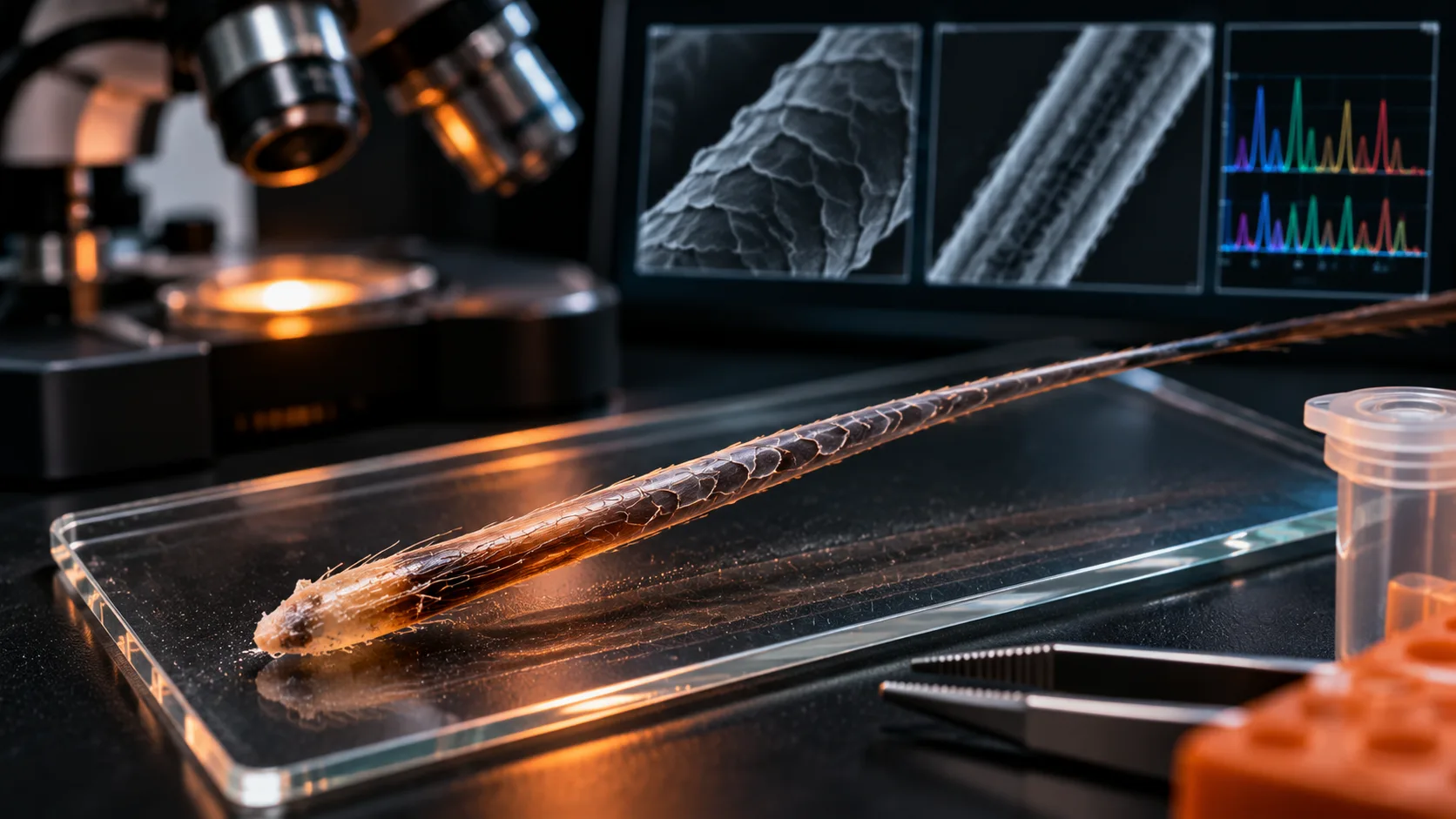
Editorial note: All scenarios and the schematic are original educational illustrations, not real casework. The featured image is AI-generated conceptual artwork. This article is not a substitute for a validated laboratory SOP or qualified forensic examination.