


On television, forensic DNA DNA, or Deoxyribonucleic Acid, is the genetic material found in cells, composed of a double helix structure. It serves as the genetic blueprint for all living organisms. Read Full Definition analysis looks like magic: a tiny sample goes into a machine, and moments later, a perfect genetic profile appears on a screen, infallibly pointing to the perpetrator. This popular perception, the “CSI effect,” masks the complex and delicate reality of the science.
The engine driving modern DNA forensics is the Polymerase Chain Reaction (PCR), a revolutionary technology developed by Kary Mullis in 1985 that allows scientists to generate billions of copies of DNA from a sample containing only a few cells. This power to turn a nearly invisible trace of life into a definitive profile is the miracle of PCR. But this miracle is built on a mathematical knife’s edge, where the same exponential forces that create evidence
This article reveals four counter-intuitive truths about PCR that are critical to understanding the real-world capabilities and cautions of forensic DNA evidence.
More Read







1. A Small Glitch Causes an Exponential Collapse
PCR is essentially a molecular “xeroxing” process. In an ideal reaction, the amount of the target DNA sequence doubles with every thermal cycle. After about 32 cycles, this exponential growth can turn a single DNA moleculeA molecule is a fundamental unit of matter composed of two or more atoms that are chemically bonded together. It is the smallest possible amount of a particular substance that retains all of the unique Read Full Definition into approximately one billion copies—more than enough to create a detectable genetic profile.
But here is the surprising part: this process demands near-perfection. A small drop in efficiency doesn’t just slow down the copying; it causes a catastrophic collapse in the final result. Because the loss is compounded at every cycle, the outcome is exponentially worse.
The table below illustrates how a seemingly minor reduction in efficiency devastates the final number of DNA copies generated from a single molecule after 32 cycles.
| Efficiency | Final Copies from a Single Molecule (after 32 cycles) |
|---|---|
| 100% | ~1,073,741,824 |
| 90% | ~230,466,618 |
| 50% | ~191,751 |
| 30% | ~2,620 |
As the data Information in analog or digital form that can be transmitted or processed. Read Full Definition shows, a drop from 100% to 90% efficiency results in a nearly 80% loss of product. At 50% efficiency, the yield is less than 0.02% of the ideal. Evidence doesn’t just fade; for all practical purposes, it vanishes into the mathematical noise. This is why PCR inhibitors—substances commonly found at crime scenes like heme from blood, indigo dye from denim, or humic compounds from soil—can be so devastating. But the fragility is also inherent to the process itself; even suboptimal laboratory conditions, such as poor primer annealing, can trigger the same exponential failure.
The power of PCR isn’t just in its ability to grow; it’s in the near-perfection of that growth. A minor inefficiency doesn’t just slow it down; it causes the final result to vanish exponentially.
2. More Isn’t Always Better: The “Goldilocks Zone” of Amplification
If a sample is weak, it might seem logical to just run the PCR machine for more cycles to generate more DNA. However, this can actively distort the evidence. PCR amplification proceeds through three distinct phases, and only one is useful for reliable forensic interpretation.
• Exponential Phase: This is the “Goldilocks Zone.” Early in the reaction, ingredients are plentiful, and the amount of DNA produced is directly proportional to the starting amount. This phase is critical for accurately interpreting DNA mixtures.
• Linear Phase: As the reaction progresses, key ingredients like DNA building blocks (dNTPs) start to run out. More critically, the sheer volume of amplified DNA strands begins to work against the process. The strands start sticking back to each other (a process called renaturation) instead of serving as templates, causing growth to slow from multiplicative doubling to a less-efficient additive process.
• Plateau Phase: The reaction stops completely as essential resources are exhausted and product-to-product binding dominates. No significant new DNA is produced.
The critical forensic consequence is that once the reaction leaves the exponential phase, the results are no longer reliably quantitative. This creates a serious problem for interpreting mixtures, a phenomenon known as “Ratio Compression.”
Imagine a DNA sample with a 10:1 ratio of a major contributor’s DNA to a minor contributor’s. The major contributor’s DNA, being more abundant, will exit the exponential phase and enter the resource-limited linear phase much sooner. While its growth slows, the minor contributor’s DNA is still amplifying exponentially. The final peak heights will no longer reflect the true 10:1 ratio; the gap narrows, and the result might falsely appear as a 4:1 mixture. This distortion can mislead an analystA designated person who examines and analyzes seized drugs or related materials, or directs such examinations to be done; independently has access to unsealed evidence in order to remove samples from the evidentiary material for Read Full Definition about the true proportions of DNA left at the scene, potentially causing them to overstate the significance of a minor contributor or misinterpret the nature of the contact that led to the DNA transfer.
This is why standard forensic protocols are carefully designed to stop amplification around 28-32 cycles—to keep the reaction in the quantitative exponential phase and avoid the misleading results generated in the later phases.
3. The DNA Lottery: Why Small Samples Are So Unpredictable
When amplifying a good quantity of DNA, the resulting profile is a reliable reflection of the source. But when the starting material is extremely low—below 100 picograms, or the equivalent of about 15 human cells—the process becomes unpredictable due to “stochastic effects.”
A helpful analogy is reaching into a large bag that you know contains an equal number of red and blue marbles. If you pull out hundreds of marbles, your handful will be very close to a 50/50 split. But if you can only grab two marbles, you have a significant chance of grabbing two reds or two blues by sheer luck, falsely suggesting the bag only contains that color.
This is precisely what happens during the initial cycles of PCR with trace DNA. At a specific genetic location, a person inherits one allele from each parent. If these alleles

At the level of just a few DNA molecules, biology becomes a game of chance. The profile obtained isn’t a perfect snapshot of the person, but the result of which few molecules happened to win the amplification lottery.
4. The Unseen Contaminant: When Forensic Tools Betray the Test
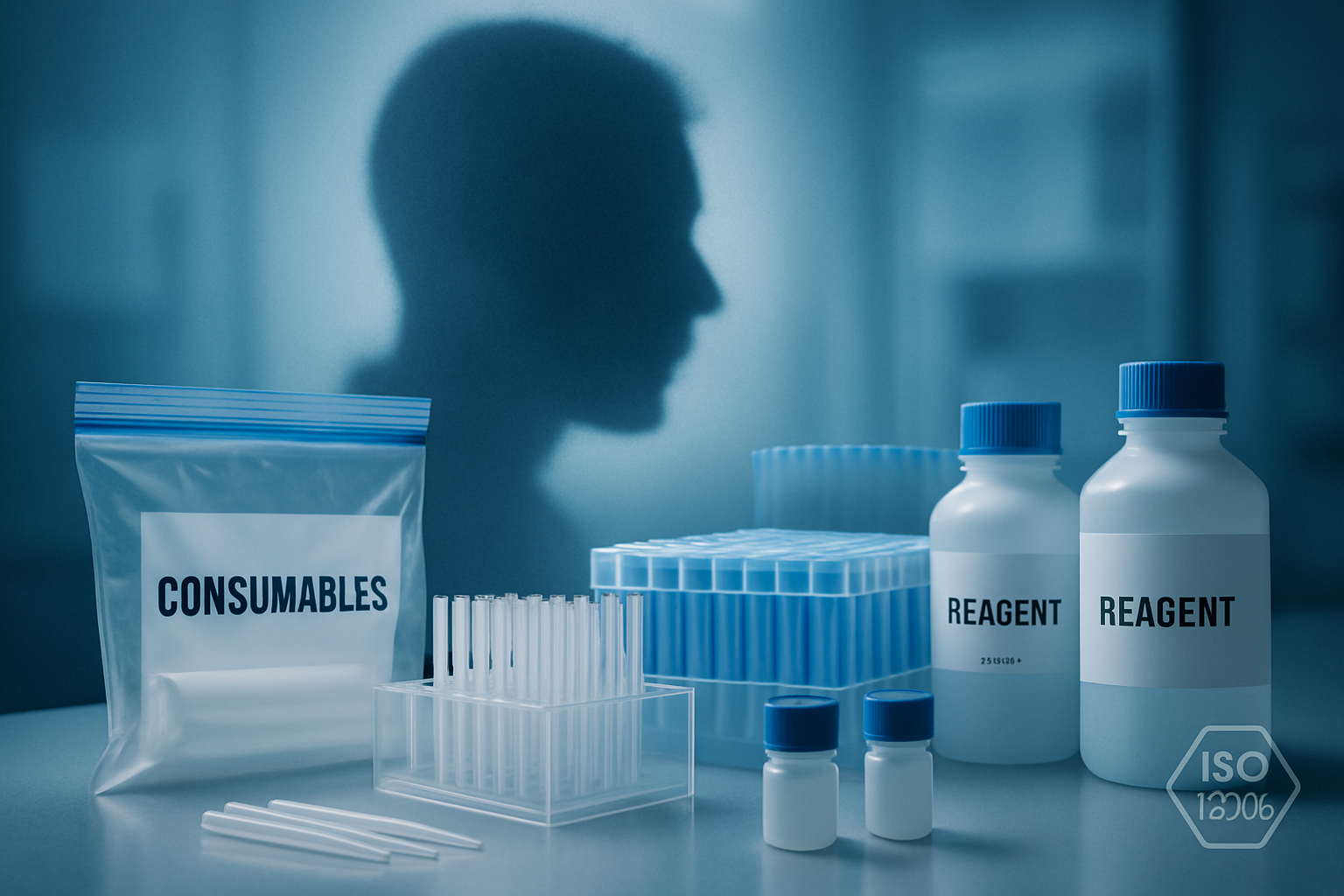
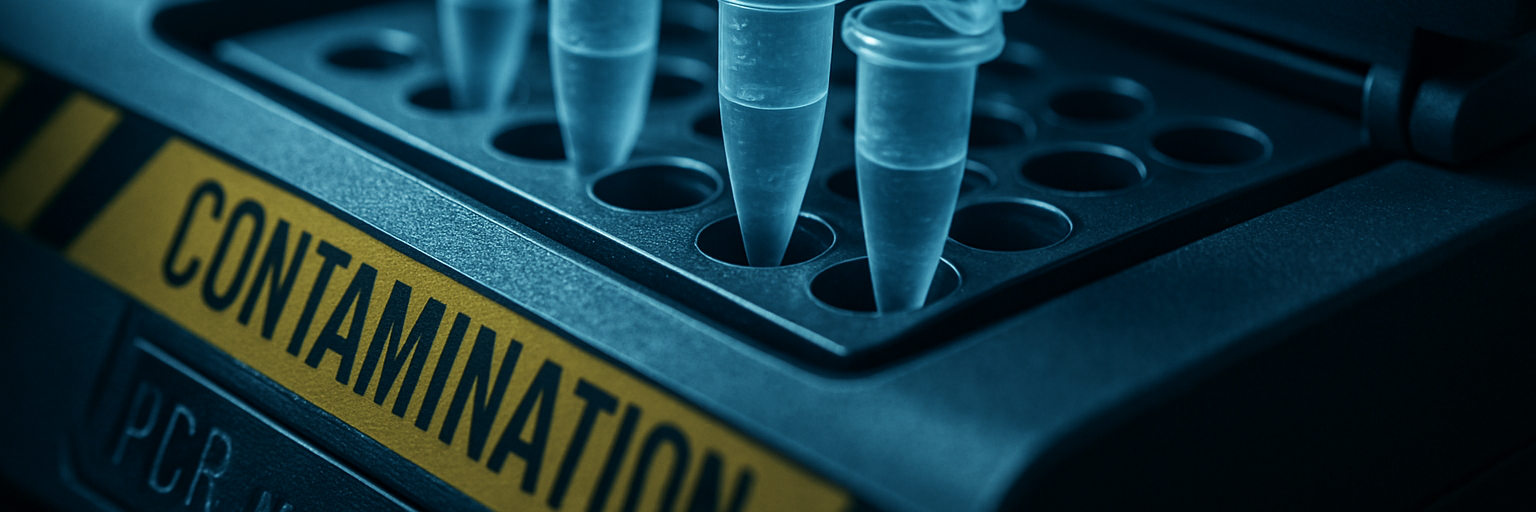
One of the greatest challenges in modern forensics isn’t just contaminationContamination - The unwanted transfer of material from another source to a piece of physical evidence. The inadvertent touching of a weapon, thereby adding fingerprints to it is an example of evidence contamination. Read Full Definition at the crime scene, but contamination originating from the very tools used to process the evidence. Because PCR is sensitive enough to detect DNA from just a few cells, even minuscule amounts of extraneous DNA on disposable plasticware and in chemical reagents can produce a detectable profile.
A notable case involved “Microcon” centrifugal filter devices, which are used to concentrate DNA samples. A distinct female DNA profile began appearing in negative controls and reagent blanks in multiple U.S. labs. The investigation traced the profile back through multiple production lots, suggesting it came from an employee at the manufacturing facility.
This is not an isolated incident. The problem became so widespread that leading forensic organizations—including Europe’s ENFSI, the U.S. and Canada’s SWGDAM, and Australia’s BSAG—issued a joint statement to manufacturers. They called for a new, cleaner grade of “forensic-use-only” products, manufactured with extreme rigor. Proposed improvements included:
• Automation of manufacturing lines to minimize human contact.
• Ensuring that staff are gowned and masked, with feet and hair covered.
• Continual quality controlQuality control (QC) refers to a series of activities and measures conducted on individual laboratory tests or analyses to verify and ensure the accuracy and reliability of the results. QC is a reactive approach that Read Full Definition checks of consumable items using highly sensitive PCR analysis.
To combat this, forensic labs must maintain an “elimination database.” This database contains the DNA profiles not only of lab staff and service engineers but also a surprisingly wide net of individuals who might have contact with samples, including police personnel, forensic medical examiners, mortuary staff, and pathologists. When an unknown profile appears in a control sampleControl sample - material of a known source that presumably was uncontaminated during the commission of the crime. Read Full Definition, it can be checked against this database to quickly identify it as a known contaminant rather than evidence from the case.
Conclusion: An Appreciation for the Process
The reality of forensic DNA analysis is a far cry from the automated, error-free process depicted in popular media. Far from being a simple machine that spits out answers, it is a science of profound and fascinating limitations. The exponential power of PCR is so fragile that a minor inefficiency can make a profile disappear entirely, while running the process for too long in a search for more signal can actively distort the evidence. For the smallest samples, the laws of biology give way to the laws of chance, turning analysis into a lottery governed by the random sampling of molecules. And through it all, the threat of contamination is pervasive, extending from the crime scene all the way back to the factories that produce the tools of the trade. Forensic DNA analysis is a complex biological process that demands careful execution, deep expertise, and a constant awareness of its inherent boundaries.
Knowing that the journey from crime scene to DNA profile is governed by these delicate and sometimes unpredictable forces, how does it shape your view of genetic evidence in the pursuit of justice?