

Finding particles associated with gunshot residue does not, by itself, prove that a person fired a gun. The result concerns microscopic material recovered from a sampled location; interpreting how the material arrived there requires the circumstances of the case, the analytical limitations, and alternative explanations.
- What is gunshot residue?
- How does SEM-EDS detect primer GSR?
- Why particle classification needs care
- Does a positive SEM-EDS result prove someone fired a firearm?
- Does a negative result mean no shooting occurred?
- What affects GSR recovery and interpretation?
- Example: a reported particle on a suspect’s jacket
- Primer GSR is not the same as firing-distance assessment
- How should a forensic report communicate the findings?
- References
Gunshot residue (GSR) examination is a useful forensic tool precisely because some particulate material is produced during firearm discharge. It is also susceptible to misunderstanding. This article focuses mainly on primer gunshot residue (pGSR) analyzed by scanning electron microscopy with energy-dispersive X-ray spectrometry (SEM-EDS).
What is gunshot residue?
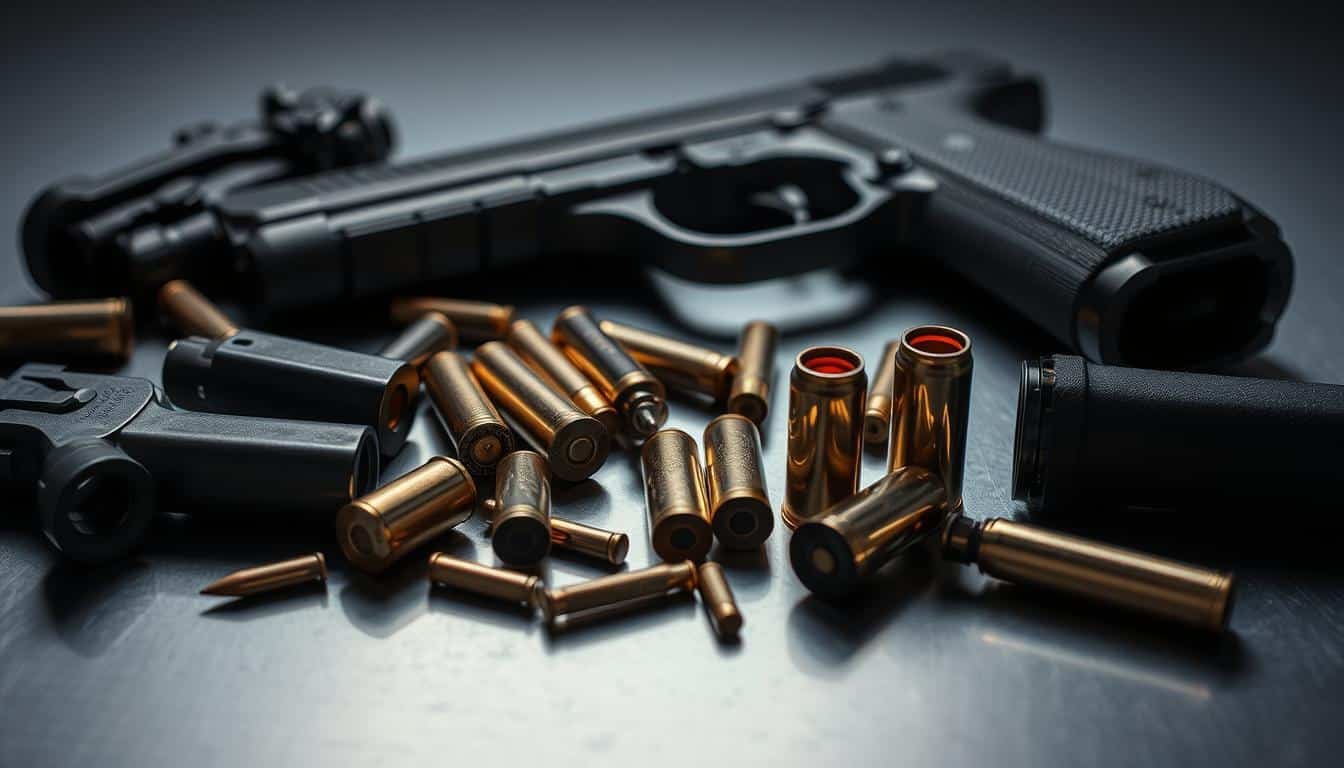
Firing a cartridge can release particles originating from the primer, propellant, bullet, cartridge case and firearm. In forensic reporting, it is essential to distinguish metallic or inorganic primer-related particles from organic propellant-related residues. The two may be investigated using different methods and have different interpretation issues.
Traditional primers often yield particles containing lead, barium and antimony. However, alternative primer formulations, lead-free ammunition and background industrial or environmental materials complicate simple recipes for classification. No single list of elements covers every type of ammunition or forensic context.
How does SEM-EDS detect primer GSR?
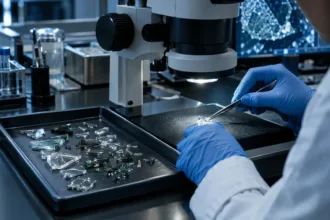
Scanning electron microscopy (SEM) examines small particles at high magnification. Energy-dispersive X-ray spectrometry (EDS) characterizes which elements are detected in an individual particle. In a typical workflow, software screens sample areas for particles meeting selected criteria and the examiner evaluates candidate particles under the laboratory’s validated method.
- Sampling: adhesive collection stubs or other validated approaches are used to recover particles from a target surface, often hands or clothing. The laboratory should document where and when samples were collected.
- Automated screening: the instrument locates potential particles based on imaging and analytical criteria.
- Confirmatory examination: candidate particles are evaluated by microscopy and elemental information according to the laboratory’s classification system.
- Documentation and review: records should permit traceable reporting and appropriate technical review of particle classifications and controls.
As of October 2026, NIST’s OSAC Standards Library identifies ANSI/ASTM E1588-25, a standard test method for GSR analysis by SEM-EDS, which supersedes E1588-20. Analysts should check the current version and their laboratory’s adopted procedures rather than relying on descriptions of an older practice.
Why particle classification needs care
The combination of elemental composition and particle morphology informs classification, but its significance is not independent of environmental background. Some compositions are more strongly associated with firearm discharge than others. Samples may include particles from occupational exposure, machinery, road environments or other activities. Conversely, lead-free primer residues may not produce the classic elemental profile found in older examples.
Examiners should use terminology consistent with the validated classification scheme and avoid collapsing analytically distinct particles into a generic “positive GSR” label without context.
Does a positive SEM-EDS result prove someone fired a firearm?
No. Depending on the case, detected particles may be consistent with discharging a firearm, proximity to a discharge, or transfer from an associated surface or person. For example, contact with a contaminated object could deposit particles without the person firing a gun. The evidential weight depends on sampling circumstances, timing, particle findings, plausible exposure routes and the propositions under consideration.
Finding material on a hand, sleeve or object does not automatically determine the direction, timing or mechanism of its transfer. Nor does it establish the identity of the shooter. Those questions require separate evidence Evidence is any form of proof, such as objects, materials, or scientific findings, presented to establish or disprove a fact in a legal proceeding. It is used to reconstruct events and link or exclude individuals Read Full Definition and a clearly specified evaluative framework.
Does a negative result mean no shooting occurred?
No. Particle availability changes with activity and time. Hands may be washed, rubbed or contacted against objects; sampling may occur after delay; deposits can be sparse; and the ammunition or scene may not produce particles of the type a particular method detects. A negative sample means no reportable particles were detected under the method and sampling conditions. It does not reliably rule out a prior discharge.
What affects GSR recovery and interpretation?
| Factor | Why it matters |
|---|---|
| Time after the event | Opportunities for loss, transfer and additional exposure increase |
| Activities and handling | Washing, wiping and contact can change recovery |
| Sampling location | Hands, clothing, nearby objects and vehicles reflect different exposure opportunities |
| Ammunition and primer chemistry | Residue composition may differ from traditional formulations |
| Environmental background | Non-firearm particle sources and pre-existing contaminationContamination - The unwanted transfer of material from another source to a piece of physical evidence. The inadvertent touching of a weapon, thereby adding fingerprints to it is an example of evidence contamination. Read Full Definition must be considered |
| Analytical criteria | Detection limits, classifier settings and reporting rules govern what is called and reported |
Example: a reported particle on a suspect’s jacket
Imagine that investigators collect a jacket several hours after a shooting. An examiner detects a particle meeting the laboratory’s criteria for a firearm-associated classification. The scientifically sound report describes what was recovered and classified, and explains relevant limitations. It does not state that the jacket’s wearer certainly fired the weapon. Investigators may need additional information about where the jacket had been, other sources of exposure, scene movement and handling.
Primer GSR is not the same as firing-distance assessment
SEM-EDS examination of collected particles is distinct from examining residue distributions, bullet defects or patterns around a target for firing-distance assessment. Distance estimates require different reference material, test conditions and validated procedures. A small number of recovered primer particles on clothing is not, by itself, a distance measurement.
How should a forensic report communicate the findings?
- Identify the sampled item or location and the method used.
- Use the laboratory’s scientifically supported classification language.
- Report relevant controls, limitations or uncertainties according to the applicable SOP.
- Explain that particles may be deposited through more than one activity.
- Do not imply that a positive result uniquely identifies a shooter, or that a negative result excludes firearm discharge.
For related topics, read Simply Forensic’s introduction to forensic ballistics and trace evidence guide.
References
- NIST OSAC Standards Library. ANSI/ASTM E1588-25 Standard Test Method for Gunshot Residue Analysis by SEM-EDS.
- ASTM Work Item WK72526: Development of an interpretation practice for pGSR examination opinions (work item, not an adopted standard).
- NIST OSAC Forensic Science Standards Library, current status of GSR analysis and interpretation documents.
Important distinction: This is a scientific and educational overview, not an instruction for case-specific conclusions or a substitute for a validated laboratory procedure.