

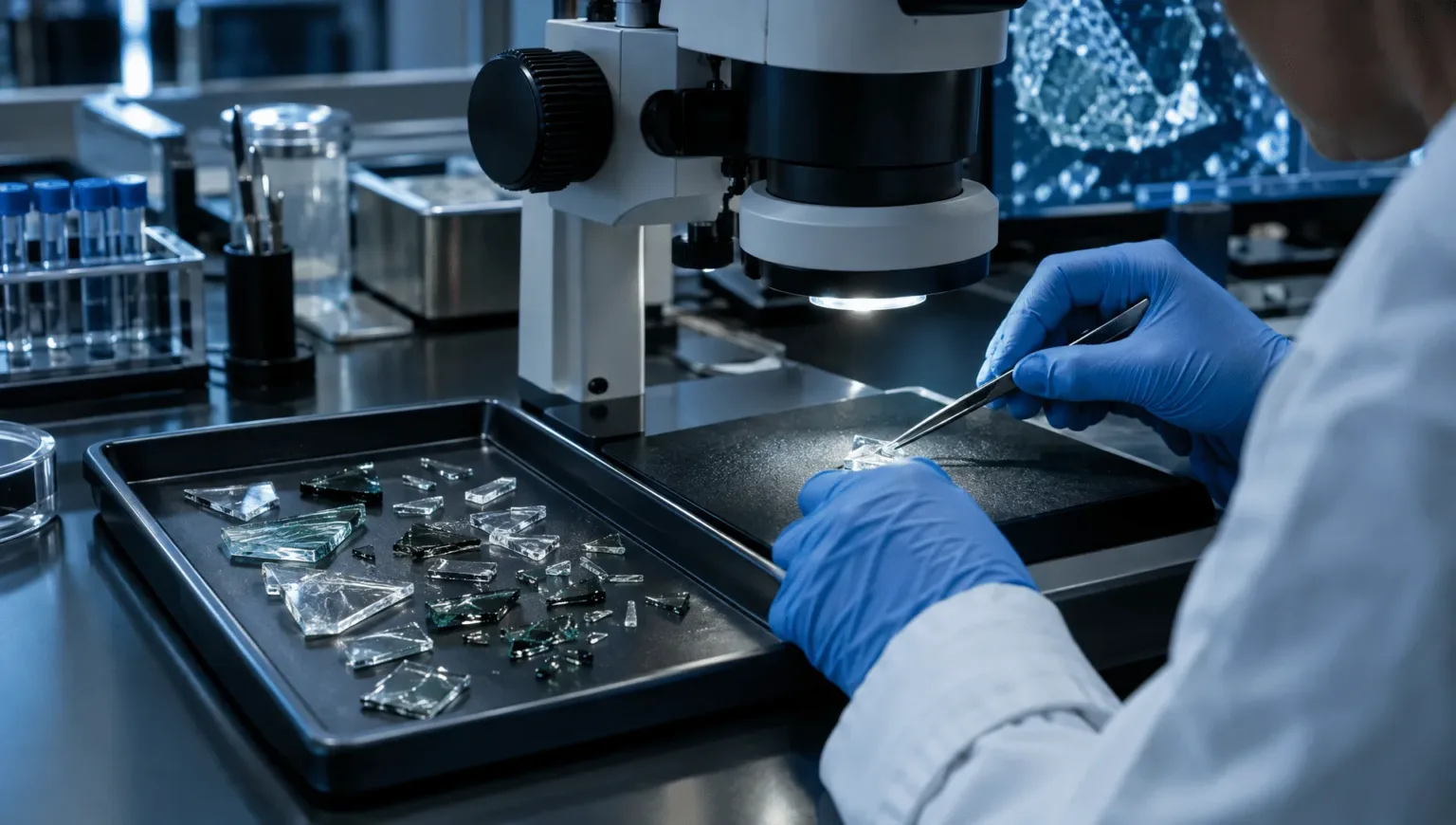
A tiny fragment of glass can link an object to a broken window, vehicle or other source, but similar measurements do not automatically prove a unique origin. Forensic glass analysis uses physical and chemical characteristics to compare questioned fragments with known samples. The strength of the finding depends on the method, observed variability, background information and the propositions being evaluated.
- What is forensic glass evidence?
- Collection and contamination control
- What does refractive index tell us?
- What do elemental methods contribute?
- What did interlaboratory glass research show?
- How are glass comparison conclusions expressed?
- Example: glass on a jacket after a burglary
- Frequently asked questions
- Can two windows contain very similar glass?
- Does more sophisticated instrumentation always provide a better conclusion?
- Can glass evidence prove a particular activity?
- Primary research
Glass is a common trace material in burglaries, road collisions and violent incidents. Fragments can transfer to clothing, footwear, tools or vehicles when glass breaks. Conversely, glass can arrive on an item through routine activities or earlier contact. Analytical correspondence must therefore be separated from conclusions about the alleged Alleged is a term used in legal contexts to describe an accusation or claim that has been made against an individual but has not yet been proven or confirmed. Read Full Definition activity.
What is forensic glass evidence?
Glass evidence Evidence is any form of proof, such as objects, materials, or scientific findings, presented to establish or disprove a fact in a legal proceeding. It is used to reconstruct events and link or exclude individuals Read Full Definition includes individual fragments and fine particles recovered from an exhibit or scene. Sources can include architectural glass, automotive glazing, containers and other manufactured products. Products with different uses may vary in physical construction and chemical composition, but some formulations are widespread.
A glass examiner first asks whether the questioned material is glass and whether the available physical and chemical features permit a meaningful comparison. A particle that is too small, contaminated or altered may yield limited information.
Collection and contamination control
- Photograph the scene and document where fragments were found before recovery.
- Collect known comparison fragments from relevant possible sources with attention to the source’s internal variation.
- Separate questioned and known material and use packaging suitable for small fragments.
- Record whether fragments were found loose, embedded in clothing or trapped within folds, as the location may inform later transfer questions.
- Consider additional reference samples and alternative environments rather than assuming that the first broken window is the only plausible source.
Recovery and preparation should follow validated procedures to reduce contaminationContamination - The unwanted transfer of material from another source to a piece of physical evidence. The inadvertent touching of a weapon, thereby adding fingerprints to it is an example of evidence contamination. Read Full Definition and avoid destructive testing before adequate documentation.
What does refractive index tell us?
Refractive index (RI) describes how light propagates through a material relative to a reference medium. Glass fragments can be measured using suitable optical techniques under controlled conditions. The measured RI can help compare fragments and sometimes differentiate material that looks similar.
However, many glasses have overlapping refractive indices. Temperature control, instrument calibrationThe act of checking or adjusting (by comparison with a standard) the accuracy of a measuring instrument. Operation that, under specified conditions, in a first step, establishes a relation between the quantity values with measurement Read Full Definition, fragment characteristics and analytical uncertainty can influence results. Similarity in RI alone is not proof that two fragments came from the same pane.
What do elemental methods contribute?
Elemental analysis investigates chemical constituents that may differentiate glass from different manufacturing origins or batches. Common techniques in research and casework include:
| Method | What it adds | What must be controlled |
|---|---|---|
| Micro X-ray fluorescence (µXRF) | Elements detected in a small sample, commonly without dissolution | Instrument conditions, fragment geometry and calibration |
| Laser-induced breakdown spectroscopy (LIBS) | Elemental emission patterns from laser-produced plasma | Sampling effects and validated classification procedures |
| Laser ablation ICP-MS | Trace-element information useful for discrimination | Calibration, matrix effects, measurement precision and sample consumption |
| Refractive index measurement | Optical property complementary to chemical methods | Temperature, repeatability and uncertainty |
Technique selection depends on sample size, analytical questions, access to instruments and method validationValidation, often referred to as method validation, is a crucial process in the laboratory when introducing a new machine, technology, or analytical technique. It involves a series of systematic steps and assessments to ensure that Read Full Definition. Multiple tests are useful only if they add interpretable information; they do not automatically create independent evidence.
What did interlaboratory glass research show?
Corzo and colleagues conducted interlaboratory exercises involving 17 laboratories examining automotive windshield glass using refractive index, µXRF and LIBS. For same-pane comparisons, the overall correct association rate exceeded 92% for each technique. In comparisons involving glass from different vehicles, reported correct exclusion rates varied by method. The paper also documented variation in how laboratories expressed conclusions and highlighted the value of standardized reporting and background information.
These results belong to the specific samples, procedures and study design. They should not be quoted as a universal accuracyIn scientific and measurement contexts, "accuracy" refers to the degree of proximity or closeness between a measured value and the true or actual value of the measured quantity. Accuracy indicates how well a measurement reflects Read Full Definition rate for all forensic glass examinations or used to assert that a particular case conclusion is 92% certain.
Another interlaboratory project examined LA-ICP-MS analytical data Information in analog or digital form that can be transmitted or processed. Read Full Definition and reporting, reinforcing the importance of reproducibility and defensible interpretation.
How are glass comparison conclusions expressed?
A result may support differentiation, fail to distinguish materials within the tested criteria, or remain inconclusive. Reporting should specify the observed properties, methods, uncertainty where relevant, and what the result does not establish.
Indistinguishable within the tested measurements is different from identical in every possible respect. Likewise, reliable differences can support exclusion for a proposed source, provided the sampling and measurement conditions are adequate.
Example: glass on a jacket after a burglary
Fragments recovered from a jacket have an RI and elemental profile similar to material from a broken window. The finding may support an association with that glass source. Its weight depends on how common such glass is, whether the recovered fragments adequately represent the distribution, and potential alternative sources. The result cannot by itself establish who broke the window, when the glass was deposited, or whether the garment was worn during the offence.
Frequently asked questions
Can two windows contain very similar glass?
Yes. Industrial manufacturing can produce glass with overlapping properties. Background distributions and complementary methods matter.
Does more sophisticated instrumentation always provide a better conclusion?
No. The method must be suitable for the sample and validated for the forensic decision. Complexity alone does not guarantee higher evidential weight.
Can glass evidence prove a particular activity?
Material association is only one step. The alleged action, timing and transfer mechanism require case context and, where possible, activity-level evaluation.
Read Simply Forensic’s trace evidence guide and hierarchy of forensic propositions for interpretation context.
Primary research
- Corzo et al. (2021). An interlaboratory study evaluating the interpretation of forensic glass evidence using RI and elemental composition. Forensic Chemistry.
- Lambert et al. (2021/2022). An interlaboratory study to evaluate the forensic analysis and interpretation of glass evidence.
- NIST Glass Evidence Analysis research program.