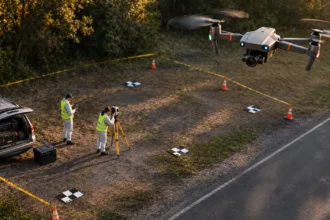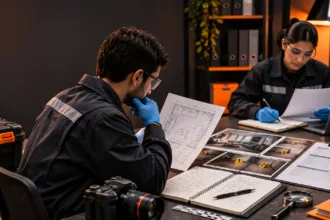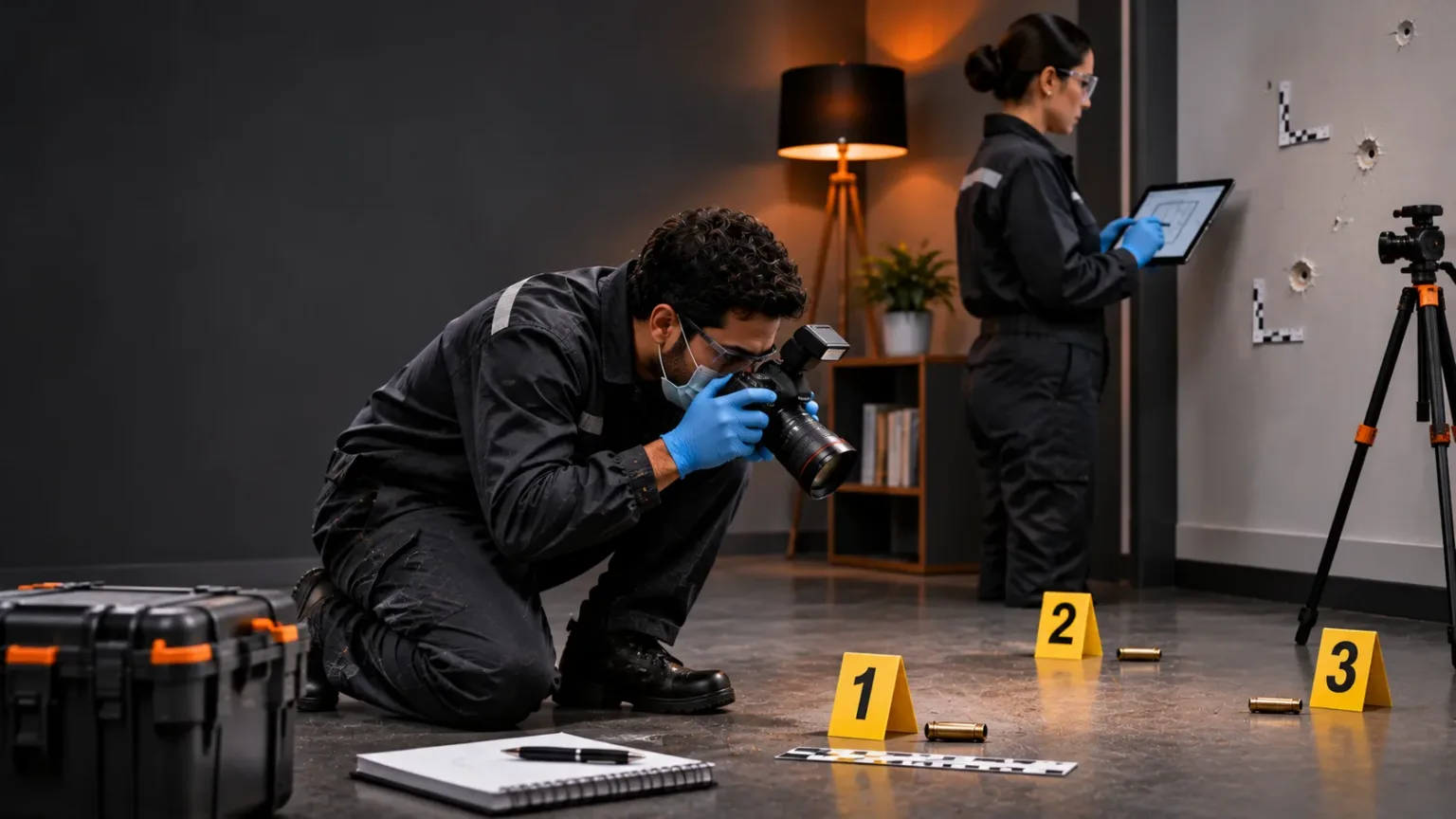
Shooting scene investigation is the systematic recognition, documentation and preservation of evidence potentially associated with firearm discharge. The work may involve locating cartridge cases and projectiles, describing suspected impact defects, identifying relevant trace and biological material, recording spatial relationships and providing properly documented information for specialist laboratory examinations or reconstruction.
- What is the scope of shooting scene investigation?
- Initial response: safety and emergency interventions come first
- Document the whole scene before selecting exhibits
- Cartridge cases: what to record and what not to infer
- Projectile, bullet and fragment recovery
- Bullet impacts: distinguish suspected defects, penetration, perforation and ricochet
- Trajectory documentation versus full shooting reconstruction
- A useful documentation record for shooting-related features
- Gunshot residue: do not confuse primer GSR with firing-distance assessment
- Evidence-recovery sequence: biological traces, fingermarks and other tests
- Interpreting multiple evidence types together
- Worked example 1: Cartridge cases near an open doorway
- Worked example 2: An irregular defect in a metal surface
- Worked example 3: A possible ricochet and a later defect
- Worked example 4: pGSR on clothing with no identified firearm
- Preparing a scientifically defensible shooting scene report
- Common misconceptions about shooting scene evidence
- Quality checklist: shooting scene documentation and evidence control
- Frequently asked questions
- References and scientific sources
The fundamental distinction is between recording the scene as it was found and inferring an earlier shooting event. Three cartridge cases beside a doorway do not necessarily establish three shots from the same position. An apparent bullet hole does not, on its own, identify a firing point. A gunshot-residue finding does not automatically show who fired a weapon. These questions require evidence-specific examinations, clear assumptions and scientific limitations.[1][3][7][8]
This guide focuses on forensic scene examination rather than firearm operation or instructions for using weapons. It explains the published 2026 shooting-scene standard, documentation of cartridge cases and projectile impacts, the distinction between trajectory and shot-direction estimates, cross-disciplinary sampling, muzzle-to-target distance and gunshot-residue issues, four hypothetical scenarios, practical record templates and FAQ answers.
Key Takeaways
Scene findings need careful interpretation: the location of a cartridge case or projectile defect is not the same as a proven account of a shooting.
- Document recovered cartridge cases, projectiles and suspected impacts before handling or scene changes, with location, orientation and exhibit identity.
- Distinguish recorded impact geometry from trajectory reconstruction and avoid assigning one shooter position from incomplete traces.
- Coordinate DNADNA, or Deoxyribonucleic Acid, is the genetic material found in cells, composed of a double helix structure. It serves as the genetic blueprint for all Read Full Definition, latent print, trace, toolmark and residue examinations to limit interference and preserve source evidence.
- Report pGSR findings, specialist results and investigative hypotheses within the limits of the methods; do not infer individual activity or guilt from an association alone.
Scientific caution
What is the scope of shooting scene investigation?
A shooting-related location may be indoors, outdoors, inside or around a vehicle, at a residence or across multiple linked sites. The examined scene may contain live ammunition, firearms, fired cartridge cases, recovered bullets and fragments, impact defects, damaged structures, bloodstains, residue deposits and electronic records. It may also contain traces unrelated to the reported incident. The task is to recognize and preserve material of potential relevance without assuming every item was produced during one event.
ANSI/ASB Standard 196-26, Standard for the Documentation and Processing of Shooting Scenes, was published in 2026. The standards developer explicitly says it gives requirements for documentation and processing of scenes that may be subject to reconstruction, not complete protocols for conducting a full shooting reconstruction. It supersedes the earlier OSAC 2021-N-0019 proposed document. ANSI/ASB Standard 159-24 provides broader published principles for investigation and reconstruction.[1][2][3]
The technical requirements of these standards are not automatically law in all countries. Their adoption, the competence expected of practitioners and any legal requirements must be determined for the actual organization and jurisdiction. The UK Forensic ScienceDiscover the fascinating field of Forensic Science, the application of scientific principles to legal matters. This post delves into its many disciplines, from DNA analysis Read Full Definition Regulator’s August 2026 Issue 2 incident-scene guidance likewise addresses case-specific search strategy, quality and recording decisions within its jurisdiction.[6]
Initial response: safety and emergency interventions come first
Protect life, request qualified assistance and manage immediate hazards before forensic work. At a shooting scene, the hazards may include unsecured firearms, ammunition, sharp fragments, traffic, chemical contamination and unstable structures. Any firearm or potentially dangerous device should be managed only by personnel trained and authorized for the situation. Scene investigators should not improvise methods of making a firearm safe merely to preserve fingerprintsFingerprint, impression made by the papillary ridges on the ends of the fingers and thumbs. Fingerprints afford an infallible means of personal identification, because the Read Full Definition or photographs. When assistance is needed, coordinate with the appropriately qualified armorer or firearms specialist.[4][5]
Medical responders may move a casualty, clothing or nearby objects to provide necessary care. Those changes should be documented once doing so is safe. Begin an access log, identify known responders, record arrival conditions and protect relevant areas while maintaining lawful access and emergency response. An item may have been moved before a scene log was established; that uncertainty belongs in the record.
A provisional perimeter protects the scene, but the later forensic examination boundary may differ. Consider surrounding surfaces, possible continuation of material into adjacent areas and safe access routes. Do not expand the examination merely because one preferred shooting narrative would require it. Record the reason for including or excluding areas.[4][6]
Urgent care, hazardous area, qualified firearm handling
Original scene conditions, notes, photographs, access history
Distinct case, projectile and impact locations; orientation and height
Plan evidence sequence and specialist testing
Preserve item integrity, identifiers and custody
Competing explanations, constraints and unresolved questions
An adaptable documentation framework, not a substitute for the published standard or local SOP. Safety and urgent interventions take priority over photography.
Document the whole scene before selecting exhibits
Start with observations that can be independently verified: overall and intermediate photographs, written descriptions, measured diagrams and relevant environmental conditions. Record light conditions, damaged objects, the location of possible projectiles and cases, and alterations resulting from emergency treatment, safety activity or previous collection. Photographs should preserve original digital files and be linked to the scene record. Place markers and scales only after appropriate initial context images if their placement may alter sensitive surfaces.[1][4]
For an object on the floor, record a defined point on the object, its orientation when relevant, horizontal location and a clearly named reference system. Where elevation matters, record a height using a stated datum. For a defect in a wall, distinguish measured dimensions, height, relation to nearby features, surface material and any photographs. Photographs that look visually perpendicular to a wall do not establish the accuracy of an unmeasured position.
When several objects are near one another, use unique IDs consistently across sketch, images, evidence packaging and laboratory requests. Preserve original notes and record which identifiers were changed or corrected. An examiner should be able to compare the scene map with the physical exhibit register without guessing which case or fragment was assigned to a location.
Cartridge cases: what to record and what not to infer
A cartridge case is one component of ammunition, distinct from a projectile or bullet. Some firearm systems retain fired cases, while others eject them. A recovered case may bear marks suitable for specialist firearm/toolmark examination. Its presence at a particular location is an observation about where it was found, not direct observation of the discharge point or the firing person’s location.[5][12]
Where possible, record each case separately, including its assigned identifier, location, orientation, condition, apparent damage and relevant nearby objects. Avoid unnecessary handling that could affect microscopic markings or associated trace material. Different exhibits should be protected against damaging contact during packaging; requirements depend on the intended laboratory examination. Where a case is still within a firearm, trained personnel must manage the safety and documentation process.
Recovered case counts cannot always be equated with the number of shots fired. Cases may remain in a weapon, be removed, be missed in a search, have originated earlier or be moved by people, vehicles, animals or environmental conditions. Conversely, multiple projectiles or fragments can be associated with one discharge or with additional impacts. Counts should be reconciled with all relevant evidence rather than treated as self-evident statistics.
A 2021 research study by Lo and Liscio examined estimates of shooter position using controlled cartridge-case ejection data. With a blind test of six cases in that particular study, mean positional error was approximately 122 cm, and applicability depended on firearm, ammunition, user and environment. This is a warning about method-dependent errors, not a universal tolerance or a rule for estimating a shooter from the nearest case.[7]
Where the spent case was recovered, not automatically the discharge point
Where recovered material was found; source comparison and damage may be examined
A recorded feature requiring assessment before assuming it is a bullet impact
Material that can inform carefully defined questions; source, transfer and persistence remain important
These evidence classes can interact but should not be treated as interchangeable proof of shooter location, shot count, time, weapon or identity.
Projectile, bullet and fragment recovery
A recovered projectile or fragment may provide physical characteristics for firearm/toolmark comparison, impact-material study or other examination. Document its original visible position and surrounding material before recovery, and record whether it was found loose, embedded or associated with a particular defect. Avoid assuming that a projectile found beneath a hole necessarily passed through that hole without other relevant support.
Protect potentially significant markings and trace adherents from unnecessary abrasion, rubbing or cleaning. Separate suitable exhibits and label packaging in a manner that avoids altering the areas needed for comparison. Some items may contain biological material, glass or other trace particles; the receiving laboratory should help determine a safe examination order. NIST reference bullets and cartridge cases support image-acquisition quality assurance in firearm/toolmark laboratories but do not themselves establish that any individual casework comparison is correct.[5][12]
Where personnel observe a projectile or fragment in a person, its examination and recovery are the responsibility of appropriately authorized medical and medicolegal professionals. Scene investigators should coordinate identifiers and handover rather than treating clinical and pathology recovery as an informal extension of the outdoor scene search.
Bullet impacts: distinguish suspected defects, penetration, perforation and ricochet
An opening or damaged area is not automatically a bullet hole. Investigators should record the material, dimensions, edges, deformation, associated deposits, surrounding fractures and whether a projectile or fragment was located. A penetrating defect may terminate within a target; a perforating defect extends through it; a ricochet involves deflection after contact without penetration or perforation of that particular impacted target. These terms describe different physical circumstances and require specialist interpretation.[1][8][9]
Projectile behavior depends on target material, angle, projectile condition and possible prior impacts. An irregular hole can reflect deformation or an unstable projectile; a roughly circular opening does not necessarily imply a perfect perpendicular path. The apparent side of entry or exit may be difficult to assess, especially after glass breakage, spalling, fragmentation or alteration. Document, rather than prematurely classify, uncertain features.
Specialist chemical or physical tests may assist evaluation of suspected projectile deposits, but presumptive findings must be described with their limits. A test that suggests metallic residues does not necessarily establish a unique firing event or the firearm that produced them. Sampling or chemical enhancement can alter the original surface and compete with other examinations; coordinate the order and record treatment history.
Trajectory documentation versus full shooting reconstruction
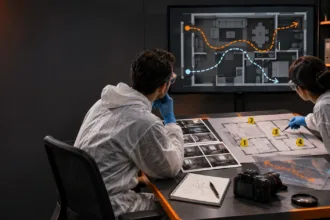
A trajectory refers to a projectile’s path through space. A forensic scene examiner may document the direction and geometry suggested by related defects, but not every defect permits a scientifically reliable trajectory. For some local paths, two valid, spatially related features may constrain a line segment. Longer back-extrapolation can be affected by uncertainty in each location, the target’s deformation, ricochet, intermediate contact and, over appreciable distances, flight curvature.[1][8][9]
The horizontal direction and vertical inclination must be described with their reference conventions when measured. A photograph of an indicator or a colored line superimposed on a scene is a visualization; it does not supply missing measurements. Trajectory markers, lasers and scene models used by specialists must be appropriate to the evidence and documented according to safety and competence requirements. The investigator should not assert a specific person’s position from an illustrative line.
A single uncertain defect does not establish one unique three-dimensional path.
If A and B are valid related points, a segment can constrain local direction subject to uncertainty.
Critical limits: Target deformation, deflection, ricochet, unknown sequence and ballistic curvature may invalidate long extrapolation. The diagram is conceptual, not a measured trajectory or shooter-position guide.
A 2016 forensic trajectory study compared different methods using controlled impacts on materials including drywall, MDF and sheet metal, finding performance differences associated with material and impact angle. A 2024 validation study of the lead-in approach likewise emphasizes that some single-defect circumstances cannot be treated like a two-point path. These results support method selection and uncertainty disclosure, not an assertion that every elongated hole yields one accurate shooting trajectory.[8][9]
Be especially cautious where a projectile may have ricocheted or deflected. A local post-impact segment, if determinable, is not necessarily aligned with a pre-impact path. Recovering a bullet or estimating a path also does not automatically reveal the sequence of discharges or movement of people during an event.
A useful documentation record for shooting-related features
| Feature | Recorded observations | Critical qualification |
|---|---|---|
| Fired cartridge case | Unique ID, position, orientation, condition, visible context, collection details | Resting place may differ from discharge point |
| Projectile or fragment | Location, embedded/loose state, apparent material, association, packaging | Fragment count does not necessarily equal shot count |
| Suspected impact defect | Substrate, dimensions, orientation, height, visible deposits, fractures | Nature and direction require specialist assessment |
| Possible local path | Location and identity of reliable related constraints, reference frame and limitations | Do not extrapolate a unique origin without support |
| Residue or stain | Area, visible condition, sampling method, treatment history and control | Detection does not independently prove source or activity |
| Firearm or ammunition item | As-found appearance and location, authorized safety intervention, custody | Handle only under qualified safety procedure |
| Supplementary records | Digital files, scene access log, medical movements and witness accounts | Different data sources may be incomplete or have clock errors |
Gunshot residue: do not confuse primer GSR with firing-distance assessment
Primer gunshot residue (pGSR) concerns particles potentially associated with firearm discharge and often examined using SEM-EDS. Muzzle-to-target distance assessment evaluates patterns or physical effects on a particular target, typically with appropriate comparative methods and relevant ammunition/firearm information. They answer different questions. Finding pGSR particles on a garment does not directly determine how far the muzzle was from that garment when a shot was fired.[10][15]
In 2026, NIST’s OSAC Registry lists the published ANSI/ASTM E3345-26 on interpretation of pGSR analytical opinions, and ANSI/ASTM E3497-26 on the collection of pGSR particles from clothing, vehicles and other inanimate objects. These are activity-specific references, not automatic permissions for a scene team to conduct specialist laboratory tests.[10][11]
A positive pGSR result can be consistent with involvement in a discharge-related environment but may also be relevant to proximity, transfer or contamination scenarios depending on its classification and circumstances. A negative result does not prove no firearm discharge occurred. Persistence differs by material, exposure, activity and sampling conditions, as illustrated by recent residue studies; no single global recovery cutoff is scientifically valid.[10][16]
Suspected muzzle-to-target distance questions may require qualified laboratory comparison and consideration of the target material, firearm/ammunition, deposits and physical effects. The draft ASB Standard 164-2x on muzzle-to-target distance determinations remains in standards-development organization development as of this review; it must not be described as a completed published ANSI/ASB standard.[13]
Evidence-recovery sequence: biological traces, fingermarks and other tests
Firearm-associated items may contain latent fingermarks, DNA, small trace fragments, toolmarks or chemical residues. Some recovery actions can compromise other tests. Repeatedly handling a projectile may disturb surface residues; swabbing a cartridge case may affect latent detail; fingerprint processing or chemical screening may change the appearance or suitability of other regions. Decide the examination strategy with competent specialists rather than routinely processing everything in a fixed order.
Where an intact item can be safely protected and submitted to a laboratory, coordinated examination may preserve more options than extensive field treatment. If fragile evidence needs immediate recovery, record what was collected, where, and the effect of the intervention on remaining examinations. EvidenceEvidence is any form of proof, such as objects, materials, or scientific findings, presented to establish or disprove a fact in a legal proceeding. It Read Full Definition moved by qualified firearms-safety personnel should have its condition and handling history documented for later interpretation.[4][5][14]
Package items to reduce impact, mixing, moisture damage or abrasive contact, consistent with specimen type and laboratory instructions. Keep relationships among scene exhibit ID, recovered firearm item, cartridges, bullets and any later biological subsamples clear. Do not infer a firearm identification outcome from an investigator’s visual inspection of a case or bullet.
Interpreting multiple evidence types together
Laboratory toolmark comparison, DNA profiling, pGSR, pathology, bloodstain patterns, impact documentation and digital records may address different propositions. Their findings should be evaluated with the required specialist competence and not converted into one certain narrative merely because several observations appear mutually consistent. Source-level associations are not automatic activity-level conclusions, and an activity explanation is not a finding of criminal responsibility.
For example, an examiner may document two cartridge cases in a room and a mark on a wall, but those observations alone do not establish that the two cases relate to the mark. The items may require independent comparison, chronology assessment, scene changes and evaluation of other possible explanations before relationships can be inferred. Uncertainty and seemingly contradictory findings must remain in the reconstruction record.[3][7]
Three cases documented near a doorway.
Potential class/toolmark information, with examination limitations.
One or more discharge locations may be considered with other evidence.
Exact person, firing position, shot order or legal responsibility from those cases alone.
This is a reporting-boundaries diagram; it is not a statistical model or a conclusion about a real event.
Worked example 1: Cartridge cases near an open doorway
Hypothetical setting: Three cartridge cases are recovered near a doorway. A witness says all shots were fired from the corridor. Observations to preserve: each case’s unique location and condition, doorway position, floor surface, responder movements, the limits of the search and relevant digital or physical evidence. Potential explanations: more than one possible firing location or subsequent movement could produce the resting positions.
Scientific limit: three recovered cases do not by themselves prove three discharges, one weapon, one shooter or one firing location. The witness account is separately evaluated; it should not be silently treated as a calibrated measurement. Independent toolmark results or scene data may help constrain—but not automatically settle—the reconstruction.
Worked example 2: An irregular defect in a metal surface
Hypothetical setting: An elongated opening in a vehicle panel is provisionally described as a bullet hole. Observations to preserve: the complete defect, substrate condition, surrounding damage, apparent deposits, relevant nearby surfaces and any other suspected impact features. Document it before intrusive specialist testing.
Scientific limit: an irregular metal opening may reflect projectile deformation, previous contact, substrate behavior or a non-projectile cause. Without suitable validation and multiple constraints, one geometric extrapolation cannot be represented as an established shooter position. A specialist may decide that a path is indeterminate.[8][9]
Worked example 3: A possible ricochet and a later defect
Hypothetical setting: Investigators document a possible shallow surface strike and a separate defect on another object. Relevant questions: Are both features truly projectile related? Can they be associated with the same object or event? Is there evidence of intermediate contact or deflection? Photograph and identify both features separately and seek specialist input.
Scientific limit: if the object was deflected, the later path cannot safely be extended backward as though there had been no intermediate contact. The apparent order of marks and the number of shots may remain unresolved. A proposed diagram must distinguish measured features from hypothetical connecting lines.
Worked example 4: pGSR on clothing with no identified firearm
Hypothetical setting: SEM-EDS examination reports particles consistent with the laboratory’s pGSR criteria on a jacket. No firearm has been recovered. Relevant assessment: review sampling locations, result classification, activity history, contamination controls, transfer possibilities and any other scene findings.
Scientific limit: the particles do not uniquely establish that the wearer fired a gun or the distance between a muzzle and the clothing. A firing-distance assessment, if relevant and possible, is a different specialized examination requiring suitable target evidence and methods.[10][11][15]
All four examples are hypothetical teaching cases. They do not establish standard operating procedures for firearm handling or reconstruct an actual shooting.
Preparing a scientifically defensible shooting scene report
A report should distinguish direct scene observations, measured geometry, laboratory findings received from other examiners and interpretative conclusions. State the methods used and their limitations, the qualification of the specialist providing each opinion, material changes made to the scene, and the status of unresolved examinations. If a diagram includes assumed positions or a proposed event sequence, label those elements as hypothetical.
Do not use phrases such as “the casings prove the shooter stood here,” “the hole shows exactly where the gun was held,” or “GSR confirms the suspect fired a weapon” without a scientifically supported basis. Instead, describe what was documented and what conclusions are possible under the applicable examination conditions. Reports should allow independent review of any significant opinion and preserve the original scene notes and records.[1][3][6]
If the examination supports several explanations, say so. A reconstruction may appropriately remain inconclusive on exact shot order, shooter location or specific participant activity, even when some component measurements or laboratory associations are informative.
Common misconceptions about shooting scene evidence
Myth
A cartridge case's resting place identifies the shooter's exact position.
Reality
Ejection, contact with surfaces, case movement and scene handling can affect the final location. Position estimates require a properly qualified analysis.
Myth
The number of cartridge cases collected is the number of shots fired.
Reality
Not all discharges necessarily produce a recovered case, and cases can be moved, absent or unrelated to the incident under investigation.
Myth
An apparent bullet hole alone establishes the shooter's location.
Reality
Defect origin, substrate effects, impact angle, intermediate contact and uncertainty must be evaluated before inferring a constrained path.
Myth
Gunshot residue detected on clothing proves its wearer fired a firearm.
Reality
A pGSR result does not uniquely establish the activity that deposited particles. Transfer, proximity, background and contamination considerations remain relevant.
Myth
Primer gunshot residue analysis determines muzzle-to-target distance.
Reality
Particle classification and muzzle-to-target distance determination are different examinations with distinct methods and limits.
Myth
A firearm toolmark association identifies the person who discharged it.
Reality
A source association cannot by itself determine the user of a firearm, time of discharge or criminal responsibility.
Quality checklist: shooting scene documentation and evidence control
Educational self-review only: checking an item does not establish laboratory QC acceptance.
Frequently asked questions
Frequently Asked Questions
What is shooting scene investigation?
It is the recognition, documentation and preservation of firearm-related evidence and scene context for appropriate specialist examination and, where supported, later reconstruction.
What standard covers shooting scene processing in 2026?
ANSI/ASB Standard 196-26 is a published standard on documentation and processing of shooting scenes. It does not provide complete shooting-reconstruction protocols, and local applicability must be determined.
Do recovered cartridge cases reveal the exact shooter location?
No. Ejection behavior and final resting positions depend on multiple factors and possible post-discharge movement. A controlled study found substantial positional error under its test conditions; it does not provide a universal reconstruction tolerance.
Does the number of cartridge cases equal the number of shots?
Not necessarily. Cases may be absent, retained, moved or from an earlier event. Different firearm types and scene histories also affect what is recovered.
Can an irregular bullet hole determine firing direction by itself?
Usually not without adequate method-specific examination. Substrate, impact angle, projectile deformation, prior contact and ricochet can affect the defect.
What is the difference between penetration and perforation?
Penetration describes entry into a target without necessarily emerging from it; perforation creates a passage through it. Scene terminology and classification require examination of the actual target.
Can a trajectory line establish where the shooter stood?
A local path estimate may constrain direction under suitable conditions. It does not automatically determine a unique shooter position, especially with uncertainty, movement, intermediate contact or curved flight.
What happens to trajectory interpretation after a ricochet?
Deflection may change a projectile's direction. A later path should not simply be extended backward as though the earlier impact had not occurred.
Does pGSR on someone's clothing prove they fired a gun?
No. Depending on the circumstances and laboratory classification, results can also be relevant to proximity, transfer or contamination. Negative results likewise do not definitively exclude firearm discharge.
Is gunshot residue testing the same as muzzle-to-target distance determination?
No. pGSR particle analysis and firing-distance assessment involve different questions, samples, methods and limitations.
How should fired cases and bullets be preserved?
They should be uniquely identified, protected from damage or mixing, and packaged according to intended laboratory examinations. Personnel must not compromise toolmarks or traces through unnecessary handling.
Can a forensic examiner determine exactly how many shooters were present?
Not from scene counts or impacts alone. The number of people involved may remain uncertain even when some projectiles or cases can be associated with particular firearms.
Does firearm toolmark identification prove who fired the firearm?
No. Source-comparison findings concern the origin of the item under the method used; identity of a person, time of discharge and legal responsibility require separate evidence.
Related Simply Forensic Articles
References and scientific sources
Reviewed 15 November 2026. Published shooting-scene and scene-investigation standards are distinguished from standards still under development. The archived NIJ training materials are educational resources rather than automatic current requirements. The applicability of national regulations and laboratory procedures varies by jurisdiction.
References & Sources
Show referencesHide references
- NIST/OSAC. ANSI/ASB Standard 196-26, Standard for the Documentation and Processing of Shooting Scenes (2026, 1st ed.; published). Source
- AAFS Academy Standards Board. Standard for the Documentation and Processing of Shooting Scenes: scope and publication (2026). Source
- NIST/OSAC. ANSI/ASB Standard 159-24, Scene Investigation and Reconstruction—Foundational Principles (2024). Source
- National Institute of Justice (2013). Crime Scene Investigation: A Guide for Law Enforcement. Source
- National Institute of Justice. Firearms Examiner Training: Collection of Evidence (archived training resource). Source
- UK Forensic Science Regulator (2026). Incident Scene Examination, FSR-GUI-0006, Issue 2. Source
- Lo A., Liscio E. (2021). Determining the accuracy and errors of estimating a shooter's position based on cartridge case ejection patterns. Forensic Science International 328:111045. Source
- Bullet trajectory reconstruction—Methods, accuracy and precision (2016). Forensic Science International 262:204–211. Source
- ValidationValidation, often referred to as method validation, is a crucial process in the laboratory when introducing a new machine, technology, or analytical technique. It involves Read Full Definition of the lead-in method in a practical shooting scenario (2024). Journal of Forensic Sciences 69:1235–1245. Source
- NIST/OSAC. ANSI/ASTM E3345-26, Opinions on Interpretation of Primer Gunshot ResidueParticles or chemical compounds associated with firearm discharge, potentially originating from primer, propellant or related materials. by SEM/EDS (published; Registry September 2026). Source
- NIST/OSAC. ANSI/ASTM E3497-26, Collection of Primer Gunshot Residue from Clothing, Vehicles and Inanimate Objects (published; Registry July 2026). Source
- NIST. Standard Bullets and Cartridge Cases: SRM 2460 and 2461 and quality assurance for toolmark imaging. Source
- NIST/OSAC. ASB Standard 164-2x, Test Method for Muzzle-to-Target Distance Determinations (in SDO development; not a published standard). Source
- National Institute of Standards and Technology (2013). The Biological EvidenceBiological evidence - physical evidence such as bodily fluids that originated from a human, plant or animal. Read Full Definition Preservation Handbook, NISTIR 7928. Source
- NIST/OSAC Lexicon. Distance determination (updated 2026). Source
- Redouté Minzière, V., Tilborg, T., Gassner, A.-L., et al. (2026). Persistence of organic and inorganic gunshot residues on hands, forearms, and face of shooters 24 h after a high number of discharges. Forensic Science International, 387, 113032. doi:10.1016/j.forsciint.2026.113032. Source
Educational limitation: This guide does not provide firearm operation or hazardous-scene response instructions, authorize handling of live firearms, or substitute for qualified shooting reconstruction, laboratory examinations, agency SOPs or applicable law.