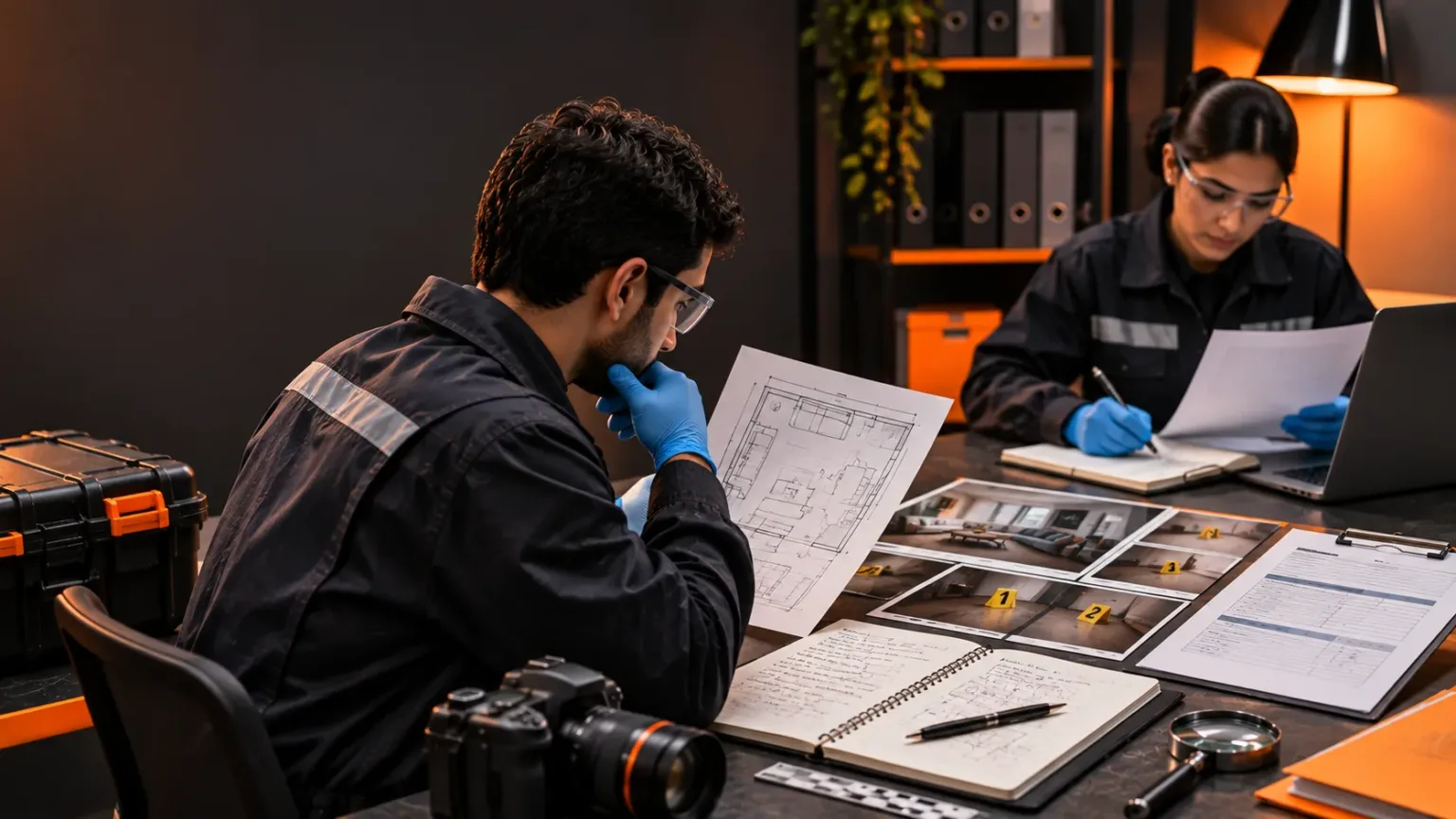
Crime scene examination reports translate observations, recovery decisions and relevant forensic findings into a record that investigators, reviewers and courts can understand and scrutinize. A defensible report explains what was examined, what was actually found, what was not examined, which methods and limitations matter, and what conclusions are justified. It must not turn a preliminary scene hypothesis into a fact or conceal an important negative result simply because it does not support the initial investigative account.
- Why does a crime scene examination report matter?
- Field notes, technical records and the issued report are not interchangeable
- What information should a forensic scene report contain?
- What makes scene notes technically defensible?
- Observation, method-limited result, investigative interpretation and opinion
- How should negative findings and examinations not performed be reported?
- Worked reporting case: suspected forced entry at a small office
- Worked example 2: an impression that becomes partly washed out
- Worked example 3: provisional finding followed by a corrected laboratory result
- Worked example 4: different interpretations of a possible scene event
- Evidence traceability: notes, photographs, sketches and custody
- How to report limitations without weakening valid findings
- Quality review: what is the difference between administrative and technical checks?
- Bias, irrelevant information and independent reporting
- Provisional reports, corrections and amendments
- Common misconceptions about crime scene reporting
- What should the final forensic report quality checklist include?
- Frequently asked questions
- References and technical guidance
A scene report is not the same as a notebook, evidence register, laboratory analytical report or expert reconstruction opinion. Each is part of a connected documentation system. The report should be clear and proportionate, while the complete underlying case file must remain available for appropriate technical review, disclosure and testimony. Records written after the event cannot retroactively replace observations that were never made.[1][4][5]
This article explains technical notes, scene report structure, observational versus interpretative language, exhibit traceability, provisional results, reporting of limitations, quality checks, corrections and secure release. It includes a fictional worked case, contrasting reporting examples, four editable diagrams, three tables, a report-review checklist, twelve FAQs and current authoritative references.
Key Takeaways
A defensible crime scene examination report keeps records, findings, interpretations and limitations traceable.
- Describe the examination scope, original observations, methods, items recovered and actions actually performed.
- Separate field notes, laboratory results and investigative accounts from interpretations or opinions.
- State non-detection, unexamined areas and provisional results within the limits of the methods and available records.
- Retain exhibit traceability, competent quality review and a controlled audit trail of corrections and release.
Key reporting principle
Why does a crime scene examination report matter?
Crime scene work involves decisions made under uncertain and sometimes changing conditions. The examiner may move an item to permit a search, alter an environment for safety, swab part of a surface and preserve another part for specialist analysis. If the final report provides only a polished outcome without showing the basis for key decisions, a later reviewer may be unable to determine whether alternative evidence opportunities were considered or whether apparent gaps arose from the scene or the examination.
The published ISO 21043-5:2025, Forensic Sciences—Part 5: Reporting, covers forensic work performed both at scenes and in facilities. Its publicly available abstract identifies reporting accuracy, clarity, transparency, completeness, impartiality, review, issuance, report control and testimony among its topics. These are relevant across disciplines, although local accreditation, law and the full licensed standard govern detailed obligations.[1]
ISO/IEC 17025:2017 remains the published and confirmed general standard for competent testing and calibration laboratories. It supports traceability of technical records, reporting and valid results within its applicable scope; it does not mandate one identical scene-report form for every agency or establish that all scene activity is accredited under that standard.[3]
Where rules are cited, distinguish technical standards from legal requirements. In England and Wales, the Forensic ScienceDiscover the fascinating field of Forensic Science, the application of scientific principles to legal matters. This post delves into its many disciplines, from DNA analysis Read Full Definition Regulator’s statutory Code of Practice, Version 2, came into force on 2 October 2025. Its specific incident-scene provisions include records of examination decisions and peer-review arrangements. It is not automatically a statutory code for agencies in other countries.[4][5]
Field notes, technical records and the issued report are not interchangeable
Contemporaneous field notes record observations and actions close to when they occur. A note may include arrival time, weather, who entered, an object’s as-found location, a change caused by emergency medical treatment, the sampling area, who performed the work, and the basis for a departure from the original strategy.
Technical case records can encompass notes, worksheets, digital photographs, sketches, measurements, collection history, controls, relevant correspondence, test data, decision logs and reported findings. The record may also document preliminary ideas and later changes to understanding. Records should be identifiable, retrievable and preserved under the relevant quality and retention policy.
The issued scene examination report is a controlled communication to an intended recipient. It should answer the agreed forensic questions without reproducing every operational detail, but it must make relevant scope, evidence, methods and limitations apparent. A concise report is not necessarily deficient if adequate underlying records exist and the reporting purpose is clear. Conversely, length and confident language do not compensate for undocumented work.[1][4][5]
Contemporaneous observations, actions, timestamps and measurements
Photos, sketches, exhibits, methods, controls and consultation logs
Purpose, scope, selected factual findings and supported opinions
Competent, proportionate technical and administrative review
Authorized report, date, version, recipients and corrections log
Preservation rule: the issued report is a controlled summary, not a replacement for the fuller source records. A corrected or amended version must remain traceable to the version it supersedes.
| Document | Core purpose | Should preserve | Common error |
|---|---|---|---|
| Field notebook / scene log | Record actions and contemporaneous observations | Times, people, conditions, original locations, changes | Reconstructing missing details from memory without disclosure |
| Technical case record | Support verification and independent assessment | Photos, measurements, methods, item maps, controls, decisions | Discarding raw files after creating a report |
| EvidenceEvidence is any form of proof, such as objects, materials, or scientific findings, presented to establish or disprove a fact in a legal proceeding. It Read Full Definition and custody register | Link scene items, samples, locations and transfers | Unique IDs, parent-child links, seals, handover history | Using inconsistent identifiers across records |
| Scene examination report | Communicate relevant work, findings and limits | Scope, observations, results, supported conclusions, status | Presenting preliminary interpretations as established facts |
| Specialist laboratory report | Convey results from a defined specialist examination | Examined items, methods, interpretation and limits | Scene report taking ownership of an unreviewed laboratory opinion |
What information should a forensic scene report contain?
A report should enable the reader to identify its author and work, link it to the correct case, understand the scope of examination and locate the underlying records. The full set of fields depends on the incident, reporting status, customer needs, method and jurisdiction; the following is an educational report structure, not a universal official form.
| Report component | Illustrative content |
|---|---|
| Report identification | Unique report number, revision, issue date, case number, commissioning body and examiner |
| Scope and request | Locations examined, reason, questions to address, authority and constraints |
| Scene attendance | Dates and times, personnel roles, observed conditions, prior interventions, limitations on access |
| Examination activities | Photography, search, relevant methods, significant deviations and why they occurred |
| Findings | Location and nature of observations, item IDs, measurement references and any validated screening results |
| Recovery and transfer | Exhibit ID, specimen ID where different, source area, packaging and custody references |
| Interpretation and limits | Clearly attributed specialist opinions, unresolved explanations, uncertainty and unperformed work |
| Supporting material | Photograph schedule, sketches, exhibit lists, relevant annexes and report cross-references |
| Review and authorization | Applicable review records, report approval, version and recipients |
Where a case has multiple scenes, visits or practitioners, identify each relevant location and examination separately. The report should not imply that a single examiner witnessed all activities if observations and recovery were performed by others. Attribute external laboratory findings to the appropriate source and report number.
What makes scene notes technically defensible?
Notes should explain the identity of the observer, date/time or sequence, relevant location, action performed and result observed. Use precise descriptions and measurements when practicable. A note such as “stain on table” lacks adequate location detail for later sampling and review; “irregular reddish area, approximately 25 mm at widest point, on the upper surface 180 mm from the eastern table edge; photographed as IMG_024” is more traceable, assuming each measurement was actually made.
Record significant changes to strategy. For instance, an investigator might defer fingerprint processing pending DNADNA, or Deoxyribonucleic Acid, is the genetic material found in cells, composed of a double helix structure. It serves as the genetic blueprint for all Read Full Definition and trace examination, protect a threatened impression during rainfall or use an alternative search route due to electrical hazards. The relevant rationale and any effects on later examinations belong in the case record, not only in a reconstructed narrative months later.[4][5][9]
Legitimate corrections should be dated, attributable and made so the previous information remains recoverable through the organization’s approved procedure. A digital log or laboratory information management system may preserve audit histories automatically, while a paper notebook uses an appropriate correction convention. Never erase, silently replace or backdate an original note to make it appear contemporaneous.
Do not add unobserved detail merely to complete a template. If a measurement, condition or time was not recorded, state that it is unavailable and, where necessary, explain the implications. An absence of notes may limit the interpretation of scene findings even when the exhibit itself remains securely preserved.
Observation, method-limited result, investigative interpretation and opinion
The UK Forensic Science Regulator’s March 2026 FSR-GUI-0004, Version 2, distinguishes factual communication from investigative, evaluative, analytical and categorical interpretations. This matters because the language of a scene report should match the level of expertise, method and question actually addressed. An investigative explanation is not the same as a balanced evidential-strength assessment between mutually exclusive propositions.[6]
For example, “an irregular reddish stain was visible on the frame” is an observation. “The tested area produced a positive reaction with a named presumptive blood-screening procedure” is a method-limited result, if a properly performed test and appropriate controls support that wording. “This proves the suspect deposited blood while forcing entry” is a claim about source, activity and timing that the same observations do not establish.
A reddish area was visible on the eastern door frame.
A specified screening method gave a positive reaction in the sampled area.
A qualified specialist may evaluate findings in a stated context and against relevant alternatives.
The offender deposited blood here during the offence.
Examples are hypothetical; the wording of screening results must follow the actual validated method, controls, competence and organization reporting policy. A positive presumptive test does not establish source, timing or legal activity.
Use provenance within sentences. If a witness states that a door was open before police arrived, write “Witness W1 reported that the door was open at approximately 19:00,” not “The door was open at 19:00” unless the examiner has independent direct evidence. If the specialist laboratory later reports an association, state which report and examiner are responsible for that conclusion.
Interpretation and expert opinion must remain within demonstrable competence. A scene examiner may be able to identify where and how an item was recovered without being qualified to offer a forensic DNA source-level statistic, bloodstain mechanism opinion, injury interpretation or categorical firearm identification.[2][4][7]
How should negative findings and examinations not performed be reported?
One of the most consequential reporting errors is turning non-detection into proof of absence. “No latent ridge detail suitable for comparison was developed using the procedures performed on the stated area” is more precise than “There were no fingerprintsFingerprint, impression made by the papillary ridges on the ends of the fingers and thumbs. Fingerprints afford an infallible means of personal identification, because the Read Full Definition on the door.” The latter claims more about the surface than the examination has established.
A negative result should be linked to the item, location, examination area, method, relevant detection limit or limitation and scope of search where material. A presumptive test result cannot be reported as a definitive identification unless the method and evidence actually warrant that conclusion. A scene not searched behind a locked section of a building cannot be characterized as completely examined merely because all accessible rooms were searched.[6][9]
Distinguish negative (a specified search or test did not detect the target under stated conditions), not examined (no relevant examination was attempted), not suitable (the method could not give reliable information), and inconclusive (the available assessment cannot answer the question). They are different report states, though exact terminology must follow the laboratory’s methods and reporting policy.
Worked reporting case: suspected forced entry at a small office
The following fictional example illustrates how the same incident may generate different records. It is not an actual case, and no presumptive test or forensic source attribution is asserted.
Example case details
Case: SF-CASE-001 (fictional). Scene: Office A. Attendance: 15 November 2026, 09:10–11:20 local time. Request: document reported damage to a door and recover selected material for further forensic examination. The scene examiner observes a rectangular metal door, visible damage near its latch, a small loose glass fragment on the floor and a reddish area on the lower door frame.
| Identifier | Source and observation | Action or result | Record cross-reference |
|---|---|---|---|
| SF-E01 | Loose transparent fragment on floor near western wall | Photographed and separately collected; material origin not determined at scene | Photograph P010–P012; exhibit register 01 |
| SF-E02 | Reddish area on lower door frame | Photographed; an indicated area reserved for later specialist assessment; identity not determined at scene | P013–P016; scene sketch S01 |
| SF-OBS03 | Visible deformation near door latch | Described and measured without assigning a cause | P017–P020; measurement notes M01 |
| Area B | Adjacent room locked during attendance | Not examined; access limitation reported | Scene log L01 |
Example: contemporaneous note versus issued-report wording
Field note excerpt: “09:47 — photographed apparent door-latch deformation; no toolmark assessment undertaken. 10:03 — observed irregular reddish region on east side of lower frame, approximate visible extent 18 × 8 mm. No presumptive body-fluid test performed. 10:12 — Area B remained inaccessible; commissioning officer advised.”
Report excerpt: “I examined the accessible portions of Office A as detailed in the scene log. Visible deformation near the door latch and a reddish region on the lower frame were documented photographically. Neither observation was subjected to a specialist source or activity assessment during this attendance. A transparent loose fragment, identified as SF-E01, was recovered from the indicated floor location. Area B was not examined because access was unavailable.”
Appropriate limitation: “The examination does not establish how or when the door was damaged, whether the reddish material is blood, or the origin of the recovered fragment. Other possible examination areas were not accessible during this attendance.”
This report avoids calling the fragment window glass without analysis, calling the stain blood without suitable testing, or concluding that a person forced entry. It retains useful observations while showing which questions remain unresolved and which specialist examinations could be considered.
Worked example 2: an impression that becomes partly washed out
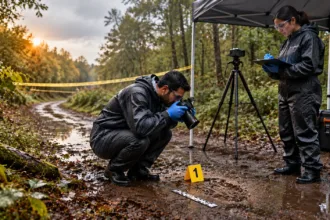
Scenario: A footwear impression is photographed outdoors before rain damages one portion. A cast is not made because the surrounding substrate becomes unstable and there is no safe qualified recovery opportunity.
Misleading report: “The offender’s footprint was destroyed by rain and cannot be compared.”
More defensible: “One partial footwear-shaped impression was documented at location SF-L04 using photographs P040–P044. Rain occurred before further recovery; subsequent examination found reduced visible detail. No cast was obtained. The remaining image quality and suitability for any footwear comparison have not been evaluated by a qualified examiner.”
Why it matters: The report records what changed without asserting the creator, age, deliberate interference, or impossibility of all future comparison. It preserves the basis for further assessment and makes the limitation visible.[4][5]
Worked example 3: provisional finding followed by a corrected laboratory result
Scenario: An investigator receives a verbal provisional update suggesting an exhibit may contain a particular material. A later laboratory report reaches a different, reviewed conclusion.
Correct response: Record who provided the provisional information, when, the exact status communicated, who received it and how the investigation used it. When the later finding arrives, identify who must be notified promptly, update any affected interpretation and retain the original communication and revised statement according to the quality system.
Reporting example: “The initial communication dated [date] was preliminary and is superseded by Laboratory Report LR-02, issued [date]. The revised result is set out in LR-02. Any conclusions in this scene report that depended on the earlier result require reassessment.”
This avoids silently deleting a material correction from the record. The UK FSR Code specifies explicit controls over provisional results, reevaluation and communication of changed preliminary information in its applicable scene-forensic activities.[4][5]
Worked example 4: different interpretations of a possible scene event
Scenario: A door frame is damaged, a table has moved, and one investigator believes these findings show a violent struggle. A second reviewer identifies plausible emergency intervention or earlier damage explanations.
Reportable findings: the measured damage, documented as-found table position and any verified changes recorded by responders. An inference that there was a struggle may be offered only if the examiner is competent and the evidence supports that particular limited opinion. Any alternative explanations and uncertainties should be recorded.
Limitation: A photograph of moved furniture does not establish when or why movement occurred. If the time of movement is unknown, a categorical event sequence would overstate the evidence. Inferences should not be retrospectively entered as if they were initial scene observations.[2][6][10]
Evidence traceability: notes, photographs, sketches and custody
The report should use identifiers that connect each material observation and recovered item to its source. The scene photograph may show marker 3; the evidence register must identify what marker 3 represents, where it was located, and which exhibit or specimen number was ultimately assigned. If multiple samples come from one object, identify parent exhibit and individual subsamples distinctly.
Chain-of-custody records should capture who transferred an item to whom, when, under what condition and for what purpose. An examiner may cite a linked custody record rather than repeat every handover in narrative prose, but the link and item identity must be unambiguous. Where packaging or seal condition affected interpretation, that fact should also appear in the relevant scientific record.
For digital photographs, video and measured models, retain original records with documented acquisition and controlled derivatives. A hash may support file-integrity checks, but does not establish that metadata, scene interpretation or a camera clock is accurate. The NIST digital-evidence preservation guidance addresses the challenges of maintaining reliable digital records across collection, storage and later use.[9][12]
How to report limitations without weakening valid findings
A limitation is information needed to understand what a finding can or cannot establish. It may concern the examined area, access, substrate, weather, recovery method, contamination risk, unavailable controls, material quantity, detection capability, incomplete context, missing source data or uncertainty in an interpretation. State which conclusion or question it affects, rather than insert an unconnected generic disclaimer at the end of the report.
Example: “The entire eastern surface was not examined because it was covered by fixed machinery. Accordingly, this report does not address the possible presence of traces behind the machinery.” This is more useful than “Results may vary.”
Limitations should be proportionate. If a clearly photographed object was recovered under good conditions, explain its identity and location without surrounding a factual observation with unnecessary speculation. Equally, if an item was moved before examination, do not claim its found location was its deposition location merely because the evidence label is secure.
Do not declare admissibility, guilt or an offence from a report on scene attendance. Legal decisions are made by the responsible authorities under applicable law; the scene examiner supplies evidence and scientifically justified opinion within their professional scope.[6][7]
Quality review: what is the difference between administrative and technical checks?
A high-quality report is not simply “signed by another analyst.” Review must match the risks in the work. The UK FSR Code, Version 2, distinguishes examination strategy review, critical-finding checks, peer review and administrative checks. For incident-scene examination, Section 90.10 addresses proportional peer review of notes, examination strategies and decisions. Those are specific regulatory requirements within the Code’s scope, not a worldwide rule that exactly three independent reviewers must sign every crime scene report.[4]
Case IDs, dates, signatures, exhibits, attachments, typos, recipients.
Source notes, methods, examination decisions, adequacy of findings, conclusions and limits.
Where required, a defined independently checked result or opinion with recorded level of independence.
The responsible person controls report release, version and notification obligations.
Administrative checks concern the correctness and completeness of report identifiers, dates, references, annexes, spelling, authorization and distribution. Technical peer review assesses the work against the request, methods, notes, documented decisions, relevant evidence and the reasoning of any opinions. Critical-finding checks, when required, assess specified significant findings and may need a defined degree of independence. A reviewer signing only a formatting checklist must not be described as having independently validated a complex reconstruction opinion.[4][6]
Competence to review should be established for the work in question. A scene manager may be competent to review evidence continuity but not the statistical interpretation of a complex DNA mixture or a specialist bloodstain mechanism. If several distinct activities are included, the report should identify whether appropriate specialist opinions were separately reviewed.
Checks should be documented with who performed them, when and the status or outcome. Significant disagreements, corrective actions and reasons for changes should be retained. A peer review is not an automatic guarantee that a method is validated or that a conclusion is true.
Bias, irrelevant information and independent reporting
Reporting can be affected by an initial investigative theory, suspect information or pressure to produce a neat narrative. The FSR’s updated interpretation guidance distinguishes task-relevant information from irrelevant, potentially biasing context. What is relevant depends on the scientific question: a scene examiner needs access and hazard information, but may not need an unverified claim that a particular suspect confessed before describing a damaged window.[6]
A reviewer should ask whether the report contains unsupported causal words such as “proved,” “caused by the offender,” “deliberately removed,” or “clearly occurred during the incident.” Where the method cannot determine activity, timing or intent, limit the statement to observed and technically supported conclusions.
Balanced reporting does not require giving equal weight to every imaginable story. It requires acknowledging reasonable alternatives when they materially affect interpretation and avoiding false claims of evidential strength. The standards and guidance for forensic interpretation offer different frameworks for investigative explanations and evaluative opinions; the report must not turn a preliminary hypothesis into a likelihood ratio without a justified scientific basis.[2][6][10]
Provisional reports, corrections and amendments
Some scenes require an urgent verbal update or initial report before every examination is complete. Such communication should be clearly marked provisional when that is its actual status. Identify pending tests, whether the findings have undergone required review, and the intended communication route. Do not present an unreviewed screening result as a final specialist identification simply because investigators need rapid information.[4]
After a report is issued, new findings or a discovered error may require a supplementary or amended report. Preserve the earlier issued record, identify the reason and extent of the change, link the new report to the prior version, carry out applicable review and inform affected recipients as required. Not every administrative correction changes an interpretation; not every laboratory result requires the entire scene report to be rewritten. The impact should be assessed and recorded.
Clearly identified as provisional; content and recipients logged.
Authorized findings based on available information and declared limitations.
Trigger for documented reevaluation, peer review or corrective process as appropriate.
Explicitly linked to prior report; change reason, version and notice recorded.
No earlier issued document is silently overwritten. Record which recipients need prompt notification when a previous conclusion may be affected.
Example amendment record: “Report SF-001, Revision 2, corrects the eastern/western orientation of location SF-L04 shown in Annex A. The original measurement record and photographic orientation were reviewed. No other conclusion has been changed.” This is hypothetical wording; an actual unit must follow its report control and correction procedure.
Version control should also account for digital images, drawings and other derived outputs. Do not silently replace a photogrammetric model or illustrative reconstruction file without preserving a traceable history of what was issued and why it changed.
Common misconceptions about crime scene reporting
Common Misconceptions About Scene Reporting
Myth
A polished final report replaces the original field notes.
Reality
The issued report communicates findings, while contemporaneous notes and supporting records must remain available for review and traceability.
Myth
If no fingermarks are detected, none were ever present.
Reality
Non-detection is limited to the surfaces examined and methods used; it does not establish that a trace was never present.
Myth
Every scene report requires exactly three independent reviewers.
Reality
The necessary administrative and technical reviews depend on applicable requirements, activity and risk. There is no universal three-reviewer rule.
Myth
A scene examiner's report determines who committed the offence.
Reality
Scene reports document evidence and scientifically supported opinions. Decisions on culpability belong to the appropriate legal authorities.
Myth
Correcting an issued report means silently replacing the old version.
Reality
Preserve the earlier issued record and identify any corrected or supplementary report, its reason, review and affected recipients.
What should the final forensic report quality checklist include?
Educational self-review only: checking an item does not establish laboratory QC acceptance.
Frequently asked questions
Frequently Asked Questions
What is a crime scene examination report?
It is a controlled communication describing the scope, relevant actions, scene observations, recovered material, technically supported findings and limitations of a scene examination. It should remain traceable to underlying records.
How is a crime scene report different from an officer's field notes?
Field notes preserve contemporaneous observations and actions in detail; a report communicates the relevant work and findings to a defined recipient. The report does not replace the underlying notes and case file.
What are the essential sections of a scene report?
Typical components are identifiers, examiner and dates, purpose and scope, methods, observations, evidence register, key findings, limitations, linked annexes and review/issue information. The required layout varies by organization and law.
Should every photograph and observation appear in the issued report?
Not necessarily. A proportionate report may use referenced photo schedules and records, provided the underlying data are retained and significant findings and limitations are not omitted.
Can an examiner state that no fingerprints were present?
The defensible wording usually describes what the specified examination detected or did not detect on the examined surfaces. Non-detection does not automatically prove complete absence of a trace.
How should a presumptive positive test be reported?
Identify the method and relevant sampled area, confirm that required controls and procedures were satisfied, and use qualified terminology. Do not treat a presumptive result as a universally definitive identification of a body fluid.
What is a technical peer review in crime scene examination?
It is a competent assessment of the case records, examination strategy, decisions, methods, findings and opinions to check whether the work and report are adequately supported and meet applicable procedures.
Is an administrative review the same as technical review?
No. Administrative checks often focus on identifiers, dates, grammar, annexes and distribution, whereas technical review examines methods, evidence, reasoning and limitations. A quality system must specify which are required.
Must three independent reviewers sign every forensic scene report?
No universal international rule requires that exact workflow. Some laboratories adopt sequential independent review, while applicable standards and regulations define risk- and activity-specific checks.
What should a report say when a room or area could not be examined?
Identify the excluded area, reason and relevant consequences. Do not imply full scene coverage or absence of traces in unexamined regions.
How should a provisional scene result be communicated?
Make its provisional nature explicit, identify pending work or review, record who communicated it and to whom, and use a controlled process to notify recipients if later findings materially change.
What happens if an issued forensic report contains an error?
Assess the nature and impact of the error, preserve the original version, issue an identifiable correction or supplementary report when required, apply appropriate review and notify affected recipients under local procedures.
Which standards are most relevant to forensic reporting in 2026?
ISO 21043-5:2025 covers reporting of forensic work at scenes and facilities; ISO 21043-4:2025 addresses interpretation; ISO/IEC 17025:2017 covers competent laboratory operations. The UK Forensic Science Regulator's Version 2 Code adds jurisdiction-specific requirements.
Related Simply Forensic Articles
References and technical guidance
Research verified 15 November 2026. ISO 21043-5:2025 and ISO 21043-4:2025 are published international standards; only their publicly accessible descriptions were consulted here, not the full licensed standards. The UK Code and expert-report guidance have defined scope in England and Wales. Training resources and scientific guidance do not create universal legal obligations.
References & Sources
Show referencesHide references
- ISO 21043-5:2025. Forensic sciences — Part 5: Reporting. ISO published standard and public abstract. Source
- ISO 21043-4:2025. Forensic sciences — Part 4: Interpretation. ISO published standard and public abstract. Source
- ISO/IEC 17025:2017. General requirements for the competence of testing and calibration laboratories (current confirmed edition). Source
- UK Forensic Science Regulator (2025). Forensic Science Activities: Statutory Code of Practice, Version 2; sections 20, 31 and 90. Source
- UK Forensic Science Regulator (2026). Incident Scene Examination, FSR-GUI-0006, Issue 2 (24 August 2026). Source
- UK Forensic Science Regulator (2026). Forensic Science Activities: Interpretation and Communication, FSR-GUI-0004, Version 2 (24 March 2026). Source
- UK Forensic Science Regulator (2024). Expert Report Content, FSR-G-200, Issue 4. Source
- UK Forensic Science Regulator (2024). Non-Expert Technical Statements, FSR-G-225, Issue 2. Source
- National Institute of Justice (2013). Crime Scene Investigation: A Guide for Law Enforcement. Source
- NIST/OSAC (2024). ANSI/ASB Standard 159-24, Standard for Scene Investigation and Reconstruction—Foundational Principles. Source
- NIST/OSAC (2025). ANSI/ASB Standard 195-25, Scene Response: Initial Response by Scene Investigators. Source
- NIST (2022). NISTIR 8387, Digital Evidence Preservation: Considerations for Evidence Handlers. Source
- UK College of Policing. Authorised Professional Practice: Investigation—Scene Strategy. Source
Educational notice: These fictional examples illustrate reporting principles, not an official report template or legal advice. Practitioners must follow their own validated procedures, authorization, regulatory scope, confidentiality duties and evidence-disclosure obligations.