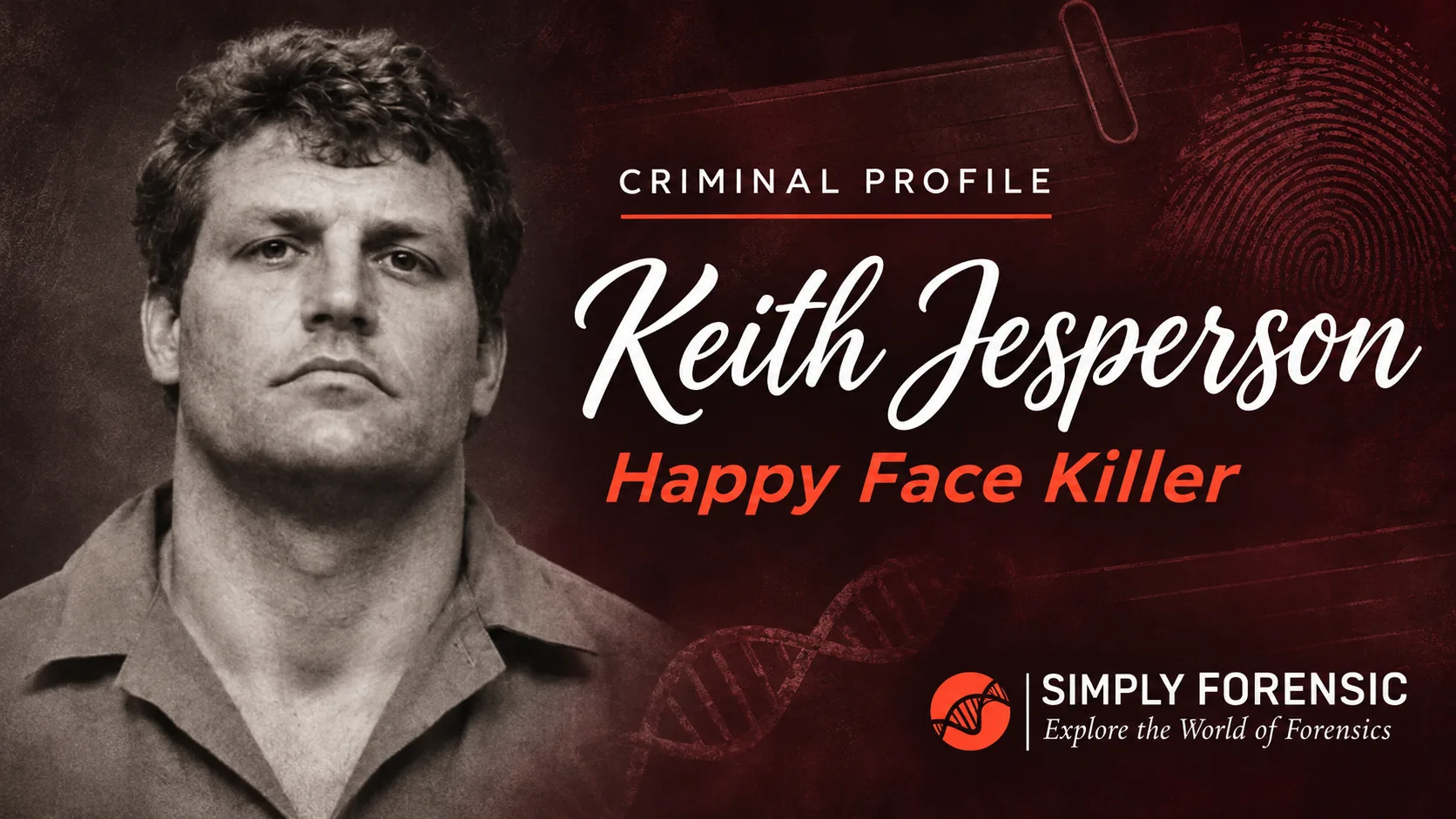
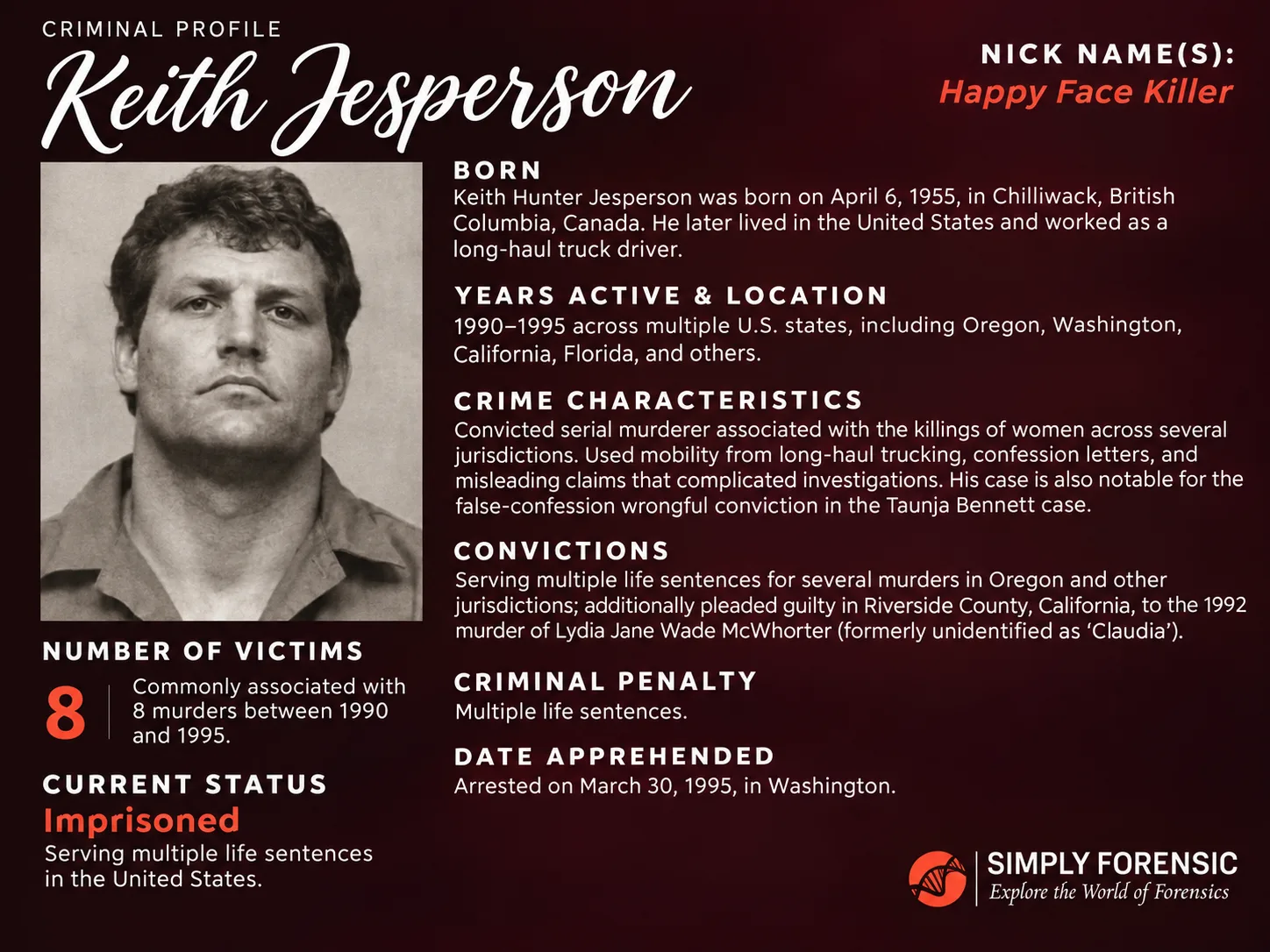
Reviewed 15 November 2026. Keith Hunter Jesperson, widely called the Happy Face Killer, is an American convicted serial murderer whose crimes crossed several states during the early 1990s. His case is remembered not simply for the letters that produced his nickname, but for a series of serious investigative questions: how apparently unrelated murders were connected, why a false confession placed innocent people in prison, and how a woman whose killer was already convicted remained unidentified for decades.
- Who is Keith Jesperson?
- The murders and the problem of linking cases
- How the letters influenced the investigation
- A wrongful-conviction warning: Taunja Bennett’s murder
- Convictions and prison status
- 2026 development: Lydia Jane Wade McWhorter is identified
- What can be concluded from Jesperson’s criminal history?
- Why this profile matters to forensic science
- Frequently asked questions
- References
This criminal profile separates documented convictions and official findings from Jesperson’s own claims. It focuses on the offender and criminal proceedings. The laboratory methods used in individual victim-identification investigations warrant separate forensic case studies.
Who is Keith Jesperson?
Jesperson worked as a long-haul truck driver. That occupation gave him extensive mobility and made it possible for crimes committed in different jurisdictions to appear unrelated. Authorities associate him with the murders of eight women between 1990 and 1995. The geographical spread matters because investigators working separate homicide cases may not initially recognize common characteristics, especially when victims have limited personal records or are found far from home.
The name Happy Face Killer originated from communications attributed to Jesperson in which he wrote about killings and used a smiley-face symbol. That label is common in news coverage; it should never substitute for an explanation of the criminal evidence Evidence is any form of proof, such as objects, materials, or scientific findings, presented to establish or disprove a fact in a legal proceeding. It is used to reconstruct events and link or exclude individuals Read Full Definition. Publicity created by an offender is itself information that investigators must verify, not evidence that every boast is true.
The murders and the problem of linking cases
Jesperson’s first known victim was Taunja Bennett, murdered in Oregon in 1990. Subsequent murders occurred across different states. Police faced the ordinary obstacles of dispersed investigations: crime scenes separated by long distances, variable quality of biological evidenceBiological evidence - physical evidence such as bodily fluids that originated from a human, plant or animal. Read Full Definition, unidentified deceased people and incomplete information about the victims’ movements.
Jesperson eventually confessed to crimes in several states. Investigators could not simply accept a confession because a person claimed to know the offender’s identity. Reliable investigation required checking whether statements contained nonpublic facts, matched recovered evidence and were consistent with independently established chronology. Courts subsequently convicted Jesperson in multiple homicide cases, and he is serving multiple life sentences in Oregon.
How the letters influenced the investigation
Communications to news organizations and authorities were among the ways Jesperson connected himself to crimes. They became a subject of investigative scrutiny because their contents could be compared with details known from crime scenes. Yet an offender may exaggerate, omit or deliberately distort information. The existence of a letter is not sufficient to attribute a particular unsolved death to its writer.
Forensic and investigative assessment therefore involves several questions: Was the letter genuinely authored by the suspect? Did it include knowledge not publicly available? Does the alleged Alleged is a term used in legal contexts to describe an accusation or claim that has been made against an individual but has not yet been proven or confirmed. Read Full Definition sequence of events agree with physical and documentary evidence? What alternate explanations exist? Distinguishing a claimed number of victims from murders proven in court is especially important in serial-offender profiles.
A wrongful-conviction warning: Taunja Bennett’s murder
The Bennett investigation also exposes the danger of false confessions. Before Jesperson admitted responsibility, Laverne Pavlinac had claimed she and John Sosnovske participated in the killing. The two were convicted in the case, but Jesperson’s later confession revealed a serious miscarriage of justice. Both were released in 1995.
The National Registry of Exonerations documents that Jesperson provided information linked to the killing, and that the prosecution came to accept the innocence of the two people imprisoned. Importantly, the Registry identifies false confession as a contributing factor and does not classify their exoneration as one produced by DNA DNA, or Deoxyribonucleic Acid, is the genetic material found in cells, composed of a double helix structure. It serves as the genetic blueprint for all living organisms. Read Full Definition evidence. A responsible criminal profile should not turn this documented case into a fictional story about an automatic DNA exoneration.
The broader lesson is about corroboration. Detailed statements can still be untrue, and investigative certainty can become misplaced when interviewers or witnesses acquire facts from other sources. A confession should be evaluated against independently obtained evidence.
Convictions and prison status
Jesperson’s convictions include a California case involving the woman long referred to as “Claudia.” He pleaded guilty to that murder in Riverside County on 8 January 2010 and received a sentence of 25 years to life. At the same time, he was already serving multiple life sentences in Oregon. The legal history should be described by jurisdiction; the California sentence was not his only sentence.
Reports that Jesperson may have committed further murders are distinct from crimes supported by convictions and official case records. His admissions have been investigated, but their evidential strength varies. This page does not treat unverified statements as additional proved victims.
2026 development: Lydia Jane Wade McWhorter is identified
A major update arrived on 27 August 2026. The Riverside County District Attorney announced that the final formerly unidentified woman associated with Jesperson’s convicted murders had been identified as Lydia Jane Wade McWhorter. Her body had been discovered on 30 August 1992 beside Highway 95 near Blythe, California. Jesperson referred to her as “Claudia,” but that was not her established name.
The county’s cold-case investigators used improved DNA work, genealogy research and information from the public. The investigation had found relatives on Lydia’s paternal side, but a maternal connection remained important. A lead enabled investigators to locate a direct maternal relative and obtain reference DNA that confirmed the proposed identity.
This update closes an extraordinary gap between criminal conviction and victim identification. Jesperson had pleaded guilty to killing her in 2010, yet her family did not receive a definitive identification for another sixteen years. The distinction is essential: knowing who committed a crime and knowing the victim’s identity are different investigative tasks.
What can be concluded from Jesperson’s criminal history?
The most firmly supported observations are operational: his work gave him mobility; crimes occurred in several jurisdictions; he communicated claims about murders; separate investigations ultimately produced convictions; and a false confession in the Bennett case caused wrongful imprisonment. None of these facts yields a clinically validated psychological diagnosis or a universal pattern by which a person can be recognized as a future serial murderer.
Likewise, investigators should not assume that every offender who travels frequently or writes disturbing letters resembles Jesperson. Criminal profiling may organize investigative hypotheses, but properly interpreted physical evidence, witness information, records and court findings remain central.
Why this profile matters to forensic science
- Cross-jurisdiction coordination: information must move reliably between investigating agencies.
- Confession corroboration: claims of guilt require independent evaluation.
- Wrongful-conviction prevention: apparently convincing statements can still be false.
- Victim identification: identifying the deceased can remain unfinished long after a conviction.
- Kinship privacy: genetic genealogy can involve relatives who were not part of the crime.
For a broader explanation of the science, see Simply Forensic’s introduction to SNPs and forensic genetic genealogy. A future case study can examine the specific DNA identification workflow for Lydia McWhorter without duplicating this biography.
Frequently asked questions
Why is Keith Jesperson called the Happy Face Killer?
His nickname came from letters about killings that incorporated a smiley-face symbol.
How many victims are associated with Jesperson?
Official and major news accounts associate him with eight murders between 1990 and 1995. Other claims should not be counted as proven crimes without supporting evidence.
Was Lydia McWhorter’s murderer identified before she was?
Yes. Jesperson pleaded guilty to her murder in 2010, while her formal identification was announced in August 2026.
Did DNA exonerate the people wrongly convicted in the Bennett case?
No. The National Registry of Exonerations documents the role of Jesperson’s confession and identifies false confession as a contributing factor, rather than DNA exoneration.
References
- Riverside County District Attorney, identification of Lydia Jane Wade McWhorter, 27 August 2026.
- National Registry of Exonerations, Laverne Pavlinac case record.
- Los Angeles Times, McWhorter identification and family response, August 2026.
- ABC News, Bennett investigation and false-confession history, November 2021.
Editorial standard: Convictions, official identifications, confessions and unproven allegations are identified separately. This profile has not been written from a fictional dramatization.