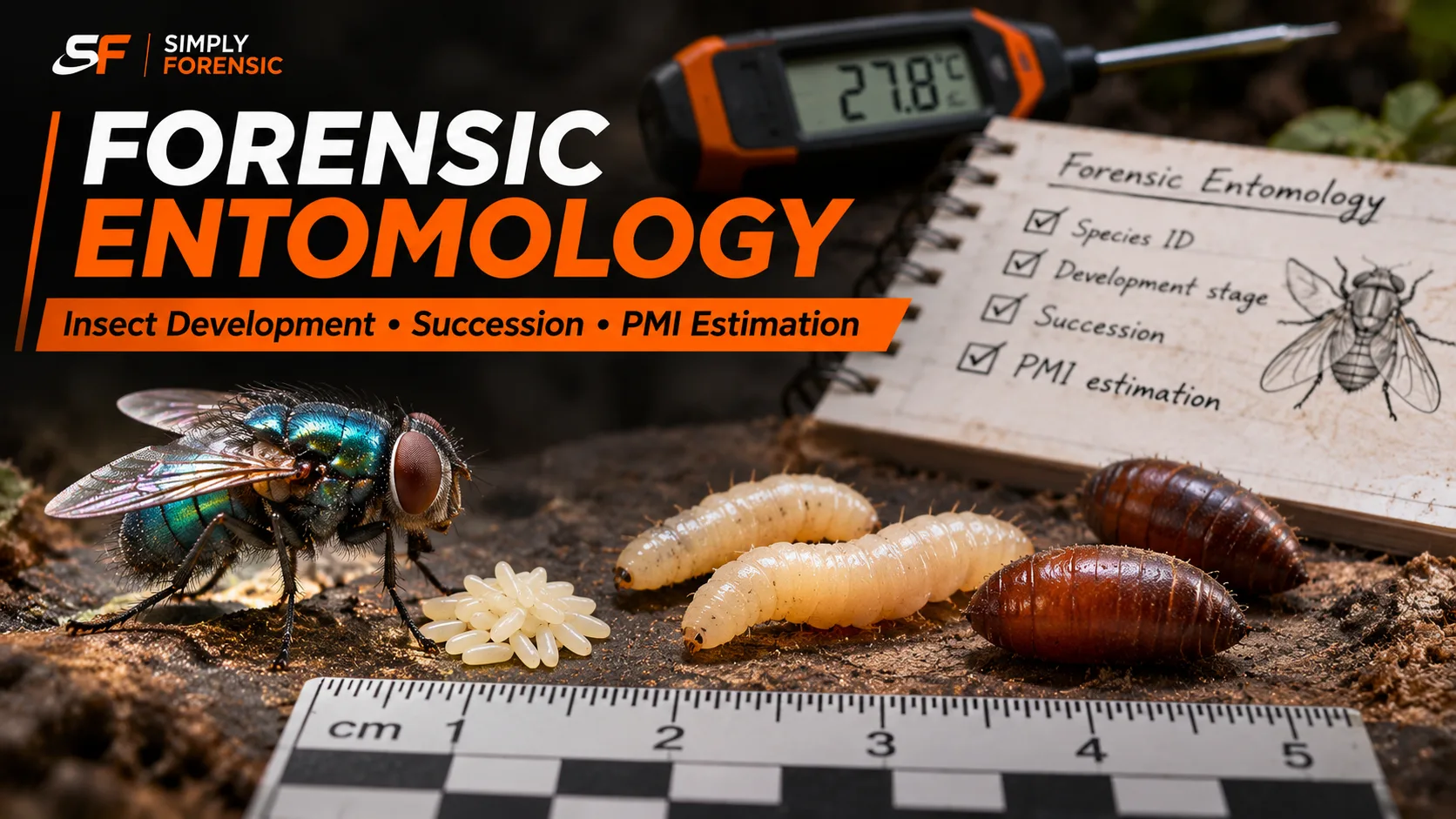
Forensic entomology applies knowledge of insects and other arthropods to questions arising in legal investigations. In death investigation, the growth and activity of insects associated with remains can provide time-related information when conventional postmortem changes become less informative. The central challenge is to interpret the evidence Evidence is any form of proof, such as objects, materials, or scientific findings, presented to establish or disprove a fact in a legal proceeding. It is used to reconstruct events and link or exclude individuals Read Full Definition correctly: the age of a larva, the timing of insect colonization and the time since death are not necessarily the same.
- 1. What Can Forensic Entomology Investigate?
- 2. Which Insects Are Important in Death Investigation?
- 3. Blowfly Development: Eggs, Larvae, Puparia and Adults
- 4. Postmortem Interval, Time of Colonization and Pre-Colonization Delay
- 5. Development-Based Estimation: Temperature and Accumulated Degree Hours
- 6. Insect Succession: Ecological Change Over Decomposition
- 7. Collecting and Preserving Insect Evidence
- 8. What Can Make an Entomological PMI Estimate Unreliable?
- 9. Three Hypothetical Forensic Scenarios
- 10. Reporting an Entomological Estimate and Its Limitations
- Related Simply Forensic Articles
- Frequently Asked Questions
- References and Authoritative Sources
This guide explains forensically important insects, the blowfly life cycle, temperature-dependent development, insect succession, evidence collection, accumulated degree hours (ADH), practical case examples and the limitations of minimum postmortem interval (minPMI) estimates. It integrates current scientific research, including human-remains field validationValidation, often referred to as method validation, is a crucial process in the laboratory when introducing a new machine, technology, or analytical technique. It involves a series of systematic steps and assessments to ensure that Read Full Definition published in September 2026.[3]
Core interpretation:
1. What Can Forensic Entomology Investigate?
Medicolegal forensic entomology studies the interaction of arthropods with human remains, wounds and living people. Its most familiar application is estimating a period of insect colonization relevant to the postmortem interval, but specimens may also help investigate animal or human neglect, myiasis (infestation of living tissue), insect activity after body movement and patterns of decomposition. Other branches concern stored products or urban pests in legal disputes.[1][2]
Insects do not provide an internal clock that starts at death. Some flies arrive soon after suitable remains become accessible, whereas colonization can be delayed by season, temperature, closed rooms, wrapping, burial, weather, or other barriers. Certain insects may have colonized a living person’s wounds. When the question is time since death, all these possibilities must be evaluated, not assumed away.
Entomological analysis normally combines three information streams: which insects are present, how developed they are, and what environmental and scene conditions they experienced. A competent conclusion distinguishes observations from assumptions and expresses uncertainty rather than reporting a clock time of death.
2. Which Insects Are Important in Death Investigation?
Most well-known forensic species are flies in the order Diptera and beetles in the order Coleoptera. Species differ widely in their geographic distribution, seasonal activity, preferred habitat and development rate. A taxon considered an early colonizer in one location cannot be presumed to behave identically elsewhere.[7]
| Insect group | Potential significance | Important caution |
|---|---|---|
| Blowflies (Calliphoridae) | Frequently important early colonizers; eggs, larvae and pupae support development-based interpretation. | Not all blowflies have the same thresholds, ecology or colonization patterns. |
| Flesh flies (Sarcophagidae) | Some deposit live larvae; species can contribute to colonization analysis. | Larviposition means egg-based assumptions may be inappropriate. |
| Other flies (e.g., Muscidae, Phoridae) | Can be important in indoor, concealed, buried or later-stage settings. | A fly’s presence does not by itself establish when it arrived. |
| Carrion and rove beetles (e.g., Silphidae, Staphylinidae) | May be predators, scavengers or succession indicators. | Appearance varies with location, access and competing fauna. |
| Dermestid beetles and other late-associated taxa | Often relevant to dry tissue and longer-term ecological changes. | Not all species are restricted to a single decomposition stage. |
| Ants, mites and other arthropods | Can alter remains, feed on insects or create artifacts. | Their presence alone rarely provides a validated PMI estimate. |
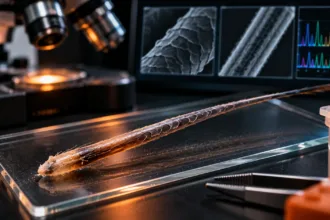
Species identification matters. Larvae can be challenging to identify morphologically. Microscopic examination, adult emergence from reared larvae and, where validated and appropriate, DNA-based taxonomic identification can complement one another. Database coverage, taxonomic uncertainty, cryptic species and reference quality must be considered before selecting growth curves.[3][7]
3. Blowfly Development: Eggs, Larvae, Puparia and Adults
Blowflies undergo complete metamorphosis. After an adult female lays eggs, larvae hatch and develop through successive instars. Mature larvae commonly leave the food source and enter a wandering or postfeeding phase before pupation. The fly develops inside a hardened larval skin—the puparium—and eventually emerges as an adult. An empty puparium indicates an adult has emerged, but the time represented depends on the species and thermal history.[2]
Eggs
Deposition
Larvae
Instars I–III
Postfeeding
Migration
Puparium
Metamorphosis
Adult
Emergence
Original educational schematic. This is an order-of-events diagram, not a developmental timetable. Stage durations depend on species, temperature and other conditions; flesh flies and other taxa may differ.
Age estimation requires more than measuring the longest larva. Growth can slow or reverse in body length as a larva stops feeding; older postfeeding individuals may be smaller than actively feeding individuals. Proper stage assessment, representative sampling and an appropriate species-specific developmental reference are essential. Some modern methods assess internal developmental changes during pupation, but such observations also require validated reference data Information in analog or digital form that can be transmitted or processed. Read Full Definition.[3][6]
4. Postmortem Interval, Time of Colonization and Pre-Colonization Delay
The true postmortem interval (PMI) is the elapsed time between death and a defined endpoint such as discovery or examination. The time of colonization (TOC) is when insect offspring were deposited. The estimated age of the oldest relevant insects is commonly used to infer an earliest plausible colonization time and to inform a minimum PMI. These are distinct quantities, particularly where insects were unable to access remains immediately.[1][4]
Schematic only; bar lengths are arbitrary. The pre-colonization interval may be short, prolonged or unresolved, depending on the case.
Pre-colonization delay is not merely a theoretical complication. A 2025 human-remains study evaluated blowfly pre-colonization intervals and demonstrated improved estimates under defined conditions when that interval was modeled, rather than automatically treating arrival as immediate.[4] Research published in 2026 also identified temperature and physical barriers as influences on the time to oviposition.[11]
Terminology warning:
5. Development-Based Estimation: Temperature and Accumulated Degree Hours
Many insect developmental models are based on the relationship between temperature and the time required to reach a defined stage or growth measurement. Within an experimentally supported temperature range, a thermal-summation approach may be used, combining temperature above a developmental base threshold with elapsed time. Common measurements are accumulated degree hours (ADH) and accumulated degree days (ADD). These are species- and stage-dependent; model choice is a scientific decision, not a universal formula.[2][6]
Illustrative heat-unit equation
ADH = Σ max(0, Thour − Tbase) × 1 hour
This simplified lower-threshold approximation applies only when its assumptions and temperature range are appropriate. Upper thermal limits, nonlinear growth, fluctuating temperatures and species-specific model structures may require more complex treatment.
Hypothetical worked example: what does an ADH estimate establish?
Assume, only for teaching, that a validated developmental model for an unspecified insect-stage landmark requires 600 degree-hours above a hypothetical base temperature of 10°C. Reconstructed local temperatures are 20°C for the first 24 hours and 25°C for the next 24 hours.
| Period | Simplified calculation | Heat units |
|---|---|---|
| 24 h at 20°C | (20 − 10) × 24 | 240 degree-hours |
| 24 h at 25°C | (25 − 10) × 24 | 360 degree-hours |
| Total over 48 h | 240 + 360 | 600 degree-hours |
Under these deliberately idealized assumptions, that stage could have been reached about 48 hours after the relevant start of development. It would not establish death 48 hours before collection. In a real investigation, the analystA designated person who examines and analyzes seized drugs or related materials, or directs such examinations to be done; independently has access to unsealed evidence in order to remove samples from the evidentiary material for Read Full Definition must select a species-specific stage reference, consider temperature uncertainty, and evaluate colonization delay and other evidence. The figures above are invented for arithmetic demonstration, not published development requirements for any particular species.
Why local temperature history matters
A single ambient temperature taken when the body is found does not represent the conditions insects experienced throughout development. Analysts may reconstruct hourly conditions from weather-station data and scene measurements while accounting for sun exposure, shade, buildings, soil, vehicle interiors, and storage conditions after recovery. A group of feeding larvae may generate heat substantially above the surrounding air, producing a maggot-mass microclimate that affects growth.[1][5]
Temperature records, corrections and modeling decisions should be documented. Development at very low or high temperatures can depart from simple linear heat-summation assumptions. If a model is extrapolated beyond validated conditions, a precise"Precise" refers to the degree of closeness or consistency between multiple measurements or values taken under the same conditions. It indicates how well these measurements agree with each other, regardless of whether they are accurate Read Full Definition number of calculated hours can create a false sense of accuracyIn scientific and measurement contexts, "accuracy" refers to the degree of proximity or closeness between a measured value and the true or actual value of the measured quantity. Accuracy indicates how well a measurement reflects Read Full Definition.
What do recent field validations show?
In a September 2026 study, Owings and colleagues analyzed 725 larval samples from 79 human donors and assessed the influence of species, developmental stage, base temperature choice and reference dataset. Species, developmental stage and reference dataset significantly affected accuracy; the effect of base temperature selection was not significant for most of the tested species in that study. This is evidence against relying on one borrowed growth curve across taxa or assuming that the arithmetic precision reflects biological precision.[3]
A separate 2026 investigation of Lucilia sericata examined species-specific thermal requirements and field validation, emphasizing why reference data must be relevant to the insect actually identified.[6]
6. Insect Succession: Ecological Change Over Decomposition
Insect succession refers to changes in the communities associated with decomposing remains through time. Early arriving blowflies and other flies may be followed or accompanied by predatory and scavenging beetles and other arthropods. As tissues, moisture and habitat conditions change, the abundance and composition of species can change. But insect succession is not a universal five-stage timetable that can be assigned fixed days everywhere.[7][8]
| General decomposition context | Possible entomological observations | Why this is not a fixed chronological marker |
|---|---|---|
| Fresh to early decomposition | Adult fly interest, eggs or larvae where access is possible | Cold weather, darkness, concealment, closed interiors and competing substrates can delay colonization. |
| Active tissue decomposition | Feeding larval aggregations, multiple fly taxa and predators | Mass temperature and food availability modify rates and assemblage composition. |
| Advanced changes | Postfeeding dispersal, pupae, beetles, varied communities | Species overlap and environmental conditions differ across regions and seasons. |
| Dryer remains / reduced soft tissue | Some dermestids and other specialist scavengers; empty puparia may remain | Late assemblages do not provide a universal date or prove no earlier colonization. |
Insect succession can be useful where the oldest insect individuals were not recovered or where developmental evidence is complemented by broader ecological observations. Species absence is difficult to interpret because an insect may be absent due to local geography, a sampling failure or access restrictions, rather than elapsed time. Studies combining multiple taxa and developmental and succession evidence show potential value, but results from an individual case or locality should not be generalized as a universal accuracy rate.[8][9]
Research applying succession to human remains remains limited in many geographic settings. A 2026 systematic review of studies from 1989–2025 highlighted gaps in human-cadaver-based validation and regionally representative entomological data. That is especially relevant when extrapolating temperate-climate models to tropical, maritime or highly seasonal locations.[7]
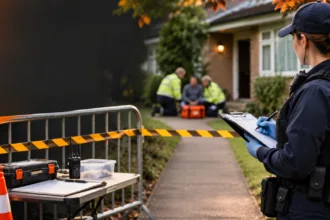
7. Collecting and Preserving Insect Evidence
Evidence collection is a major source of uncertainty if the scene team does not recognize the insects or record their original context. A preserved larva with no collection time, species context or temperature history may offer much less information than a properly documented specimen. The NIST OSAC 2022-N-0039 proposed standard, version 2.1 dated January 2025, provides detailed collection and preservation guidance. It is important to distinguish its status as an OSAC proposed standard on the Registry rather than describe it as a separately published mandatory SDO standard.[1]
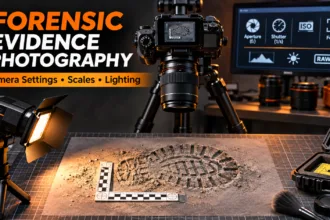
- Photograph before collection. Record the scene, remains and insect locations; include both context and close-ups, where appropriate with scales. Document wounds, feeding aggregations and dispersal areas.
- Sample broadly. Consider eggs, larvae of different sizes, puparia, empty puparia and adults, including visually different groups and separate locations. Search around and under remains, within clothing or coverings, and in nearby soil or indoor recesses for migrating older larvae.
- Separate preservation and rearing specimens. Representative specimens may be preserved to arrest development while separate live specimens are held in appropriate secure, ventilated conditions for specialist rearing. Do not mix material from different body sites, apparent species or developmental stages if doing so would obscure interpretation.
- Control and record timing. Note collection and preservation times, precise location, storage and transportation conditions, and any refrigeration of remains. Rapid changes of temperature after collection can affect the development of living specimens.
- Document the microclimate. Record sun or shade, available weather data, indoor thermostat settings and changes made by responders, as well as relevant body, soil or larval mass temperatures where justified.
- Maintain custody. Use properly labeled containers, case identifiers, sample locations, collector identity and audit-ready handover records. Consult the entomologist before selecting preservation procedures that may affect subsequent species identification or developmental measurements.
The proposed standard describes fixed and live rearing material, collection from different sites and particular precautions for indoor scenes. The 2025 ANZPAA consensus statement offers additional practical jurisdictional guidance. Evidence recovery must follow the laboratory’s approved method, biosafety requirements, local legal authority and an appropriately trained entomologist’s advice.[1][12]
Critical collection error:
8. What Can Make an Entomological PMI Estimate Unreliable?
| Source of uncertainty | Potential effect | What the expert should evaluate |
|---|---|---|
| Misidentified species | Wrong developmental growth curve or habitat assumptions | Morphology, adult rearing and validated molecular methods where needed |
| Misclassified instar or postfeeding stage | Systematic age error; older larvae may no longer be longest | Anatomical staging, representative sample and rearing data |
| Temperature reconstruction | Developmental age shifted by inaccurate thermal history | Hourly weather records, microhabitat, maggot-mass heat and model range |
| Colonization delay | Time since death longer than insect age | Insect access, wrapping, indoor conditions, cold, rain and time-of-day |
| Body relocation or refrigeration | Current location or temperature not representative of earlier interval | Transport, storage and scene reconstruction chronology |
| Drug/toxin exposure or substrate differences | Potential changes in insect growth or behavior | Whether there are validated species- and compound-specific data |
| Insufficient regional validation | Published succession or development pattern may not transfer | Population, season, habitat and geographic relevance |
| Incomplete or biased sampling | Oldest individuals or taxa missed | Search around remains and preserved/live sampling adequacy |
| Unclear reporting assumptions | Precision exaggerated; colonization age called time of death | State assumptions, plausible range and what remains unknown |
Research on maggot-mass thermogenesis demonstrates why air temperature alone may underestimate larvae’s experienced temperature.[5] Toxicants and drugs are sometimes detectable in feeding insects, a branch termed entomotoxicology, but their effects are inconsistent across species, compounds and conditions. Such observations should be reported separately from claims of a validated adjustment to an age estimate.[7]
Statistical uncertainty should reflect the relevant developmental dataset, measurement error, temperature scenarios and biological variation. A reported time window may be narrower than justified if it captures only calculation variation while ignoring colonization delay and missing older specimens. A point estimate with multiple decimal places is not a substitute for a defensible interval.
9. Three Hypothetical Forensic Scenarios
The following are invented teaching examples. They are not actual casework, and no numerical developmental values are proposed as species-specific reference data.
Scenario 1: Outdoor remains with developed larvae
Remains are found outdoors in warm weather. Several larval groups are collected, and an experienced examiner identifies a forensically relevant blowfly species and a late developmental stage. Hourly station temperatures are available, but the scene has a large feeding larval mass. Approach: use the relevant species-stage reference, reconstruct plausible local temperatures, account for the heat generated by the mass, evaluate the oldest relevant material and report a development-supported minimum interval. Limit: the estimate does not itself exclude death before colonization or rule out earlier changes to the scene.
Scenario 2: Apartment with closed windows
A body is discovered indoors after the apartment has apparently remained closed for several days. Small larvae are present, but staff opened the door and window on entry. Approach: document insect access before and after discovery, thermostat settings, possible earlier entry points and storage temperature; investigate whether new insects could have arrived after access changed. Limit: the larvae may substantially underestimate the duration since death if insects were unable to enter earlier.
Scenario 3: Puparia in a vehicle
Empty puparia and a few adult flies are collected from vehicle carpet and trim. The present parking location is exposed to afternoon sun, but previous locations and indoor garage storage are unknown. Approach: establish which species emerged, determine the possible thermal histories and document that the dispersal and emergence period is relevant. Limit: a single temperature reading taken at collection cannot reconstruct development through the vehicle’s unknown past conditions.
10. Reporting an Entomological Estimate and Its Limitations
A scientifically balanced report should describe the specimens examined, identification methods, developmental stages, collection timing, environmental data, reference studies, calculations or model used, uncertainties and interpretive scope. If only a minimum interval is defensible, it should be presented as such. The examiner should avoid statements such as “death occurred at 02:00” when the evidence supports only an estimated colonization or development interval.[2][3]
Illustrative cautious reporting language
Based on the identified insect specimens, their assessed developmental stages and the temperature history considered, the findings are consistent with insect colonization having begun at least approximately [estimated interval] before collection, subject to the stated assumptions and uncertainty. This estimate does not independently establish the time of death.Template wording only. Replace the bracketed interval only after case-specific analysis, validation and expert review.
Quick field-to-report quality checklist
Educational self-review only: checking an item does not establish laboratory QC acceptance.
Related Simply Forensic Articles
- Carrion Insects in Forensic Science — a shorter study-focused introduction.
- Forensic Taphonomy — how biological and environmental processes affect remains.
- Stages of Human Decomposition — broader postmortem changes.
- Research: Light-Based Analysis of Blowfly Larvae — an example of specialized entomology research.
- Crime Scene Investigation — documentation and coordinated recovery.
- Forensic Method Validation — validity, uncertainty and reporting.
Frequently Asked Questions
Frequently Asked Questions
How can insects help estimate the postmortem interval?
The developmental stage and age of identified insects, together with reconstructed temperatures and colonization conditions, can provide an estimate relevant to the minimum time since death. Succession evidence may provide additional context.
Can maggots reveal the exact time of death?
No. Developmental analysis concerns an insect's age or colonization history. Insects may not have reached the remains immediately after death, so a precise clock time of death is usually unjustified.
Which insect is most important in forensic entomology?
Blowflies are frequently significant early colonizers, but flesh flies, other Diptera, beetles and other arthropods can be relevant. Local ecology and the specimens actually collected determine which taxa matter.
What are accumulated degree hours (ADH)?
ADH is a measure of accumulated thermal exposure relative to a model-specific developmental threshold. It is useful only with appropriate, validated species and developmental-stage data and a sufficiently reliable temperature history.
Do all blowflies grow at the same rate?
No. Development varies with species, population, temperature, feeding conditions and other factors. The September 2026 field validation demonstrated the importance of correct species and reference-dataset selection.
Why can insect evidence underestimate time since death?
Colonization may be delayed by limited insect access, low temperatures, burial, wrapping, closed buildings or other conditions. Age of the oldest recovered insects therefore may reflect only part of the interval since death.
Can insect succession be used as a fixed decomposition calendar?
No. Succession patterns are influenced by region, season, habitat, access and decomposition conditions. General ecological stages can inform an investigation, but assigning universal days to each stage is not scientifically justified.
Why collect live and preserved insect specimens separately?
Preserved samples help document the developmental state at collection, while controlled rearing may support adult identification or further biological assessment. They serve different purposes and should not be indiscriminately mixed.
Can drug exposure change the development of maggots?
Some compounds can affect development, but effects depend on the substance, species, dose and experimental conditions. A universal correction for drugs cannot be assumed without relevant validated evidence.
Does DNA DNA, or Deoxyribonucleic Acid, is the genetic material found in cells, composed of a double helix structure. It serves as the genetic blueprint for all living organisms. Read Full Definition barcoding replace morphology and ecological interpretation?
No. Molecular methods can support taxonomic identification where reference databases and methods are suitable, but developmental staging, environmental assessment and case interpretation still require other expertise.
References and Authoritative Sources
Research cutoff: 15 November 2026. Peer-reviewed studies and authoritative professional guidance are distinguished below; OSAC proposed guidance is not misrepresented as an independently issued SDO standard.
References & Sources
Show referencesHide references
- NIST OSAC. (January 2025). OSAC 2022-N-0039, version 2.1: Standard for the Collection and Preservation of Entomological Evidence from a Terrestrial Environment. OSAC PROPOSED standard on the Registry; not an SDO-published standard. Source
- Obafunwa JO, Roe A, Higley L. (2025). A review of the estimation of postmortem interval using forensic entomology. Medicine, Science and the Law, 65(1), 52–64. DOI: 10.1177/00258024241275893. Source DOI: 10.1177/00258024241275893.
- Owings CG, McKee-Zech HS, Pat rick EA, Steadman DW. (2026). Field validation of blow fly age estimation methods for determining time of placement of human remains in Tennessee, USA. Journal of Forensic Sciences. Published online 16 September 2026. DOI: 10.1111/1556-4029.70463. Source DOI: 10.1111/1556-4029.70463.
- Owings CG, McKee-Zech HS, Patrick EA, Steadman DW. (2025). A blow fly (Diptera: Calliphoridae) pre-colonization interval dataset for improving forensic entomology estimations. Journal of Forensic Sciences, 70(6), 2393–2402. DOI: 10.1111/1556-4029.70150. Source DOI: 10.1111/1556-4029.70150.
- Gbenonsi AF, Higley L. (2025). Thermal ecology and forensic implications of blow fly maggot mass dynamics: A review. Insects, 16(10), 1018. DOI: 10.3390/insects16101018. Source DOI: 10.3390/insects16101018.
- Martín-Vega D et al. (2026). The blow fly Lucilia sericata as a forensic indicator: Thermal requirements of the immature stages and field validation of thermal summation data. International Journal of Legal Medicine, 140, 3253–3265. DOI: 10.1007/s00414-026-03888-w. Source DOI: 10.1007/s00414-026-03888-w.
- Jayakody D, Gunathilaka N, Perera N. (2026). A comprehensive assessment of forensic entomology applications on human remains: A systematic review from 1989 to 2025. Science & Justice, 66(3), 101447. DOI: 10.1016/j.scijus.2026.101447. Source DOI: 10.1016/j.scijus.2026.101447.
- When insect development meets insect succession: Advantages of combining different methods and insect taxa in estimating the post-mortem intervalThe post-mortem interval (PMI) is the time that has elapsed since an individual's death. When the time of death is not known, the interval may be estimated, and so an estimated time of death is established. Read Full Definition. (2025). Forensic ScienceDiscover the fascinating field of Forensic Science, the application of scientific principles to legal matters. This post delves into its many disciplines, from DNA analysis to crime scene investigation, its importance in the justice system, Read Full Definition International: Synergy, 10, 100574. DOI: 10.1016/j.fsisyn.2025.100574. Source DOI: 10.1016/j.fsisyn.2025.100574.
- Field validation of post-mortem interval estimation based on insect development. Part 2: Pre-appearance interval, expert evidence selection and accuracy baseline data. (2025). Forensic Science International, 367, 112316. DOI: 10.1016/j.forsciint.2024.112316. Source DOI: 10.1016/j.forsciint.2024.112316.
- Medical–Legal Entomology in Action: Evaluation of Insect-Based Post-Mortem Interval Estimation in South Korean Death Investigations. (2025). Insects, 16(2), 231. DOI: 10.3390/insects16020231. Source DOI: 10.3390/insects16020231.
- Environmental Drivers of Blowfly Pre-Colonization Interval on Human Remains in Forensic Entomology. (2026). Forensic Sciences, 6(2), 44. Source
- ANZPAA. (2025). Consensus Statement on the Collection and Processing of Forensic Entomology Evidence. Forensic specialist consensus guidance. Source
Educational notice and image provenance. Original article and conceptual HTML diagrams prepared for Simply Forensic. The associated featured photograph is AI-generated, depicts a staged educational composition and is not evidence from a real case. Actual entomological recovery and estimates require trained personnel, local procedures, appropriate biosafety controls and case-specific expert interpretation.