


Multispectral drone mapping has emerged as a valuable analytical tool in modern forensic science
 Information in analog or digital form that can be transmitted or processed. Read Full Definition across multiple spectral bands, this technology supports non-intrusive documentation of crime scenes, environmental disturbances, and large geographic areas relevant to investigations.
- What Is Multispectral Drone Mapping?
- Definition of Multispectral Imaging in Forensic Context
- How Multispectral Drone Mapping Differs from RGB Aerial Imaging
- Why Multispectral Drone Mapping Matters in Forensic Investigations
- Preserving Crime Scene Integrity Through Non-Intrusive Mapping
- Detecting Environmental Changes Relevant to Criminal Investigations
- Core Forensic Applications of Multispectral Drone Mapping
- Environmental Forensics and Land Disturbance Analysis
- Search, Recovery, and Missing-Person Investigations
- Crime Scene Reconstruction and Terrain Contextualization
- Accuracy and Reliability of Multispectral Drone Mapping Data
- Comparison With Traditional Forensic Survey Methods
- Legal, Ethical, and Evidentiary Considerations
- Admissibility and Supporting Evidence Role
- Ethical Use of Multispectral Drone Mapping in Investigations
- Limitations and Challenges of Multispectral Drone Mapping
- The Future of Multispectral Drone Mapping in Forensic Science
- Conclusion
As forensic science increasingly incorporates digital and remote sensing technologies, multispectral drone mapping offers a scientifically grounded approach to terrain analysis that complements traditional methods. Its ability to detect subtle changes in vegetation, soil, and land structure makes it particularly relevant in environmental forensics, search and recovery operations, and crime scene reconstruction.
This article examines the principles of multispectral drone mapping, its forensic dapplications, reliability, and limitations, while addressing ethical and evidentiary considerations associated with its use in forensic investigations.
What Is Multispectral Drone Mapping?
Definition of Multispectral Imaging in Forensic Context
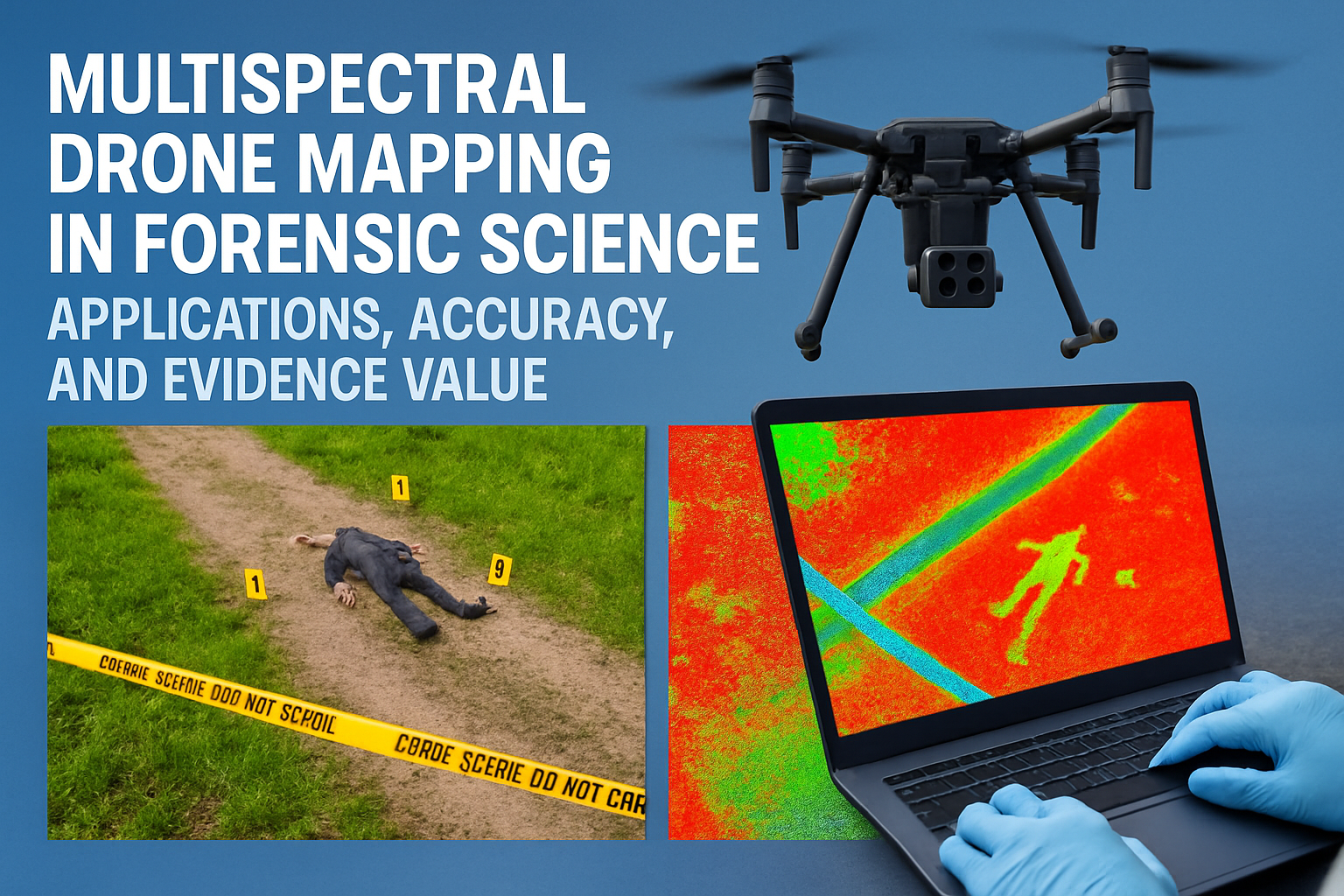
Multispectral imaging refers to the capture of data across multiple wavelengths of light, including both visible and non-visible spectral bands. In a forensic context, multispectral drone mapping involves mounting multispectral sensors on unmanned aerial vehicles (UAVs) to collect spatial data that reveals patterns not detectable through conventional photography.
Unlike single-band imagery, multispectral data allows forensic analysts to assess variations in surface composition, vegetation health, and environmental conditions. These variations can provide contextual information relevant to forensic interpretation, particularly in cases involving land disturbance or environmental change.
How Multispectral Drone Mapping Differs from RGB Aerial Imaging
Traditional RGB aerial imaging records only visible red, green, and blue light, limiting its analytical depth. Multispectral drone mapping extends beyond these bands, capturing additional wavelengths that respond differently to biological and physical materials.
This distinction enables the identification of subtle anomalies in terrain that may not be visually apparent. In forensic investigations, such distinctions are useful when analyzing areas where physical evidence
Why Multispectral Drone Mapping Matters in Forensic Investigations
Preserving Crime Scene Integrity Through Non-Intrusive Mapping
One of the key advantages of multispectral drone mapping is its non-contact approach to data collection. Forensic investigators can document scenes without physically entering sensitive areas, reducing the risk of evidence contaminationContamination - The unwanted transfer of material from another source to a piece of physical evidence. The inadvertent touching of a weapon, thereby adding fingerprints to it is an example of evidence contamination. Read Full Definition or disturbance.
This approach aligns with established forensic principles that emphasize preservation of original scene conditions. Aerial multispectral data serves as a supplemental record that can be revisited for analysis without repeated site access.
Detecting Environmental Changes Relevant to Criminal Investigations
Environmental changes such as soil disruption, vegetation stress, or land alteration may indicate past human activity. Multispectral drone mapping assists forensic analysts in identifying these changes by highlighting spectral variations associated with environmental stress or disturbance.
Such information can support broader investigative hypotheses when combined with physical evidence, witness statements, and other forensic findings.
Core Forensic Applications of Multispectral Drone Mapping
Environmental Forensics and Land Disturbance Analysis
Environmental forensics often involves investigating unauthorized land use, illegal dumping, or ecological damage. Multispectral drone mapping provides a method for assessing affected areas over large spatial scales while minimizing investigator exposure.
Spectral data can reveal inconsistencies in land cover and vegetation that warrant closer examination, supporting evidence-based environmental assessments.
Search, Recovery, and Missing-Person Investigations
In search and recovery operations, terrain analysis plays a critical role. Multispectral drone mapping allows forensic teams to survey expansive or difficult terrain efficiently, identifying irregular patterns that may guide ground-based follow-up efforts.
While not a replacement for physical searches, multispectral mapping can assist in prioritizing areas of interest, especially in complex landscapes.
Crime Scene Reconstruction and Terrain Contextualization
Accurate terrain context is essential for reconstructing events at outdoor crime scenes. Multispectral drone mapping contributes to this process by generating spatial datasets that support digital terrain models and spatial analysis.
These models help forensic professionals understand elevation changes, surface conditions, and spatial relationships among evidence locations, enhancing interpretive accuracyIn scientific and measurement contexts, "accuracy" refers to the degree of proximity or closeness between a measured value and the true or actual value of the measured quantity. Accuracy indicates how well a measurement reflects Read Full Definition.
Accuracy and Reliability of Multispectral Drone Mapping Data
Spectral Data Interpretation in Forensic Analysis
The value of multispectral drone mapping lies not only in data collection but also in expert interpretation. Spectral indices derived from multispectral imagery can highlight environmental patterns, but they must be evaluated within appropriate forensic and environmental contexts.
Misinterpretation of spectral data can lead to incorrect conclusions, underscoring the importance of trained analysts and corroborating evidence.
Validation, Calibration, and Error Considerations
As with all forensic tools, multispectral drone mapping requires validationValidation, often referred to as method validation, is a crucial process in the laboratory when introducing a new machine, technology, or analytical technique. It involves a series of systematic steps and assessments to ensure that Read Full Definition and calibrationThe act of checking or adjusting (by comparison with a standard) the accuracy of a measuring instrument. Operation that, under specified conditions, in a first step, establishes a relation between the quantity values with measurement Read Full Definition to ensure data reliability. Sensor performance, environmental conditions, and data processing methods can influence results.
Understanding these limitations is essential when presenting multispectral data as part of a forensic investigation, particularly when it contributes to evidentiary assessments.
Comparison With Traditional Forensic Survey Methods
Efficiency and Coverage Advantages
Compared to ground-based surveys, multispectral drone mapping offers rapid data acquisition across large areas. This efficiency is particularly beneficial in time-sensitive investigations or when access is limited by terrain or safety concerns.
The ability to revisit digital datasets also supports longitudinal analysis without repeated site visits.
Safety and Risk Reduction in Hazardous Environments
Forensic investigations may involve unstable terrain, contaminated environments, or hazardous conditions. Multispectral drone mapping reduces direct exposure by allowing investigators to assess conditions remotely.
This approach enhances operational safety while maintaining analytical effectiveness.
Legal, Ethical, and Evidentiary Considerations
Admissibility and Supporting Evidence Role
Multispectral drone mapping is typically used as supporting evidence rather than standalone proof. Its admissibility depends on methodological transparency, data integrity, and adherence to forensic standards.
Clear documentation of data collection and analysis procedures is essential to ensure evidentiary credibility.
Ethical Use of Multispectral Drone Mapping in Investigations
Ethical considerations include privacy protection, lawful data collection, and responsible data handling. Forensic use of multispectral drone mapping must comply with applicable legal frameworks and ethical guidelines to maintain public trust and scientific integrity.
Limitations and Challenges of Multispectral Drone Mapping
Despite its advantages, multispectral drone mapping has limitations. Environmental factors such as seasonal vegetation changes and lighting conditions can affect data interpretation. Additionally, the technology requires specialized expertise and should not replace traditional forensic methods.
Recognizing these challenges ensures balanced and responsible application in forensic investigations.
The Future of Multispectral Drone Mapping in Forensic Science
Advancements in sensor technology, data analytics, and artificial intelligence are likely to expand the forensic applications of multispectral drone mapping. Integration with other forensic disciplines, including digital and environmental forensics, may further enhance investigative capabilities.
As standards evolve, multispectral mapping is expected to remain a complementary tool within the broader forensic toolkit.
Conclusion
Multispectral drone mapping represents a scientifically grounded approach to terrain and environmental analysis in forensic science. By enabling non-intrusive documentation, supporting environmental assessments, and enhancing spatial context, it adds value to modern investigations when used responsibly.
Drone as a Service (DaaS) further supports forensic investigations by providing on-demand access to specialized drone expertise and advanced data analytics without the need for in-house drone infrastructure.