

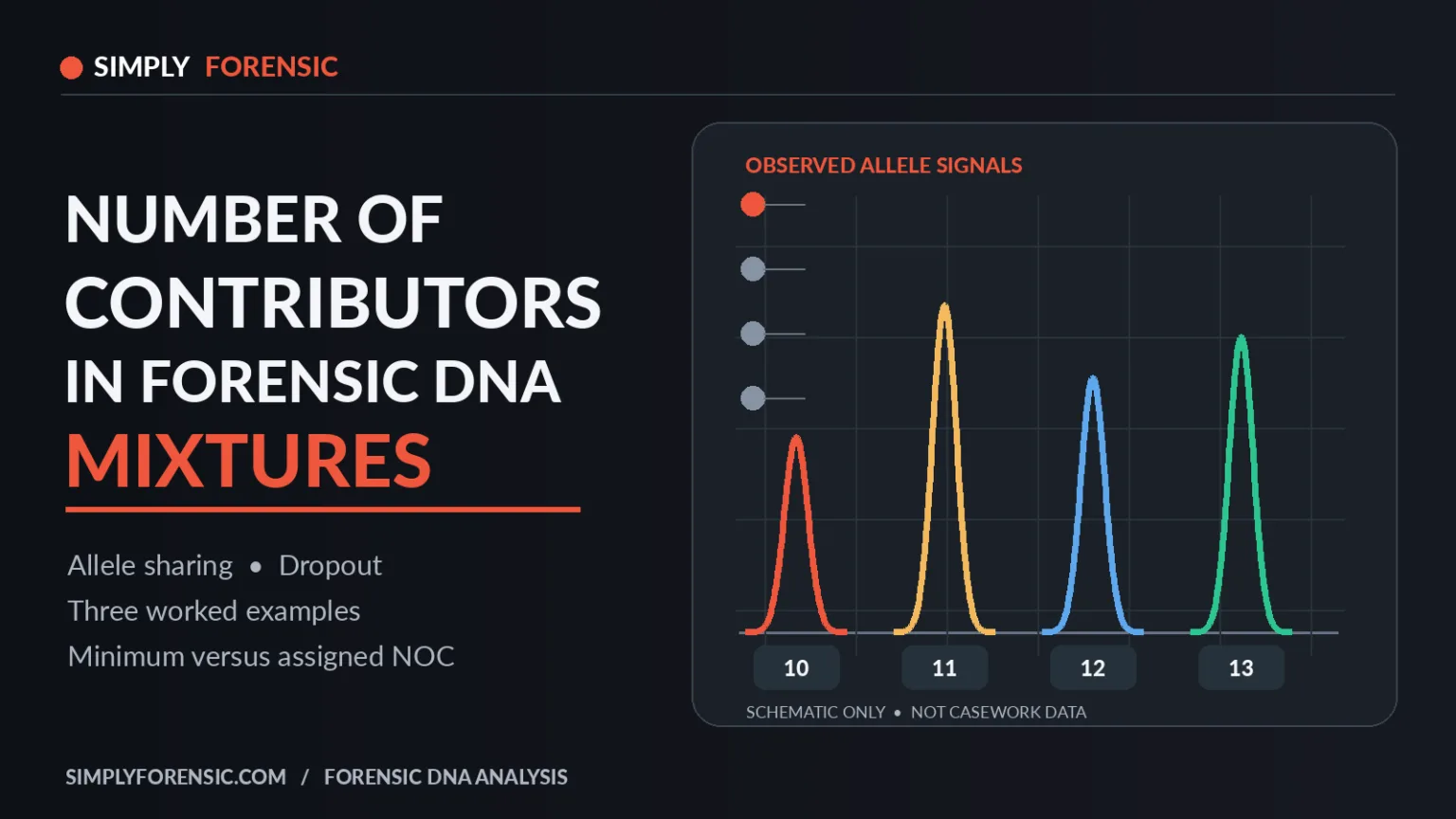
How many people contributed to a forensic DNA DNA, or Deoxyribonucleic Acid, is the genetic material found in cells, composed of a double helix structure. It serves as the genetic blueprint for all living organisms. Read Full Definition mixture? The answer is rarely obtained by simply counting electropherogram peaks. Different individuals can share STR alleles
 Alleles are different forms of a gene resulting from mutations or variations in the DNA sequence or gene expression. They can be dominant (expressed with one copy) or recessive (expressed only with two copies). Read Full Definition, some expected alleles may not be detected, and artefacts can resemble additional contributors. Consequently, analysts distinguish the minimum number of contributors supported by observed alleles from the number assigned for interpretation and the true number, which is generally unknown in casework.
- Why does the number of contributors matter?
- Minimum NOC: what allele counting can tell us
- Infographic: eight allele copies, only four peaks
- Worked examples: two, three and four contributors
- Example 1: two contributors sharing alleles
- Example 2: three contributors with dropout
- Example 3: four contributors hidden by allele sharing
- Why peak heights cannot simply separate people
- What should analysts do when NOC is uncertain?
- A practical contributor-number assessment workflow
- Common problems in contributor-number assessment
- Validation and scientifically defensible reporting
- Frequently asked questions
- References and further reading
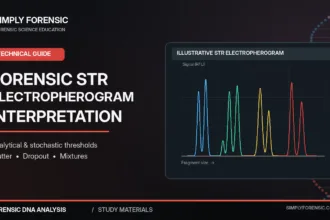
This advanced guide builds on our STR electropherogram interpretation article. Here the focus is specifically contributor-number estimation, including three synthetic mixtures whose underlying genotypes are disclosed for teaching.
Why does the number of contributors matter?
The number of contributors (NOC) changes which genotype combinations can explain an STR profile, how peak heights and overlapping alleles are assessed, and the assumptions in a likelihood-ratio (LR) calculation. Underassigning contributors can incorrectly favour exclusionary propositions; overassigning can increase the scope for adventitious inclusionary support. Neither error has a universally predictable effect on every result.
The 2024 NIST scientific foundation review identifies contributor number, allele overlap and low-level DNA as major interpretation challenges. SWGDAM requires the laboratory’s approach to be established and validated, rather than chosen to accommodate a person of interest.
Minimum NOC: what allele counting can tell us
For ordinary diploidDiploid is the quality of a cell or organism having two sets of chromosomes, one from each parent. Sexually reproducing organisms are diploid. In humans, only their egg and sperm cells are haploid. Read Full Definition autosomal STR loci, one person generally has no more than two alleles at a locus A locus is the precise position of a gene on a chromosome. Different alleles of the same gene occupy the same locus. Read Full Definition. A useful preliminary lower bound is:
Minimum NOC ≥ ceiling(maximum distinct credible alleles at one locus ÷ 2)
For example, five genuine distinct alleles require at least three ordinary diploid contributors; four require at least two. This calculation assumes peaks are correctly classified as alleles and that unusual tri-allelic or chromosomal patterns do not explain the observation. It establishes a lower bound, never an exact headcount.
Stutter, pull-up, contaminationContamination - The unwanted transfer of material from another source to a piece of physical evidence. The inadvertent touching of a weapon, thereby adding fingerprints to it is an example of evidence contamination. Read Full Definition, drop-in, tri-allelic patterns and other exceptions may increase apparent allele counts. Conversely, allele sharing, degradation and dropout can reduce the number observed. A laboratory must evaluate these alternatives across loci using validated procedures.
Infographic: eight allele copies, only four peaks
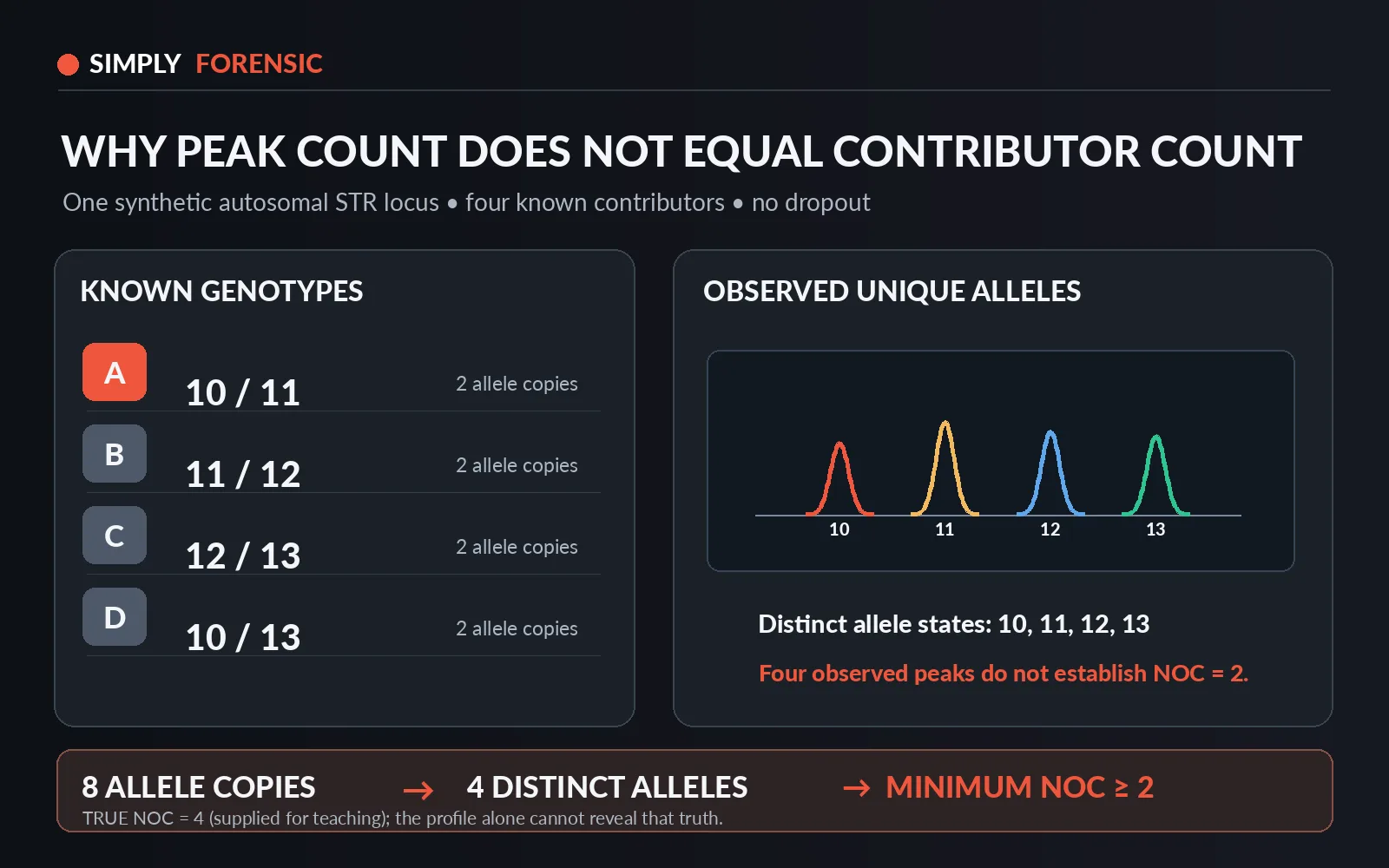
Shared alleles contribute signal to the same observed peak. That peak cannot be assigned to just one donor using its height alone. Additional contributors may therefore be concealed even in profiles without dropout. NIST notes that allele overlap becomes more troublesome as mixtures become more complex or contributors are genetically related.
Worked examples: two, three and four contributors
All examples below are synthetic. Contributor genotypes are shown as teaching information; a real analystA designated person who examines and analyzes seized drugs or related materials, or directs such examinations to be done; independently has access to unsealed evidence in order to remove samples from the evidentiary material for Read Full Definition interpreting questioned evidence Evidence is any form of proof, such as objects, materials, or scientific findings, presented to establish or disprove a fact in a legal proceeding. It is used to reconstruct events and link or exclude individuals Read Full Definition would not know them. No numerical peak heights, likelihood ratios or universal stochastic thresholds are implied.
Example 1: two contributors sharing alleles
| STR locus | Contributor A | Contributor B | Detected alleles |
|---|---|---|---|
| 1 | 10,11 | 11,12 | 10,11,12 |
| 2 | 8,9 | 9,10 | 8,9,10 |
| 3 | 14,15 | 15,16 | 14,15,16 |
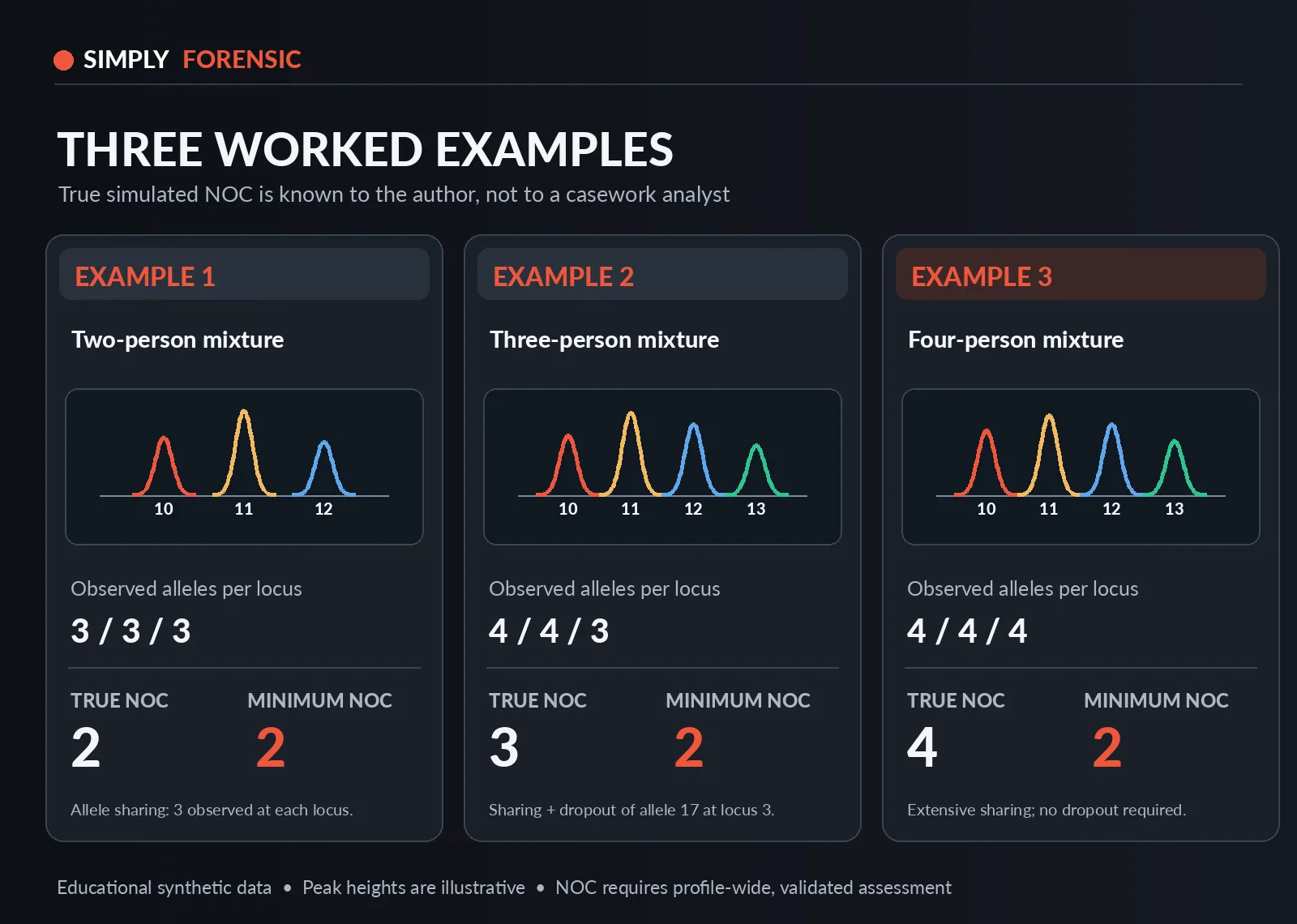
True simulated NOC: 2. Allele-count minimum: 2. Each locus contains three distinct alleles. The taller middle peak, if present, could reflect both contributors sharing one allele. The count is compatible with two, but the data Information in analog or digital form that can be transmitted or processed. Read Full Definition alone do not prove there are exactly two.
Example 2: three contributors with dropout
| STR locus | A | B | C | Detected alleles |
|---|---|---|---|---|
| 1 | 10,11 | 11,12 | 12,13 | 10,11,12,13 |
| 2 | 8,9 | 9,10 | 10,11 | 8,9,10,11 |
| 3 | 14,15 | 15,16 | 16,17 | 14,15,16 |
True simulated NOC: 3. Allele-count minimum: 2. At locus 3, allele 17 is designated as dropped out. Elsewhere, sharing limits the visible count to four. The observed profile does not establish three contributors merely because that is the simulated truth; rather, a validated assessment may need to consider more than one reasonable NOC.
Example 3: four contributors hidden by allele sharing
| STR locus | A | B | C | D | Detected alleles |
|---|---|---|---|---|---|
| 1 | 10,11 | 11,12 | 12,13 | 10,13 | 10,11,12,13 |
| 2 | 8,9 | 9,10 | 10,11 | 8,11 | 8,9,10,11 |
| 3 | 14,15 | 15,16 | 16,17 | 14,17 | 14,15,16,17 |
True simulated NOC: 4. Allele-count minimum: 2. All eight allele copies at each locus collapse into four distinct positions. No dropout is needed. This is why a four-allele locus should not automatically be described as a two-person mixture.
Why peak heights cannot simply separate people
Peak-height patterns may help identify a major component or estimate mixture proportions, particularly when contributors are present in different amounts. But a shared allele contains signal from multiple sources. Stutter can coincide with a genuine minor allele, while stochastic variation, degradation and inhibition can change apparent balances between loci.
Therefore, a major/minor designation is not the same as a verified contributor count. Neither the highest peak nor the strongest two-allele pattern necessarily belongs to one identifiable person. The profile must be assessed as a whole.
What should analysts do when NOC is uncertain?
SWGDAM’s 2025 probabilistic-genotyping guidance recognises that more than one NOC may be reasonable. A validated laboratory may evaluate alternative contributor-number assumptions, or use a model that incorporates their uncertainty. Peak heights, stutter expectations, dropout, allele frequencies and mixture proportions may all inform a continuous model.
The initial NOC assessment should not be driven by whether a person’s reference profile fits. Analysts should examine model diagnostics and whether the interpretation is sensitive to a change in assumed NOC. An LR compares evidence probabilities under specified competing propositions and assumptions; it does not reveal the actual number of people present. See our separate likelihood-ratio explanation.
A practical contributor-number assessment workflow
An NOC decision should be based on a structured examination of the complete profile, not a single peak count or a reference genotype. A defensible sequence is:
- Establish reliable observations. Check controls, sizing, peak morphology and validated analytical criteria. Document unresolved peaks rather than silently treating them as alleles or artefacts.
- Identify a preliminary lower bound. Examine the maximum number of credible distinct alleles and the distribution of apparent additional alleles across loci. Investigate exceptional biological patterns before using the count.
- Evaluate information that may be hidden. Consider overlapping genotypes, low-template stochastic behaviour, dropout and masking by stutter. A strong shared peak may represent several contributors, while a weak component may contribute no detectable allele at particular loci.
- Evaluate quantitative coherence. Consider whether peak heights, heterozygote balances and mixture proportions support plausible genotype combinations. Do not insist that a particular contributor has the same apparent proportion at every locus.
- Document reasonable NOC assignments. If more than one assumption remains scientifically plausible, use the laboratory’s validated strategy to address uncertainty, assess model diagnostics and record the rationale for the reported interpretation.
Related contributors can have greater allele sharing than unrelated individuals, increasing ambiguity. Conversely, unexpected allele numbers may also reflect tri-allelic variants or other unusual genetic findings; such exceptions require specialist review. The examples in this article concern ordinary diploid autosomal STR loci and are not a direct counting model for lineage markers such as Y-STRs.
Common problems in contributor-number assessment
| Observation | Potential explanation | Recommended review |
|---|---|---|
| Unexpected extra peaks | Additional donor, stutter, pull-up or contamination | Raw traces, controls and validated artefact criteria |
| Fewer alleles than anticipated | Sharing and/or dropout | Low-template behaviour, DNA quality, other loci |
| Minor peaks at stutter positions | Stutter, minor allele or both | Validated stutter modelling and overall profile |
| Different plausible NOC values | Limited information | Alternative assumptions and sensitivityIn the context of laboratory equipment or analytical techniques, the term "sensitive" describes the capability of a machine or method to detect even very small amounts or concentrations of a substance. Sensitivity is a quantitative Read Full Definition analysis |
| Model fits poorly | NOC or peak classification may be wrong | Diagnostics, input review and documented reassessment |
Validation and scientifically defensible reporting
Relevant frameworks include SWGDAM interpretation guidelines, the ANSI/ASB 020 mixture-validation standard, FBI DNA Quality Assurance Standards effective 1 July 2025, and the newly published ANSI/ASB 186-26 statistical-analysis standard. Applicability depends on jurisdiction, accreditationAccreditation – a process by which a laboratory must prove to an accrediting agency that their processes, equipment, and employees are competent, credible, and accurate. The accrediting agency will inspect the laboratory and observe its Read Full Definition and laboratory procedures.
Reports should distinguish the minimum supported by observed alleles from the NOC assigned for interpretation. For example: “At least two contributors are required to explain the observed alleles under the laboratory’s interpretation criteria. Statistical analyses were evaluated assuming three contributors.” Such wording describes analytical assumptions without claiming an exact biological headcount.
Frequently asked questions
Do four STR alleles prove a two-person mixture?
No. Four credible alleles generally require at least two ordinary diploid contributors, but sharing can conceal more.
Can dropout make a three-person profile look like two?
Yes. Missing alleles and shared allele positions can reduce the observed count. The actual NOC remains an inference.
Can probabilistic genotyping automatically establish true NOC?
No. Models can assist and compare assumptions, but outputs depend on data quality, model scope and validationValidation, often referred to as method validation, is a crucial process in the laboratory when introducing a new machine, technology, or analytical technique. It involves a series of systematic steps and assessments to ensure that Read Full Definition.
References and further reading
View scientific references (6)
- Butler JM et al. DNA Mixture Interpretation: A NIST Scientific Foundation Review. NIST IR 8351 (2024).
- SWGDAM. Interpretation Guidelines for Autosomal STR Typing (2021); Guidelines for the Use of Probabilistic Genotyping (2025).
- Gill P et al. ISFG recommendations for STR results with dropout/drop-in. Forensic Science
 Discover the fascinating field of Forensic Science, the application of scientific principles to legal matters. This post delves into its many disciplines, from DNA analysis to crime scene investigation, its importance in the justice system, Read Full Definition International: Genetics (2012).
- Bright JA et al. The effect of uncertainty in contributor number on interpretation. Forensic Science International: Genetics (2014).
- Alfonse LE et al. NOCIt: a computational method to infer contributor number. Forensic Science International: Genetics (2015).
- OSAC. Human forensic DNA reporting appendix (2025).