Research at a glance
The use of stable isotopes in postconflict forensic identification
Study summary
An applied review of how isotope information from human tissues can support identification, location histories and sorting of commingled remains.
Critical appraisal
- Limitations
- Geographic signatures overlap; diets and mobility complicate inference; isotope measurements do not uniquely identify a person.
- Implications
- Use isotopic evidence to generate or narrow hypotheses alongside records, anthropology and DNADNA, or Deoxyribonucleic Acid, is the genetic material found in cells, composed of a double helix structure. It serves as the genetic blueprint for all Read Full Definition.
An unidentified set of human remains may contain clues about where a person lived and what they ate, even when personal records have disappeared. Stable isotope analysis can help investigators examine those clues. It does not supply a name, and it cannot replace DNA comparisons, but it can narrow the possible history of an unknown individual.
That is the central argument of a review by Lesley A. Chesson and Gregory E. Berg, first published online in August 2021 and included in the 2022 volume of WIREs Forensic Science. The authors focus on the difficult circumstances of postconflict forensic identification, where burial sites may contain multiple individuals and conventional reference information is incomplete.
What stable isotopes reveal
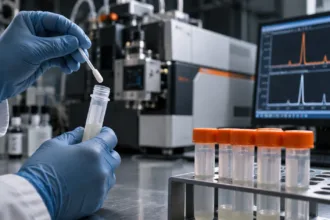
Stable isotopes are non-radioactive variants of an element with different neutron counts. The relative abundance of particular isotopes varies among geological environments, water sources and food webs. People incorporate some of these patterns into their tissues through drinking water and diet. Analysts can measure isotope ratios and compare them against appropriately selected reference data.
Hydrogen and oxygen isotopes may help investigate drinking-water and geographic histories. Carbon and nitrogen measurements often provide information about broad dietary patterns. Strontium and other systems can offer geological or environmental context when suitable local reference data exist. None creates an infallible geographic fingerprint: imported foods, shifting diets, migration and overlapping regional signatures complicate interpretation.
Why the tissue matters
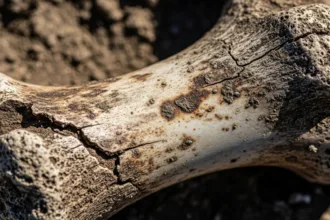
Different tissues preserve information over different periods. Tooth enamel develops during defined stages of childhood and can retain an earlier environmental signature. Bone remodels and may reflect a later or longer period of life, depending on the sampled component and the person. Hair and nails can provide sequential records over shorter periods when sufficiently preserved.
Consequently, the analytical question must be set before sampling. Investigators looking for childhood residence should not interpret a bone measurement in the same way as a tooth-enamel result. The review emphasizes selection, sample preparation, quality assurance and the need to document tissue-specific limitations.
Postconflict identification and commingled remains
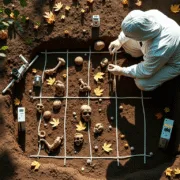
A mass grave can contain bones belonging to several people, sometimes displaced or mixed during burial and recovery. Isotopic comparisons may help test whether different skeletal elements could come from the same individual or whether their life histories are inconsistent. Such associations remain probabilistic and context dependent.
Isotopic results can also guide missing-person inquiries toward plausible populations or migration histories. They are most useful when linked with osteological findings, DNA, dental records, historical documentation and the burial context. Agreement between two isotope measurements is not sufficient proof that two bones belong to the same person.
Quality controls and interpretive limits
The paper discusses contamination and alteration after burial, preparation protocols, appropriate reference materials and measurement uncertainty. Local geology alone is not enough to establish what an individual consumed. Geographic reference datasets may be incomplete, while modern food supply chains weaken simple location assumptions.
Taphonomic alteration must also be considered. Researchers need to assess whether an observed signal reflects life history or changes in the burial environment. Analysts should explain the relevant reference populations, assumptions and competing interpretations instead of reporting a single birthplace or home country as a definitive result.
What has changed since publication?
Research into commingled human remains has continued, but the basic caution has not changed: isotope analysis is one line of evidence within a multidisciplinary identification process. A 2025 review of advances in commingled-remains analysis also discusses isotopic approaches among other methods; it should not be mistaken for validation of universal identification accuracy.
For a forensic laboratory, the practical starting point is a clearly defined question, an appropriate tissue, a reliable analytical provider, defensible controls and an interpretation linked to the case history. A persuasive isotope result is useful because it narrows the investigation—not because it independently identifies a missing person.
Key Takeaways
What this research can—and cannot—tell forensic investigators.
- Stable isotope measurements can reveal information about diet and possible geographic history, not a unique identity.
- Tooth, bone, hair and nail samples represent different life-history intervals.
- Comparison of commingled remains requires multiple independent lines of evidence.
- Reference coverage, mobility and postmortem alteration substantially limit location inferences.
Frequently Asked Questions
Can isotope analysis identify a missing person by name?
No. It may narrow geographical or dietary hypotheses, but identification requires corroborating evidence such as DNA, dental records or other accepted comparisons.
Which tissue is best for identifying childhood residence?
Tooth enamel can preserve an early-life signal. Suitability depends on the question, preservation and the isotope system measured.
Can isotopes prove that bones in a mass grave belong together?
Not independently. Consistent or inconsistent profiles can inform association hypotheses, which must be assessed with the wider evidence.