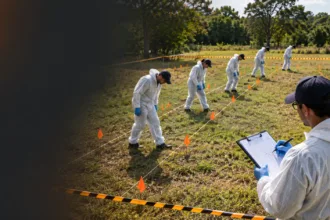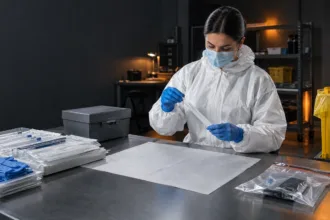
Crime scene investigation tools and equipment are the practical foundation of reliable scene documentation, evidence Evidence is any form of proof, such as objects, materials, or scientific findings, presented to establish or disprove a fact in a legal proceeding. It is used to reconstruct events and link or exclude individuals Read Full Definition protection and recovery. But there is no single universal CSI kit that suits every investigation. A first responderFirst responders - The initial responding law enforcement officer(s) and/or other public safety official(s) or service provider(s) arriving at the scene prior to the arrival of the investigator(s) in charge. Read Full Definition securing a residence, an examiner collecting low-template DNADNA present at an amount where sampling and amplification variation can substantially affect the detected result for the assay in use., an impression specialist working in rain and a digital investigator handling an active electronic device have different equipment, contaminationContamination - The unwanted transfer of material from another source to a piece of physical evidence. The inadvertent touching of a weapon, thereby adding fingerprints to it is an example of evidence contamination. Read Full Definition and safety requirements.
- What should a crime scene investigation kit contain?
- Core crime scene equipment: an item-by-item field checklist
- Personal protective equipment and contamination-control supplies
- Forensic photography, lighting and measurement equipment
- Biological evidence collection kit: swabs, tools and preservation
- Fingerprint equipment: powder, brushes, lights and lifting media
- Trace evidence kit: hairs, fibers, glass, paint and small particles
- Footwear and tire impressions: photography, lifting and casting tools
- Presumptive reagents, forensic light sources and field testing kits
- Digital evidence equipment: preserve first, examine only with authority
- Advanced field technologies: when do they genuinely help?
- Packaging and preservation: the field kit must include exceptions
- Planning kit deployment: four hypothetical scenes
- Purchasing and stocking CSI kits: what matters more than price?
- How to maintain an operational crime scene field kit
- Essential readiness checklist for CSI personnel
- Common misconceptions about forensic scene equipment
- Frequently asked questions
- References and authoritative technical sources
A useful crime scene field kit is therefore modular, task-specific and auditable. It includes clean collection materials, identification and documentation supplies, appropriate protection, packaging options and systems for checking equipment condition. Specialist tools should be deployed only by competent personnel under appropriate methods and authorizations.[1][2][3]
This guide consolidates the practical content of the existing Simply Forensic equipment and collection-kit materials. It provides a core field-kit inventory, specialist module tables, contamination-control and packaging guidance, four hypothetical scene examples, troubleshooting decisions, supply-management checklists and references. The aim is not to endorse particular brands or claim that a purchased device makes results reliable.
Key Takeaways
A useful CSI field kit is modular, traceable and suited to the scene—not a fixed list of expensive equipment.
- Start with documentation, PPE, evidence identifiers, clean collection tools and suitable packaging.
- Deploy separate specialist modules for DNA
 DNA, or Deoxyribonucleic Acid, is the genetic material found in cells, composed of a double helix structure. It serves as the genetic blueprint for all living organisms. Read Full Definition, fingermarks, trace, impressions and digital devices only when warranted.
- Choose methods with attention to interferences, contamination control, trained operators and laboratory requirements.
- Verify cleanliness, calibrationThe act of checking or adjusting (by comparison with a standard) the accuracy of a measuring instrument. Operation that, under specified conditions, in a first step, establishes a relation between the quantity values with measurement Read Full Definition or performance where applicable, expiry dates and restocking before deployment.
Key distinction
What should a crime scene investigation kit contain?
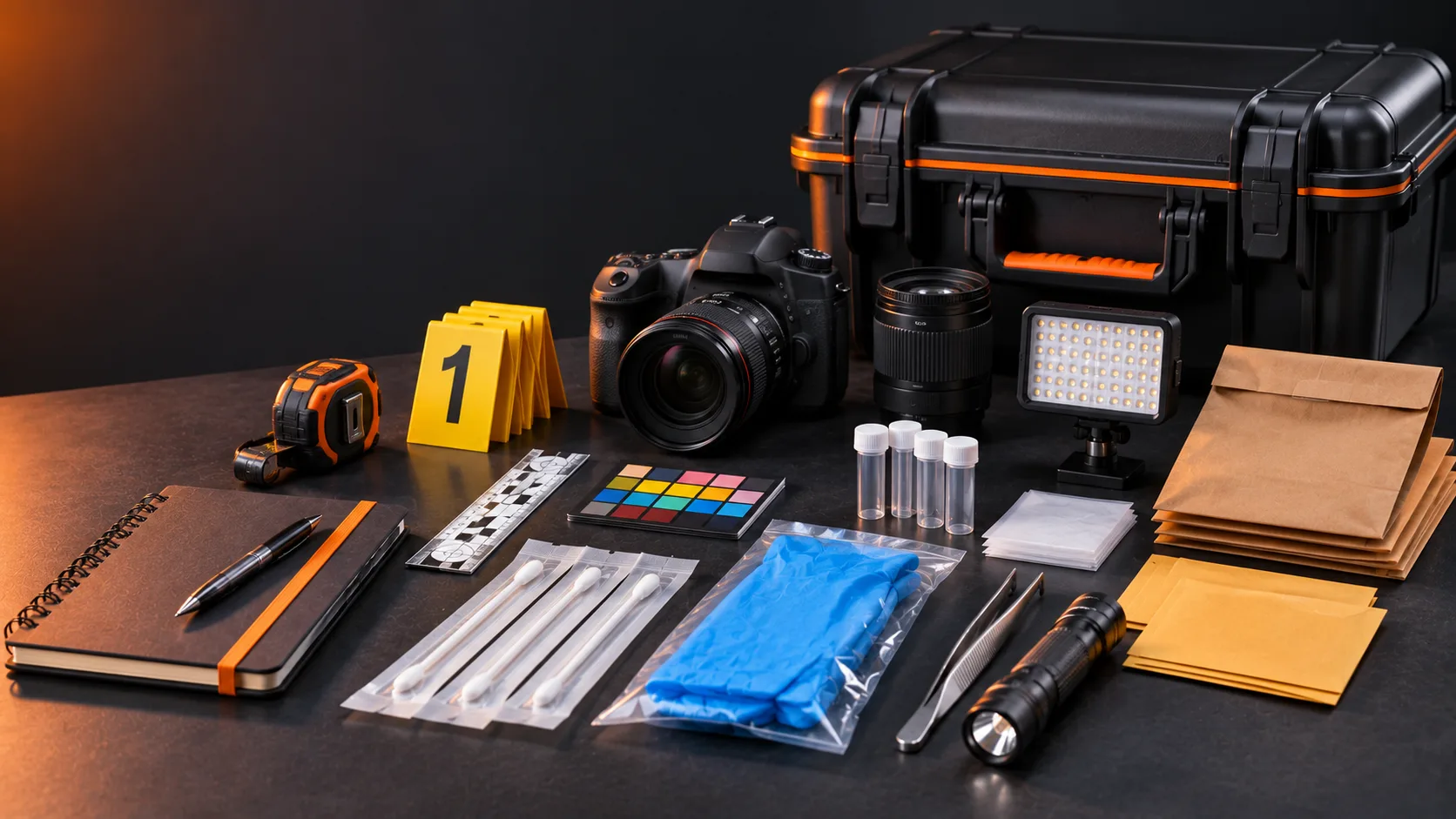
The best starting point is a core scene kit that supports safety, recording, traceability and protection without assuming a specialist collection method. Separate modules can then be chosen for biological material, fingermarks, trace particles, footwear impressions, electronic devices, fire debris and other evidence classes. The NIJ’s 2013 crime-scene guide has a dedicated equipment section and the NIJ’s older equipment resource lists examples—not a legally mandatory global shopping list.[1][2][13]
Notes, camera, scales, evidence labels, scene markers
Protected PPE, sterile consumables, separate collection tools
Approved fingerprint, trace, impression, chemical or digital equipment
Lighting, batteries, weather protection, hazard controls, storage
Select modules after assessing scene conditions and personnel competence. Specialist processing is not authorized merely because equipment is available.
Individual agencies may deploy a smaller officer kit, a fully equipped evidence vehicle, or a shared pool of specialized instruments. Operational readiness matters more than the number of items. Extra equipment increases cost and can create new contamination routes if storage, cleaning and staff competency are poorly controlled.
Core crime scene equipment: an item-by-item field checklist
| Function | Typical equipment | Purpose and precautions |
|---|---|---|
| Scene recording | Water-resistant notebook, pens, standard forms, case log or approved secure device | Record contemporaneous observations and who performed each action; preserve original files and notes |
| Photography | Camera with manual control and suitable lens, charged batteries, spare storage media, flash or portable light, tripod | Capture overall, midrange and detail views; keep unaltered originals and document any image processing |
| Measurements | Measurement scales, tape, suitable laser distance meter, sketch paper or digital mapping device | Show item position and scale; verify geometry, units and instrument suitability |
| Evidence identification | Unique labels, numbered placards, adhesive evidence seals, permanent markers and custody forms | Maintain the link between scene location, item number, sample number, package and record |
| Access control | Barriers or tape, signs, scene-entry log and safe route markers | Limit unnecessary movement; lawful emergency access and hazard response take precedence |
| Basic protection | Appropriate disposable gloves, mask or coverall as indicated by risk, eye protection, footwear controls | Protect people and reduce shedding/transfer; PPE is selected for specific hazards and forensic tasks |
| Clean recovery | Individually protected collection swabs, disposable forceps or scissors, clean barrier paper | Open only when needed; maintain distinct tools and sampling regions |
| Packaging | Paper bags, bindle paper, envelopes, rigid boxes, leak-proof tubes, secure vials and tamper-evident supplies | Select the package for the material, condition and intended tests, not one container for everything |
| Lighting and search | Primary flashlight, backup light, batteries, oblique-light capability as needed | Assist detection and photography; document illumination and validate specialized use |
| Safety and maintenance | Hazard assessment information, appropriate first-aid resources, cleaning materials, stock and fault records | Follow employer safety arrangements; avoid improvised handling of hazardous material |
Do not require an arbitrary camera resolution, a particular brand of flashlight or a minimum number of swabs across all agencies. A camera can be unsuitable despite high megapixels, and a good field kit becomes inadequate when its batteries fail or sterile stock is exposed to contamination.
Personal protective equipment and contamination-control supplies
Disposable gloves, masks, protective garments and footwear controls are often part of a CSI deployment. Their selection must reflect both occupational safety and the need to protect evidentiary material; these are related but separate assessments. Biohazard conditions, sharps, toxic chemicals, smoke, structural instability and other risks cannot be addressed by assuming ordinary disposable gloves provide universal protection.[3][4]
For DNA-sensitive work, clean supplies need protected storage, controlled access and suitable consumable quality. ISO 18385:2016 sets manufacturing requirements intended to minimize detectable human DNA contamination of relevant forensic collection and analysis products. It does not guarantee that an opened swab or glove remains DNA-free during scene handling.[6]
The UK Forensic Science Discover the fascinating field of Forensic Science, the application of scientific principles to legal matters. This post delves into its many disciplines, from DNA analysis to crime scene investigation, its importance in the justice system, Read Full Definition Regulator’s scene-contamination guidance addresses glove/PPE practice, clean equipment, cleaning verification and prevention of transfer between practitioners, items and locations. A glove can acquire DNA or particles when it touches a telephone, face covering or reused camera. Changing gloves while repeatedly touching the same dirty camera is not a complete contamination-control strategy.[4]
Sealed unused swabs, gloves, unopened containers and protected collection tools
Open only needed supplies; collect, seal and document identified samples
Used PPE and tools segregated; sealed exhibits kept in appropriate protected custody
Control point: Personnel, gloves and equipment should not move from a potentially contaminated area into clean stock without required changes or documented cleaning. These zones are illustrative, not an identical layout for every scene.
Keep recovered exhibits segregated from unused swabs, spare packaging and cleaning stock. Secure contaminated waste and reusable tools separately, and establish a controlled area for changing PPE when justified. A scene-zone diagram is a risk-management model, not a requirement to erect identical three-zone tents at every incident.
Forensic photography, lighting and measurement equipment
A scene photographer may need a reliable camera, interchangeable lenses where appropriate, tripod, flash, oblique lighting, neutral measurement scales and an approved system for storing original files. The objective is to record relevant context and detail clearly enough for review. Photograph the item before placing a scale against a sensitive surface when that placement could disturb material; then take suitable scaled detail images as needed.[1][8]
Digital photographs require provenance. Record the image creation sequence, original file identity, device settings when relevant and any later processing, and preserve the unaltered originals according to policy. A photographic scale does not automatically guarantee dimensional accuracyIn scientific and measurement contexts, "accuracy" refers to the degree of proximity or closeness between a measured value and the true or actual value of the measured quantity. Accuracy indicates how well a measurement reflects Read Full Definition if it is at a different plane from the item or the camera geometry is inappropriate.
Scene sketches and mapping may use tapes, rules, verified laser distance meters, total stations or 3D scanners. These are measurement systems, not accuracy guarantees. Operators should understand reference points, calibration/verification needs, geometry, registration errors and the limits of reported precision. Complex terrain, large buildings and reconstruction demands may justify specialist surveying rather than an ordinary field-kit measurement.[3]
Biological evidence collection kit: swabs, tools and preservation
A biological-evidence module may include appropriately qualified sterile swabs, individually packaged sampling tools, sterile water where specified, drying containers, specimen labels, clean barriers and approved packages. Some specimen types require separate liquid containers and temperature controls. Presumptive body-fluid testing supplies are not necessarily part of the routine collection pack, and their use should not compromise confirmatory or DNA examination opportunities.[1][2][5]
Choose whether to recover a stain, swab a specific region or submit a portable item intact after considering material, surface, expected amount and other disciplines. The fact that a swab is sterile at manufacture does not establish that it remains uncontaminated after field use. Open it only when needed, use an appropriate sampling protocol and document any contact between swab, substrate and tools.
Wet and dry samples are different. Dried stained clothing generally benefits from separate clean breathable packaging; wet items commonly need prompt controlled drying or other approved preservation. Liquid blood and other designated specimens may require leak-proof tubes, secondary containment, preservatives or temperature control. Temporary leak-resistant transport for a wet item is not a license for prolonged damp storage in ordinary plastic. The NIST biological-evidence handbook and receiving laboratory instructions should guide the decision.[5]
Fingerprint equipment: powder, brushes, lights and lifting media
The field fingerprint module may include suitable powders and applicators, approved lifting tape or gelatin lifters, backing cards, clean gloves, photography scales, contrast aids and lighting. The NIJ Fingerprint Sourcebook treats equipment selection as dependent on substrate and method, with overlap between field and laboratory capabilities. Some chemical development and controlled fuming processes are more appropriate to specialist facilities and trained practitioners.[8]
Fingerprint powders and brushes can redistribute trace material or introduce contamination, and DNA swabbing can disturb latent ridge detail. Examine the item in context and consider DNA, trace and other recovery before applying potentially interfering methods. A visible ridge impression may need suitable photography before contact. The right sequence depends on the material and planned examinations rather than a rule to always dust first.
Unknown powders, solvent-based treatments, adhesive surfaces, porous papers and chemically contaminated exhibits require a method-specific safety and competency assessment. A field kit should not encourage general investigators to perform specialist chemical techniques outside their scope.
Trace evidence kit: hairs, fibers, glass, paint and small particles
Trace items may be small, mobile and easily mixed. Typical tools include clean single-use forceps, bindle paper, small secure vials, protected slides where appropriate, suitable lifting media, examination lights and individually identified comparison-sample containers. Whole-item submission may sometimes preserve the distribution of particles better than on-scene removal.[2][7]
ANSI/ASTM E3457-25 is a published guide for the detection and preservation of forensic trace evidenceTrace evidence - Physical evidence that results from the transfer of small quantities of materials (e.g., hair, textile fibers, paint chips, glass fragments, gunshot residue particles). Read Full Definition and was added to the OSAC Registry in June 2026. It is distinct from an older OSAC proposal it superseded. The presence of a standardized guide does not remove the need for local method selection, packaging controls or verification of any recovery technique.[7]
Recovered fragments should not be left loose in an ordinary envelope where they may escape through seams or cause packaging damage. Use suitable inner and outer packaging to secure their identity and avoid abrasion An abrasion is a superficial skin wound, or scrape, caused by friction. In forensic pathology, its pattern and characteristics can reveal crucial information about the cause, timing, and circumstances of an injury... Read Full Definition, transfer or loss. Suspect and known-comparison sources should be separately identified, including their collection locations.
Footwear and tire impressions: photography, lifting and casting tools
Impression-evidence modules may include scales, camera lighting, casting materials, appropriate mixing and protective supplies, lifting media and equipment for securing fragile marks. An impression in loose soil is not recovered by the same technique as a two-dimensional dust impression on a clean floor. Substrate, moisture, depth, shape and whether the mark can be safely approached govern method choice.[2][9]
Document the mark’s context and take suitable examination-quality photographs before potentially altering it. Trained operators decide when casting is suitable and how to preserve the original shape. The published ANSI/ASB Best Practice Recommendation 126-20 (2022) covers casting footwear and tire impression evidenceImpression evidence - Objects or materials that have retained the characteristics of other objects that have been physically pressed against them Read Full Definition at crime scenes.[9]
Different impressions may carry additional biological or particulate traces. Avoid casting, wetting, lifting or contact without evaluating competing examinations. A field kit containing casting material is not permission to cast every visible impression.
Presumptive reagents, forensic light sources and field testing kits
Alternate light sources, chemical reagents and screening tests can help locate or classify material for further examination, but they must be selected and interpreted appropriately. Fluorescence or chemiluminescence is not automatically proof that a stain is blood, semen or another specified body fluid. Similarly, a presumptive chemical reaction has potential false-positive and false-negative interpretations and does not replace relevant confirmatory or specialized examination.
Some reagents can alter the target surface or compromise other tests. Consider hazards, reagent expiry, required positive/negative controls and whether the examination should be performed by a qualified specialist. A light source requires suitable eye and skin protection when indicated; it should not be used without assessing photobiological and scene-specific risks. Preserve untreated evidence or reserve appropriate regions where another examination is likely.
The basic scene kit should contain information on how to request specialist screening, not a collection of hazardous reagents intended for unrestricted use. Chemical and radiation hazards, unstable devices or suspected controlled substances may require dedicated response teams.
Digital evidence equipment: preserve first, examine only with authority
Phones, computers, storage devices, cameras and connected systems may store information relevant to a scene. The NIJ’s digital first-responder guide highlights that electronic data Information in analog or digital form that can be transmitted or processed. Read Full Definition can change during handling and that recognition, documentation, preservation, seizure and transport require specific procedures. Not every scene examiner should attempt to extract data, unlock devices or change their power and network state.[10]
A digital-evidence response kit may contain documentation aids, approved anti-static or protective packaging, evidence identifiers, suitable power accessories and agency-approved specialist isolation tools where indicated. A write blockerA device or software control intended to prevent writing to source storage while forensic data are accessed., forensic imaging station or mobile extraction device is specialist examination equipment, not a mandatory component of the ordinary CSI field bag.
Any decision about powered-on devices, live systems, wireless isolation or volatileIn scientific and chemical contexts, the term "volatile" describes a substance that has the propensity to evaporate or change from a liquid state to a gaseous state readily at normal or room temperatures. Volatility is Read Full Definition data should follow current specialist procedures and lawful authority. Improperly changing a device can irreversibly affect evidence, so the correct action may be to document and preserve the scene while consulting a digital forensic examiner.
Advanced field technologies: when do they genuinely help?
Terrestrial laser scanners, photogrammetry, total stations, drones and specialist portable analytical devices may enhance documentation or certain examinations. They require trained operators, appropriate validationValidation, often referred to as method validation, is a crucial process in the laboratory when introducing a new machine, technology, or analytical technique. It involves a series of systematic steps and assessments to ensure that Read Full Definition or performance checks, documented software versions, environmental limitations and preserved original data. A detailed 3D point cloud is not automatically accurate or complete; reflective surfaces, occlusion, scanning positions and registration can introduce error.[3]
Portable DNA or chemical analyzers may be appropriate in selected validated workflows, but they are not substitutes for conventional forensic laboratory analysis or interpretation merely because they return results quickly. Users must distinguish field screening from confirmatory testing and recognize the consequences of limited sample quantity and destructive processing.
The newest device is not necessarily the most useful purchase. For many scenes, adequate lighting, reliable photography, clean single-use consumables, appropriate packaging and trained staff are a better priority than an expensive instrument that cannot be competently maintained.
Packaging and preservation: the field kit must include exceptions
A single ‘evidence bag’ cannot safely accommodate all specimen types. The container should protect the material needed for examination, prevent loss or cross-contact, preserve necessary chemical characteristics and allow traceable transfers. Materials and specimen condition matter as much as the package’s external strength.[5][12]
Clean breathable paper or suitable protective box; prevent rubbing
Prompt approved drying/preservation; temporary leak containment only when necessary
Secure bindle, rigid vial or protected mount inside labelled outer package
Approved airtight, chemically compatible container; do not air-dry for volatile-residue analysis
Approved leak-proof tube and secondary containment; follow temperature requirements
Rigid immobilized container; protect contact-sensitive surfaces
General examples only. Confirm requirements with the receiving laboratory; not all biological specimens are dried or stored at room temperature.
Fire debris intended for volatile ignitable-liquid analysis is a particularly important exception: approved chemically compatible airtight packaging may be necessary. Ordinary paper packaging that can be suitable for dry biological evidenceBiological evidence - physical evidence such as bodily fluids that originated from a human, plant or animal. Read Full Definition is inappropriate for preserving volatile residues. Likewise, a liquid specimen generally needs a closed leak-proof container rather than a breathable bag.
Planning kit deployment: four hypothetical scenes
Example 1: A forced-entry scene with possible fingerprints and touch DNA
Situation: A broken door and displaced objects are reported at a residential entryway. Kit selection: core documentation supplies, suitable protective PPE, clean DNA/trace collection materials, protective packaging and, if qualified staff are present, an appropriate latent-print module. Decision: document the original arrangement, protect glass particles, assess other trace opportunities and agree the sequence of fingerprint and DNA processing. Limit: a detected print or DNA profile cannot alone establish when contact occurred or which act caused the damage.
Example 2: Rain threatens an outdoor footwear impression
Situation: An impression is visible in wet soil as weather worsens. Kit selection: safe scene barriers, weather protection where appropriate, camera, scale, measurement tools and specialist impression equipment. Decision: protect the mark, photograph its context and seek a suitable trained recovery method. Limit: no universal casting recipe is suitable for every soil, moisture level or impression substrate.
Example 3: Clothing with wet biological staining and foreign fibers
Situation: A damp garment has possible biological staining and visible fibers. Kit selection: clean PPE and handling area, appropriate biological and trace tools, separate packaging, labels and access to a secure drying/preservation facility. Decision: record the condition and particle locations, coordinate trace and biological examination, and arrange prompt approved preservation rather than sealing wet clothing for days in ordinary plastic. Limit: fiber proximity does not prove a common deposition event or source.
Example 4: Fire-damaged room with a laptop and possible volatile residues
Situation: A damaged room contains charred material and a partially intact electronic device. Kit selection: hazard-assessment and documentation equipment, qualified fire-scene personnel, approved airtight fire-debris containers and a digital specialist. Decision: avoid improvised handling of potentially hazardous debris and electronic components. Coordinate fire-debris and digital examinations and maintain separate item records. Limit: visible fire damage does not identify an ignitable liquid, and an intact-looking device may still be electronically compromised.
All four examples are hypothetical training scenarios. Specific methods require appropriate authorizations, safe conditions and laboratory-supported procedures.
Purchasing and stocking CSI kits: what matters more than price?
Build a purchase specification around the cases actually encountered, the laboratory’s submission rules, the risk of contamination, shelf life, staff training and total cost of use. Cheap supplies may be unsuitable for trace-sensitive evidence; expensive packaged kits may contain chemicals or tools the staff are not authorized to use. Compare candidates by function and documented performance instead of marketing claims.
| Procurement question | What to verify | Common failure |
|---|---|---|
| Purpose and compatibility | Which evidence type and validated method does it support? | Universal-kit claims without specimen-specific suitability |
| Contamination control | Manufacturer suitability, forensic DNA-grade status where needed, protected packaging and documented cleaning | Uncontrolled consumables stored beside used tools |
| Consumable identity | Lot/batch, expiry and storage constraints for critical items | Expired reagent or opened stock with no history |
| Equipment verification | Checks, calibration where applicable and maintenance interval | Measurement results with no instrument traceability |
| Operator competency | Training, authorization and assessment needs | Specialist device purchased without qualified users |
| Information security | Protected image storage, approved device accounts, auditSystematic, independent and documented process for obtaining audit evidence and evaluating it objectively to determine the extent to which audit criteria are fulfilled. Read Full Definition records | Uncontrolled copies of sensitive scene images |
| Transport and storage | Clean/used segregation, secure vehicle layout and climate needs | Evidence exposed to heat or cross-transfer in a vehicle |
How to maintain an operational crime scene field kit
A kit should have an assigned owner or accountable unit, an inventory, approved stock locations, documented cleaning arrangements and a process for reporting faults and replacing depleted material. The FSR’s August 2026 guidance explicitly discusses secure equipment storage, separation of unused consumables from exhibits and used items, cleaning of vehicles, stock-level management and controls on the use of scene vehicles.[3]
At deployment, confirm that required consumables are available, protected and in date; that cameras and lights work; that instruments requiring verification have suitable records; and that storage and transport arrangements can support the specimens expected. If an equipment fault is discovered during work, record affected activities and assess whether it may influence the examination.
Stock, expiry, equipment checks, charged batteries
Risk assessment, clean setup, item documentation
Seal evidence, log movement, protect transport
Replenish, clean, record faults, review deviations
A usable kit is supported by competence, instrument verification, records and maintenance; a packing checklist alone is not quality assuranceQuality assurance (QA) is a comprehensive set of activities and processes to ensure the overall quality and reliability of the work conducted within a laboratory. QA is a proactive approach that focuses on improving scientific Read Full Definition.
After return, replenish unused stock appropriately, segregate and dispose of used items under approved procedures, clean reusable tools in controlled areas, check instruments, securely transfer digital files and report any discrepancy in the evidence register. Avoid returning unopened-looking supplies to clean inventory when they have been exposed to uncontrolled scene conditions without an authorized assessment.
Essential readiness checklist for CSI personnel
Educational self-review only: checking an item does not establish laboratory QC acceptance.
Common misconceptions about forensic scene equipment
Myth
Every scene needs the same kit.
Reality
Evidence types, scene geometry, hazards and available specialists change the appropriate contents.
Myth
Gloves prevent all cross-contaminationCross-contamination - The unwanted transfer of material between two or more sources of physical evidence. For example, improperly collecting biological evidence such as blood could lead to one sample mixing with another sample and contaminating Read Full Definition.
Reality
Gloves can acquire and redistribute material; changing and controlling contact surfaces matters.<sup><a href="#sf-kit-ref-4" aria-label="Reference 4">[4]</a></sup>
Myth
All forensic evidence belongs in paper bags.
Reality
Liquid, volatile, fragile and damp specimens can require different containment.<sup><a href="#sf-kit-ref-5" aria-label="Reference 5">[5]</a></sup>
Myth
A field presumptive testPresumptive test - a test that is typically conducted at a crime scene that provides investigators with basic information regarding the compound in question. Presumptive tests can typically reveal the class of evidence, but are Read Full Definition identifies a body fluid conclusively.
Reality
Screening results have defined specificityIn the context of laboratory equipment or analytical techniques, the term "specific" describes the capability of a machine or method to accurately and selectively detect particular molecules or substances while minimizing interference from others. Specificity Read Full Definition, sensitivityIn the context of laboratory equipment or analytical techniques, the term "sensitive" describes the capability of a machine or method to detect even very small amounts or concentrations of a substance. Sensitivity is a quantitative Read Full Definition and interference limitations.
Myth
An alternate light sourceAlternate light source - Special lighting device that produces visible and invisible light at various wavelengths to help investigators locate and visually enhance items of evidence (e.g., fluids, fingerprints, clothing fibers). Read Full Definition confirms semen or blood.
Reality
Optical responses can be nonspecific; interpretation and confirmatory tests are separate.
Myth
A 3D scanner guarantees an accurate scene model.
Reality
Survey geometry, coverage, data registration, equipment performance and operator decisions matter.
Myth
A portable DNA analyzer replaces laboratory procedures.
Reality
Analysis remains subject to applicable quality requirements, validation, interpretation and casework controls.
Frequently asked questions
Frequently Asked Questions
What equipment should every crime scene investigator carry?
A basic kit generally supports documentation, safe scene control, measurement, identification, appropriate PPE and evidence protection. The exact equipment varies by agency, scene risks and role; specialist tools belong in task-specific modules.
What is included in a basic crime scene collection kit?
Typical supplies include a camera or approved imaging device, scales, notebook, evidence identifiers, protected gloves, clean collection tools, labels, seals and suitable packaging. Not all items are needed at every scene.
Are all forensic swabs DNA-free?
No product can guarantee that an opened swab cannot become contaminated. ISO 18385:2016 provides manufacturing requirements intended to minimize detectable human DNA contamination of relevant consumables; careful handling remains necessary.
Why are paper bags often used for biological evidence?
Breathable paper may be suitable for dried biological material because it avoids trapping moisture. Wet items need controlled drying or approved preservation, while liquid specimens need appropriate leak-proof containment.
Can investigators carry both fingerprint and DNA collection tools?
Yes, but their methods can affect each other. The examiner should plan the sequence and choose sampling locations to preserve the evidence opportunities most relevant to the case.
Do forensic light sources prove that a stain is blood or semen?
No. Light-based screening can help locate areas of interest, but fluorescence and other optical effects are not necessarily specific to a body fluid. Further validated testing may be required.
What tools are suitable for trace evidence?
Clean forceps, secure bindles or vials, appropriate lighting and approved lifting media are common examples. The specimen and substrate determine the collection technique and packaging.
Should all CSI kits contain casting plaster or chemicals?
No. Casting and chemical-processing supplies are specialist modules requiring appropriate training, risk assessment and suitable methods; a general field kit need not include them.
Are digital forensic write blockers needed by every first responder?
No. Such devices generally belong to authorized digital forensic workflows. First responders should prioritize appropriate documentation and preservation, then consult a qualified specialist before altering device state.
What should be checked before a crime scene kit is deployed?
Check stock suitability and expiry, consumable cleanliness, battery status, measurement-system verification where relevant, protective equipment, labels, packaging options, tools and a safe transport arrangement.
How often should a crime scene kit be restocked or cleaned?
There is no universal schedule for every item. Agencies should use defined pre- and post-deployment checks, appropriate decontamination after use and risk-based periodic inventory, maintenance and expiry review.
Can a high-end forensic instrument make scene evidence admissible automatically?
No. Legal admissibility and scientific reliability depend on jurisdiction, relevance, lawful procedures, method validity, competence, traceability and other case factors—not the cost or sophistication of equipment alone.
Related Simply Forensic Articles
References and authoritative technical sources
Reviewed 14 November 2026. These are published guides, standards and archived training resources. OSAC 2021-N-0018 is a proposed standard in development, not a published ANSI standard; the UK FSR guidance and Code requirements have defined jurisdictional and activity scope. Agency SOPs and receiving-laboratory requirements take precedence over a general educational equipment list.
References & Sources
Show referencesHide references
- National Institute of Justice. Crime Scene Investigation: A Guide for Law Enforcement (2013), including section E on crime scene equipment.. Source
- National Institute of Justice. Equipment Needed for Crime Scene Investigation (archived educational resource).. Source
- Forensic Science Regulator. Incident Scene Examination, FSR-GUI-0006, Issue 2 (August 2026; England and Wales).. Source
- Forensic Science Regulator. Contamination Controls: Scene of Crime, FSR-GUI-0016, Issue 1 (2023).. Source
- National Institute of Standards and Technology. The Biological Evidence Preservation Handbook: Best Practices for Evidence Handlers, NISTIR 7928 (2013).. Source
- International Organization for Standardization. ISO 18385:2016, Minimizing the Risk of Human DNA Contamination in Products Used to Collect, Store and Analyze Biological Material for Forensic Purposes — Requirements.. Source
- NIST/OSAC. ANSI/ASTM E3457-25, Standard Guide for Detection and Preservation of Forensic Trace Evidence (published; OSAC Registry June 2026).. Source
- National Institute of Justice. The Fingerprint Sourcebook, Chapter 11: Equipment (2011).. Source
- NIST/OSAC. ANSI/ASB Best Practice Recommendation 126-20 (2022), Casting Footwear and Tire Impression Evidence at the Crime Scene.. Source
- National Institute of Justice. Electronic Crime Scene Investigation: A Guide for First Responders, Second Edition (2008).. Source
- NIST/OSAC. ANSI/ASB Standard 195-25, Scene Response: Initial Response by Scene Investigators (published 2025).. Source
- NIST/OSAC. OSAC 2021-N-0018, Standard for On-Scene Collection and Preservation of Physical Evidence, Version 2.0 (2026; proposed standard in SDO development).. Source
- National Institute of Justice. Crime Scene Investigation: Guides for Law Enforcement — agency policy and legal caveats (2017).. Source
Editorial note: This article consolidates the coverage planned in Simply Forensic’s separate unpublished draft “Guide to Crime Scene Kits and Equipment.” That secondary draft remains preserved for editorial records and is not intended as a duplicate publication.
Educational notice: Equipment descriptions do not constitute authorization to conduct hazardous-material handling, chemical screening, forensic body examination, electronic extraction or any other specialist procedure outside demonstrated competence, validation, safety requirements and applicable law.