A mobile app’s SQLite database may not contain its latest committed records unless its write-ahead log is considered. This practical guide explains what examiners can recover, how to preserve the files and where interpretation can go wrong.
- Why a database file may not tell the whole story
- What SQLite stores
- The three-file picture
- How a WAL transaction works
- Preservation before interpretation
- Why copying a live database is difficult
- A practical examination sequence
- Committed records versus remnants
- Example 1: a message appears only with the WAL
- Example 2: a recovered fragment suggests an older value
- Example 3: timestamps seem contradictory
- What integrity checks can and cannot prove
- Common interpretation mistakes
- Reporting a defensible conclusion
Key Takeaways
For a reliable SQLite examination, the main database, available WAL files and acquisition circumstances must be assessed together.
- Newer committed records may exist in the WAL before being checkpointed into the main database.
- Preserve and hash acquired files before parsing. Work from verified copies.
- Differentiate current logical records from older page fragments and uncommitted remnants.
- WAL frame counts do not equal the number of messages or user actions.
- Document transaction context, timestamp interpretation, tool versions and uncertainty.
Why a database file may not tell the whole story
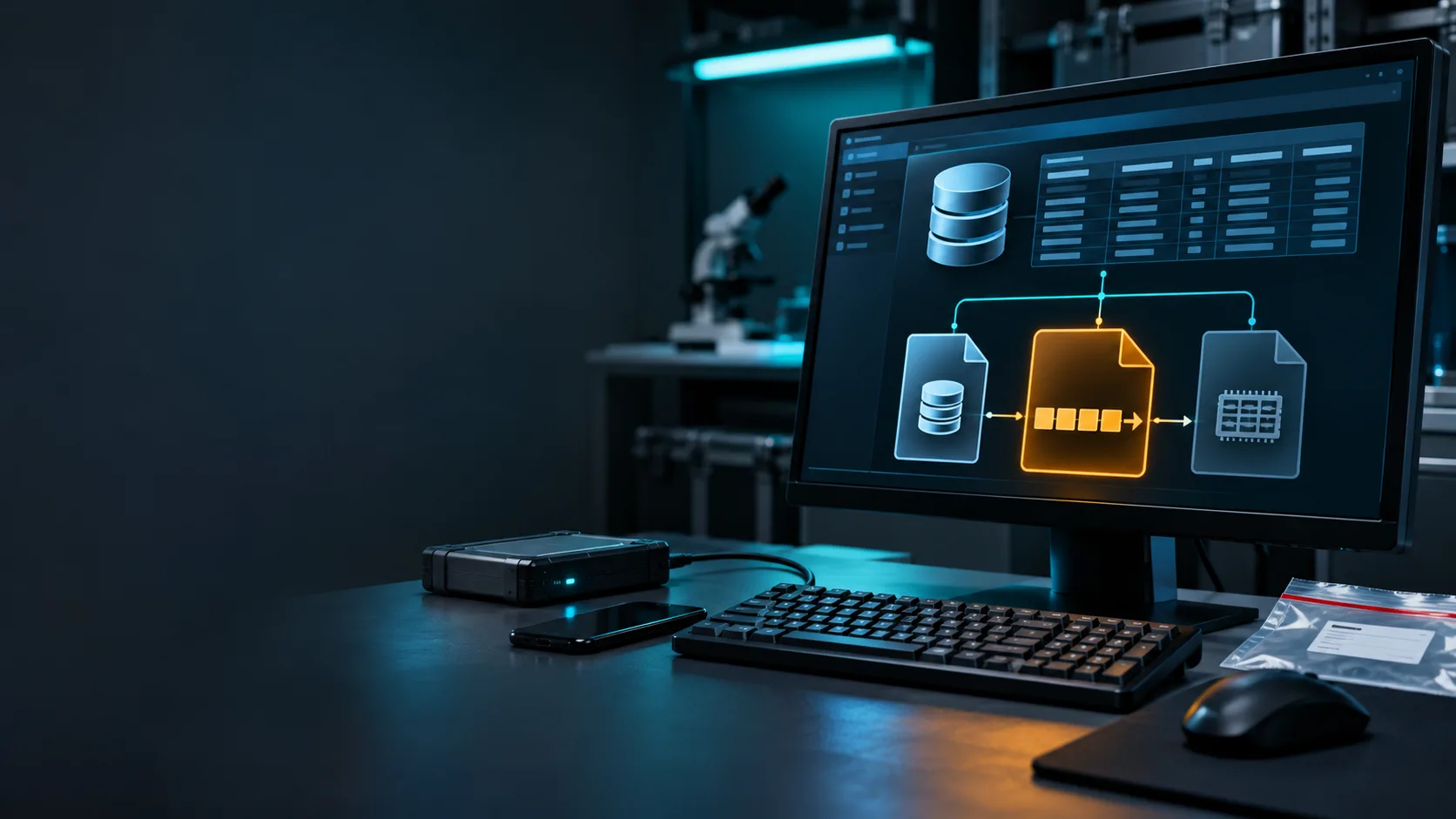
A mobile application can appear to store its records in a single SQLite database, yet that file may not contain the most recent committed changes. SQLite is widely used by applications to organize structured records, and one of its transaction mechanisms is write-ahead logging (WAL). In WAL mode, updates are initially appended to a companion file rather than immediately written into the main database. Forensic examiners who copy only the main file risk overlooking records or examining an older state. The practical lesson is not that every WAL contains deleted messages. It is that the database, its transaction files and the circumstances of acquisition must be considered together.
What SQLite stores
SQLite is an embedded relational database engine. Applications can store messages, contacts, settings, event records, timestamps, identifiers and relationships in tables, but the schema is application-specific. A row labelled “deleted” may be an application state flag rather than evidence Evidence is any form of proof, such as objects, materials, or scientific findings, presented to establish or disprove a fact in a legal proceeding. It is used to reconstruct events and link or exclude individuals Read Full Definition that the underlying data
 Information in analog or digital form that can be transmitted or processed. Read Full Definition was physically removed. A message identifier may link to a conversation table; a timestamp may use Unix seconds, milliseconds, a platform-specific epoch or a string with timezone information. Before interpreting any field, inspect the schema and establish the meaning of its values through documentation, controlled testing or corroborating artifacts. Never assume that a database field is self-explanatory.
Forensic Definition
- Term
- SQLite write-ahead log (WAL)
- Plain-language explanation
- A companion file holding changed database pages prior to checkpointing.
- Example
- A compatible examination of the database plus WAL may expose committed records absent from a main-file-only view.
- Limitation
- Not every WAL frame is a discrete user action, and recovered bytes do not automatically prove a deliberate deletion.
The three-file picture
In a common WAL-mode configuration, investigators may encounter messages.db, messages.db-wal and messages.db-shm. The main database holds database pages. The WAL can hold newer versions of pages from committed transactions that have not yet been checkpointed to the main file. The shared-memory file supports the WAL index and coordination; it is generally reconstructible, but its presence and condition can still help document the acquired environment. Names vary with the application’s database filename. Some systems use rollback journals instead of WAL, and a missing WAL file does not establish that no WAL activity occurred.
How a WAL transaction works
Imagine an application updates a message status from “unread” to “read.” In WAL mode, the modified database page may be appended to the WAL. A commit record establishes the transaction boundary. A reader can combine the main database with appropriate committed WAL frames to obtain the current logical view. Later, a checkpoint transfers eligible page content back into the main database. SQLite documents that checkpoint progress can be limited by concurrent readers and that the default automatic checkpoint threshold is ordinarily 1,000 pages, although applications may change it. Consequently, the mere size of a WAL does not translate directly into the number of user actions, messages or deleted records.
Preservation before interpretation
The safest workflow starts with a defensible acquisition method appropriate to the device, authorization and operating conditions. Preserve the source evidence and record acquisition method, tool version, device state, date, time and known limitations. Where available, acquire the database and associated journal or WAL files as a coherent set. Calculate cryptographic hashes for acquired files and retain the originals unchanged. Do not open the original database with an ordinary application viewer: SQLite may create sidecar files, perform recovery or checkpointing, and thereby change the evidence. Instead work from verified copies, ideally with a read-only workflow that has been tested for the specific tool and SQLite configuration. NIST’s digital evidence preservation guidance emphasizes maintaining evidential integrity and documenting handling decisions.
WAL Evidence Preservation Checklist
Educational self-review only: checking an item does not establish laboratory QC acceptance.
Why copying a live database is difficult
A device may be writing to the database while files are being collected. Sequentially copying the main database and then its WAL can produce files from different moments. A database parser may report corruption, omit records or present a state that never existed as one coherent snapshot. An acquisition technique that freezes a filesystem or obtains a consistent application snapshot may reduce this risk, but availability depends on the operating system, permissions, encryptionEncryption is the process in which the message or data is scrambled using the various algorithms available in all cryptographic algorithms. Read Full Definition and tool capabilities. Record whether the device was live, locked, unlocked, powered off or otherwise manipulated. A successful file copy alone is not proof of a transactionally consistent acquisition.
A practical examination sequence
Begin by making a working copy of all available companion files and noting their exact filenames, sizes and hashes. Inspect the SQLite header, schema and table relationships using a validated tool. Establish whether the database uses WAL mode, while remembering that the current journal setting does not prove how every historical transaction was recorded. Parse the main database and available WAL together in a controlled environment. Compare the logical records returned by a compatible SQLite engine with any additional pages or historical remnants identified by a forensic parser. Preserve the raw bytes and record the parser version and settings. Where tools disagree, investigate the underlying pages and transaction status rather than selecting the most convenient output.
SQLite WAL Forensic Examination Workflow
1. Preserve
Acquire the database and available sidecar files using a documented method.
A live sequential copy may be inconsistent.
2. Verify
Record hashes, file sizes, source paths and the working-copy procedure.
Do not work on the only evidence copy.
3. Inspect
Identify schema, header, journal configuration and available WAL frames.
Do not infer all past activity from the current journal setting.
4. Reconstruct
Compare the main-file-only state with the appropriate logical database and WAL view.
Check transaction boundaries and page provenance.
5. Corroborate
Test timestamps and compare records with logs, notifications and other artifacts.
Fragments need independent interpretive caution.
6. Report
Record observations, tool differences, limitations and supported conclusions.
Avoid unproven assertions of deletion, authorship or intent.
Committed records versus remnants
An especially important distinction is between an active logical record, a record in a committed WAL frame, and a fragment recovered from unused space or an older page version. They do not have the same evidential status. An older page image may retain bytes associated with a previous value, but those bytes might be overwritten, incomplete or unrelated to a successful user action. A carved string is not automatically a deleted message, and an apparent message is not automatically evidence that its recipient saw it. Interpret fragments in relation to the table schema, page structure, transaction history and corroborating artifacts. If provenance cannot be established, report the uncertainty rather than reconstructing an unsupported narrative.
Critical interpretation limitation
Example 1: a message appears only with the WAL
Consider a hypothetical messaging database acquired with a companion WAL. A viewer opened against the main database alone shows 18 conversation entries, while a compatible analysis of the complete acquired set shows 20. The difference may reflect committed pages that had not yet been checkpointed. The examiner should confirm the records’ page and transaction context, compare tool outputs and document why the two views differ. The result supports the presence of those records in the acquired database state; it does not, by itself, prove who typed them or whether they were transmitted over a network.
Example 2: a recovered fragment suggests an older value
Suppose a forensic parser identifies a partial text string in an older WAL page image, while the current logical row contains different text. The fragment might be associated with an earlier version, but without reliable page linkage and transaction context, it should not be called an edited message with certainty. A defensible report would identify the fragment, its offset, the recovery method and the limits of attribution. Supporting artifacts such as application logs, notifications or synchronized records may help test a proposed explanation.
Example 3: timestamps seem contradictory
A table records a numeric value that an examiner interprets as a Unix timestamp in seconds. It produces a date decades earlier than the investigation. The value may instead be milliseconds, a different epoch or an application-defined counter. A second table may use local time while another uses UTC. Test the conversion against known events and document timezone assumptions. SQLite itself does not assign a universal meaning to application timestamp columns. Reporting a precise"Precise" refers to the degree of closeness or consistency between multiple measurements or values taken under the same conditions. It indicates how well these measurements agree with each other, regardless of whether they are accurate Read Full Definition time without confirming its encoding creates avoidable errors.
What integrity checks can and cannot prove
SQLite provides PRAGMA integrity_check to assess aspects of database structural consistency. A successful result is useful, but it does not authenticate the provenance of the evidence, validate a forensic acquisition or establish that every historical record was recovered. SQLite’s documentation also notes that integrity_check does not detect foreign-key violations; foreign_key_check addresses those separately. Conduct checks on verified working copies and record any changes the examination environment makes. A damaged or incomplete database may still contain recoverable information, but recovery should be distinguished from normal logical parsing.
Common interpretation mistakes
Five errors deserve particular attention. First, treating the main database as the complete acquisition while ignoring companion files. Second, assuming every WAL frame represents a distinct user action. Third, equating carved fragments with successfully committed or deliberately deleted messages. Fourth, treating application timestamps as self-evident without verifying epoch, units and timezone. Fifth, allowing an analysis program to modify the only copy of the evidence. A related mistake is to infer a person’s identity or intent from a database entry alone. Device access, account synchronization, automated processes and third-party actions can complicate attribution.
SQLite WAL: Myth vs Fact
Myth
Each WAL frame corresponds to a message or one user action.
Reveal the reality
Reality
A WAL frame stores a database page, not a count of human actions.
Transactions can change multiple pages.
SourceMyth
Opening only the main .db file shows the entire current database.
Reveal the reality
Reality
Committed transactions may still reside in the associated WAL.
Evaluate the coherent database and valid WAL together.
SourceMyth
Recovered WAL text proves intentional deletion.
Reveal the reality
Reality
Older-page remnants and incomplete fragments have different evidential status.
Confirm provenance and corroborate.
SourceReporting a defensible conclusion
A useful report identifies the source device or image, acquisition method, examined file paths, hashes, relevant SQLite version or parser details, and the distinction between logical records and recovered remnants. Explain whether the WAL was available, whether a consistent snapshot could be established and how timestamps were interpreted. State what was observed before drawing inferences about activity. For example: “The acquired SQLite database and associated WAL contained a committed record with the following fields…” is more informative than “The suspect deleted a message.” Where only a fragment was recovered, say so explicitly. Separate technical findings from investigative hypotheses and preserve sufficient detail for independent review.
Frequently Asked Questions
What is the difference between a SQLite database and its WAL?
The main .db file holds database pages; WAL mode records changed pages in a -wal companion file until they are checkpointed. Valid committed WAL frames can be part of the current logical database state.
SourceCan SQLite WAL files contain deleted messages?
They can retain older page versions or fragments, but a fragment is not automatically a deleted message. Interpret its page, transaction and application context before reporting it.
SourceWhat does the -shm file do?
It supports the WAL index and coordination between readers and writers. It is generally reconstructible, but its condition should be documented.
SourceIs it safe to open the original database in a SQLite viewer?
No. Conventional viewers may create or modify companion files. Retain originals, verify copies and use a controlled examination procedure.
SourceWhy might two forensic parsers show different records?
Differences can result from handling WAL frames, carved fragments, application schema or inconsistent live acquisition. Check settings, versions and raw page evidence rather than assuming either output is complete.
Does PRAGMA integrity_check show that every record was recovered?
No. It assesses aspects of database integrity and does not validate acquisition, provenance or completeness of forensic recovery. Foreign keys need separate checks.
SourceReferences & Sources
Show referencesHide references
- SQLite Documentation. Write-Ahead Logging. Source
- SQLite Documentation. WAL-mode File Format. Source
- SQLite Documentation. Database File Format. Source
- SQLite Documentation. PRAGMA Statements. Source
- NIST. Digital Evidence Preservation: Considerations for Evidence Handlers. NISTIR 8387 (2022). Source DOI: 10.6028/NIST.IR.8387
- NIST. Guidelines on Mobile Device Forensics. SP 800-101 Revision 1 (2014). Source
- NIST. Digital Forensics program and tool-testing context. Source