Crime scene search patterns are systematic ways to organize how an area is examined for potential physical evidence Evidence is any form of proof, such as objects, materials, or scientific findings, presented to establish or disprove a fact in a legal proceeding. It is used to reconstruct events and link or exclude individuals Read Full Definition. The five commonly taught approaches—strip or line, grid, zone or quadrant, spiral, and wheel or radial—do not represent five interchangeable instructions. Each controls movement and coverage differently. A pattern that helps search a level open field may be impractical in a furnished room or unsafe on a steep hillside.
- What is a crime scene search pattern?
- Before choosing a pattern: plan the search
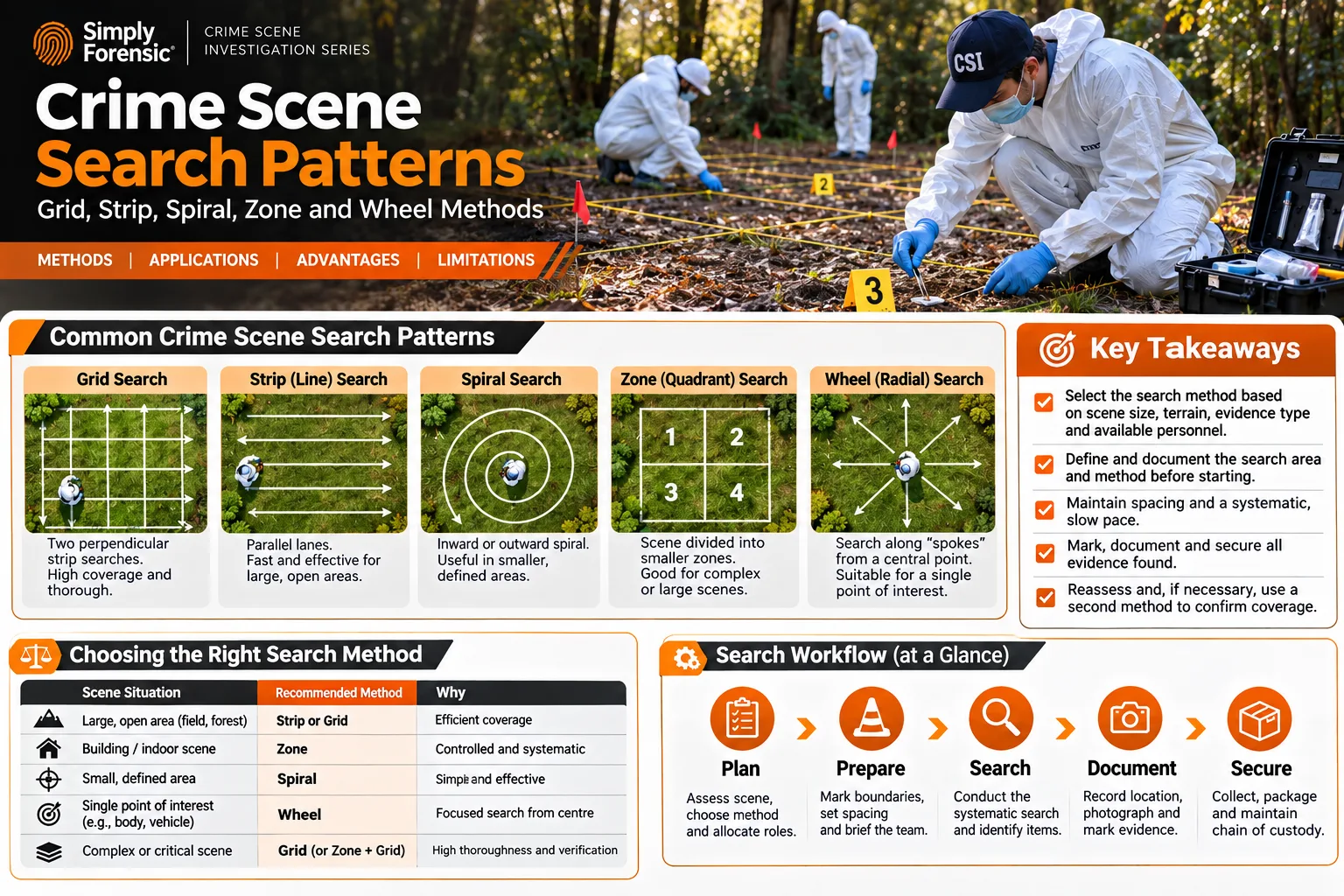
- Comparison of the five crime scene search patterns
- 1. Strip or line search pattern
- 2. Grid search pattern
- 3. Zone or quadrant search pattern
- 4. Spiral search pattern
- 5. Wheel or radial search pattern
- How to choose the appropriate search pattern
- Worked example 1: Small metallic evidence in a grassy open area
- Worked example 2: A furnished apartment with linked rooms
- Worked example 3: Circular courtyard and an apparent focal point
- Worked example 4: Rain threatens an outdoor footwear impression
- Documenting search coverage: what records should show
- Finding evidence is not the same as recovering it
- Five common mistakes when using crime scene search patterns
- Crime scene search checklist
- Frequently asked questions
- Related Simply Forensic articles
- References and further reading
The central question is not which pattern sounds most thorough. It is which approach makes the relevant search area, searcher responsibility, evidence-detection limitations, and unexamined spaces identifiable and reviewable. Search plans must be adapted to the scene, anticipated evidence, terrain, lighting, time, personnel and safety constraints.[1][2][3]
This illustrated teaching guide describes the geometry, strengths and limitations of each pattern, provides a decision table, and works through four hypothetical situations. It also shows how to record search coverage without claiming that a scene can ever be proven completely free of evidence.
What is a crime scene search pattern?
A crime scene search pattern is a planned route, series of passes or set of bounded assignments intended to reduce accidental omissions. The National Institute of Justice’s 2013 crime-scene guide presents lane/strip, grid, zone and spiral as four principal search methods. Wheel/radial searches appear in additional police and forensic training sources, but are not one of the four illustrated approaches in that particular NIJ section.[1][4][5]
A search is not always a literal walking path. In a zone search, for example, an assigned examiner might systematically search an entire room, inspect vertical surfaces and carefully examine furniture; the zone plan defines responsibility while the local search technique defines the actual movement. In an outdoor strip search, the location and width of lanes are central. A search boundary should also not be confused with the larger safety or evidence-protection cordon.[6][7]
Before choosing a pattern: plan the search
Scene safety, emergency response and the authority to search take priority. Once appropriate personnel can begin examination, the responsible investigator should define a search objective and document the intended approach. Consider the following variables:
- Target: a small cartridge case, a large discarded object, footwear impressions, biological stains or an unknown range of physical traces require different observation distances and techniques.
- Scene geometry: shape, measured area, rooms, walls, furniture, obstructions, slope, dense vegetation and changes in elevation.
- Visibility: daylight, artificial light, glare, vegetation, rain, shadow and the contrast of the object against its background.
- Available personnel: competence, number of searchers, observers, scene photographers and people tasked with logging findings.
- Risk of damage or transfer: fragile footprints, wet stains, potential trace cross-transfer, hazardous materials and routes through sensitive areas.
- Search history: where officers, rescue personnel or other investigators have already walked, collected or moved objects.
The plan should explain who is examining what, from which boundary, in which direction, and what happens when an item is located. A method can be revised; record the reason and the changed coverage. No published guidance establishes one universally optimal search pattern for every case.[1][6]
Comparison of the five crime scene search patterns
| Pattern | Basic design | Often suitable for | Principal limitation |
|---|---|---|---|
| Strip / line | Parallel lanes or coordinated linear passes | Open, relatively uniform areas with clear boundaries | Gaps from excessive spacing, terrain and inconsistent scanning |
| Grid | First set of lanes followed by a second set approximately perpendicular | Ground searches where a second viewing direction is useful | More time and foot traffic; second pass cannot guarantee discovery |
| Zone / quadrant | Separate, labelled bounded areas, each with a local search plan | Buildings, multiple rooms, vehicles or complex scenes | Zones may be treated as complete without checking corners, overlap and hidden surfaces |
| Spiral | Continuous inward or outward curved route | Relatively open, limited areas with few obstacles | Variable coverage spacing; difficult around furniture and fragile central evidence |
| Wheel / radial | Searches along spokes radiating from or toward a common point | Selected small focal areas where spokes can be safely followed | Wedge-shaped spaces between spokes remain unless separately searched |
1. Strip or line search pattern
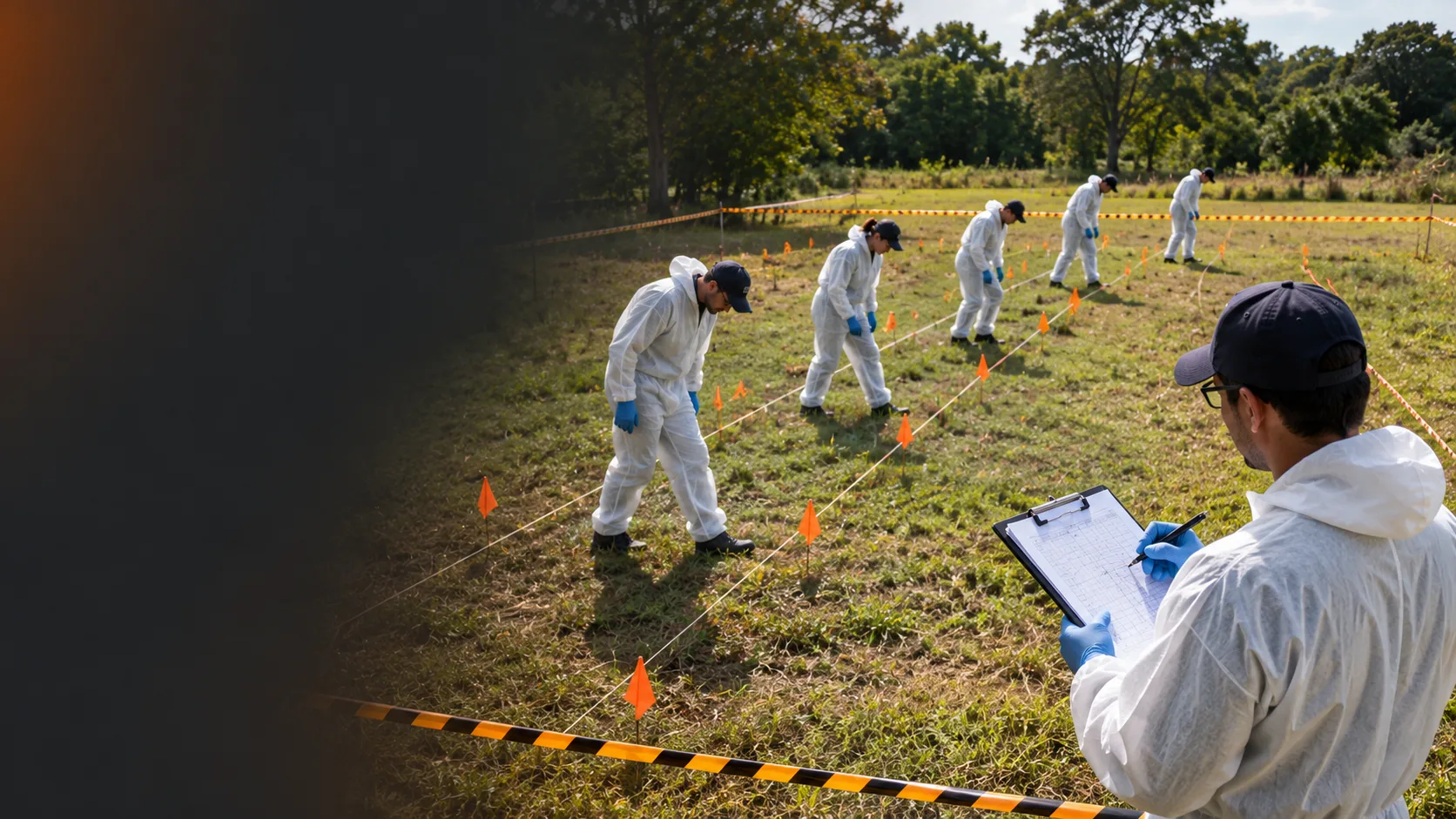
In a strip search, the search area is organized into adjacent linear lanes. A person or coordinated group systematically observes one lane or a moving front of lanes, then proceeds to the next as planned. Lanes may be traversed in the same direction or by a controlled back-and-forth arrangement, depending on the scene and team strategy. The defining feature is planned coverage of parallel lanes, not one universally mandated walking direction.[1][2][3]
Strip searches are intuitive in open land, road verges, beaches and other defined environments. Their value depends strongly on spacing: searchers must be able to detect the expected target within the effective observation width. The NIJ guide uses approximately an arm’s-length lane width as a general consideration, but this is not a validated fixed distance for every target, surface or lighting condition. Small or low-contrast objects may require tighter spacing or specialist detection methods.[1]
Example: a trained team examines a cleared roadside verge in assigned parallel sections while a separate recorder notes searched boundaries and item locations. Before any found object is disturbed, the team follows its agreed notification and documentation procedure. If dense vegetation interrupts a lane, the gap must be recorded and revisited rather than described as searched.
Strengths and limitations of line searches
Strip searches are easy to brief, map and divide between multiple trained searchers. They may be efficient when terrain is uniform. Limitations include inconsistent pace, widening gaps between team members, irregular boundaries, slopes or low-visibility areas. Walking itself can damage fragile traces, so the route may need to avoid sensitive ground.
2. Grid search pattern
One coordinated family of parallel lane passes.
Second lane search approximately perpendicular to the first.
Schematic lines indicate directions of planned passes, not a complete physical route or fixed searcher spacing.
A grid search typically consists of one complete lane/strip search followed by a second series of passes oriented approximately 90 degrees to the first. This is sometimes called a double-line or cross-hatch search. The principal advantage is seeing the same general area from a different approach, potentially reducing omissions caused by orientation, shadows or obstructing surfaces.[1][2][3]
The double pass increases time, effort and the amount of movement through the scene. It should not be described as ‘100% accurate,’ nor does a repeated search prove that nothing was missed. Detectability still depends on the material sought, lighting, observation methods, human factors, coverage spacing and the physical environment. The second search should be planned to avoid disturbing identified items or footprints created by the initial pass.
Example: a relatively even outdoor site is searched in north–south lanes, then east–west lanes after appropriate review and documentation. The first and second pass are both logged. If rain or an unstable surface makes a second pass dangerous or destructive, repeating the physical grid may be inappropriate and another controlled method may be chosen.
3. Zone or quadrant search pattern
A zone search divides a scene into labelled areas assigned for systematic examination. A simple rectangle may be divided into four quadrants; a building may be divided by room, floor, corridor, vehicle section or other defensible boundary. The NIJ guide notes that a zone can itself contain multiple searchers; a zone is a unit of search responsibility, not necessarily one person or one walking path.[1][3]
Zones are useful when movement is restricted by walls, furniture, stairs or architectural compartments. Each zone should have clear boundaries and a documented local technique. One room may receive a methodical wall-to-wall inspection while another requires a careful item-by-item examination after photography. Do not assume that a room’s floor is the entire search surface: the tops, sides and undersides of objects may contain relevant traces.
Example: a residence is divided into kitchen, living area, bedroom and external entry zones. Searchers record the scope and status of each zone. A hallway threshold between zones needs explicit assignment so it is neither overlooked nor needlessly processed twice using contaminated tools.
Zone searches and grid searches are not the same
Both may show squares on a sketch, but the organizing principle differs. A grid usually means crossing sets of directed passes across the same area; a zone means separate labelled areas that are searched using whatever safe and suitable technique is appropriate. A zone may be searched with a grid. Some educational references use these terms less consistently, so the actual method and documentation should be described rather than relying on the label alone.
4. Spiral search pattern
A spiral search follows a continuous curved path either from the outside toward a center (inward spiral) or from the center toward the outside (outward spiral). It is generally illustrated for relatively open, limited areas where a continuous route can be maintained without frequent obstacles. The path’s successive turns need a sufficiently narrow observation band for the evidence being sought.[1][3][4]
For an outward spiral, reaching the center before the search begins may require crossing an area that has not yet been protected or examined. The NIJ guidance specifically notes the potential for destruction of evidence when approaching the center to begin an outward spiral. An inward spiral can avoid this particular starting problem but can still miss material if the turns are too far apart or obstacles interrupt the path.[1]
Example: a defined, clear courtyard may be searched inward from the perimeter, provided safe access and likely evidence distribution make this sensible. A room containing many chairs, shelves and floor obstructions is a poor candidate for a literal spiral and is more appropriately divided into zones.
5. Wheel or radial search pattern
Light lines = spokes
Dark wedges = intervening areas
A radial path does not cover the area between it and the next spoke. A systematic infill plan is needed where full sector coverage is intended.
A wheel search, sometimes called a radial, ray or spoke search, follows straight routes outward from a center or inward from a perimeter. It may be taught for a small, approximately circular scene centered on a clearly identified point. It is included in some police training materials and forensic education modules, although not in the NIJ guide’s core four diagrams.[4][5]
The principal weakness is geometric: the area between two spokes becomes wider with distance from the center. Searching only along the spokes therefore leaves wedge-shaped sectors that have not been systematically examined. If the center contains fragile evidence, repeatedly reaching or crossing it can cause disturbance. A wheel pattern may organize initial radial observations, but a separate infill search of the intervening sectors is necessary for more complete coverage.
Example: a small open area has a central reference point and safe access from outside. Investigators document a limited set of radial observations, then systematically examine the wedges between spokes using suitable local paths. The wheel alone is not described as a complete evidentiary search.
How to choose the appropriate search pattern
No one method wins by name. A better decision is based on search objective, spatial complexity, visibility and safe access, then revised as evidence or hazards become apparent. The following examples are prompts for planning, not universal operating rules.
| Scene situation | Reasonable initial approach | Additional caution |
|---|---|---|
| Open, uniform grass verge with a known target category | Parallel strips; grid if a justified perpendicular second pass is practicable | Spacing should reflect target visibility and cover |
| Multiroom residence with furniture and hallways | Zone by room/area, then detailed local search within each zone | Document thresholds, overlaps and higher or hidden surfaces |
| Small unobstructed open area | Possible inward spiral | Guard against increasing gaps and central disturbance |
| Small circular focal area | Potential radial orientation plus systematic infill | Wheel spokes alone leave unsearched sectors |
| Dense scrub, slope or irregular outdoor terrain | Zones and adapted strips with documented inaccessible areas | Safety and vegetation limit detection |
| Scene at immediate risk of rain or loss | Risk-led priority protection, documentation and specialist collection | Do not delay urgent preservation merely to complete a geometric pattern |
Worked example 1: Small metallic evidence in a grassy open area
Hypothetical scenario: a team is asked to search an enclosed grassy area for small objects that may be partly hidden by vegetation. A strip search may define the initial lanes, but observation width should reflect how well the target can actually be seen under current conditions. A second perpendicular grid pass may be valuable if safe and proportionate. The team records the two pass directions and any lanes blocked by hazards or dense vegetation. What cannot be concluded: a negative grid search does not prove that no object was present.
Worked example 2: A furnished apartment with linked rooms
Hypothetical scenario: three rooms and a short hallway contain potential trace and impression evidenceImpression evidence - Objects or materials that have retained the characteristics of other objects that have been physically pressed against them Read Full Definition. A zone plan allocates the rooms and hallway separately; searchers define which team covers the doorway thresholds and shelves. Each room receives an appropriate local search after documentation. Materials associated with different areas are managed to reduce transfer. What cannot be concluded: completion of a floor-plan quadrant does not establish that every vertical, hidden or undersurface has been examined.
Worked example 3: Circular courtyard and an apparent focal point
Hypothetical scenario: investigators observe a central object in a small, open courtyard. An inward spiral might be feasible if no sensitive surface must be crossed. A radial search can orient the team around the focal point, but any sectors between spokes must be separately examined. The scene manager records whether one or both techniques were used. What cannot be concluded: the focal point’s position does not establish the sequence of events or justify assuming all relevant evidence is centrally distributed.
Worked example 4: Rain threatens an outdoor footwear impression
Hypothetical scenario: rain is approaching while a fragile impression is visible near a pathway. Protection, safe documentation and a qualified preservation strategy may take precedence over completing a preset strip search. If the team changes to a temporary zone around the threatened trace, it records the change and resumes other coverage when practicable. What cannot be concluded: a search plan does not override safety or the need to document compromised areas.[6]
Documenting search coverage: what records should show
A defensible search record identifies both completed work and known limitations. The NIJ guide recommends marking finished areas and establishing a clear procedure for what happens when evidence is found. Without this, another team may not know which part of a lane was interrupted or whether a second pass occurred.[1]
| Search record field | What it answers |
|---|---|
| Area and boundaries | Exactly which location or zone was assigned? |
| Pattern and directions | Was it a strip, two-direction grid, zone, spiral or radial/infill arrangement? |
| Searchers and responsibilities | Who searched and who logged finds? |
| Start, interruption and completion times | What work happened and when? |
| Visibility, spacing and obstacles | What restricted observation or access? |
| Found items and locations | Where was each potential evidence item identified, before movement? |
| Unsearched, rechecked or changed sections | Where are known gaps, and why did the plan change? |
| Final review and signoff | Who confirmed the record and remaining limitations? |
Finding evidence is not the same as recovering it
When an item of possible evidential value is noticed, the team should stop or adjust movement as needed, protect the item from disturbance, record its location and follow the designated photography, measurement, collection and labeling procedure. The precise"Precise" refers to the degree of closeness or consistency between multiple measurements or values taken under the same conditions. It indicates how well these measurements agree with each other, regardless of whether they are accurate Read Full Definition collection sequence depends on the specimen and potential competing examinations. For example, handling an object for a closer look can affect latent impressions, trace particles or biological material.[1][2]
Searchers should also be conscious of confirmation biasThe difference between the expectation of the test results and an accepted reference value. Read Full Definition: a scene can contain information inconsistent with the prevailing hypothesis. Search objectives can be focused but should not be so narrow that relevant alternative explanations are ignored. Recording absence claims cautiously is essential: ‘not located under the documented search conditions’ is more defensible than ‘definitely not present’.
Five common mistakes when using crime scene search patterns
- Confusing zones with grids: a divided floor plan is not proof of two perpendicular searches.
- Choosing fixed spacing without reference to evidence: a lane suitable for a large object may miss tiny traces.
- Calling a wheel search complete: spaces between spokes are not covered simply because the spokes were walked.
- Ignoring three-dimensional surfaces: floors, walls, shelves, vehicles, vegetation and under-surfaces may require different search approaches.
- Failing to document interruptions: areas searched before and after an emergency diversion must be distinguishable.
Crime scene search checklist
- Have life safety, scene security and authority to examine been addressed?
- Is the purpose of the search defined without assuming an outcome?
- Are the boundaries, access route and any sensitive areas documented?
- Has a pattern been selected for the target, terrain and available personnel?
- Are lane widths or zone boundaries sufficient for the expected item and actual visibility?
- Has the team assigned searchers, recording responsibility and procedures for finds?
- Are contamination controls and specialist examination priorities considered?
- Are obstructions, unsafe locations and unsearched sections recorded?
- Has the plan been revised and documented if circumstances change?
- Do notes, scene diagrams and exhibit locations support independent review?
Frequently asked questions
What are the five common crime scene search patterns?
The commonly taught five are strip or line, grid, zone or quadrant, spiral, and wheel or radial. The 2013 NIJ crime-scene guide explicitly illustrates the first four; wheel is discussed in other police and forensic training sources.
What is the difference between a strip search and a grid search?
A strip search covers planned parallel lanes. A grid search normally adds a second series of lane passes approximately perpendicular to the first. The second pass may improve observation from another direction but does not guarantee that all evidence will be found.
Which search pattern is best for a house or building?
A zone approach is commonly practical because rooms, hallways and compartments are natural boundaries. Each zone still needs a suitable local search technique, including consideration of hidden and vertical surfaces.
Is the grid pattern always the most thorough?
No universal ranking applies. A two-direction grid can be useful in certain open areas, but its effectiveness depends on target size, surface, visibility, searcher behavior, safety, and whether the required area was actually covered.
Can a spiral search start at the center?
Yes, outward spirals are illustrated in forensic guidance. However, reaching the center may disturb an unsearched area; an inward spiral may avoid that particular starting problem. Both require suitable terrain and coverage spacing.
What is the main weakness of the wheel or radial method?
The search paths are spokes. The wedge-shaped areas between the spokes remain without full coverage unless the team performs a separate systematic infill search.
How many searchers are needed for a zone search?
A zone may be assigned to one or several searchers depending on its size, complexity, hazards and the team’s available skills. Zone boundaries and handovers between searchers should be documented.
Does a completed crime scene search prove no evidence exists?
No. A negative search result applies to the searched area, conditions, methods and detection limits. Investigators should document known limitations rather than claiming absolute absence of evidence.
Can search patterns be combined in one investigation?
Yes. For example, a building can be divided into zones and individual clear zones searched in strips, or an outdoor area can receive a second perpendicular grid pass. The plan and changes should be recorded.
Related Simply Forensic articles
- Crime Scene Investigation: A Comprehensive Guide
- 12 Critical Steps of Crime Scene Processing
- Crime Scene Documentation Techniques
- Footwear Impression Evidence: Recovery and Comparison
- Trace Evidence: Sources and Interpretation
References and further reading
Scientific and training-source review: 14 November 2026. Source documents include published procedural guidance, educational manuals and a published scene-response standard. These are teaching methods, not universally mandated or empirically proven rankings of crime-scene search effectiveness.
- National Institute of Justice/Bureau of Justice Assistance (2013). Crime Scene Investigation: A Guide for Law Enforcement, Section C.5, pp. 39–41.
- National Institute of Justice. Firearms Examiner Training: The Crime Scene (archived educational resource).
- U.S. Fire Administration / National Fire Academy (April 2025). Fire Investigation: Forensic Evidence and Interviewing, Student Manual, Unit 1, pp. 27–30.
- Global Forensic and Justice Center, Florida International University. Evidence Search Methods (educational module).
- Police procedural guide hosted by Chandigarh Police. SOP: Audio Visual Recording of Scene of Crime (includes methods for searching crime scenes).
- College of Policing. Authorised Professional Practice: Scene Strategy (updated 30 January 2024).
- ANSI/ASB Standard 195-25, Standard for Scene Response: Initial Response by Scene Investigators (published 2025); NIST OSAC Standards Library.
Educational limitation: Search planning must follow the responsible agency’s protocols, lawful authority, occupational safety procedures and applicable evidence-handling requirements. Specialist hazardous, underwater and excavation searches require appropriate competency and additional guidance.