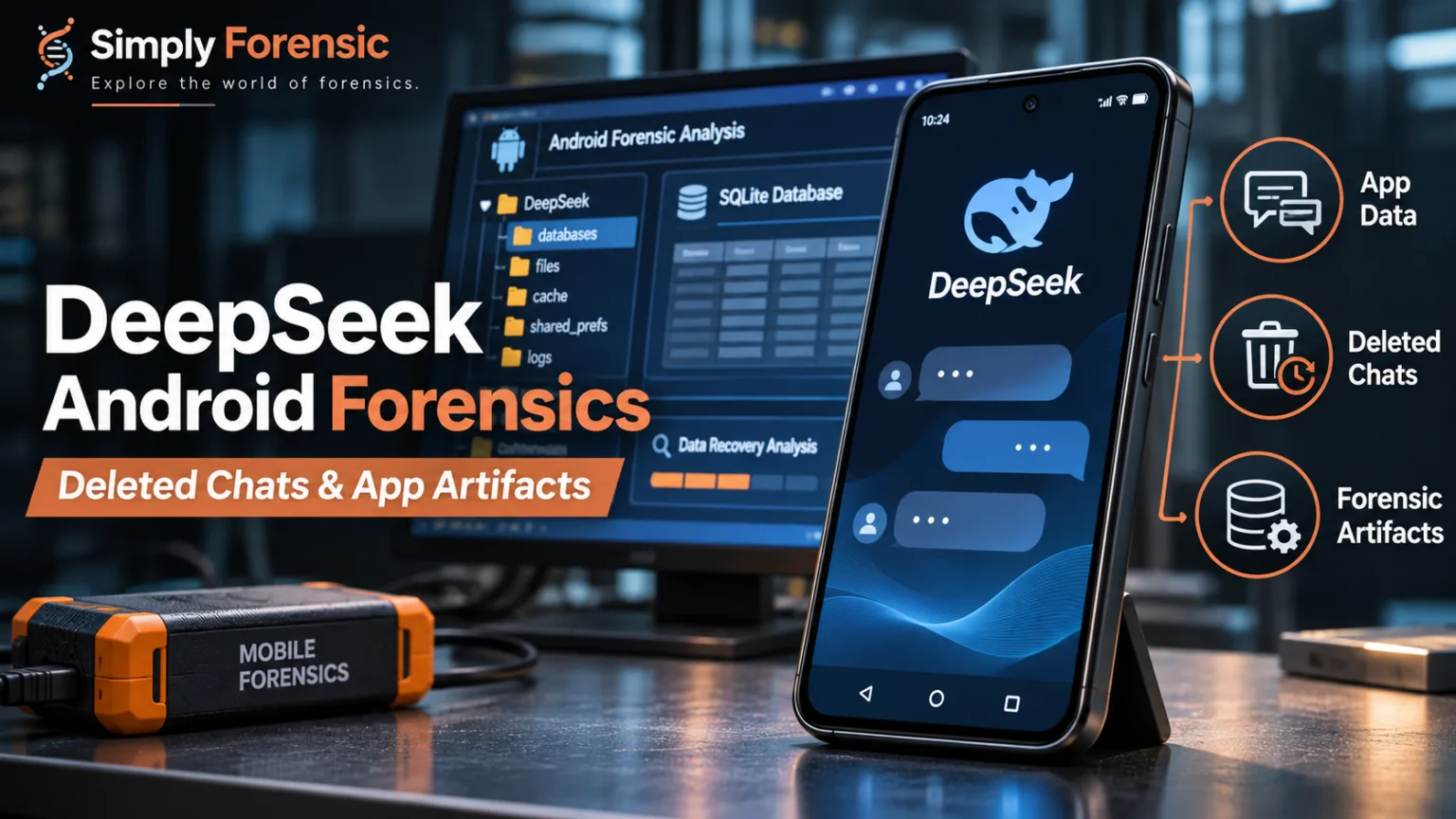
AI chat applications can leave forensic traces beyond what a user sees on screen. A peer-reviewed study published on 26 November 2026 examines the Android version of DeepSeek, focusing on application databases, conversation records, authenticationVerifying the identity of a user, process, or device, often as a prerequisite to allowing access to resources in an information system. Read Full Definition artefacts and the results of deleting chats. The findings provide a useful case study in mobile evidence acquisition, with clear limits on what they establish about real-world devices.
- What was tested?
- Where were useful artifacts stored?
- What happened when chats were deleted?
- How could an investigator approach these records?
- Three ALEAPP modules
- A finding about access is not a finding about encryption
- Limits and evidential interpretation
- Why this matters for modern digital investigations
- Examiner validation checklist
- Frequently Asked Questions
- References
Research at a Glance
Digital Forensic Analysis of the DeepSeek Application for Android
Study summary
Static, dynamic and post-mortem analysis of DeepSeek v1.5.5 on a rooted Android 13 emulator, with a targeted compatibility check of v2.7.4, identified local chat databases and deleted-session persistence.
Critical appraisal
- Limitations
- Controlled rooted Android Virtual Device, two accounts, no real physical-device acquisition comparison; server-side retention and device-level encryption not assessed.
- Implications
- App-specific SQLite and metadata can support reconstruction when lawful, suitable access exists; findings require version-specific verification.
Key Takeaways
The scientific findings must be interpreted within the design and limitations of their sources.
- DeepSeek chat data and account metadata were recoverable from the tested application's private storage on a rooted Android 13 emulator.
- Some deleted sessions were removed from the visible session list while their message tables remained queryable.
- Researchers developed three ALEAPP modules to parse selected DeepSeek application artifacts.
- The study does not show that ordinary users or examiners can access app-private files on every physical phone.
What was tested?
Santos, Frade, Domingues and Negrão studied DeepSeek version 1.5.5 using a rooted Android 13 Virtual Device. They configured two accounts, generated controlled application activity, examined files after use, reviewed application code using JADX and inspected communications using HTTP Toolkit. They then performed a narrower compatibility check on version 2.7.4. This design permits close observation of local behaviour but is not equivalent to an acquisition study across multiple physical phones.
Where were useful artifacts stored?
The study identified the application’s private directory as a source of SQLite databases holding account information, session records and message content. Some records supported association of messages with specific chat sessions and their ordering. App lifecycle logs and other metadata provided additional context about activity. These are potentially evidential observations, but attribution to a particular human user requires corroboration.
The researchers reported that an authentication bearer token and JSON-formatted message content were readable in the acquired files without a separate application or database encryption key in their test environment. That observation should not be reported as proof that all DeepSeek data are unencrypted on physical phones. Root access to an emulator bypasses Android’s ordinary application sandbox, and device-level storage protection was not evaluated.
What happened when chats were deleted?
The researchers observed that deletion removed a session from the graphical interface and the chat session list but did not remove its corresponding message table in the tested local database. In each tested account dataset, 12 message tables were present while the session list contained 10 entries; two tables related to deleted sessions. The tables were still queryable after force-stopping or restarting the app and after logging back into the same account.
The result illustrates why visible deletion and complete local data erasure are not necessarily the same. It does not establish whether all deleted conversations survive, how long they remain, or what happens on DeepSeek servers. It also does not justify unauthorized access to someone else’s device or account.
How could an investigator approach these records?
- Preserve the relevant device and establish legal authority and a documented acquisition scope.
- Record the Android version, DeepSeek app version, acquisition method and privileges used.
- Keep forensic copies and document hash values, timestamps and time-zone interpretation.
- Review SQLite schema, session identifiers, message content and surrounding metadata together.
- Validate parser outputs against the original database tables and known test actions.
- Treat authentication tokens as sensitive credentials; never place them in a public report or training screenshot.
Three ALEAPP modules
The study contributed three open-source modules for Android Logs Events and Protobuf Parser (ALEAPP). They support structured extraction of certain DeepSeek data and can improve repeatability of examinations. Automated parsers should still be validated on known reference datasets and compared with raw artifacts. Software updates may alter file names, table schema or storage practices.
A finding about access is not a finding about encryption
A rooted virtual environment allowed access to a protected app directory that would normally be isolated by Android’s sandboxing rules. The researchers distinguished this access-control mechanism from file or database encryption. Their observation of readable files after acquisition therefore does not show whether the device had Android file-based encryption active or whether normal network traffic was unsecured. The app’s communication with a service used a bearer token; transport security must be evaluated separately.
Limits and evidential interpretation
No physical Android handset was included. The detailed testing used one rooted AVD and two accounts rather than independently replicated physical devices. The precise sequence and repetitions of every action were not retained. The compatibility check for version 2.7.4 was targeted rather than a new complete study. Results should not be generalized to all versions, operating systems, configurations or users.
A message associated with an account shows that data were retained in an application record; alone, it cannot establish who typed the message, whether another person used the account or whether time-related metadata are complete. Examiners should also distinguish local artifacts from potentially different server-side copies.
Why this matters for modern digital investigations
Conversational AI apps create an expanding class of digital trace: questions, generated responses, timestamps, attachments and account-linked settings. Analysts should include such apps in appropriate triage plans without assuming they work identically to messaging clients or email. Mobile forensic training now needs version-aware application artifact analysis and safeguards for privileged tokens and sensitive content.
Related Simply Forensic material includes SQLite WAL files in digital forensics and digital forensics and artificial intelligence.
Examiner validation checklist
Android App Artifact Validation
Educational self-review only: checking an item does not establish laboratory QC acceptance.
Frequently Asked Questions
Frequently Asked Questions
Can investigators always recover deleted DeepSeek conversations?
No. This research observed persistence in a controlled rooted Android emulator and selected app versions; other configurations require testing.
Were messages stored in plaintext?
The acquired database files in the tested environment contained readable message JSON. The researchers did not assess device-level encryption.
Does a recovered chat prove who used the account?
Not by itself. Identity and activity require corroborating evidence.
What is ALEAPP?
ALEAPP is an open-source Android artifact-parsing framework. The authors contributed modules to report selected DeepSeek data.