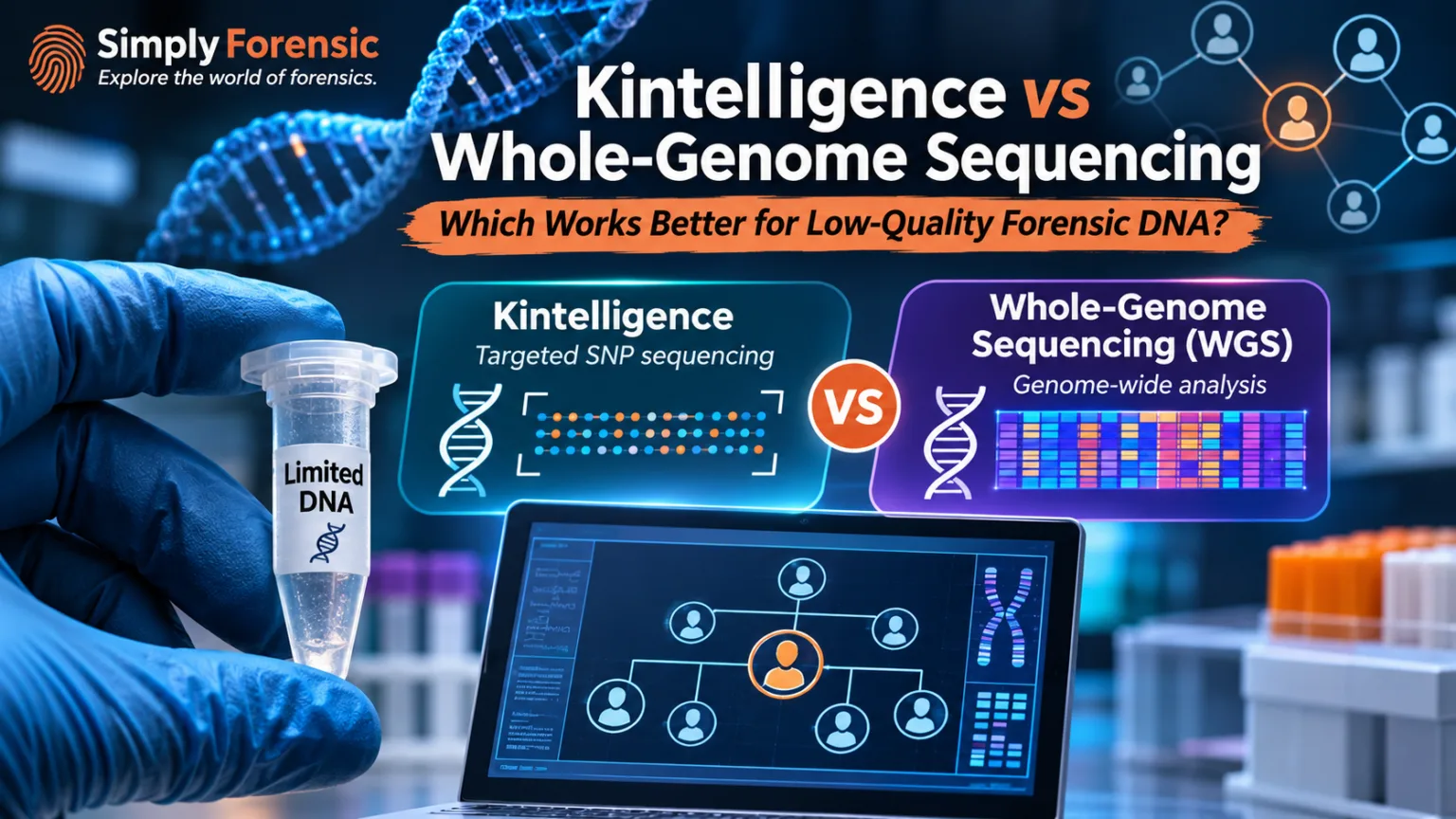
When investigators have only a small quantity of compromised DNADNA, or Deoxyribonucleic Acid, is the genetic material found in cells, composed of a double helix structure. It serves as the genetic blueprint for all Read Full Definition, choosing how to generate SNP data is consequential. A new Journal of Forensic Sciences study compared potential genetic relatives produced by the ForenSeq Kintelligence workflow with those identified after whole-genome sequencing (WGS). Its central result was substantial disagreement between the two approaches. It is a finding worth examining carefully, not proof that one technology always fails.
- Why genetic genealogy relies on SNP data
- What the researchers did
- The results: substantial relative-list discordance
- What does this mean for low-quality forensic DNA?
- A fair comparison must include analytical and interpretive quality
- What the study does not demonstrate
- Implications for validation and reporting
- Practical checklist before committing limited DNA to FIGG
- Frequently Asked Questions
- References
Research at a Glance
Low-quality DNA, high-stakes decisions: A comparative study of SNP genotyping methods for investigative genetic genealogy in forensic casework
Study summary
In the reported casework samples, Kintelligence and later WGS produced markedly different lists of potential genetic relatives. More than 95% of the potential matches identified using Kintelligence were absent from the WGS results.
Critical appraisal
- Limitations
- The accessible abstract does not provide sufficient sample-level method details to assess ground-truth identity, sequencing coverage or match thresholds independently.
- Implications
- Consider SNP density and the consequences of testing choices when handling scarce, degraded forensic DNA.
Key Takeaways
The scientific findings must be interpreted within the design and limitations of their sources.
- The authors compared potential-relative lists after Kintelligence testing was followed by WGS on remaining sample material.
- More than 95% of Kintelligence-predicted potential relatives were not reproduced in the WGS results.
- For overlapping associations, Kintelligence yielded higher estimated shared-DNA values in the reported comparisons.
- Disagreement alone does not establish which result is correct; raw quality metrics and independent confirmation matter.
Why genetic genealogy relies on SNP data
Forensic investigative genetic genealogy (FIGG) may help develop investigative leads from unknown human DNA using SNP profiles, database matching and genealogical research. SNP results are not the same as routine autosomal STR identification profiles. Their suitability depends on the number and distribution of usable markers, genotype quality, the database being searched, relationship distance and the statistical or algorithmic assumptions underlying each match estimate.
Kintelligence interrogates a targeted set of SNP markers, while WGS can provide much denser genome-wide information where sufficient usable data can be recovered. Greater marker density may help resolve distant genetic relationships, but sequence depth, missing data, contamination and bioinformatic quality control still matter.
What the researchers did
According to the published abstract, challenging forensic DNA evidence first underwent Kintelligence testing. Investigators evaluated the resulting possible relatives but were unable to establish useful genetic networks. The remaining DNA material was then tested using WGS. The researchers compared the lists of potential relatives produced by the two approaches, including predicted shared-DNA estimates for overlapping associations.
This is a casework-oriented comparison, rather than a randomized benchmark of every available SNP platform. The abstract does not specify sufficient per-sample detail for an independent comparison of input masses, locus recovery, coverages, kinship thresholds or database composition. Those parameters need to be obtained from the full article before making quantitative performance recommendations.
The results: substantial relative-list discordance
The most striking reported observation is that more than 95% of potential relatives predicted from Kintelligence data were not reproduced among the WGS-derived potential relatives. Very few individuals appeared on both lists. For associations present in both outputs, the study also reported inflated estimates of DNA sharing from Kintelligence compared with WGS.
Interpretation requires caution: a match appearing in one list but not another is not necessarily a demonstrated false positive. The difference might reflect marker density, genotype missingness, filtering, matching criteria or other quality variables. Without a verified ground truth for each relationship and detailed metrics, readers should not calculate a platform error rate from the 95% figure.
What does this mean for low-quality forensic DNA?
There is a practical issue in sequential testing: after DNA is consumed in an initial assay, a reduced amount may remain for more informative alternatives. A laboratory planning FIGG work should therefore assess available quantity, degradation, contamination, extraction yields and downstream method requirements early. This is especially important when recovery of distant cousins is expected to form a key part of the genealogical search.
The authors suggest that denser SNP methods may be more prudent for poor-quality or low-quantity samples intended for distant-relative searches. That is a research-informed consideration, not a universal instruction to bypass targeted assays. Facilities need performance data for the particular specimen types, protocols, downstream databases, assay costs and success criteria they use.
A fair comparison must include analytical and interpretive quality
- SNP coverage: report usable marker count and genome-wide distribution, not just total attempted markers.
- Input suitability: document DNA concentration, degradation, inhibition and remaining material.
- Match criteria: compare database coverage, thresholds, false-discovery controls and shared-DNA estimation methods.
- Independent corroboration: confirm an investigative genealogical lead through appropriate conventional identification and case evidence.
- Transparency: distinguish a genetic association, an investigative lead and a confirmed identity.
What the study does not demonstrate
The reported abstract does not show that all Kintelligence-relative predictions are false, or that WGS invariably identifies the correct person. It also does not establish performance for every degraded specimen, every genealogy database or every laboratory workflow. The paper supports closer scrutiny of the accuracy of relationship estimates in challenging samples and argues for a data-driven initial test strategy.
Implications for validation and reporting
In a forensic quality system, fit-for-purpose validation and case-specific review should document target SNP recovery, sample consumption, analytical limitations and decision rules before results enter an investigative workflow. Genealogical associations should be reported as leads rather than courtroom-grade identification by themselves. Routine STR comparison or another appropriate validated confirmation procedure remains important when a person is identified through genealogy.
Related Simply Forensic reading: forensic kinship testing, MPS and forensic biology, and common DNA interpretation misconceptions.
Practical checklist before committing limited DNA to FIGG
FIGG Method-Selection Checklist
Educational self-review only: checking an item does not establish laboratory QC acceptance.
Frequently Asked Questions
Frequently Asked Questions
Does the study prove Kintelligence is inaccurate?
No. It reports marked discordance in the cases studied. The abstract does not independently establish which individual matches were true or false.
Why might WGS provide more relatives?
A denser usable SNP dataset can improve power for distant relationship inference, although coverage, missingness and reference database conditions remain important.
Can a genealogical match identify a suspect conclusively?
No. FIGG leads require independent investigative and appropriate laboratory confirmation.
Is WGS always the better first test?
Not automatically. Method selection depends on specimen quality, validation, required data density and constraints of the case.
References
References & Sources
Show referencesHide references
- Philipps DL, Binder C, Boyle T, Morin B. Low-quality DNA, high-stakes decisions: A comparative study of SNP genotyping methods for investigative genetic genealogy in forensic casework. Journal of Forensic Sciences. 2026. Source