


Forensic DNA DNA, or Deoxyribonucleic Acid, is the genetic material found in cells, composed of a double helix structure. It serves as the genetic blueprint for all living organisms. Read Full Definition extraction methods differ in how they release, recover and purify DNA from biological evidenceBiological evidence - physical evidence such as bodily fluids that originated from a human, plant or animal. Read Full Definition. The choice affects amplifiable DNA yield, inhibitor carryover, fragment recovery, contaminationContamination - The unwanted transfer of material from another source to a piece of physical evidence. The inadvertent touching of a weapon, thereby adding fingerprints to it is an example of evidence contamination. Read Full Definition risk and compatibility with STR profiling or massively parallel sequencing (MPS). No method is universally superior: laboratories must select and validate procedures for the specimen, substrate and downstream assay.
- Quick comparison of forensic DNA extraction methods
- 1. Organic phenol-chloroform extraction
- 2. Chelex 100 extraction
- 3. Silica-based solid-phase extraction
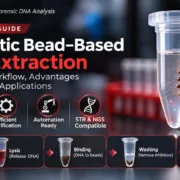
- 4. Magnetic bead-based extraction
- Which extraction method suits each evidence type?
- Differential extraction: separating sperm and non-sperm fractions
- Quality control and forensic validation
- Practical extraction-selection checklist
- Frequently asked questions
- Which forensic DNA extraction method gives the highest yield?
- Are magnetic beads better than silica columns?
- Can the same DNA extract be used for STR and MPS analysis?
- Selected scientific references
Quick comparison of forensic DNA extraction methods
| Method | Principle | Key advantage | Main limitation |
|---|---|---|---|
| Organic (phenol-chloroform) | Protein denaturation and phase separation | Can recover high-molecular-weight DNA | Hazardous solvents; manual transfers |
| Chelex 100 | Metal-ion chelation and heat lysis | Fast, simple PCR-oriented preparation | Crude lysate; potential inhibitors and denatured DNA |
| Silica-based | Reversible binding, washing and elution | Purification and concentration | Recovery loss during binding and elution |
| Magnetic beads | DNA binding to paramagnetic particles | Automation and scalable processing | Product-dependent recovery and equipment costs |
1. Organic phenol-chloroform extraction
Organic extraction typically begins with detergent-mediated lysis and proteinase K digestion. Phenol-chloroform treatment separates proteins and other cellular components from DNA, which remains primarily in the aqueous phase. The recovered fraction may require concentration or further cleanup.
This established approach can preserve relatively long DNA molecules, but its multiple transfers increase opportunities for sample loss and handling error. Phenol and chloroform require chemical-safety precautions; residual phenol may inhibit PCR. Organic extraction is not automatically the purest or highest-yielding option for every specimen.
2. Chelex 100 extraction
Chelex 100 is an ion-exchange resin that binds polyvalent metal ions, including magnesium. A conventional workflow combines resin with biological material, heats the suspension to release DNA, then centrifuges to separate the resin and debris from the DNA-containing supernatant.
Chelex is economical, rapid and well established for validated PCR-based testing of some bloodstains, buccal samples and other forensic materials. However, the extract is less thoroughly purified than washed solid-phase preparations. Resin carryover can inhibit amplification, and heat treatment can affect DNA strandedness. Suitability for MPS library preparation must be demonstrated rather than inferred from successful STR amplification.
3. Silica-based solid-phase extraction
Silica methods exploit DNA adsorption to silica under defined high-salt or chaotropic conditions. After DNA binds to a spin-column membrane or silica particles, wash buffers remove contaminants and a low-salt solution elutes the DNA.
Silica purification is useful where inhibitor removal and small elution volumes matter. Yet binding efficiency, fragment-size recovery, washing and elution can affect total recovery, particularly with trace or degraded samples. Silica protocols for skeletal remains may differ substantially from routine blood or saliva kits.
4. Magnetic bead-based extraction
Magnetic methods bind DNA to functionalised paramagnetic particles. A magnet retains the particles during washing, allowing contaminants to be removed before elution. This design is well suited to robotic extraction platforms and large casework batches.
Automation can reduce repetitive manual handling but does not eliminate contamination or sample-tracking risks. Bead composition, binding capacityThe amount of finished product that could be produced, either in one batch or over a defined period of time, and given a set list of variables. Read Full Definition, elution volume and recovery of short fragments vary among products. Performance claims should be evaluated against laboratory validationValidation, often referred to as method validation, is a crucial process in the laboratory when introducing a new machine, technology, or analytical technique. It involves a series of systematic steps and assessments to ensure that Read Full Definition data Information in analog or digital form that can be transmitted or processed. Read Full Definition, not assumed to apply to every magnetic system.
Which extraction method suits each evidence type?
- Blood and saliva: Silica and magnetic workflows often provide practical purification; Chelex may be suitable for validated, relatively uncomplicated samples. Blood-derived PCR inhibitors remain a concern.
- Touch DNA: Low starting template makes extraction loss, final volume and contamination particularly consequential. Neither silica nor beads can recover DNA absent from the sampled surface.
- Semen and sexual-assault evidence
 Evidence is any form of proof, such as objects, materials, or scientific findings, presented to establish or disprove a fact in a legal proceeding. It is used to reconstruct events and link or exclude individuals Read Full Definition: Determine whether sperm and non-sperm cells require separation before purification. Differential extraction is a cell-separation strategy, not a fifth purification chemistry.
- Hair: Attached root tissue and rootless shafts present different analytical challenges. Rootless hair may require specialised recovery and mitochondrial or other appropriately validated analysis.
- Bone, teeth and degraded remains: Demineralisation, inhibitor removal and retention of short DNA fragments are central considerations. Specialised silica and magnetic protocols may be appropriate.
- Inhibited material: Haem, dyes, humic substances, calcium and extraction reagents can interfere with PCR. Dilution may reduce inhibition but also lowers template concentration.

Differential extraction: separating sperm and non-sperm fractions
In conventional differential extraction, an initial selective lysis releases DNA from non-sperm cells while relatively resistant sperm heads remain for separation and washing. A subsequent treatment lyses sperm cells. The fractions can then undergo an appropriate validated purification method. Incomplete separation may leave mixed DNA in either fraction, so sperm recovery and fraction purity require evaluation.
Quality control and forensic validation
Extraction blanks: Reagent blankSpecimen or sample not containing the analyte or other interfering substances. Read Full Definition controls monitor DNA introduced during extraction and subsequent analysis. The FBI Quality Assurance Standards for Forensic DNA Testing Laboratories, effective 1 July 2025, establish requirements for relevant reagent blanks and evidence controls.
Quantification: Human-specific qPCR provides information beyond total extract concentration. Depending on the assay, degradation indices and internal PCR controls can help distinguish fragmented template from amplification inhibition. Dilution may address some inhibition; it cannot reverse DNA degradation.
Validation: Before implementation, laboratories should evaluate representative sample types, substrates, low-template recovery, degraded material, inhibition, reproducibility, contamination, elution volume and downstream STR or sequencing performance. Automated systems also require assessment of carryover and plate handling. See SWGDAM validation guidance.
Traceability: Maintain unique identifiers and chain-of-custody records for evidence, cuttings, lysates, sperm/non-sperm fractions, extracts and any re-extraction or cleanup.
Practical extraction-selection checklist
- Identify the biological material, substrate and likely inhibitors.
- Estimate the amount and condition of available DNA.
- Decide whether cellular separation is required.
- Prioritise fragment retention and purification where degradation or inhibition is expected.
- Check compatibility with the intended STR, SNP, mtDNA or MPS assay.
- Use validated recovery, contamination and throughput data to select the workflow.
- Interpret extraction blanks, qPCR metrics and DNA profiles together.
Frequently asked questions
Which forensic DNA extraction method gives the highest yield?
No single method does so across all evidence types. Yield depends on starting material, degradation, substrate, chemistry and elution conditions. A NIST-associated study of extraction efficiency highlights sample- and method-dependent recovery.
Are magnetic beads better than silica columns?
Not categorically. Both are solid-phase approaches. Magnetic beads offer automation advantages; silica columns are established purification tools. Recovery and downstream performance depend on the specific protocol and sample.
Can the same DNA extract be used for STR and MPS analysis?
Sometimes, but STR amplification alone does not prove compatibility with sequencing-library preparation. DNA fragment length and single-/double-stranded proportions may differ between extraction methods.
Selected scientific references
- FBI. Quality Assurance Standards for Forensic DNA Testing Laboratories (effective July 2025).
- SWGDAM. Publications and validation guidance.
- Walsh PS, Metzger DA, Higuchi R. Chelex 100 as a medium for simple extraction of DNA for PCR-based typing from forensic material. BioTechniques. 1991.
- Boom R et al. Rapid and simple method for purification of nucleic acids. J Clin Microbiol. 1990.
- Butler JM. Advanced Topics in Forensic DNA Typing: Methodology.
- Mullen L, Romsos E, Vallone P. A Quantitative Method to Assess DNA Extraction Efficiency. 2026.
- Forensic DNA extraction methods for human hard tissue: systematic review and meta-analysis. Forensic Sci Int Genet. 2023.
- Effect of forensic DNA extraction protocols on ssDNA/dsDNA proportion and integrity.
Editorial note: The best extraction workflow is the one validated for the specific forensic evidence and analytical purpose, not the one with the most favourable generic ranking.