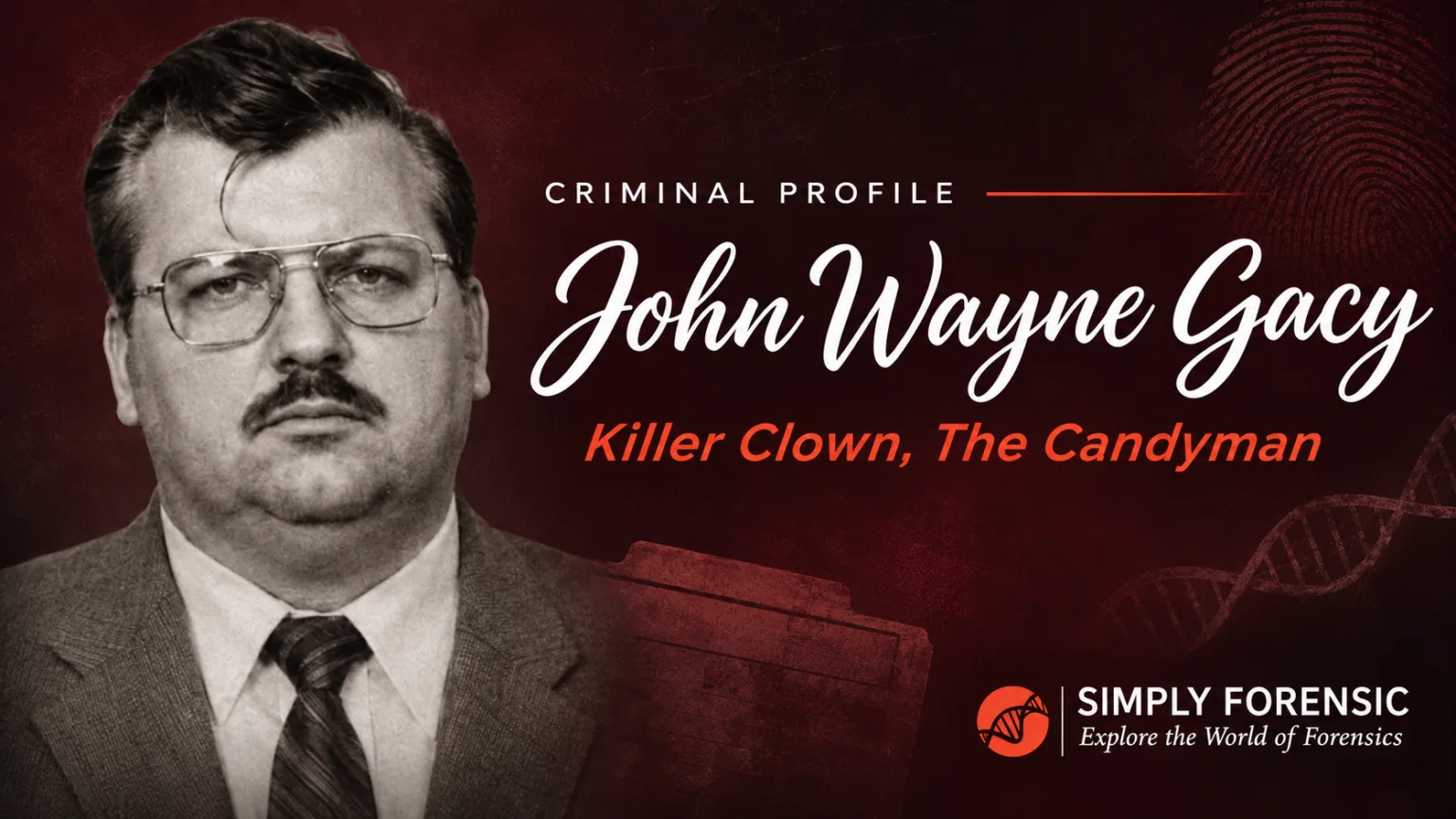
Reviewed 15 November 2026. John Wayne Gacy was convicted in Illinois in 1980 of murdering 33 boys and young men. The crimes, committed between 1972 and 1978, came to light following the disappearance of a teenager in the Chicago area. Gacy was executed in 1994. Yet the investigation into the people he killed has not entirely ended: the Cook County Sheriff’s Office continues seeking the names of five unidentified victims.
- Who was John Wayne Gacy?
- Victims and criminal conduct
- How the investigation developed
- The trial and legal findings
- Why identification continued after conviction
- The role of criminal investigation versus forensic identification
- Why the case remains significant
- Common misconceptions about the case
- Lessons from the criminal profile
- Frequently asked questions
- References and source documents
This criminal profile examines the offender’s background, documented offenses, investigative chronology and court outcome. A separate forensic case study should address the detailed DNADNA, or Deoxyribonucleic Acid, is the genetic material found in cells, composed of a double helix structure. It serves as the genetic blueprint for all Read Full Definition work required to identify human remains.
Key Takeaways
The criminal prosecution and the later identification of victims answered different forensic and legal questions.
- Gacy was convicted of murdering 33 boys and young men in Illinois in 1980; the crimes were investigated before modern forensic DNA profiling.
- The disappearance of Robert Piest in December 1978 was pivotal to the investigation that led to the recovery of human remains.
- Later DNA-based comparisons and investigative genealogy supported the identification of previously unnamed victims.
- A DNA profile can provide an investigative lead without by itself establishing a person's identity or the circumstances of death.
Who was John Wayne Gacy?
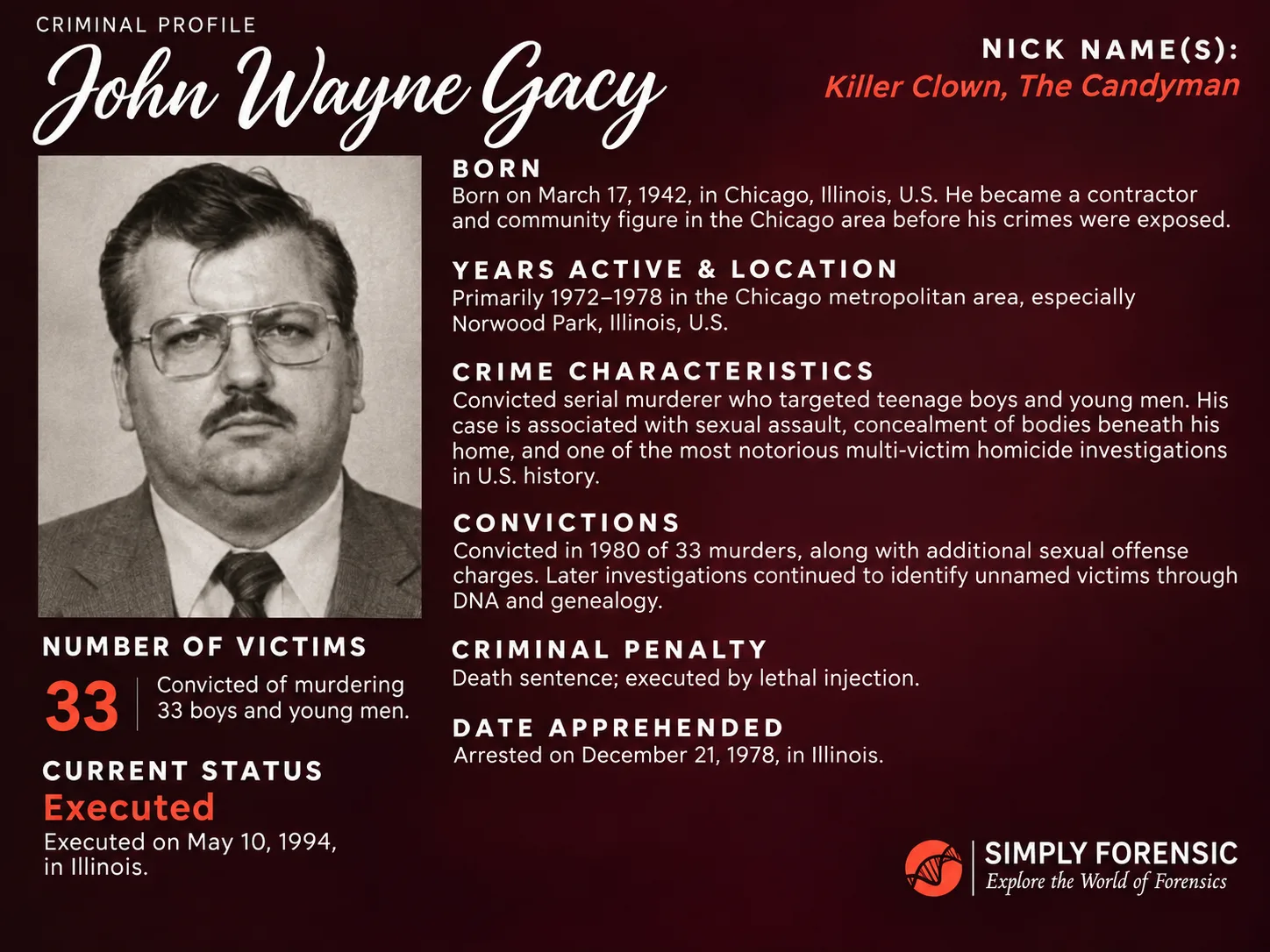
Born in Chicago in 1942, Gacy worked in business and contracting and became a recognizable figure in his community. He was also known for occasional charitable and entertainment activities, including appearances in clown costume. Popular accounts often exaggerate the relevance of the clown persona. The documented killings were not a series of attacks committed by an offender in clown costume, and the image should not be allowed to obscure the actual investigation and victims.
Before the Illinois murders, Gacy had been convicted in Iowa of sexual offenses involving a teenage boy and had served prison time. After release, he returned to the Chicago area, where he established a contracting business. The later murders occurred over several years while he maintained elements of an outwardly ordinary working life.
Victims and criminal conduct
Gacy targeted teenage boys and young men. Investigators recovered most victims’ remains from the crawl space and other areas associated with his suburban home. The case record established the deaths of 33 people, though not every victim could be identified at the time. Individual experiences and identification histories should not be compressed into a single generic statement about victims.
His offender profile is supported by a lengthy criminal investigation, court testimony and physical recoveries. It does not require an invented diagnosis. Claims about his motives should be attributed to specific statements, records or expert testimony rather than inferred simply from his crimes.
How the investigation developed
In December 1978, the disappearance of 15-year-old Robert Piest helped bring police attention to Gacy. A developing investigation examined contacts and circumstances surrounding the teenager’s disappearance. As the inquiry progressed, investigators searched Gacy’s property and began recovering human remains, establishing that the case involved multiple homicide victims.
The recovery was a complex scene investigation involving locations beneath and around the house. Examiners faced the daunting need to record remains, distinguish individuals and connect bodies with missing-person reports. At that time, dental comparisons and other conventional identification methods were especially important; DNA typing as practiced in modern forensic laboratories was not yet available.
Investigators also considered witness accounts, earlier criminal conduct and Gacy’s statements. None of those sources should be described as independently sufficient to explain every murder. The trial presented a broad evidential record, while the identification of victims required an additional, separate line of inquiry.
The trial and legal findings
Gacy stood trial in Cook County in 1980. He was convicted on all 33 murder counts, as well as additional sexual offense charges. For twelve of the murders, the jury found statutory grounds for death sentences; the remaining murder convictions resulted in life terms. The Illinois Supreme Court affirmed the convictions and sentences in People v. Gacy in 1984.
The case generated sustained litigation, but the convictions were not overturned. Gacy was executed by lethal injection on 10 May 1994. The precise legal outcome matters: he was not an offender who died before trial, and his convictions were not dependent on later genetic genealogy work.
Why identification continued after conviction
The absence of a known name for some victims did not prevent the criminal prosecution from proceeding. But it denied families the certainty of a confirmed identification. Police later returned to the unresolved identities with DNA technologies and comparative reference data.
In 2011, Cook County authorities reopened work to identify eight remaining unnamed victims. Subsequent investigations led to three identifications, including Francis Wayne Alexander, announced in 2021 after DNA Doe Project genealogy research and confirmation using DNA from relatives. Authorities also identified James Haakenson and William Bundy.
According to the Cook County Sheriff’s Office’s public unidentified-victims page, five victims remain unidentified as of this review. Investigators report that DNA profiles suitable for comparison are available for each, but the presence of a profile is not equivalent to knowing who the person was. A missing-person reference and investigative connections may still be required.
The role of criminal investigation versus forensic identification
This is a useful example of how two investigations can overlap without answering the same question. The prosecution established Gacy’s criminal responsibility for murders. Years later, the scientific question was whether remains could be assigned to individual missing people and whether family-reference samples supported those identifications.
For a criminal-profile reader, the implication is straightforward: advances in scientific methods can continue to serve victims’ families long after an offender’s legal case is closed. For a forensic reader, the case highlights the need to distinguish a genealogy-generated lead from confirmation by appropriate comparison and other independently obtained information.
Why the case remains significant
The Gacy case illustrates limitations in missing-person reporting and cross-agency communication. Some victims had not been reported missing, some came from other jurisdictions, and some families lacked immediate knowledge of where a relative had traveled. These obstacles cannot be solved by laboratory sensitivity alone.
It also underscores an ethical problem in historical true-crime writing: repeated emphasis on the offender’s notoriety can erase the people harmed. Credible profiles should identify established facts without glamorizing violence or treating victim names as incidental details.
Common misconceptions about the case
Myths and Historical Record
Myth
The murders were committed by an offender dressed as a clown.
Reality
The clown persona features heavily in popular accounts, but the documented killings should not be portrayed as a series of attacks committed in clown costume.
Myth
Modern forensic DNA profiling was what secured the 1980 conviction.
Reality
The conviction predates modern DNA profiling. Subsequent DNA analysis and genealogy were used in work to identify previously unnamed victims.
Myth
Conviction of the offender means every victim was already identified.
Reality
Criminal responsibility and victim identification are separate questions. Authorities continued working to establish identities long after the conviction.
Lessons from the criminal profile
- Pattern recognition: connections between missing persons and a suspect may emerge gradually from multiple reports.
- EvidenceEvidence is any form of proof, such as objects, materials, or scientific findings, presented to establish or disprove a fact in a legal proceeding. It Read Full Definition preservation: records and remains retained across decades can support future identification.
- Legal precision: 33 murder convictions are a documented court outcome, not an estimate of a larger unproved total.
- Victim-centered reporting: unidentified people deserve continued investigation even when an offender is no longer alive.
- Scientific boundaries: a forensic profile suitable for comparison does not automatically provide a person’s identity.
Frequently asked questions
Frequently Asked Questions
How many murders was John Wayne Gacy convicted of?
He was convicted of 33 murders in 1980.
When was Gacy executed?
He was executed in Illinois on 10 May 1994.
Are any of his victims still unidentified?
Yes. The Cook County Sheriff's Office states that five victims remain unidentified and invites relevant family-reference leads.
Did DNA evidence convict Gacy?
No. His conviction preceded modern forensic DNA profiling. DNA and genealogy have subsequently assisted in identifying victims.

References and source documents
References & Sources
Show referencesHide references
Editorial note: The investigation and convictions are described separately from the ongoing effort to identify human remains. The number of unidentified victims reflects the county’s published record as reviewed on 15 November 2026.