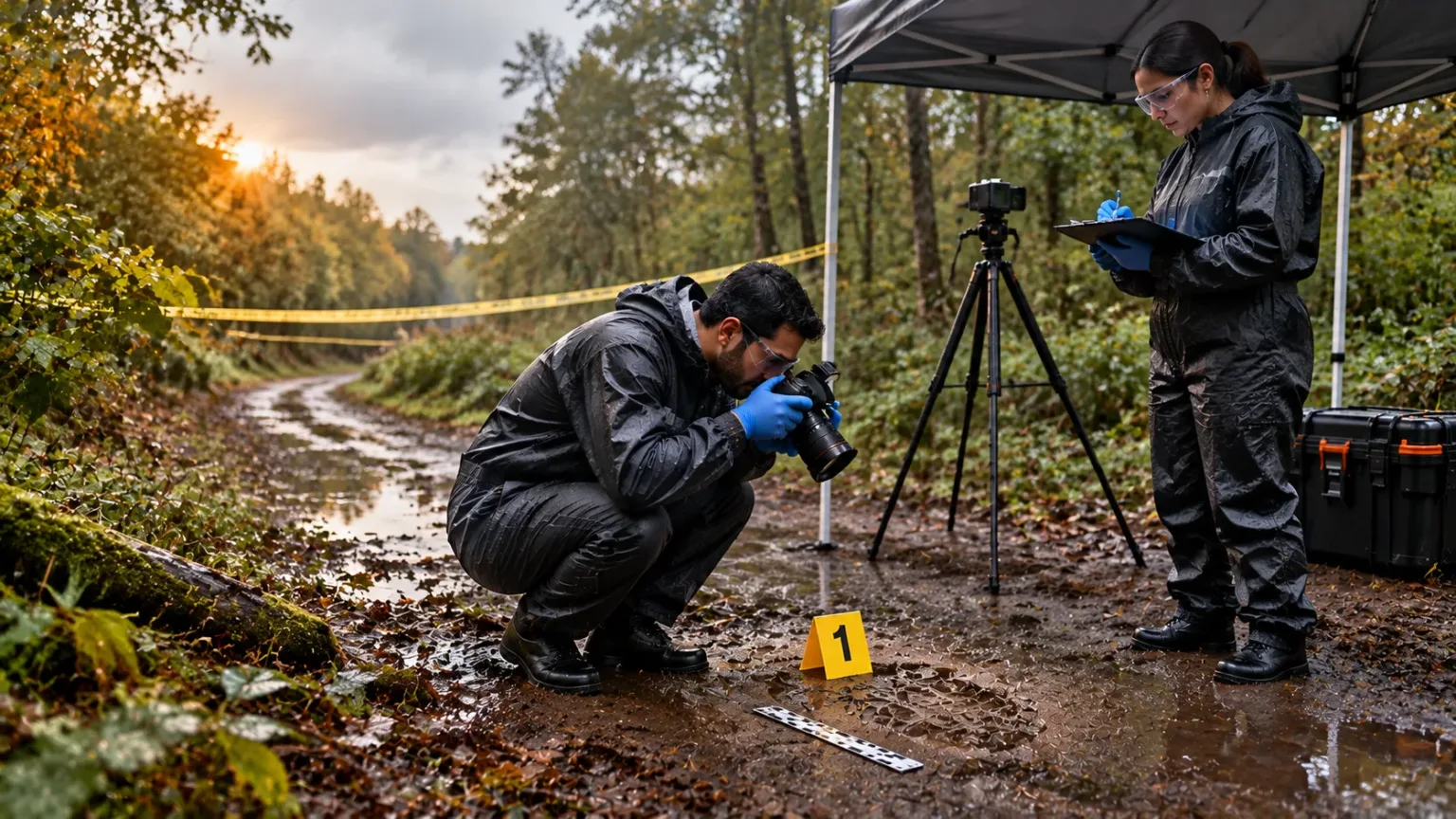
Outdoor crime scene investigation requires investigators to examine a scene that is continuously exposed to changing conditions. Rain can alter bloodstains and impressions, wind can move loose traces, sunlight and heat can affect biological material, and snow or tidal water can hide or redistribute evidence. These processes may begin before emergency responders arrive and continue during the examination.
- Why are outdoor scenes particularly vulnerable?
- Step 1: Assess immediate hazards and preserve safe access
- Step 2: Triage the evidence most at risk
- Rain and surface water: dilution, transport and changing context
- Heat, sunlight, humidity and forensic DNA
- Wind, airborne material and fragile trace evidence
- Outdoor footwear and tire impressions: rain, snow, dust and unstable ground
- Tides, rivers, drainage channels and coastal exposure
- Night investigations and changing visibility
- Outdoor remains, insect activity and microclimate
- Environmental timeline: distinguish observation from reconstruction
- Outdoor evidence packaging: protect it without creating additional damage
- Outdoor evidence priority matrix: planning examples
- Four hypothetical worked examples
- Common misconceptions about outdoor crime scenes
- Field checklist for outdoor scene examination
- Frequently asked questions
- References and scientific guidance
The central task is not to collect everything immediately or to postpone all searching until the weather improves. It is to assess which material is vulnerable, protect people, choose a proportionate sequence of documentation and recovery, and record how conditions and interventions may affect interpretation. A scene exposed to heavy rain can still yield valuable evidence, while a sheltered scene can lose traces through avoidable handling.[1][2][4]
This guide explains how to manage weather-related risks, transient evidence, field documentation, footwear impressions, biological samples, trace particles, water and tide exposure, packaging and scene release. It also includes four technical figures, decision tables, hypothetical outdoor scenarios, a practical checklist, FAQs and authoritative references.
Key Takeaways
Outdoor evidence recovery requires a documented, exposure-specific plan rather than a rigid collection order.
- Secure safe access and record weather, light, surface conditions and interventions with times.
- Prioritize vulnerable biological stains, loose trace material and impressions according to the risk of loss and potential interference.
- Select specimen-specific packaging and preservation; wet clothing, liquid samples and volatile residues require different approaches.
- Distinguish weather observations and recovery location from unsupported claims about when or where evidence was deposited.
Scientific principle
Why are outdoor scenes particularly vulnerable?
Outdoor scenes differ from controlled interiors in several important ways. They may be accessible to passersby, animals or vehicles; the search boundary can expand as additional items are located; and air, moisture, heat or moving water can cause physical changes beyond the investigator’s control. A trail, beach, roadway or field also contains naturally occurring background material and potentially unrelated signs of previous activity.
The National Institute of Justice describes outdoor scenes as especially vulnerable to loss, deterioration and contamination from heat, cold, rain, snow and wind. Its archived teaching resources encourage prompt protection or recovery when conditions threaten exposed material. This advice must be balanced against safe entry and the consequences of changing the scene; “outdoor first” is a priority consideration, not a universal instruction to ignore safety or linked indoor evidence.[4]
The UK’s August 2026 incident-scene guidance explicitly recognizes adverse-weather decisions that depart from ordinary procedures. It includes examples in which rapid recovery or altered measurement approaches were justified to preserve evidence. The important requirement is to make the decision proportionate and document the grounds, action, limitations and later follow-up.[2][3]
Step 1: Assess immediate hazards and preserve safe access
Urgent medical care and protection of people come first. Possible hazards include moving traffic, unstable slopes, floodwater, lightning, electrical lines, cold exposure, extreme heat, contaminated water, concealed sharp objects and wildlife. A field examiner should not enter a dangerous area simply because a visible item might be washed away. Seek authorized rescue, hazardous-material or specialist scene support when appropriate.[1][14]
Define an initial protective boundary and the safest controlled approach route. For a road verge, distinguish the operational traffic-control boundary from the forensic search area. For a beach or riverbank, consider how the boundary may shift as water moves. Note known responders, their movements, vehicles and emergency alterations to the substrate, because they may explain some later marks or transfers.
Keep clean supplies protected from weather and physical contact with the scene. Raincoats, camera equipment, glove surfaces and boots may transfer material. The scene contamination plan must therefore account for both environmental movement and investigator-mediated cross-transfer.[6]
Step 2: Triage the evidence most at risk
An early assessment should identify both the material likely to change and the time available before that change. A shallow impression in loose mud near an approaching runoff channel may warrant urgent protection and documentation. A dry object in a covered shelter may remain relatively stable while the team attends to a threatened outdoor stain. The choice depends on the scene, evidence question and safe access—not an immutable rank of DNADNA, or Deoxyribonucleic Acid, is the genetic material found in cells, composed of a double helix structure. It serves as the genetic blueprint for all Read Full Definition, fingerprintsFingerprint, impression made by the papillary ridges on the ends of the fingers and thumbs. Fingerprints afford an infallible means of personal identification, because the Read Full Definition, impressions or trace evidence.
The NIJ scene guide advises prioritizing transient evidence and choosing a progression of methods that does not needlessly compromise later examinations. The current FSR code also calls for contemporaneous notes, including adequate recording of urgent recovery when adverse conditions prevent complete routine documentation.[1][3]
Life safety, accessibility, weather, legal authority and likely evidence types
Rain runoff, incoming tide, melting impression, advancing hazard or exposed fragile trace.
Cover or isolate without contacting evidence, obstructing documentation or creating new contamination.
Qualified team selects and documents urgent recovery where exposure or access makes delay worse.
Any branch may be inappropriate if it threatens people or contaminates evidence. Urgent recovery can precede a complete diagram, but contemporaneous identifiers, initial location and reasons for the deviation still need recording.
If there is time, obtain an initial photograph or video that captures location and condition before an intervention. If waiting to complete all standard photographs would lead to probable immediate loss, document the location and recovery sequence using the best safe method available and clearly record why the standard sequence changed. Urgency does not make a guessed location acceptable.
Rain and surface water: dilution, transport and changing context
Rain can wet porous substrates, cause runoff across hard surfaces, soften or erode impressions, move unattached particles and change the visible distribution of stains. These effects are not uniform. A protected stain under a ledge may remain different from material exposed on open asphalt; soil texture, slope, drainage, vegetation and the presence of shelter all influence exposure.
A bloodstain exposed to rain is not necessarily analytically useless. The original pattern may be diluted, spread or redistributed, while biological material can sometimes remain recoverable at the sampled location or within the substrate. A recovered DNA profile does not reconstruct the original pre-rain stain shape, and a washed-out stain does not necessarily prove that no blood was originally present. Sampling choices should consider possible movement of material and appropriate laboratory analyses.[5][11][12]
Do not treat the downstream location of a trace as conclusive evidence of its original deposition point. Runoff from a higher surface may carry particles or liquids to lower ground. Map slope and drainage direction as observed, note nearby barriers and collection points, and avoid speculative arrows drawn on a diagram without evidence of actual flow at the relevant time.
Protective covers can be appropriate, but poorly placed covers, stakes, weighted material or their runoff edges may disturb evidence or produce new impressions. Use protection that does not contact vulnerable surfaces, and record its placement, timing, condition and removal. Never guarantee that a tent or sheet preserves the original environmental state.
Heat, sunlight, humidity and forensic DNA
Environmental exposure may change the quantity, quality or detectability of biological material. Heat and moisture can influence degradation processes; sunlight includes ultraviolet radiation that can damage DNA; and the substrate can protect or expose the material differently. A sheltered fabric item, dried stain on glass and exposed saliva deposit are not equivalent specimens.
A long-term study of blood, saliva and epithelial material under different indoor and outdoor conditions found that the capacity to obtain complete DNA profiles varied by specimen type, substrate, environment and exposure duration. Outdoor persistence decreased under the investigated conditions, but the study does not justify one forensic deadline after which all outdoor samples become unusable.[11]
A separate 2024 experiment with sunlight-exposed bloodstains showed reduced DNA concentration over time and substrate-dependent STR recovery. The experimental findings emphasize early collection when feasible, while illustrating the importance of the material and exposure setting. Laboratory success cannot be calculated solely from hours of sunlight or ambient temperature recorded at a nearby station.[12]
Implication for practice: Document exposure and recover material under validated procedures. Do not refuse sampling just because it rained, the scene was hot or the item remained outdoors for an extended time. Conversely, never promise that a usable DNA profile will result because a stain remains visually recognizable.
Wind, airborne material and fragile trace evidence
Loose fibers, hairs, dust, soil, leaves, glass particles and lightweight residues may move during windy conditions, rainstorms or when objects are handled. Air movement may also introduce material from beyond the initial scene boundary. A fragment recovered in one location may represent original deposition, later environmental movement or post-arrival disturbance.
ANSI/ASTM E3457-25, a published trace-evidence guide added to the OSAC Registry in June 2026, emphasizes considering trace recovery alongside other forensic examinations. The guide is primarily directed to laboratory detection and preservation, with some methods applicable at scenes; it is not a complete outdoor-weather manual. Field teams should coordinate how trace recovery might disturb DNA, fingermarks or impression evidence.[10]
Document a particle’s original visible location before contact, control equipment and personnel movement, and secure small items in suitable packaging to prevent loss. If transporting an entire item retains the distribution better than field removal, an intact submission may be justified. Wind-dispersed material is not automatically evidence of a direct transfer between particular people or objects.
May wet, dilute, redistribute, erode or transport material. Exposure and protection depend on terrain and substrate.
May increase biological degradation, drying or deformation; UV affects some DNA evidence. No universal persistence time.
May move small particles, loose fibers, leaves and coverings; can deposit material from elsewhere.
Can bury or alter impressions and obscure surfaces. Thawing and refreezing change the recorded scene.
Can change scene boundaries and transport objects. Currents and access hazards require specialist assessment.
May reduce detection and photography quality; additional lighting cannot guarantee an exhaustive negative search.
Each box describes a potential mechanism, not inevitable loss. The same evidence type may respond differently on different surfaces or under different exposure durations.
Outdoor footwear and tire impressions: rain, snow, dust and unstable ground
Footwear and tire impressions are especially vulnerable when the recording surface is wet, soft, brittle, melting or routinely crossed. A three-dimensional soil impression may lose edge detail through water erosion, collapse or later footprints. A two-dimensional dust impression can disappear after rain or contact. A snow impression may change as snow melts or refreezes.
The published ANSI/ASB Best Practice Recommendations 050 (2021), 052 (2022) and 126-20 (2022) address photographic documentation, detection/collection and casting, respectively. They are specialist references; simply owning casting material does not make casting appropriate in mud, wet snow or a fragile substrate.[7][8][9]
Where safe and appropriate, obtain overall and midrange images followed by examination-quality images with suitable scale and lighting before applying a lift, cast or other altering process. Document the impression’s location and relationship to other features. The scale should be suitable for the impression plane and should not disturb it. Later rain or drying can produce distortions that may affect comparison.
For winter scenes, qualified specialists may use substrate-specific techniques; there is no universal instruction to pour one casting compound into all snow impressions. If protection, photography or collection cannot be carried out safely, document the limitation and seek appropriate assistance.
Tides, rivers, drainage channels and coastal exposure
Beach, shoreline and river scenes require special attention to the movement of the environment itself. A rising tide may change access, conceal impressions and move objects. Rainwater channels can widen; water depth or current can change during an examination. A road or bank that was safe on arrival may become hazardous after a storm.
Record observed waterline, tide or current conditions and their times where relevant. If external tide, rainfall or hydrological data are consulted, record their source, measurement station and relationship to the actual scene. A tidal chart or forecast is not, by itself, direct evidence of the precise water level at an exhibit during an earlier alleged event.
Recovered material may have traveled by current, flotation or handling. The location where an object was found is not automatically its point of entry into the water. Underwater retrieval, swift-water access and hazardous flood scenes require personnel and methods specifically qualified for those tasks, not improvisation by general scene examiners.
Night investigations and changing visibility
Nighttime searching changes how small and low-contrast traces are detected. Portable lamps, oblique lighting and appropriate search patterns may improve visibility, yet a negative search at night may have different limitations from a search in daylight. Rain, fog, glare and shadows can affect both human examination and photographic records.[4]
If delaying a full search until daylight is safe and evidence can be protected, that may be reasonable. If weather or public access creates a substantial risk of immediate loss, postponement may be inappropriate. A documented partial recovery can coexist with a later systematic daylight search. Record which areas were examined, when, with what lighting, and which areas remain to be checked.
A forensic search plan should also account for the searchers’ own tracks, equipment and temporary lighting positions. Artificial light used for searching can alter the visible appearance of wet surfaces in photographs; original acquisition conditions should be recorded when material.
Outdoor remains, insect activity and microclimate
At scenes involving human remains, temperature, shade, precipitation, soil conditions and insect activity can affect the observations available to medicolegal specialists. Vegetation cover and direct sunlight may make the local microclimate different from that recorded at a distant weather station. Postmortem changes, insect development and environmental exposure require specialist interpretation, especially where the question concerns a possible postmortem intervalThe post-mortem interval (PMI) is the time that has elapsed since an individual's death. When the time of death is not known, the interval may be Read Full Definition.
Forensic entomology guidance emphasizes preserving contextual information: habitat, exposure to sun or shade, location and developmental stages of insects, evidence of animal activity, time of collection and relevant temperatures. Insect evidence collection, preservation and identification should be coordinated with a qualified forensic entomologist or medicolegal authority.[13]
Do not infer an exact time of death from the air temperature at the moment of scene attendance, the presence of one insect species or a simple weather forecast. The relevant conditions may have varied for many hours or days; temperature at the larval mass, body or soil can differ from ambient temperature. Appropriate models and uncertainty need specialist evaluation.
Environmental timeline: distinguish observation from reconstruction
A forensic examiner may have direct observations from the moment of arrival onward but only indirect information about earlier conditions. Keep three kinds of records distinct: on-site observations made and timed by personnel, independent weather records from identified stations or sensors, and inferences about how the exhibit may have been exposed between the event and recovery.
Time may be alleged or uncertain
Observed conditions, photos and time recorded
Actual rain/wind/sun conditions logged
Interventions, item condition and timestamps
Packaging, storage and transfer history
Important distinction: An observed weather condition at 15:30 and a nearby weather-station report for 13:00 do not establish what the exhibit experienced continuously since the suspected event. State data source, location, time basis and uncertainty.
A useful scene log records the observation time, time zone, source, exact location within the scene, measured or estimated value, instrument if used and the corresponding event or action. For example, “light rain observed at 15:32 near the northern entrance” differs from “regional station recorded precipitation at 14:00.” Neither proves that a stain was continuously exposed between those times.
| Field | What to record | Why it matters |
|---|---|---|
| Arrival conditions | Date/time, light, precipitation, wind, temperature source, access condition | Defines what was actually observed upon attendance |
| EvidenceEvidence is any form of proof, such as objects, materials, or scientific findings, presented to establish or disprove a fact in a legal proceeding. It Read Full Definition location | Unique ID, coordinates or measured references, height/level, exposure or shelter | Allows location review and identification |
| Environmental change | Observed onset of rainfall, tide, pooling, drying, snowmelt or movement | Links changed condition to a time and source |
| Urgent action | Protection or recovery decision, responsible practitioner, reason and time | Explains any deviation from ordinary scene processing |
| Sampling and transport | Sample type, original wet/dry state, tools, packaging, sealing and custody | Supports interpretation of subsequent tests |
| External weather record | Station, location, period, time basis and retrieval date | Separates regional records from direct observation |
| Limits and further actions | Unsearched areas, altered items, deferred specialist work and reasons | Prevents an unsupported claim of complete coverage |
Outdoor evidence packaging: protect it without creating additional damage
Environmental exposure does not end when an item is collected. A water-soaked garment can continue to deteriorate if held damp; loose particles can be lost inside unsuitable packaging; and a liquid specimen may leak or be affected by the wrong preservative. Packaging and storage must follow the specimen’s condition, intended analysis and the receiving laboratory’s instructions.[5][6]
Controlled drying or specimen-specific cold preservation without undue delay. Temporary secure transport containment may be needed.
Separate, clean approved breathable packaging where appropriate; prevent movement and contamination.
Leakproof tube, secondary containment, and specified preservative/temperature conditions as advised by the laboratory.
Document first; use a qualified method and rigid/secure protection where needed to prevent distortion or loss.
Wet biological items usually need prompt controlled drying or suitable cold preservation when indicated. Temporary leak-resistant containment may be necessary for safe transport, with the transfer to an appropriate preservation area documented. Do not seal a damp garment in ordinary impermeable plastic for prolonged storage and assume this preserves DNA. Dry biological items may be individually packed in clean breathable materials where appropriate. Liquid specimens require suitable leakproof containers and temperature instructions.
The NIST biological-evidence handbook provides matrices of storage conditions by specimen type and distinguishes short-term holding from long-term storage. It explicitly advises deference to the receiving laboratory’s policy. The UK regulator’s DNA contamination guidance also addresses controlled drying areas and separation of potentially contaminated items.[5][6]
Secure small particles in appropriate bindles, vials or protected mounts. Rigid immobilization may be necessary for fragile objects. Avoid cleaning an exhibit before an examiner has considered the original deposits. The correct container for a suspected volatile chemical residue may be airtight rather than breathable, so “always use a paper bag” is not a scientific rule.
Outdoor evidence priority matrix: planning examples
| Outdoor finding | Potential environmental risk | Reasonable early action | Important limitation |
|---|---|---|---|
| Wet-looking footwear mark in exposed mud | Rain erosion, foot traffic, drying or collapse | Protect access; photograph and ask qualified impression specialist about recovery | Altered geometry may constrain comparison |
| Visible stain on sloping pavement before rain | Dilution and redistribution in runoff | Document original appearance and site drainage; consider prompt suitable sampling | Location and appearance after rain may not equal original deposition |
| Loose fibers on an outdoor object | Wind removal, cross-transfer and handling | Record exact location; controlled recovery or intact protection | Recoverability and source association are distinct questions |
| Clothing exposed to midday sun | Heat/UV, moisture change and contamination | Assess condition; document and arrange prompt specimen-specific preservation | No universal DNA viability cutoff |
| Water-associated object near a river | Current, immersion, movement and access hazards | Qualified retrieval only; document level, current and recovered context | Recovery point may not be original deposition point |
| Scene with outdoor remains | Microclimate, insects, weather, scavenging | Document conditions and consult medicolegal/entomological specialist | Environmental data cannot alone pinpoint time of death |
Four hypothetical worked examples
Scenario 1: Approaching rainfall threatens a faint impression
Situation: A partial footwear impression is visible near a rural gate. Rain is expected soon, and the impression lies next to a safe but frequently used path. Plan: Establish a controlled alternative route, record the impression in context, obtain suitable examination-quality photographs and coordinate protection or recovery with a trained specialist. Document when precipitation actually begins. Limit: Weather forecasts are predictions, and a washed or partially recovered mark may no longer preserve all of the original detail. Do not assume its owner or age from apparent freshness.
Scenario 2: Bloodstaining on a roadside during heavy rain
Situation: A visible reddish stain and a narrow liquid trail cross a sloped roadway while rain continues. Plan: Address traffic safety, document overall and close context where practicable, note actual flow direction and time, and make a documented choice about urgent recovery of threatened material. Coordinate collection sites and suitable controls with the laboratory. Limit: Neither the current trail geometry nor a recovered DNA result proves the original bloodstain pattern, exact timing or sequence of a reported event.
Scenario 3: A suspected handled object left outdoors in summer
Situation: A portable object is located in direct sunlight several days after a report. A handled region may contain contact DNA and latent fingermarks. Plan: Photograph the object in place and its apparent exposure, consider securing it intact for interdisciplinary examination, and record other possible contacts. The receiving laboratory should coordinate potentially interfering methods. Limit: Outdoor exposure affects recovery probability but cannot determine that no DNA will be present, nor can a DNA contributor result date the contact.
Scenario 4: A winter woodland scene after changing weather
Situation: A wooded location contains disturbed snow, partly exposed objects and animal tracks after a reported thaw-refreeze cycle. Plan: Protect safe access, document terrain and visible traces, separate confirmed observations from the reported weather history, and obtain specialist advice about snow impressions and any relevant biological or entomological evidence. Limit: Changes in snow or ice can create or obscure patterns. Neither a single footprint nor current snow condition reliably dates the reported event without additional support.
These are hypothetical teaching situations, not instructions to attempt hazardous recovery without qualified staff.
Common misconceptions about outdoor crime scenes
Myth
Rain washes away all DNA.
Reality
Some material may be lost, moved or degraded, while some remains recoverable depending on the substrate and exposure.
Myth
Sunlight exposure proves a sample is too degraded to test.
Reality
Outdoor exposure influences the outcome but does not establish a universal profile-recovery deadline.<sup><a href="#sf-outdoor-ref-11" aria-label="Reference 11">[11]</a></sup><sup><a href="#sf-outdoor-ref-12" aria-label="Reference 12">[12]</a></sup>
Myth
The freshest-looking impression must be the newest.
Reality
Appearance reflects many factors, including substrate, weather, later disturbance and protective cover.
Myth
Any weather cover will preserve the scene.
Reality
Covers can change runoff, airflow, footprints or the original condition when placed incorrectly.
Myth
A weather-station record proves what happened to the exhibit.
Reality
Station measurements and local exhibit exposure are different observations.
Myth
All wet evidence should be stored in sealed plastic.
Reality
Some wet items need short-term secure transport and prompt drying or cold preservation; packaging is specimen-specific.
Myth
No evidence found at night proves there was none.
Reality
Limited lighting, search access and environmental exposure may restrict detection.
Myth
Outdoor evidence should always be collected before indoor evidence.
Reality
Exposure is a priority factor, but safety, possible loss, interference and case needs determine the plan.
Field checklist for outdoor scene examination
Educational self-review only: checking an item does not establish laboratory QC acceptance.
Frequently asked questions
Frequently Asked Questions
Why are outdoor crime scenes more vulnerable than indoor scenes?
Weather, uncontrolled access, vegetation, animals, moving water and changing light can alter or transport evidence. Effects vary by the specimen and location, so scene-specific risk assessment is essential.
Does rain destroy forensic DNA evidence?
Not automatically. Rain can dilute, move or degrade biological material, but recoverable DNA may remain depending on material, substrate, duration and exposure. A negative result must be considered within sampling and laboratory limitations.
Does strong sunlight always prevent STR profiling?
No. UV and environmental conditions may reduce DNA quantity or quality, but studies show substrate- and exposure-dependent results rather than one universal cutoff for successful profiling.
What evidence should investigators recover first when rain is approaching?
First manage safety. Then identify what is at imminent risk of loss, what can be protected without contact and what needs qualified urgent recovery. Record the rationale and any departure from ordinary documentation.
Can a wet footwear impression be photographed and recovered?
Potentially, but the suitability of photography, lifting or casting depends on the impression's substrate and condition. Use examination-quality documentation and seek a qualified impression practitioner.
How should a wet bloodstained garment be preserved?
Prompt controlled drying or approved specimen-specific cold preservation may be appropriate. Temporary secure transport containment may be necessary. Avoid prolonged wet storage in ordinary sealed plastic and follow the receiving laboratory's requirements.
Can wind introduce misleading trace evidence into an outdoor scene?
Yes. Wind and later human activity can redistribute particles and create alternative transfer explanations. Record location, exposure and handling, and avoid assuming one unique origin for every recovered particle.
Should an outdoor scene be searched at night or held until daylight?
It depends on safety, scene security and whether evidence will be lost during delay. A documented urgent partial examination followed by a further daylight search may be appropriate.
Can investigators use weather forecasts to establish when evidence was deposited?
A forecast is not a direct observation of what happened at the exhibit. Recorded weather data may help evaluate possibilities, but local exposure and uncertainty must be considered before drawing timing inferences.
What happens when a river or tide moves a recovered item?
The recovery location may differ from the original deposition point. Document conditions and seek qualified water-related scene assistance; avoid treating the found position as direct evidence of origin.
Are outdoor temperatures useful in estimating time since death?
They may inform specialist assessments, but one ambient reading does not establish an exact postmortem interval. Microclimate, insect development, exposure history and other observations require qualified interpretation.
Which current standards relate to outdoor evidence preservation?
The NIJ crime-scene guide, UK FSR 2026 scene guidance, NIST biological evidence handbook, published ANSI/ASB footwear recommendations and ASTM E3457-25 trace guide offer relevant guidance. Their scopes and legal applicability differ.
Related Simply Forensic Articles
References and scientific guidance
Technical review: 15 November 2026. The NIJ outdoor training resource is archived; the NIST/NIJ evidence handbook is published guidance; ANSI/ASB and ASTM documents are published technical standards or best practice recommendations. The UK statutory code has defined jurisdictional and activity scope. No universal legal requirement is inferred from international guidance alone.
References & Sources
Show referencesHide references
- National Institute of Justice (2013). Crime Scene Investigation: A Guide for Law Enforcement. Source
- UK Forensic ScienceDiscover the fascinating field of Forensic Science, the application of scientific principles to legal matters. This post delves into its many disciplines, from DNA analysis Read Full Definition Regulator (August 2026). Incident Scene Examination, FSR-GUI-0006, Issue 2. Source
- UK Forensic Science Regulator (2025). Forensic Science Activities: Statutory Code of Practice, Version 2. Source
- National Institute of Justice. Crime Scene and DNA Basics: Outdoor Crime Scenes (archived training). Source
- National Institute of Justice / NIST (2013). The Biological EvidenceBiological evidence - physical evidence such as bodily fluids that originated from a human, plant or animal. Read Full Definition Preservation Handbook: Best Practices for Evidence Handlers, NISTIR 7928. Source
- UK Forensic Science Regulator (2023). ContaminationContamination - The unwanted transfer of material from another source to a piece of physical evidence. The inadvertent touching of a weapon, thereby adding fingerprints Read Full Definition Controls: Scene of Crime, FSR-GUI-0016, Issue 1. Source
- ANSI/ASB Best Practice Recommendation 050-21 (2022). Photographic Documentation of Footwear and Tire Impression EvidenceImpression evidence - Objects or materials that have retained the characteristics of other objects that have been physically pressed against them Read Full Definition (2021 edition, 2022 errata). Source
- ANSI/ASB Best Practice Recommendation 052 (2022). Detection and Collection of Footwear and Tire Impression Evidence. Source
- ANSI/ASB Best Practice Recommendation 126-20 (2022). Casting Footwear and Tire Impression Evidence at the Crime Scene. Source
- ANSI/ASTM E3457-25. Standard Guide for Detection and Preservation of Forensic Trace EvidenceTrace evidence - Physical evidence that results from the transfer of small quantities of materials (e.g., hair, textile fibers, paint chips, glass fragments, gunshot residue Read Full Definition (published; added to OSAC Registry 2026). Source
- About the Influence of Environmental Factors on the Persistence of DNA: A Long-Term Study (2022), International Journal of Legal Medicine. Source
- Does Sunlight Affect the Quality for Purposes of DNA Analysis of Blood Stain Evidence Collected from Different Surfaces? (2024), peer-reviewed study. Source
- Byrd, J., and Sutton, L. (2020). Forensic entomology for the investigator. WIREs Forensic Science, 2(4), e1370. Source
- ANSI/ASB Standard 195-25 (2025). Scene Response: Initial Response by Scene Investigators. Source
- NIST/OSAC. Forensic Science Standards Library (status and adoption details). Source
Educational notice: This article does not replace emergency response, specialist scene training, validated evidence methods, legal authority, safe-water or hazardous-area operations, appropriate occupational protection or receiving-laboratory procedures.