Sexual assault crime scene investigation involves more than recovering DNADNA, or Deoxyribonucleic Acid, is the genetic material found in cells, composed of a double helix structure. It serves as the genetic blueprint for all Read Full Definition. Investigators may need to preserve clothing, bedding, biological traces, digital communications, environmental evidence and records of movements between locations. At the same time, the person reporting an assault may need urgent medical treatment, privacy, safety planning and support. A competent response must protect those needs without treating the patient as a source of evidence first and a person second.
- What makes sexual assault investigations different?
- Initial response: safety, urgent care and scene protection
- Trauma-informed communication and patient choice
- Informed consent: separate decisions, not one blanket signature
- Figure 1. Consent-based medical-forensic response pathway
- Timing: distinguish evidence recovery from urgent healthcare
- Medical-forensic history: only information needed for care and sample selection
- What evidence should investigators and clinicians consider?
- Sexual assault evidence collection kits (SAEK/SAK)
- Figure 2. Forensic evidence collection and custody pathway
- Evidence packaging, drying, labeling and preservation
- Preventing cross-contamination between samples and locations
- Drug-facilitated sexual assault: early evidence and interpretation
- Documentation: findings, photographs and the patient’s account
- Chain of custody, kit tracking and retention
- Forensic DNA results: what they can and cannot establish
- Figure 3. Medical-forensic findings versus investigative questions
- Four hypothetical training scenarios
- Common misconceptions about sexual assault forensic evidence
- Sexual assault forensic response: quality checklist
- Frequently asked questions
- References and guidance
Sexual assault is not defined by the presence of semen, visible injury or an identifiable DNA profile. A forensic examination can document findings and recover material relevant to an investigation, but it cannot independently establish whether consent was present or whether a criminal offence occurred. The evaluation of an allegation requires the totality of evidence and applicable law.[1][3][12]
This guide explains a trauma-informed, multidisciplinary approach to scene preservation, medical-forensic examination, consent, specimen selection, packaging, tracking, drug-facilitated assault concerns and evidential limitations. It is intended for forensic students, police investigators, medical-forensic examiners and evidence-management professionals. It is not an instruction manual for untrained personnel to perform intimate examinations.
Key Takeaways
A trauma-informed forensic response prioritizes care, valid consent, appropriate evidence preservation and scientifically limited interpretation.
- Urgent healthcare, privacy and patient safety are priorities; forensic examination should follow the applicable consent and legal framework.
- Medical-forensic evidence can come from the body, clothing, surroundings, digital records and witnesses; opportunities and timing are specimen-specific.
- Use appropriately trained personnel, contamination controls, separate packaging and documented chain of custody for evidence collection and retention.
- Absence of injury, semen or a DNA result does not disprove an allegation; a biological association alone does not establish consent or legal responsibility.
Essential distinction
What makes sexual assault investigations different?
The investigated event may involve private settings, pre-existing relationships, delayed disclosure and few visible injuries. EvidenceEvidence is any form of proof, such as objects, materials, or scientific findings, presented to establish or disprove a fact in a legal proceeding. It Read Full Definition may be distributed between a patient’s body, clothing, a vehicle, bedding, a public place, phones and objects used during contact. Some material is time-sensitive; other material, such as retained clothing or digital records, may remain relevant after an extended interval. There is no scientific basis for assuming that an absence of detectable biological material disproves a reported assault.[1][3][12]
A medical-forensic examination serves two distinct purposes: clinical care and, where consented to and lawful, collecting and documenting potential forensic evidence. A Sexual Assault Nurse Examiner (SANE), Sexual Assault Forensic Examiner (SAFE) or another appropriately trained clinician may perform the medical-forensic component. Scene investigators and police have different responsibilities, including protection of nonclinical locations and independent collection of evidence.[1][2]
A coordinated response can involve clinicians, victim advocates, investigators, forensic scientists, interpreters and support services. Coordination should reduce repeated questioning and unnecessary transfers, while preserving professional independence and confidentiality boundaries. Not every professional should receive unrestricted access to the patient’s medical record.
Initial response: safety, urgent care and scene protection
Immediate threats, acute injuries and medical emergencies take precedence over collection. Potential strangulation, head injury, severe bleeding, altered consciousness, intoxication, self-harm risk and exposure to hazardous substances require qualified assessment without delay. Evidence-preservation advice must never be framed as a reason to postpone essential treatment, food, water or hygiene when needed.[1][5][14]
At a reported scene, lawful police or forensic responders should preserve relevant areas, establish appropriate access control and record who entered, what was moved and how conditions changed. Consider more than a single room: routes, vehicles, outdoor spaces, waste containers and locations associated with different persons may hold relevant material. The aim is to secure potential traces while avoiding unnecessary disturbance and transfer between sites.[3][13]
Medical and scene activities must not be conflated. A police officer may identify and preserve clothing or bedding, but collection of intimate bodily samples belongs with appropriately trained and legally authorized medical-forensic professionals. Communication should clarify what was already collected, what remains to be assessed and any constraints arising from consent or privacy.
Trauma-informed communication and patient choice
Trauma-informed practice starts with explaining what is happening, why a question or procedure may be relevant, and what choices are available. Ask permission before touching the patient or proceeding with a step. Provide privacy, language assistance and a support person or advocate when desired and permitted. Avoid assumptions about emotional responses, recall, appearance, intoxication, relationship status, gender or how a person ‘should’ behave after a traumatic event.[1][5]
Use open, neutral questions to obtain information necessary for care and sample selection. Avoid repeated requests for a detailed chronological narrative by different professionals when essential information can be shared appropriately. A patient may recall information in a non-linear way or choose not to answer a question; that does not itself determine credibility. Record relevant statements accurately, distinguish direct quotations from summaries, and identify the source of information.
Patient-centered care includes supporting people with disabilities, language barriers or communication differences, and those who are transgender, nonbinary or male. A person’s anatomy, preferences and reported contact—not assumptions based on gender—should inform the clinician’s decisions about examination sites. The World Health Organization’s 2014 clinical handbook focuses on women and does not replace guidance applicable to all populations.[1][5]
Informed consent: separate decisions, not one blanket signature
Consent is an ongoing process. Forensic care may involve separate decisions concerning the clinical examination, specific intimate examinations, photographs, biological sample collection, toxicology specimens and release of collected evidence to another agency. The clinician should explain each procedure, its purpose, possible discomfort and available alternatives, then record the patient’s decisions according to the applicable policy.[1][3]
Consent to one procedure does not automatically authorize every subsequent procedure or unlimited use of collected material. Patients with decision-making capacity can generally stop or decline an examination component; special legal arrangements may apply in emergencies, for children, to people lacking capacity and under mandatory reporting laws. The consent and confidentiality rules for adolescents and children are jurisdiction-specific, so the DOJ adult/adolescent protocol should not be treated as a substitute for dedicated pediatric or local safeguarding procedures.[1]
Where law permits, a patient may have a forensic examination or collection without immediately participating in a police investigation. Options sometimes called anonymous, nonreport or confidential kits depend on the jurisdiction, reporting duty, available program and retention arrangements. Never promise anonymity, a particular storage period or that a police report is optional everywhere. Explain the actual local choices and their limits.[1][6]
Figure 1. Consent-based medical-forensic response pathway
Address urgent conditions without waiting for an evidence decision
Ask permission for each clinically appropriate forensic component
Clinical assessment, selected samples or photography within the agreed scope
Respect decision, record neutrally, explain continuing care and options
Teaching schematic only. Legal exceptions, capacity assessment, safeguarding and reporting rules are jurisdiction-specific.
Timing: distinguish evidence recovery from urgent healthcare
Samples should be considered as soon as feasible and appropriate, but a fixed 6-, 24- or 72-hour ‘semen detection window’ is not scientifically valid for every specimen, laboratory method or patient. Biological persistence varies with anatomical site, contact type, cleansing, other activities, time, sample collection and analytical sensitivity. Local kit guidance may define preferred evidence-collection periods, but those are not guarantees of recovery or absolute biological cutoffs.[1][3]
The patient’s healthcare timeline is separate. For example, the CDC’s October 2026 guidance recommends assessing HIV post-exposure prophylaxis promptly after qualifying exposures, starting as soon as possible and no later than 72 hours in ordinary recommended practice. The WHO’s emergency-contraception guidance identifies options used within 120 hours; the clinician must consider the patient’s situation, eligibility and local guidelines. These timelines must not be mistaken for universal forensic swab deadlines.[8][10]
| Question | What timing means | Practical interpretation |
|---|---|---|
| Can medical care help now? | Immediate stabilization and urgent prevention options can be time-sensitive | Do not delay treatment to preserve evidence |
| Can body samples be considered? | Collection potential depends on site, interval, contact history and local protocol | Refer to a qualified examiner rather than applying a universal cutoff |
| Are clothing or scene items still available? | Some nonbody material remains relevant after body sampling opportunities diminish | Identify, preserve and document available material |
| Is drug-facilitated assault suspected? | Many analytes have short detection windows; early urine/blood may be useful | Seek trained clinical and forensic-toxicology advice promptly |
| Is a report delayed? | Delayed reporting is not proof of unreliability or absence of evidence | Offer care and assess remaining evidence and information |
Medical-forensic history: only information needed for care and sample selection
A trained clinician gathers an appropriately focused medical-forensic history, which may include the time since the reported event; types and anatomical sites of contact; use of barriers or lubricants if relevant; post-event washing, urination or changing clothes; and health concerns that affect clinical care. Explain why sensitive questions are being asked. Record information without blame and avoid turning the clinical history into a repetitive police interrogation.[1][3]
Post-event actions may affect sample selection or interpretation. They should be recorded neutrally, without implying that a person was wrong to shower, change clothes, eat, drink or seek comfort. Those actions do not automatically make an examination useless. The UK Forensic ScienceDiscover the fascinating field of Forensic Science, the application of scientific principles to legal matters. This post delves into its many disciplines, from DNA analysis Read Full Definition Regulator explicitly requires sensitive explanations of how such activities may influence recovery.[3]
Clinical notes, medical-forensic records, photographs and laboratory submissions can have different purposes and access rules. Information sharing between healthcare, police and a laboratory should follow lawful authorization, confidentiality rules and the patient’s choices where applicable.
What evidence should investigators and clinicians consider?
Evidence selection is guided by the history and examination findings, not a requirement to collect every possible swab. Investigators should also consider material from the surroundings and from other potentially involved persons, when lawful and relevant. The same evidence type may have different roles at a medical facility and an external scene.[1][2]
| Evidence category | Potential source | Main preservation issue |
|---|---|---|
| Biological traces | Relevant body sites, visible stains, clothing, objects or bedding | Specimen-specific collection, separate packaging and contamination control |
| Hairs, fibers and particles | Clothing, surfaces and objects associated with contact | Preserve original location; avoid loss during movement or handling |
| Clothing and personal effects | Garments worn during or after the reported event | Document condition, separately package items and protect damaged or stained areas |
| Injury documentation | Clinical examination findings and consented photography | Accurate descriptive notes, privacy and secure access controls |
| Digital information | Messages, calls, images, geolocation records and available devices | Lawful acquisition, data integrity, provenance and privacy |
| Toxicology | Early urine or blood when clinically/forensically indicated | Short detection windows, suitable preservative and specialist laboratory instructions |
| Scene traces | Bed linen, room surfaces, vehicles, surrounding locations | Accurate scene documentation, contamination controls and evidence-specific packaging |
Sexual assault evidence collection kits (SAEK/SAK)
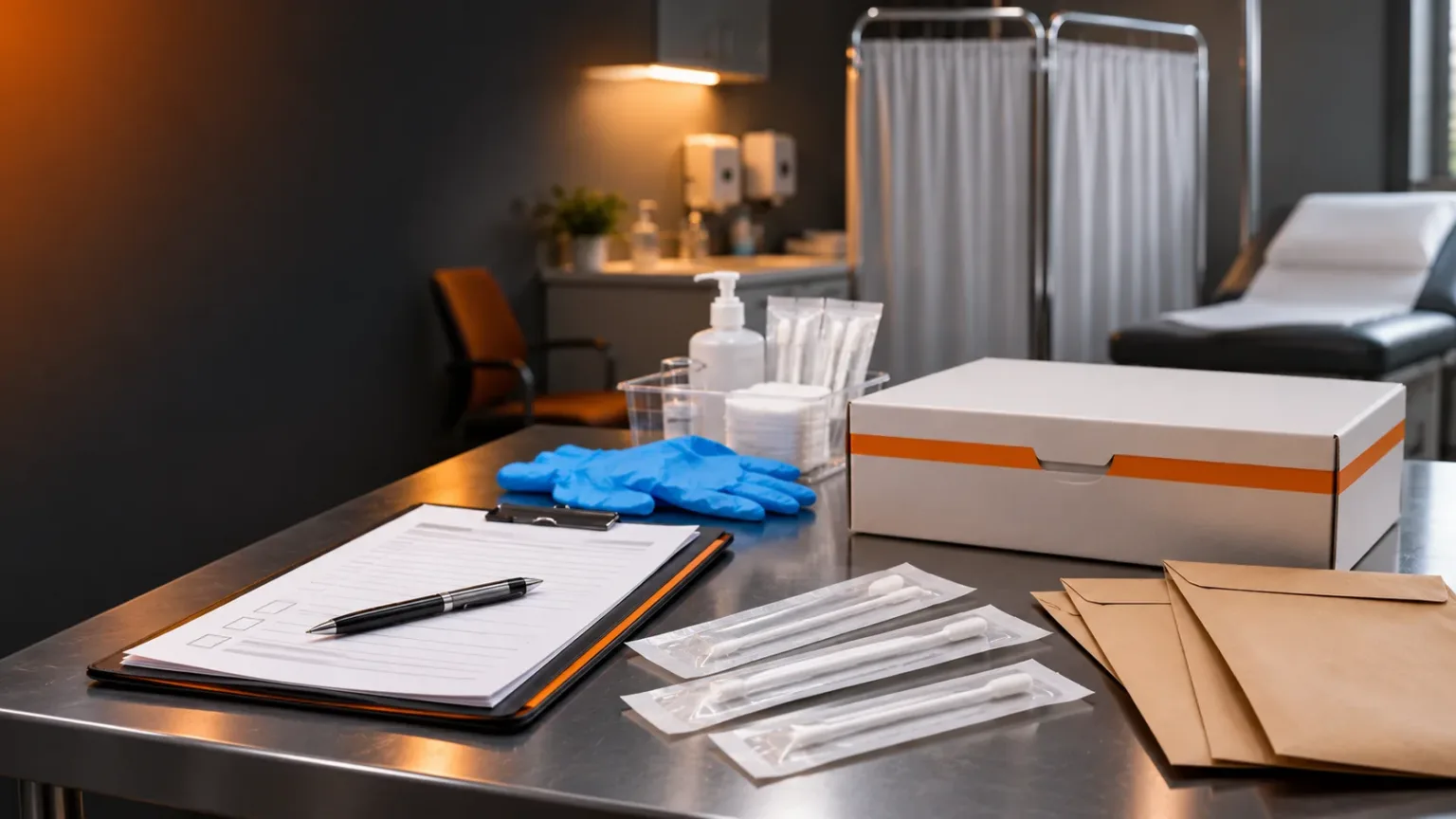
A sexual assault evidence collection kit commonly provides approved collection materials, specimen envelopes or containers, instructions and documentation forms. Its contents and sampling requirements vary across jurisdictions. Collection should be performed by a suitably trained and authorized clinician, with the patient’s consent and according to the applicable protocol. Specimens for clinical diagnosis and samples intended for external forensic analysis may require separate collection, labeling, destinations and record systems.[1][2][14]
Do not label every unperformed kit component as a failure. A specimen may not be indicated by the history, may be medically inappropriate or may be declined. The reason for an omitted step should be recorded in an accurate, nonjudgmental way without unnecessary intimate detail.
A completed kit is not synonymous with a completed investigation. It represents evidence collected at one stage, which then requires appropriate preservation, transfer, prioritization, analysis, reporting and communication. The NIJ’s multidisciplinary best-practices publication emphasizes tracking across the entire kit lifecycle.[6]
Figure 2. Forensic evidence collection and custody pathway
Trained examiner; record site, time and consent
Unique sample and kit identifiers
Dry/contain under specimen-specific requirements
Seal status and traceable custody changes
Authorized holding, transport and lab receipt
Clinical specimens and external forensic evidence may take different routes. This diagram does not authorize disclosure or transfer without the necessary legal basis.
Evidence packaging, drying, labeling and preservation
Wet biological material may support microbial growth, redistribution and degradation if kept damp. Where required, swabs and other biological samples should be dried in a clean, controlled environment before appropriate routine packaging. Clothing items are commonly packaged separately in clean paper or other laboratory-approved breathable containers once dry. Liquid blood, urine or other designated specimens need secure leakproof tubes, suitable secondary containment and condition-specific storage; there is no universal paper-bag rule.[1][7]
Sometimes a wet or leaking exhibit cannot be dried before urgent transfer. A short period in an approved leak-resistant container may be necessary to protect other material and people, with prompt arrival at a controlled drying or preservation facility. This is distinct from sealing damp clothing in ordinary plastic for prolonged storage. The receiving laboratory’s instructions govern exceptions, refrigeration, freezing, preservatives and transport times.[1][7]
Each item should be identifiable by case and exhibit/sample number, collector, collection date/time and relevant site or location. Maintain clear relationships between a kit, any separately submitted clothing, independent toxicology samples and subsequently created subsamples. Document openings and resealing. Evidential documentation should not be printed on or attached to a specimen in a way that alters an examination area.
Preventing cross-contamination between samples and locations
DNA recovered from sensitive samples may include very small quantities and multiple contributors. Controls extend beyond gloves to workspaces, collection instruments, face covering, supply storage and movement between sites or persons associated with the case. Change gloves at appropriate points, use separate approved collection supplies and protect unused materials from contact with exposed evidence.[4][13]
A medical-forensic examination room requires cleaning, appropriate zoning and consumable controls suited to its tasks. Trace and DNA material can also be carried between an examination facility and an external crime scene by clothing, equipment or vehicles. The Forensic Science Regulator updated its medical-examination DNA contamination guidance in September 2025; it should be applied within its jurisdiction and activity scope, rather than misrepresented as a global statutory rule.[4]
When collection order affects another examination, document the decision. For example, photographic documentation of a visible mark may be needed before swabbing, and loose particles on clothing may need assessment before extensive handling. See our forensic DNA contamination-control guide for a detailed quality framework.
Drug-facilitated sexual assault: early evidence and interpretation
Suspected drug-facilitated sexual assault requires clinical assessment and, where indicated and consented to, prompt consultation about forensic-toxicology sampling. Some drugs can disappear from blood and urine rapidly, and a toxicology test intended for medical treatment may have a different purpose, sensitivity and documentation route from a forensic specimen. The DOJ Third Edition protocol discusses early urine collection and blood collection within shorter intervals for relevant cases, with handling and preservatives determined by the appropriate laboratory.[1][11]
A patient may be uncertain about whether a substance was administered, particularly if there was sedation or memory loss. Ask without making assumptions. A negative toxicology result does not rule out ingestion, exposure or the reported event; possible explanations include elapsed time, analyte stability, testing scope and concentration. Hair or other later-collected specimens may be considered by specialists in selected circumstances, but cannot simply be treated as replacements for early samples.[11]
Early evidence kits may assist trained personnel in a program with lawful consent and approved protocols while a comprehensive examination is being arranged. They are not a substitute for medical assessment, and access to urgent HIV/STI care must not be delayed for sampling.
Documentation: findings, photographs and the patient’s account
Use neutral, descriptive language. Document relevant history as reported, time and source of the information, examination findings, sample sites and collection methods, any consent limits, items not collected and the reasons. Notes should distinguish what the clinician observed from what a patient or another professional reported. Avoid conclusions such as ‘no assault’ based on the absence of injury or semen.[1][3][12]
Medical-forensic photography may assist with documenting injuries and relevant findings, but intimate images require clear explanation, consent or another lawful basis, appropriate dignity measures, secure storage, restricted access and formal handling procedures. Not all patients consent to photography; images should never be taken or disseminated informally. Any examination findings must be interpreted with awareness that normal anatomy or lack of visible injury is common and does not establish consent.[1][12]
Digital evidence such as messages or location records should be obtained lawfully and proportionately. The fact that a person used a device before or after an event is not by itself an indicator of credibility, nor should electronic records be used to infer consent without careful interpretation of the wider circumstances.
Chain of custody, kit tracking and retention
Document each transfer of physical evidence with a unique identity, date/time, persons or units responsible, reason for transfer, storage location and relevant seal condition. Where a laboratory opens a kit, subsequent containers and subsamples must remain linked to their source. Evidence retained anonymously or without an immediate report requires particularly clear governance and tracking, including rules on storage, notification, later release and disposition.[6][7]
Retention periods, rights of access, notification systems and kit-submission deadlines are set by applicable legal and institutional rules; they are not universal. A chain-of-custody gap must be investigated and accurately reported where necessary, rather than assumed to prove interference or ignored because other evidence is strong.
Forensic DNA results: what they can and cannot establish
A DNA finding may support propositions about who contributed biological material to a sample. Depending on the specimen and analysis, other testing may indicate a body-fluid type, but a DNA profile alone does not establish whether the material was semen, when it was deposited, whether it was transferred indirectly, or whether a sexual act was consensual. Mixtures, background DNA and low-template limitations require careful evaluation.[1][12]
Likewise, absence of semen or spermatozoa is not proof that no sexual contact or assault took place. Ejaculation may not have occurred, a barrier may have been used, the contact may not involve semen deposition, material may be lost or samples may be below the method’s detection capability. The absence or presence of genital injury cannot independently establish consent.[1][12]
Sexual assault kits may support autosomal STR analysis, Y-STR profiling or other validated methods when appropriate. Each result must be interpreted within the case circumstances. Read Differential DNA Extraction for Sexual Assault Evidence for laboratory separation principles and Forensic DNA Reporting: Inclusion, Exclusion and Inconclusive Findings for interpretation limits.
Figure 3. Medical-forensic findings versus investigative questions
- Biological contributor information
- Potential contact or transfer evidence
- Observed injury or trace material
- Documented specimen integrity
- Whether consent was given
- Exactly when DNA was deposited
- Whether transfer was direct
- Whether a reported assault occurred
Interpret findings with competing explanations, other records, analytical limitations and applicable legal standards.
Four hypothetical training scenarios
Scenario 1: A patient presents several days after the reported event
Situation: An adult seeks care after an interval longer than the local routine body-sampling period and has changed clothes. Approach: Offer clinical care and explain available forensic options without a rigid automatic refusal. Ask whether clothing, bedding, digital records or other material remains available and document relevant post-event activities neutrally. If body specimens are still appropriate under local protocols, explain the limits and obtain consent. Limitation: Delayed collection changes potential recovery, but does not establish whether an assault occurred.
Scenario 2: The patient agrees to care but not an intimate examination
Situation: A patient wants assessment for injuries, pregnancy risk and infection but declines intimate sampling. Approach: Respect the decision and offer all clinically indicated care. Explain possible alternatives and any opportunities to reconsider, without pressure. Document what was accepted or declined and applicable consent arrangements. Limitation: The absence of a particular forensic specimen must not be portrayed as noncooperation or evidence against the report.
Scenario 3: Possible drug-facilitated assault with memory gaps
Situation: A patient reports unexplained drowsiness and fragmented recollection. Approach: Assess medical stability, explain why time-sensitive toxicology may be considered, seek consent and use an authorized clinical or forensic pathway. Document collection time, known or reported substance use and specimen handling. Limitation: A negative result does not exclude a substance that was not tested for or has already been eliminated.
Scenario 4: Two sets of clothing and a shared vehicle
Situation: Investigators receive clothing associated with two people and identify a possible common vehicle. Approach: Preserve the items separately, avoid cross-transfer through personnel or equipment, record their origins and consider evidence from the vehicle under appropriate authority. Coordinate with the laboratory before trace and DNA testing that could alter each other. Limitation: Shared DNA or fibers may be relevant to contact but do not by themselves establish the nature or voluntariness of an encounter.
These are hypothetical educational examples, not case-specific legal or clinical instructions.
Common misconceptions about sexual assault forensic evidence
Myth
Without visible injury, the reported sexual activity must have been consensual.
Reality
The presence or absence of injury cannot independently establish consent. Medical findings must be interpreted within the history and examination limitations.
Myth
A delayed report or bathing means there is no useful forensic evidence.
Reality
Some traces become less recoverable, but retained clothing, objects, communications and other specimens may remain relevant. Assessment should be individualized.
Myth
A patient must agree to every sample to receive medical care.
Reality
The patient may make separate decisions about examination components within the applicable consent and legal framework. Clinical care must not be used as leverage for evidence collection.
Myth
A negative semen or sperm result proves no sexual assault occurred.
Reality
Ejaculation or semen deposition may not have occurred, and detection is affected by timing, specimen selection and method limitations.
Myth
A DNA match establishes that sexual contact was nonconsensual.
Reality
A contributor-related finding alone does not establish consent, timing, transfer activity or the legal elements of an offence.
Myth
A negative drug screen excludes drug-facilitated assault.
Reality
Results depend on the substance, elapsed time, collection, storage and analytical scope. A substance may be undetected or already eliminated.
Sexual assault forensic response: quality checklist
Educational self-review only: checking an item does not establish laboratory QC acceptance.
Frequently asked questions
Frequently Asked Questions
How soon should a sexual assault forensic examination take place?
As soon as the patient is ready and the appropriate service is available, especially when medical prevention options or time-sensitive evidence are relevant. However, collection windows vary by specimen and jurisdiction. A delayed report should still receive medical assessment and consideration of remaining evidence.
Does bathing or changing clothes mean evidence cannot be collected?
No. These activities can affect some evidence, but do not automatically rule out a medical-forensic examination or recovery from other sources such as retained clothing, surfaces or digital records.
Can a patient refuse part of a sexual assault examination?
Generally, patients with decision-making capacity may decline individual examination or evidence-collection components; medical care remains available. Legal exceptions, safeguards and consent rules for minors or incapacitated patients depend on the jurisdiction.
Does the absence of injury mean sexual activity was consensual?
No. Lack of visible injury cannot establish consent. Clinical findings must be interpreted with the reported history, examination limitations and the totality of relevant evidence.
Is semen always found after sexual assault?
No. Semen may not have been deposited or may not remain detectable, and not all forms of sexual assault involve ejaculation or semen. The absence of spermatozoa does not by itself disprove a report.
What is a sexual assault evidence collection kit?
A jurisdiction-specific set of approved materials and documentation used by a trained, authorized clinician to collect potential forensic specimens with appropriate consent and evidence-handling controls.
Do all sexual assault forensic examinations require an immediate police report?
Not everywhere. Some jurisdictions allow nonreport or confidential collection in defined circumstances. Local laws, mandatory reporting duties, age, capacity and kit storage rules determine the available options.
How should clothing with possible biological evidence be stored?
Where required, items should be dried under controlled conditions and packaged separately in approved breathable materials. Liquid specimens and other special samples require different containment and storage; follow the receiving laboratory's instructions.
Can toxicology rule out drug-facilitated sexual assault?
No. Drug detection depends on the substance, time since possible exposure, sample type, analytic scope and storage. A negative result cannot exclude all possible exposures.
Does a DNA match establish a sexual assault occurred?
No. DNA evidence can inform contributor or transfer questions, but it does not alone establish consent, timing, manner of transfer or the legal elements of an offence.
Who should perform intimate medical-forensic sample collection?
An appropriately trained and legally authorized clinician or forensic examiner under the applicable clinical and evidentiary protocol, within the patient's consent and legal framework.
Related Simply Forensic Articles
References and guidance
Technical review date: 14 November 2026. The U.S. DOJ Third Edition is an advisory protocol for adult/adolescent examinations; U.K. regulator guidance and statutory requirements have jurisdictional scope. Clinical recommendations are not interchangeable with evidence-collection cutoffs, and local legal/clinical rules must be verified.
References & Sources
Show referencesHide references
- U.S. Department of Justice, Office on Violence Against Women. A National Protocol for Sexual Assault Medical Forensic Examinations: Adults/Adolescents, 3rd ed. (September 2024). Source
- U.S. Department of Justice, Office on Violence Against Women. Sexual Assault Medical Forensic Examination (SAFE) Information. Source
- UK Forensic Science Regulator. Forensic Medical Examination of Sexual Offence Complainants, Issue 2 (2025). Source
- UK Forensic Science Regulator. DNA ContaminationContamination - The unwanted transfer of material from another source to a piece of physical evidence. The inadvertent touching of a weapon, thereby adding fingerprints Read Full Definition Controls: Forensic Medical Examinations, FSR-GUI-0017, Issue 2 (September 2025). Source
- World Health Organization. Health Care for Women Subjected to Intimate Partner Violence or Sexual Violence: A Clinical Handbook (2014). Source
- National Institute of Justice. National Best Practices for Sexual Assault Kits: A Multidisciplinary Approach (2017). Source
- National Institute of Standards and Technology. The Biological EvidenceBiological evidence - physical evidence such as bodily fluids that originated from a human, plant or animal. Read Full Definition Preservation Handbook: Best Practices for Evidence Handlers, NISTIR 7928 (2013). Source
- U.S. Centers for Disease Control and Prevention. Clinical Guidance for PEP (updated October 7, 2026). Source
- U.S. Centers for Disease Control and Prevention. Sexual Assault and Abuse and STIs: STI Treatment Guidelines. Source
- World Health Organization. Emergency Contraception: Fact Sheet (2021). Source
- National Institute of Justice. Addressing the Challenges of Detecting Drug-Facilitated Sexual Assault (September 2024). Source
- Crown Prosecution Service, England and Wales. Rape and Sexual Offences Prosecution Guidance (current guidance, accessed November 2026). Source
- UK Forensic Science Regulator. Contamination Controls: Scene of Crime, FSR-GUI-0016 (2023). Source
- National Library of Medicine, StatPearls. Sexual Assault: Trauma-Informed Approach, Evaluation, Evidence Collection, and Documentation (2026). Source
Educational notice: This guide is intended for forensic education and does not replace emergency medical care, trained medical-forensic assessment, patient consent, safeguarding, organizational SOPs, local law or independent forensic interpretation.