

Differential DNA DNA, or Deoxyribonucleic Acid, is the genetic material found in cells, composed of a double helix structure. It serves as the genetic blueprint for all living organisms. Read Full Definition extraction is a forensic cell-separation approach used primarily for biological mixtures containing spermatozoa and non-sperm cells. Its purpose is to reduce the complexity of a mixed DNA sample before STR profiling by recovering a non-sperm fraction and a sperm-enriched fraction. Separation is not guaranteed: both fractions may contain DNA from more than one contributor.
- Why differential extraction matters in sexual-assault evidence
- Scientific principle: selective lysis
- Conventional differential extraction workflow
- Understanding epithelial and sperm fractions
- Common challenges and limitations
- Incomplete sperm recovery
- Cross-fraction DNA carryover
- Mixtures without detectable sperm
- Low-template and degraded evidence
- Differential extraction versus direct extraction
- Alternative sperm-separation technologies
- Quality control and method validation
- Interpreting results from differential extraction
- Frequently asked questions
- Does differential extraction guarantee a pure sperm DNA profile?
- Is differential extraction a fifth DNA purification method?
- Can a sperm fraction contain female DNA?
- Is differential extraction always required for sexual-assault samples?
- Selected references and technical guidance
Unlike organic, Chelex, silica or magnetic-bead extraction, differential extraction describes selective cell lysis and fractionation. DNA from each fraction still requires an appropriate purification or preparation procedure. See our comparison of forensic DNA extraction methods.
Why differential extraction matters in sexual-assault evidence
Sexual-assault samples may contain abundant epithelial DNA alongside a smaller amount of sperm-derived DNA. Direct extraction can produce a complex mixture in which the major contributor’s alleles Alleles are different forms of a gene resulting from mutations or variations in the DNA sequence or gene expression. They can be dominant (expressed with one copy) or recessive (expressed only with two copies). Read Full Definition mask or complicate interpretation of a minor contributor. Differential extraction attempts to enrich sperm-associated DNA in one fraction while retaining DNA released from other cells in another.
It does not establish how biological material was deposited, when it was deposited, whether sexual contact was consensual or whether a detected contributor committed an offence. These questions require independent contextual and evidential assessment.
Scientific principle: selective lysis
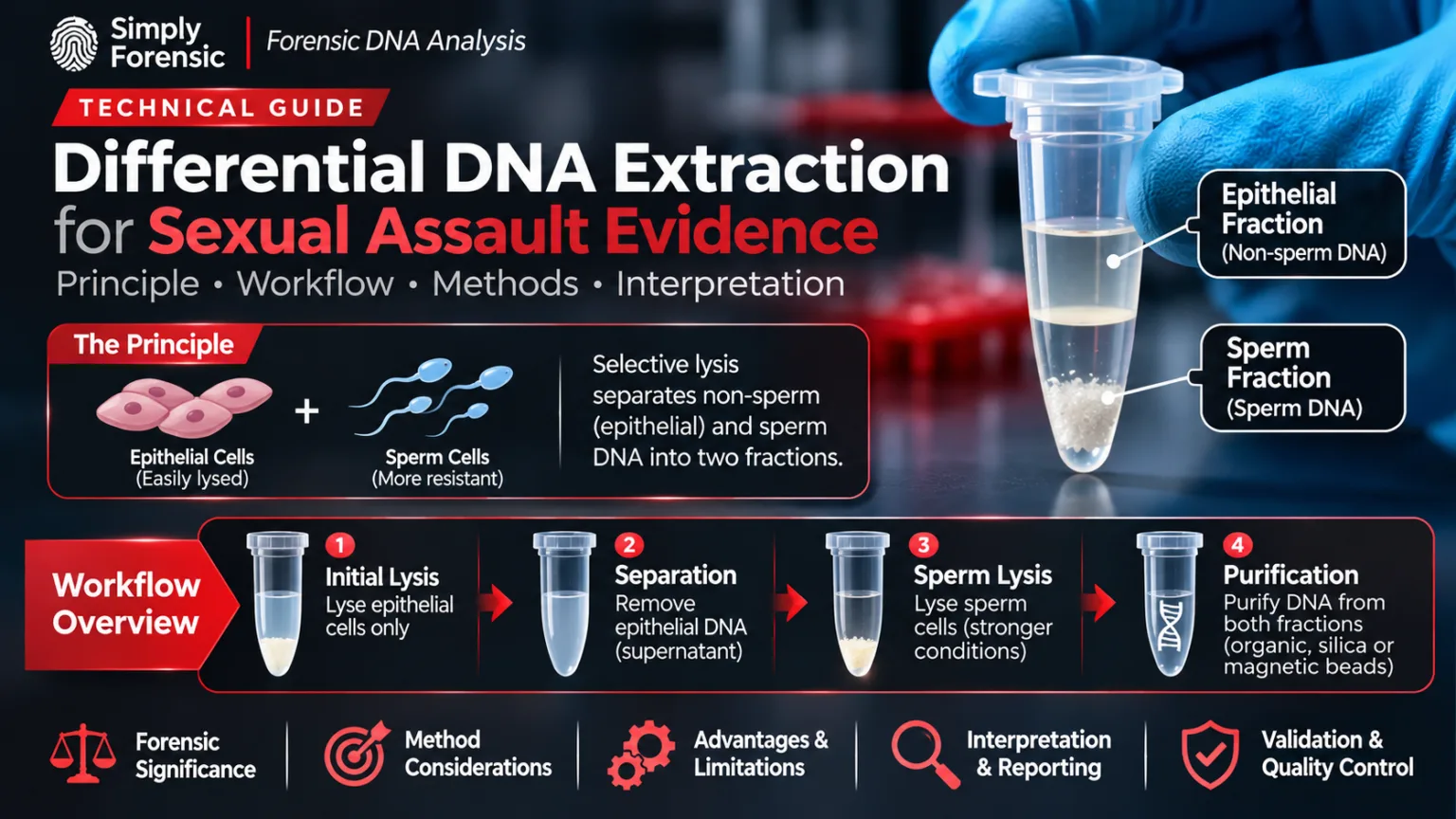
Many non-sperm cells are susceptible to an initial detergent/proteinase-based lysis. Mature sperm heads are comparatively resistant because their nuclear DNA is tightly packaged with protamines and stabilised by disulfide bonds. Under a validated differential procedure, the first treatment preferentially releases DNA from non-sperm cells while leaving a proportion of sperm heads intact. The sperm-containing material is separated, often washed, and subsequently treated under stronger reducing conditions to release sperm DNA.
The distinction is relative, not absolute. Damaged sperm can lyse during the first stage; incompletely lysed epithelial cells can remain with the pellet; and soluble DNA may transfer between fractions.
Conventional differential extraction workflow
- Evidence
 Evidence is any form of proof, such as objects, materials, or scientific findings, presented to establish or disprove a fact in a legal proceeding. It is used to reconstruct events and link or exclude individuals Read Full Definition sampling and documentation: Identify the swab, cutting or other specimen, record its source, and use validated controls and clean handling practices.
- Initial non-sperm lysis: Apply the validated selective lysis conditions to release DNA preferentially from epithelial and other susceptible cells.
- Fraction separation: Separate the liquid containing released DNA from the residual cell material. This produces a non-sperm fraction and a sperm-enriched pellet, not necessarily pure fractions.
- Pellet washing: Wash residual material as specified by the validated method to reduce carryover of soluble non-sperm DNA, while monitoring possible sperm loss.
- Sperm lysis: Apply the validated sperm-lysis treatment, often including a reducing agent, to disrupt sperm nuclear packaging and release DNA.
- DNA purification: Process each fraction using a validated organic, silica or magnetic purification workflow, or another validated approach.
- Quantification and profiling: Quantify and assess each fraction, then select appropriate autosomal STR, Y-STR or other downstream testing according to laboratory policy.
This is a conceptual workflow, not a substitute for a laboratory SOP. Reagent formulations, incubation conditions, wash steps and transfer procedures vary by validated method.
Understanding epithelial and sperm fractions
| Fraction | Intended enrichment | Important caution |
|---|---|---|
| Non-sperm / epithelial fraction | DNA released during initial lysis | May contain sperm-derived DNA if sperm are damaged or prematurely lysed. |
| Sperm-enriched fraction | DNA released after sperm-head lysis | May retain epithelial DNA or other contributors despite washing. |
Labels such as “epithelial fraction” and “sperm fraction” describe the processing pathway. They do not independently prove that the resulting DNA originated exclusively from epithelial cells or spermatozoa.
Common challenges and limitations
Incomplete sperm recovery
Some sperm may be lost during separation and washing or may not lyse efficiently during the final treatment. Low sperm numbers, damaged sperm and sample-substrate interactions can reduce recovery.
Cross-fraction DNA carryover
Non-sperm DNA may persist in the sperm-enriched fraction, while sperm DNA may appear in the non-sperm fraction. Consequently, profiles from both fractions should be evaluated on their own merits rather than assuming that a nominal sperm fraction contains a single male contributor.
Mixtures without detectable sperm
Absence of sperm on microscopy or in an examined portion does not exclude male DNA, sexual contact or other relevant biological material. Conversely, the presence of male DNA does not establish that it originated from sperm. Non-sperm mixtures may require alternative strategies.
Low-template and degraded evidence
Each transfer and wash can reduce recoverable DNA. Old, environmentally exposed or heavily washed evidence may contain degraded or low-level material, making method choice and downstream interpretation especially consequential.
Differential extraction versus direct extraction
Direct extraction lyses the sampled material without first separating cell populations. It can preserve material that might otherwise be lost during fractionation, but may produce complex mixtures. Differential extraction seeks enrichment of distinct cell populations, potentially simplifying interpretation, at the cost of additional handling and possible cell or DNA loss. Laboratories should base the choice on casework context, screening findings and validated performance.
Alternative sperm-separation technologies
Investigated alternatives include selective chemical lysis, filtration, density-based separation, microfluidics, laser capture microdissection and cell sorting. These methods differ in processing time, sperm recovery, separation purity, instrument requirements and compatibility with downstream profiling. An alternative is not necessarily superior merely because it is more automated or technically complex.
Quality control and method validation
The FBI Quality Assurance Standards for Forensic DNA Testing Laboratories require internally validated analytical procedures and relevant reagent blankSpecimen or sample not containing the analyte or other interfering substances. Read Full Definition controls. Differential extraction validationValidation, often referred to as method validation, is a crucial process in the laboratory when introducing a new machine, technology, or analytical technique. It involves a series of systematic steps and assessments to ensure that Read Full Definition should consider realistic sperm-to-epithelial cell ratios, low-level sperm, degraded samples, common substrates, sperm recovery, cross-fraction carryover, contaminationContamination - The unwanted transfer of material from another source to a piece of physical evidence. The inadvertent touching of a weapon, thereby adding fingerprints to it is an example of evidence contamination. Read Full Definition, reproducibility and the downstream STR performance of each fraction.
Record parent specimen identifiers, fraction designations, tube transfers, extraction blanks, batch assignments and any repeat processing. Both fractions should remain traceable to the original evidence item.
Interpreting results from differential extraction
Interpretation should begin with the actual electropherograms and validated mixture-interpretation procedures, not the name of the fraction. A sperm-enriched fraction may yield a single-source profile, a major/minor mixture, a complex mixture or insufficient information. The non-sperm fraction may likewise contain male and female DNA. Where relevant, Y-STR analysis can provide paternal-lineage information but does not uniquely identify an individual male.
Quantification results, including human and male-target concentrations where available, can inform downstream decisions but cannot by themselves establish cellular origin or fraction purity. Reporting should distinguish observed genetic findings from assumptions about the source or activity that produced the evidence.
Frequently asked questions
Does differential extraction guarantee a pure sperm DNA profile?
No. Separation efficiency depends on cell numbers, condition, substrate and protocol. Both fractions can contain mixtures.
Is differential extraction a fifth DNA purification method?
No. It is primarily a cell-separation and selective-lysis strategy. The resulting fractions can subsequently undergo organic or solid-phase purification.
Can a sperm fraction contain female DNA?
Yes. Epithelial DNA can carry over into the sperm-enriched fraction, so the observed profile must be interpreted rather than assumed to be exclusively sperm-derived.
Is differential extraction always required for sexual-assault samples?
No. The appropriate workflow depends on the specimen, screening results, anticipated contributors and the laboratory’s validated methods.
Selected references and technical guidance
- Chapman BR, Blackwell SJ, Müller LH. Forensic techniques for the isolation of spermatozoa from sexual assault samples: a review. Forensic ScienceDiscover the fascinating field of Forensic Science, the application of scientific principles to legal matters. This post delves into its many disciplines, from DNA analysis to crime scene investigation, its importance in the justice system, Read Full Definition Review. 2020.
- Analytical approaches to differential extraction for sexual assault evidence. 2020.
- Evaluating novel and conventional cell-separation techniques for sexual assault investigations.
- FBI. Quality Assurance Standards for Forensic DNA Testing Laboratories, effective July 2025.
- SWGDAM. DNA analysis method validation and interpretation guidance.