

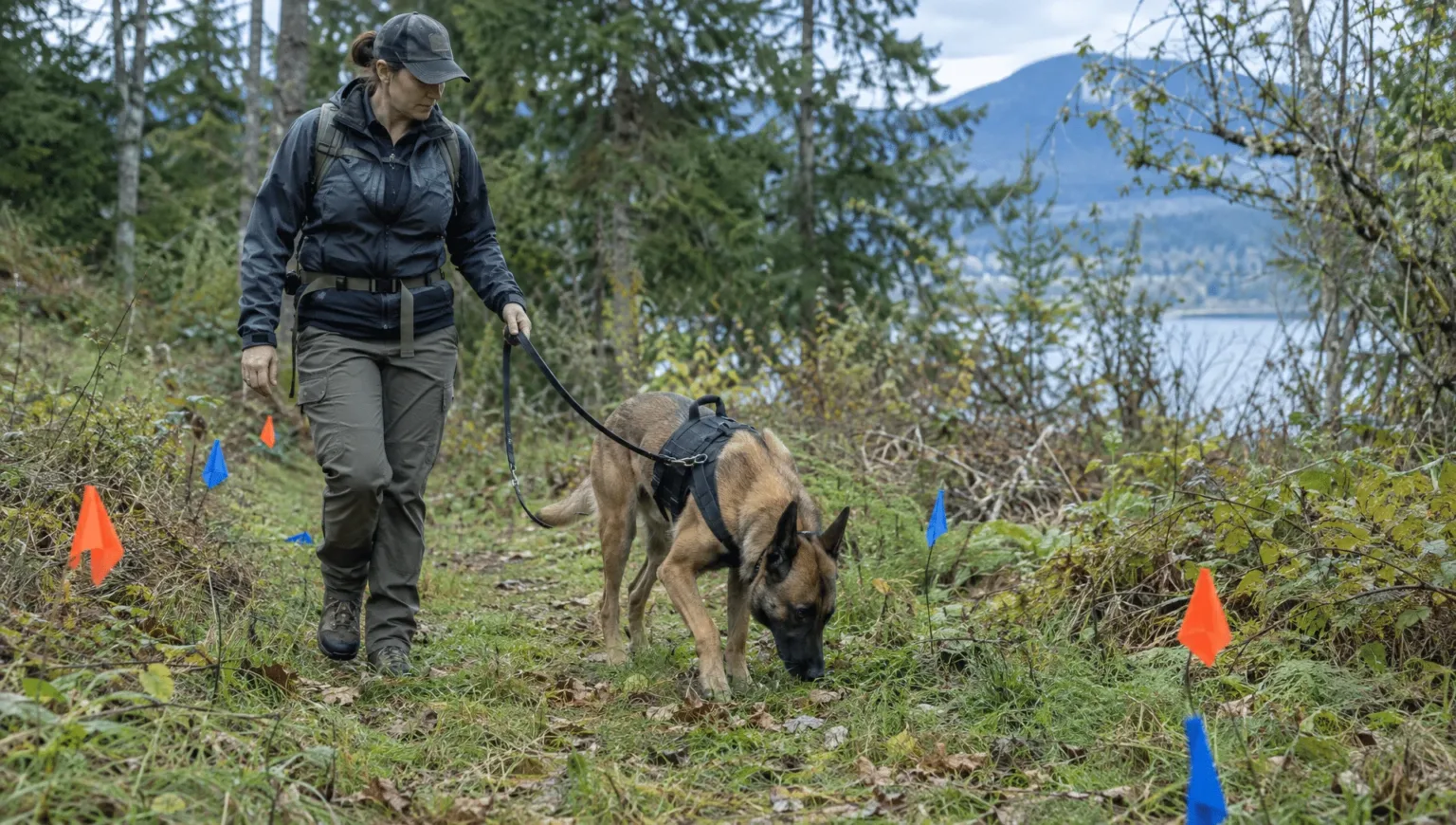
A trained detection dog’s alert may help investigators locate relevant material, but an alert does not automatically establish the identity, age or source of what was detected. In forensic investigations, dogs and their handlers work as a team. Performance depends on the target odor, training, environment, search design and how results are interpreted.
- How do forensic detection dogs work?
- Major forensic detection applications
- Why certification and training matter
- False alerts, missed targets and inconclusive searches
- Why blind and double-blind tests are useful
- Factors affecting field performance
- Example: a search for buried human remains
- What should investigators document?
- What a canine alert does not prove
- Standards and sources
Detection dogs can support searches for human remains, explosives, drugs and selected other targets. Different detection disciplines require different training materials, performance evaluations, handling practices and scientific assumptions. A canine trained for one odor task should not be assumed to be qualified for a different application.
How do forensic detection dogs work?
Dogs respond to odor information, which can arise from mixtures of volatileIn scientific and chemical contexts, the term "volatile" describes a substance that has the propensity to evaporate or change from a liquid state to a gaseous state readily at normal or room temperatures. Volatility is Read Full Definition compounds associated with particular target materials. The handler guides the search and interprets trained behavioral responses. The team’s performance is therefore affected both by biological sensing and human decisions.
Field searches differ from laboratory chemical tests. Odor may be diluted, trapped, transported or masked; targets may be absent or hard to access; and the exact chemical composition can differ with environmental conditions.
Major forensic detection applications
| Application | What the team seeks | Interpretation caution |
|---|---|---|
| Human remains detection | Odor associated with decomposition or human remains | An alert does not prove recoverable remains are directly below the location |
| Explosives detection | Trained target odors associated with explosive materials | An alert does not identify an exact explosive formulation without other evidence Evidence is any form of proof, such as objects, materials, or scientific findings, presented to establish or disprove a fact in a legal proceeding. It is used to reconstruct events and link or exclude individuals Read Full Definition |
| Narcotics detection | Specified drug-associated odor targets | Residual odor or transfer may affect what an alert means |
| Specialist searches | Other validated target-odor categories | Capability and error characteristics are task specific |
Why certification and training matter
CertificationCertification is a process through which a scientist can demonstrate their knowledge and competence in a particular field or in performing specific assays. It involves meeting established standards and requirements set by a certifying body. Read Full Definition tests whether a canine-handler team achieves defined performance criteria in a specified discipline. Maintenance training and reassessment are needed because performance can change. Records should document odors trained, search environments, outcomes, errors and remediation.
As of October 2026, NIST’s OSAC Standards Library lists ANSI/ASB Standard 076-26 concerning training and certification for detecting human remains on land. The catalogue also includes ANSI/ASB Standard 088-20 on general guidelines for training, certification and documentation of canine detection disciplines.
These documents concern training and certification. They do not establish that every operational alert is correct or that results can be interpreted identically across all search contexts.
False alerts, missed targets and inconclusive searches
A false alert is a trained indication given when the assessed target is absent under the evaluation’s ground truth. A miss occurs when a target is present but not indicated. Both rates depend on how the search task and denominators are defined. BlankSpecimen or sample not containing the analyte or other interfering substances. Read Full Definition searches are necessary because tests containing a target every time cannot adequately characterize some forms of false-alert behavior.
An operational non-alert also has limits: the dog may not have encountered a detectable odor plume, the target odor may be absent or obstructed, conditions may be unfavorable, or the team may miss the target. It does not prove that no relevant evidence exists in the area.
Why blind and double-blind tests are useful
If the handler knows where a target is hidden, unintentionally altered movement, attention or handling may affect the dog. In a double-blind evaluation, neither the handler nor the observer who interacts with the team knows which search positions contain target odor or whether a blank search is being presented. This helps separate odor detection from inadvertent cues.
The NIST OSAC Lexicon provides an operational definition of canine double-blind testing. Not every operational search can be designed as a blind experiment, but competency assessments can document whether handlers and assessors were blinded.
Factors affecting field performance
- Wind, airflow and temperature: influence odor movement and availability.
- Humidity, precipitation and surfaces: may modify odor retention and movement.
- Terrain, clutter and access: influence how much of a search area can be investigated.
- Target amount and age: may affect the odor available to the team in task-dependent ways.
- Training and experience: can alter response to novel backgrounds and distracting odors.
- Handler expectation and feedback: may affect search behaviour or interpretation if not controlled.
No universal detection probability can be inferred from a dog’s breed, years of service or one certification result. Operational capability requires evidence specific to the team and task.
Example: a search for buried human remains
A canine team alerts in an outdoor area where investigators suspect burial. The alert can guide a systematic search plan involving scene documentation, geological or geophysical assessment and other investigative information. It should not be recorded as definitive proof that human remains exist at that exact point. Search teams document the location, environmental conditions, handler response and any follow-up recovery.
A later excavation that finds no human remains does not automatically reveal why the alert occurred. The explanation could involve target absence, odor movement, residual odor, environmental interference or handler-team performance. Conclusions should reflect the available evidence rather than speculative certainty.
What should investigators document?
- Team identity, training and current certification for the specific detection task.
- Search area, route, conditions, restrictions and known contaminationContamination - The unwanted transfer of material from another source to a piece of physical evidence. The inadvertent touching of a weapon, thereby adding fingerprints to it is an example of evidence contamination. Read Full Definition concerns.
- Whether the search and any evaluation were blind or non-blind.
- Alert location, behavior and handler interpretation, clearly separated from evidence recovered later.
- Searches yielding no alerts, interruptions and relevant follow-up results.
What a canine alert does not prove
It does not independently identify a suspect, establish the timing of an alleged Alleged is a term used in legal contexts to describe an accusation or claim that has been made against an individual but has not yet been proven or confirmed. Read Full Definition crime, chemically identify a material, or guarantee that evidence is present in the location where the handler marked an alert. Its strongest use is often as a properly documented investigative aid, to be assessed alongside independent evidence and relevant performance data
 Information in analog or digital form that can be transmitted or processed. Read Full Definition.
Read Simply Forensic’s crime scene investigation overview and trace evidence guide for related search and recovery concepts.
Standards and sources
- NIST OSAC: ANSI/ASB Standard 076-26, Training and Certification of Canine Detection of Human Remains on Land.
- NIST OSAC Standards Library: ANSI/ASB Standard 088-20, general canine detection training and documentation.
- NIST OSAC Lexicon: Double-Blind Assessment/Double-Blind Testing.
- National Institute of Justice (2018). Dog and Sensor Subcommittee and standards for detector teams.
The operational example is hypothetical. A detection canine’s role, admissibility and documentation requirements vary by jurisdiction and detection specialty.