

Forensic DNA DNA, or Deoxyribonucleic Acid, is the genetic material found in cells, composed of a double helix structure. It serves as the genetic blueprint for all living organisms. Read Full Definition mixture interpretation involves more than recognizing extra STR peaks. The analystA designated person who examines and analyzes seized drugs or related materials, or directs such examinations to be done; independently has access to unsealed evidence in order to remove samples from the evidentiary material for Read Full Definition must establish which signals can be treated as alleles
 Alleles are different forms of a gene resulting from mutations or variations in the DNA sequence or gene expression. They can be dominant (expressed with one copy) or recessive (expressed only with two copies). Read Full Definition, decide whether one or more contributors are represented, assess whether any individual genotype can be reliably inferred, and determine whether the evidence
 Evidence is any form of proof, such as objects, materials, or scientific findings, presented to establish or disprove a fact in a legal proceeding. It is used to reconstruct events and link or exclude individuals Read Full Definition is suitable for comparison and statistical evaluation. Some mixtures contain a clear major contributor. Others have similarly strong components whose individual genotypes cannot be separated confidently. An unresolved mixture is not necessarily an uninterpretable mixture.
- Single-source, distinguishable and indistinguishable: what do these terms mean?
- First establish analytical quality and credible alleles
- Example 1: an apparent single-source STR profile
- Example 2: a distinguishable major–minor two-person mixture
- Example 3: an indistinguishable or unresolved two-person mixture
- Shared alleles, stutter and dropout: why apparent separation can fail
- Allele sharing can hide a contributor
- A peak at a stutter position can have two sources
- A peak above a stochastic threshold may still conceal dropout
- What about three or more contributors?
- Assumed contributors and conditional deconvolution
- From interpretation to statistical evaluation
- A practical forensic DNA mixture interpretation workflow
- How should the findings be reported?
- Common interpretation mistakes and how to avoid them
- Why validation and reproducibility matter
- Key takeaways
- Frequently asked questions
- Scientific references and further reading
This guide focuses on single-source profiles, distinguishable major–minor mixtures, and indistinguishable or unresolved mixtures generated by autosomal STR analysis. It builds on our electropherogram interpretation guide and worked guide to number of contributors (NOC). All genotype tables and peak heights below are synthetic teaching examples, not casework data Information in analog or digital form that can be transmitted or processed. Read Full Definition or universally applicable interpretation thresholds.
KEY LEARNING POINTS
- A single-source-looking profile does not prove that only one person deposited DNA.
- A distinguishable mixture may permit inference of a major genotype and sometimes part or all of a minor genotype.
- Similar peak-height contributions can make genotype pairings unresolved even when a mixture is clearly present.
- Shared alleles, stutter and dropout can defeat simple peak-height subtraction.
- Any statistical assessment must follow the laboratory’s validated methods and explicitly stated propositions.
Single-source, distinguishable and indistinguishable: what do these terms mean?
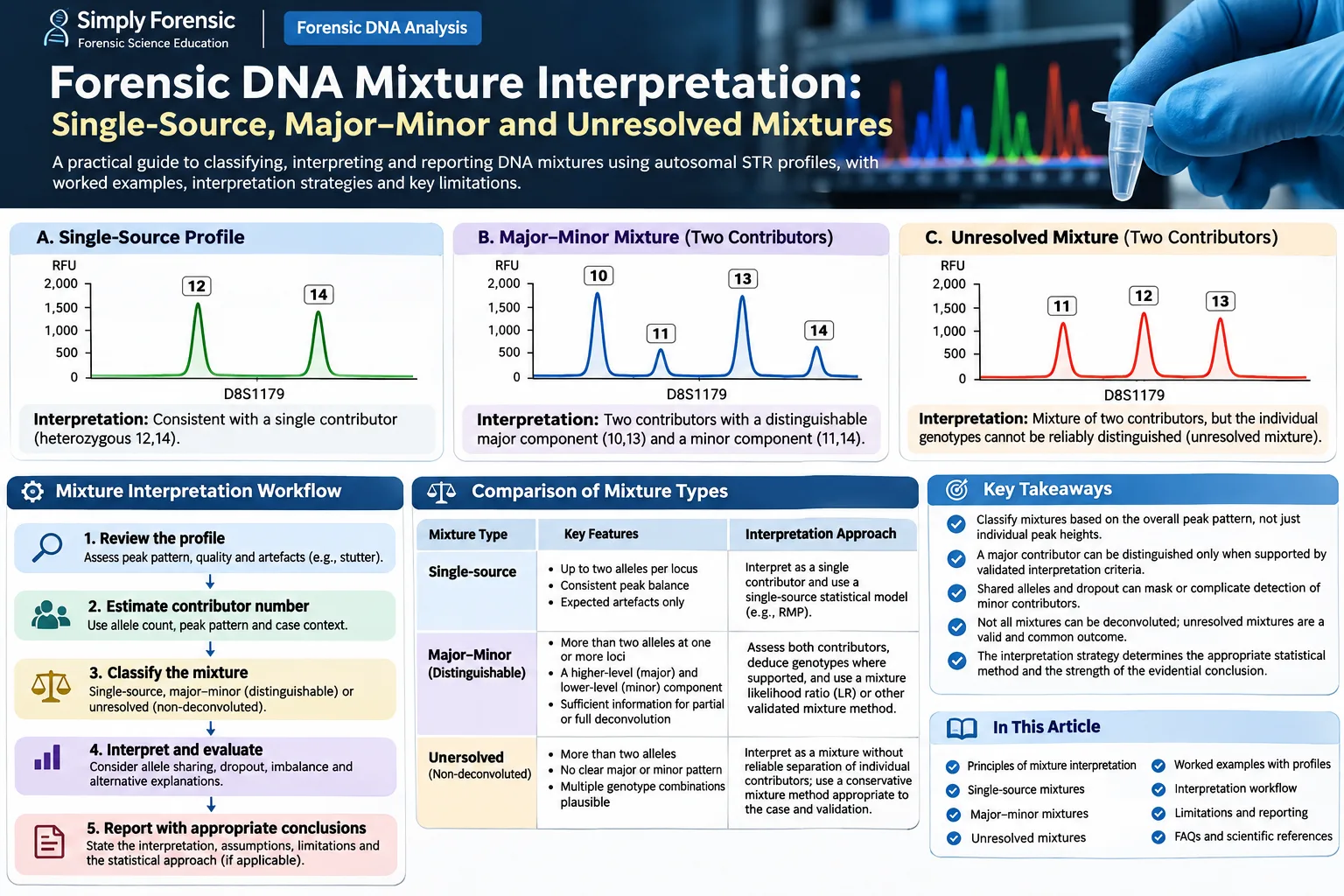
SWGDAM’s 2021 autosomal STR interpretation guidelines describe a distinguishable two-person mixture as one in which relative peak-height patterns support interpretation of the major genotype and possibly the minor genotype. An indistinguishable two-person mixture may contain similar contributions such that individual genotypes cannot be confidently assigned. Importantly, SWGDAM states that an indistinguishable mixture may still be interpretable.
| Profile description | Typical observation | What may be interpreted | Critical limitation |
|---|---|---|---|
| Apparent single source | Generally one or two credible alleles per ordinary autosomal locus A locus is the precise position of a gene on a chromosome. Different alleles of the same gene occupy the same locus. Read Full Definition, with coherent balance | A supported single-source genotype at informative loci | Additional contributors can share alleles or be below detection |
| Distinguishable mixture | Evidence of two or more contributors with a reproducible contrast in component signal | Major genotype; sometimes partial or full minor genotype | Sharing, dropout or stutter may prevent complete deconvolution |
| Indistinguishable / unresolved mixture | Multiple credible alleles but no defensible component separation | Possible genotype combinations or statistical evaluation of the mixture as a whole | Individual contributor genotypes may remain uncertain |
| Unsuitable result | Too little reliable information or unacceptable analytical quality for a specified evaluation | Only observations or limitations permitted by the validated procedure | No unsupported inclusion or exclusion should be drawn |
These categories describe the information in the result, not genetic similarity between people. The UK Forensic Science Regulator’s mixture guidance also cautions that terms such as major, prominent, minor and complex are not uniformly applied by all laboratories; they must be defined in reports and procedures.
First establish analytical quality and credible alleles
The classification of a mixture must follow review of the analytical run and data quality. Relevant questions include whether positive and negative controls passed, the internal size standard and allelic ladder were acceptable, sizing was reliable, and all peaks were appropriately classified. The analyst must distinguish true allele candidates from non-allelic signals such as stutter, pull-up, minus-A products, spikes or baseline noise. Off-scale fluorescence can compromise quantitative interpretation.
Next, evaluate the profile across all loci. Consider heterozygote peak-height balance, degradation patterns, inhibition, overall signal, possible allele dropout, and whether apparent additional alleles occur consistently across loci. The number of observed allele positions establishes only part of the picture. For a separate treatment of counting and allele sharing, see our NOC article.
Under the 2025 SWGDAM probabilistic-genotyping guidance, laboratories must establish criteria for which results are suitable for comparisons or software analysis. If a contributor-number assignment is required, the initial assessment is to be made without reference to the person of interest’s genotype, subject to properly justified assumed contributors.
Example 1: an apparent single-source STR profile
Consider a synthetic profile with the following observations. The figures are deliberately uncomplicated and are assumed to have passed the laboratory’s quality and artefact checks.
| Locus | Observed alleles (peak heights) | Initial interpretation |
|---|---|---|
| Illustrative locus A | 10 (1,250 RFU); 12 (1,180 RFU) | Well-balanced apparent heterozygote 10,12 |
| Illustrative locus B | 9 (2,200 RFU) | Single peak consistent with homozygote 9,9, subject to dropout assessment |
| Illustrative locus C | 15 (1,210 RFU); 17 (1,120 RFU) | Well-balanced apparent heterozygote 15,17 |
Reasoning: There is no convincing evidence of additional allele positions in this example. With suitable quantity, quality, controls and validated stochastic criteria, a single-source interpretation may be supported. But one or two alleles per locus do not mathematically prove that only one person contributed to the item. A second person could possess the same alleles at the examined loci or contribute too little DNA to produce separately detectable signals.
A locus displaying one allele should not be called homozygous solely because a second allele is absent. Consider the risk of allelic dropout under the laboratory’s method and the characteristics of the whole sample. The eventual weight of a comparison is a separate question from the profile classification.
Example 2: a distinguishable major–minor two-person mixture
In a distinguishable mixture, component signals are sufficiently different and coherent to support some genotype assignment under the laboratory’s validated method. The following artificial two-person dataset illustrates the principle, not a fixed mixture-ratio criterion.
| Illustrative locus | Credible peaks and heights | Candidate major genotype | Candidate minor genotype |
|---|---|---|---|
| A | 10: 1,800; 12: 1,650; 13: 420; 14: 380 RFU | 10,12 | 13,14 |
| B | 8: 1,900; 9: 2,100; 11: 350 RFU | 8,9 | 9,11 (shared allele 9) |
| C | 14: 1,700; 16: 1,580; 18: 300; 20: 340 RFU | 14,16 | 18,20 |
Stage 1 — Recognize the mixture. Four credible allele positions at loci A and C indicate that a single ordinary diploidDiploid is the quality of a cell or organism having two sets of chromosomes, one from each parent. Sexually reproducing organisms are diploid. In humans, only their egg and sperm cells are haploid. Read Full Definition source cannot explain these observations. Before attempting deconvolution, assess whether the extra peaks could instead be non-allelic artefacts.
Stage 2 — Examine component separation. At loci A and C, the two prominent peaks are substantially higher than the other two. Across this synthetic profile, the pattern is compatible with a stronger component and a weaker component. The grouping is a proposed interpretation supported by the cross-locus pattern and the exercise’s stated quality assumptions; it is not guaranteed from peak height alone.
Stage 3 — Recognize the shared peak. At locus B, the 9 peak is larger than the 8 peak, but it is also shared between the proposed major 8,9 and minor 9,11 genotypes. Its signal includes both sources. The 9 peak must not be assigned wholly to the major contributor, and the minor contributor’s genotype cannot be inferred by subtracting a presumed fixed number of RFU from the total.
Stage 4 — Consider dropout and stutter. Even where a major genotype appears clear, a low-level minor component might have alleles near the analytical limit or at stutter positions. At a tetranucleotide locus, for example, a weak signal one repeat below a prominent allele may be stutter, a genuine minor allele, or a combination of both. The synthetic locus C uses widely separated minor-allele positions to keep this particular teaching example straightforward; real casework often lacks that simplicity. Ambiguous loci could permit a partial minor genotype rather than a full genotype, or might be unsuitable for a categorical minor comparison.
Stage 5 — Interpret across the full profile. In casework, a valid major/minor conclusion depends on all examined loci, validated peak-height balance and mixture-ratio expectations, and the sample’s condition. The numerical peaks shown are simply invented to teach this reasoning; they do not establish any laboratory’s acceptance thresholds or expected mixture proportion.
Peak-height ratio is not the same as a contributor ratio
For a presumed single-contributor heterozygous genotype, a peak-height ratio may be expressed as the lower peak height divided by the higher peak height. At locus A in the example, the two proposed major peaks give 1,650 ÷ 1,800 ≈ 0.92. This is an illustrative within-genotype balance calculation, not a calculation of the amount of DNA contributed by the major person relative to the minor person. Mixture proportions can vary between loci and be affected by degradation, amplification and allele sharing. SWGDAM emphasizes the need for empirically supported expectations.
There is no universal peak-height percentage or major–minor cutoff suitable for every kit, instrument and laboratory. A numerical criterion used in one laboratory’s validated procedures must not be presented as an international standard.
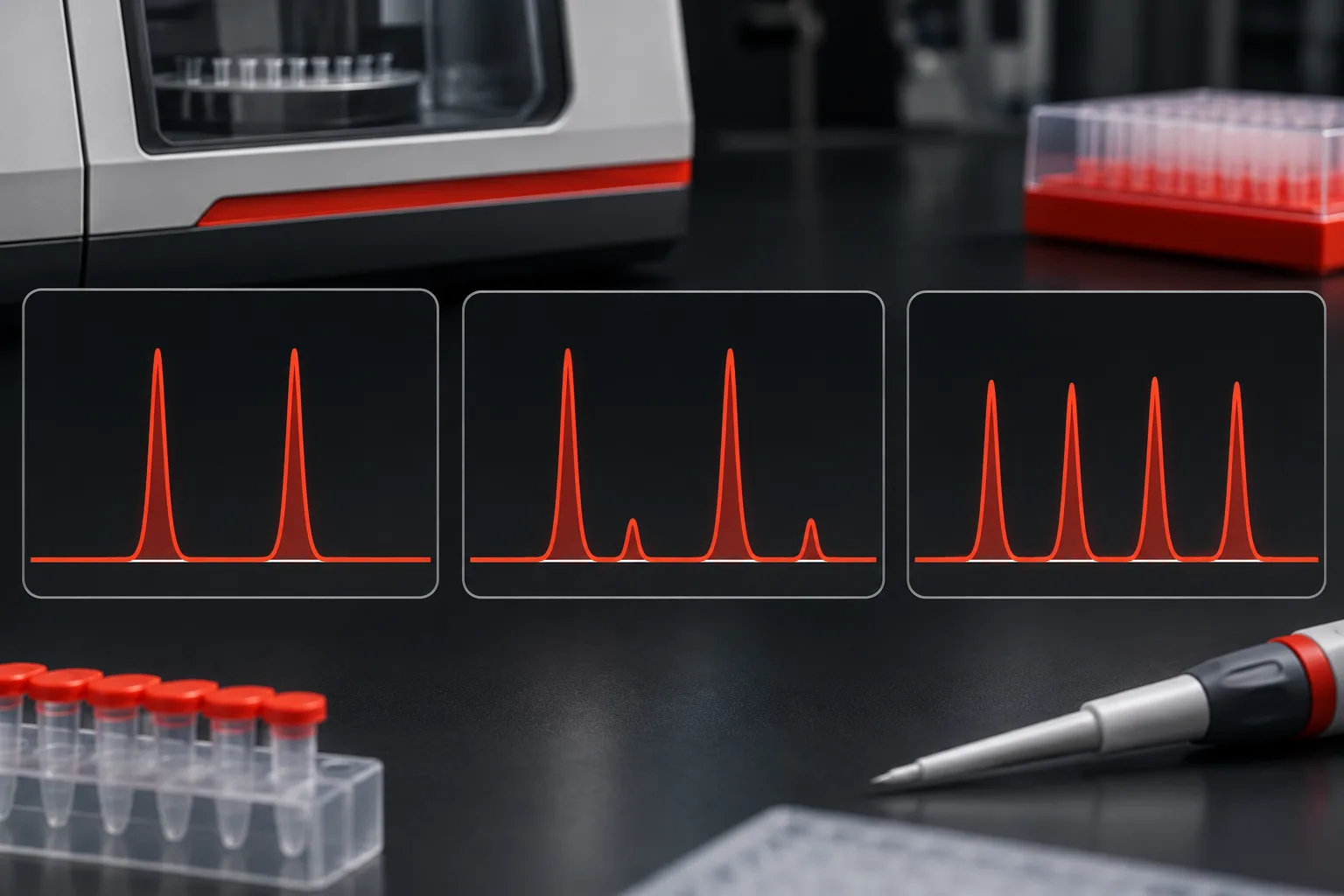
SCHEMATIC FIGURE 1 · CONTRASTING PEAK-HEIGHT PATTERNS
Distinguishable pattern
Two prominent and two lower signals
Unresolved pattern
Four comparably strong signals
Example 3: an indistinguishable or unresolved two-person mixture
Now assume a different synthetic profile has four credible alleles at locus A, but their signals are similar: allele 10 (740 RFU), 11 (680 RFU), 12 (715 RFU), and 13 (760 RFU). At locus B, alleles 8 (650 RFU), 9 (720 RFU), 10 (690 RFU) and 11 (670 RFU) are also similar in height. The exercise assumes two contributors, complete detection of the four credible alleles at each locus, and no interfering artefacts.
At locus A, multiple genotype pairings are compatible with the same four observed allele positions:
| Pairing | Possible contributor 1 | Possible contributor 2 |
|---|---|---|
| 1 | 10,11 | 12,13 |
| 2 | 10,12 | 11,13 |
| 3 | 10,13 | 11,12 |
Swapping the labels “contributor 1” and “contributor 2” does not create a new biological pairing. Peak heights of similar magnitude do not independently determine which pair is correct. Additional loci may help evaluate the proposed genotype combinations, but they do not automatically resolve every ambiguous pairing.
The correct conclusion is not that the two people have identical DNA. It is that the evidence does not currently justify assigning specific alleles to one donor rather than the other. SWGDAM calls this an indistinguishable two-person mixture; a laboratory may still be able to evaluate the mixture using a validated statistical model or, in an appropriate binary framework, assess eligible genotype possibilities and exclusions.
To avoid overstatement, an analyst might report that the mixture does not permit reliable separation into individual contributor profiles. Whether the result is suitable for a comparison or likelihood-ratio evaluation is a separate validated decision.
Shared alleles, stutter and dropout: why apparent separation can fail
Allele sharing can hide a contributor
When two people carry allele 9 at a locus, there is one observed position for allele 9 rather than two visibly separate peaks. Its combined height may appear unusually large relative to a partner allele. That does not automatically mean the sample contains an additional donor, nor can the analyst separate its signal into two individual peak heights by eye. Allele sharing is especially consequential when a small minor contribution is superimposed on a strong major profile.
A peak at a stutter position can have two sources
Suppose a strong allele 12 signal is measured at 1,800 RFU and a smaller signal at the allele-11 position measures 230 RFU. The smaller signal occupies a common back-stutter position for a tetranucleotide STR. The observed ratio (230 ÷ 1,800 ≈ 12.8%) may be informative, but it does not establish that the entire 230 RFU is stutter. The signal might comprise stutter alone, a minor contributor allele, or both. Applicable expectations depend on the locus, allele, kit and validated analysis procedure.
Automatically discarding every peak that falls in a stutter position can erase genuine minor contributor information. Conversely, treating all small signals as alleles can inflate the inferred complexity. The analytical classification has to be supported.
A peak above a stochastic threshold may still conceal dropout
For binary interpretation of an apparently single-source locus, a validated stochastic threshold can indicate when allelic dropout requires consideration. In mixtures, a visible peak can contain contributions from more than one genotype and from stutter. A composite peak above a threshold therefore does not, by itself, eliminate dropout risk for a low-level contributor. This limitation is discussed in the SWGDAM interpretation guidelines and in peer-reviewed work on mixture evaluation and CPI.
What about three or more contributors?
As the number of contributors increases, genotype overlap and the possible combinations increase substantially. A three-person mixture might have one clearly dominant component and two unresolved weaker components. Another mixture might contain three contributors at similar levels, with no defensible major genotype. A clear major component can sometimes be deduced even when the remaining contributors cannot be separated.
The appearance of several prominent peaks should not be treated as proof of several identifiable major genotypes. Equally, an analyst should not infer a particular genotype simply because it would align with a reference sampleReference sample - material from a verifiable/documented source which, when compared with evidence of an unknown source, shows an association or linkage between an offender, crime scene, and/or victim. Read Full Definition. For multilocus mixtures, the procedures and models must be validated for relevant contributor numbers, template amounts and mixture proportions. The ANSI/ASB Standard 020 addresses mixture validationValidation, often referred to as method validation, is a crucial process in the laboratory when introducing a new machine, technology, or analytical technique. It involves a series of systematic steps and assessments to ensure that Read Full Definition and reliable, consistent laboratory interpretation protocols.
Assumed contributors and conditional deconvolution
In some circumstances, the presence of DNA from a particular individual may be reasonably assumed—for example, when evaluating an intimate sample and the case circumstances support conditioning on an undisputed donor. A justified known genotype can reduce some uncertainty. But this is not equivalent to blindly subtracting a known profile’s allele labels from the mixture and calling everything else “foreign DNA.” Shared alleles remain shared, and dropout or artefacts can still affect the residual information.
The assumption must be clearly documented and appropriate to the question being addressed. Where the identity or presence of the known individual is disputed, conditioning on that person’s genotype without a valid basis risks circular reasoning. The UK Forensic Science Discover the fascinating field of Forensic Science, the application of scientific principles to legal matters. This post delves into its many disciplines, from DNA analysis to crime scene investigation, its importance in the justice system, Read Full Definition Regulator and the ISFG recommendations on propositions emphasize the need for carefully framed, case-relevant propositions rather than conclusions driven by an observed match.
From interpretation to statistical evaluation
Classification and deconvolution are not the same as determining evidential strength. A confidently deduced single-source component may support a single-source profile probability or an appropriate likelihood-ratio calculation. A mixture for which individual genotypes cannot be separated may still support a likelihood ratio using a validated semi-continuous or continuous probabilistic approach. Some laboratories use validated binary methods such as combined probability of inclusion (CPI) only for data that meet the method’s assumptions and suitability criteria.
The likelihood ratio (LR) compares the probability of the observed DNA results under two specified competing propositions. It is not the probability that a person contributed DNA, and it does not show how or when the DNA was deposited. The use of the same allele positions in a reference and a mixture does not automatically demonstrate a contributor’s presence. See our separate guide to likelihood ratios.
Do not combine the outputs of incompatible statistical frameworks into one figure without an appropriate validated statistical formulation. Where assumed NOC, contributor relationships or other parameters materially affect the answer, those assumptions and the sensitivityIn the context of laboratory equipment or analytical techniques, the term "sensitive" describes the capability of a machine or method to detect even very small amounts or concentrations of a substance. Sensitivity is a quantitative Read Full Definition of the result require consideration. The 2025 SWGDAM guidelines for reporting LRs provide further guidance.
A practical forensic DNA mixture interpretation workflow
- Verify analytical acceptability. Review amplification and electrophoresis controls, internal size standard, ladder, saturation, sizing and artefacts.
- Characterize the evidence independently. Record the credible allele set, peak heights, stutter positions, quality indicators and profile characteristics before an ordinary person-of-interest comparison.
- Assess source number and data limitations. Examine the minimum contributor count and plausible alternatives, and consider dropout, inhibition, degradation and allele sharing.
- Decide whether component separation is justified. Determine whether the mixture is distinguishable, indistinguishable, or only partly deconvolutable under validated peak-height and mixture-ratio expectations.
- Record genotype possibilities and assumptions. Separate observed allele states from inferred donor-specific genotypes. Document any reasonable conditioning contributor.
- Assess suitability. A profile, locus, major component or minor component may be unsuitable for a particular comparison even when other portions of the data remain usable.
- Select a validated evaluative method. Formulate relevant competing propositions and apply the statistical framework suitable for the observed information and validation scope.
- Review the interpretation and communicate limitations. Check that the wording describes observations, inferences, assumed contributors and evidential weight without implying unsupported individual identification or activity-level conclusions.
This sequence is educational and must not replace a forensic laboratory’s approved SOPs, technical review or relevant accreditationAccreditation – a process by which a laboratory must prove to an accrediting agency that their processes, equipment, and employees are competent, credible, and accurate. The accrediting agency will inspect the laboratory and observe its Read Full Definition requirements.
How should the findings be reported?
| Result | Illustrative careful wording | Avoid claiming |
|---|---|---|
| Apparent single source | “The DNA results are consistent with a single-source autosomal STR profile, within the scope of the laboratory’s interpretation criteria.” | That no other biological material was ever present |
| Clear major component | “A major component could be interpreted at the specified loci; the minor component was assessed separately according to laboratory criteria.” | That tall peaks uniquely identify a particular donor |
| Unresolved mixture | “The DNA results indicate a mixture, but the individual contributor genotypes cannot be reliably separated from these data.” | That the contributors possess identical genotypes |
| Insufficient result | “The available genetic information is insufficient for the specified comparison under the laboratory’s validated criteria.” | A categorical exclusion or inclusion unsupported by the data |
These examples are not standardized report templates. A final forensic report must follow the laboratory’s documented terminology, jurisdictional requirements and any applicable statistical reporting rules. In particular, “is consistent with,” “cannot be excluded” and “supports” do not have interchangeable evidential meanings. Where a DNA-level LR is reported, it cannot on its own establish the manner of transfer or a person’s involvement in an alleged Alleged is a term used in legal contexts to describe an accusation or claim that has been made against an individual but has not yet been proven or confirmed. Read Full Definition activity.
Common interpretation mistakes and how to avoid them
| Common mistake | Why it is problematic | Better practice |
|---|---|---|
| Assuming four peaks prove exactly two people | Additional donors may share alleles | Use validated full-profile NOC assessment |
| Assuming the two tallest peaks always belong to one donor | Shared alleles and peak-height variation may distort the pattern | Evaluate genotype combinations and balance across loci |
| Subtracting a known person’s alleles as though they were separate signals | Shared peaks are not physically separable by allele label | Document and validate conditional interpretation |
| Discarding every stutter-position peak | A minor allele can overlap stutter | Assess composite possibilities and laboratory stutter expectations |
| Using one universal RFU or mixture-ratio cutoff | System response varies by kit, instrument and validation | Apply laboratory-specific validated criteria |
| Calling an unresolved mixture uninterpretable by default | Statistical evaluation may still be possible | Distinguish failed deconvolution from suitability for validated LR methods |
Why validation and reproducibility matter
DNA mixture interpretation is sensitive to the evidentiary data and to the laboratory’s analytical and reporting choices. In a 2023 interlaboratory study, 134 participants from 67 laboratories assessed 29 mixtures, and the participating laboratories showed substantial variation in assessments of suitability and contributor number. The study demonstrated why policies, training, reliable thresholds and documented criteria matter; it should not be reduced to a universal casework error rate. Read the study by Hicklin and colleagues.
Validation should include representative single-source and mixed samples across contributor numbers, mixture ratios, DNA quantities, degradation, artefact patterns and relevant stochastic conditions. Analysts must also evaluate whether methods are performing within their validated limits. Independent technical review, proficiency testing and routine protocol evaluation strengthen consistent casework decisions. See ANSI/ASB Standard 123 on routine internal evaluation of interpretation and comparison protocols.
Key takeaways
A mixture should be classified from the quality and characteristics of the evidence, not from whether a person of interest appears compatible. A clear major–minor pattern may permit reliable assignment of some contributor genotypes, but overlapping alleles, low-level DNA and stochastic effects can prevent complete deconvolution. Indistinguishable or unresolved mixtures can still contain useful information, although the evaluation must remain within the chosen statistical model’s validated scope. The strongest conclusion is the one the data and method genuinely support, not the most definite wording available.
Frequently asked questions
Can an STR profile with only one or two alleles per locus still contain DNA from multiple people?
Yes. Allele sharing and very low-level DNA can conceal additional contributors. Classification requires the full profile and analytical context.
Does a major–minor mixture always permit a complete minor genotype?
No. Minor alleles may overlap the major component or stutter positions, or be affected by dropout. Only some loci may support a minor genotype.
Is an indistinguishable mixture unusable?
Not necessarily. The individual contributor genotypes may be unresolved, but the results may still be suitable for a validated mixture statistical evaluation.
Can an analyst subtract the victim’s known DNA profile to obtain an unknown person’s genotype?
Only conditional, validated interpretation may be possible. Shared alleles are not separate physical signals, and the assumed donor’s presence must be scientifically justified and documented.
Is there a universal RFU threshold or major–minor ratio for distinguishing contributors?
No. Applicable criteria must be developed, verified and used according to the laboratory’s validated method and analytical system.
Scientific references and further reading
View scientific references (10)
- Butler JM, Iyer H, Press R, Taylor M, Vallone P, Willis S. DNA Mixture Interpretation: A NIST Scientific Foundation Review. NIST IR 8351. 2024.
- SWGDAM. Interpretation Guidelines for Autosomal STR Typing by Forensic DNA Testing Laboratories. Revised 2021.
- SWGDAM. Guidelines for the Use of Probabilistic Genotyping with Autosomal STR Typing Results. 2025.
- SWGDAM. Guidelines for Reporting Likelihood Ratios. 2025.
- Gill P, Brenner CH, Buckleton JS, et al. DNA commission of the International Society of Forensic Genetics: Recommendations on the interpretation of mixtures. Forensic Sci Int. 2006;160(2–3):90–101.
- Gill P, Hicks T, Butler JM, et al. ISFG recommendations on assessing the value of forensic biological evidence: Part I, (sub-)source propositions. Forensic Sci Int Genet. 2018;36:189–202.
- Forensic Science Regulator (UK). DNA Mixture Interpretation: FSR-G-222. Accessible edition updated 2024.
- Hicklin RA, et al. Variation in assessments of suitability and number of contributors for DNA mixtures. Forensic Sci Int Genet. 2023.
- American Academy of Forensic Sciences, Academy Standards Board. ANSI/ASB Standard 020: Standard for Validation Studies of DNA Mixtures, and Development and Verification of a Laboratory’s Mixture Interpretation Protocol. 2018.
- American Academy of Forensic Sciences, Academy Standards Board. ANSI/ASB Standard 123: Standard for Routine Internal Evaluation of a Laboratory’s DNA Interpretation and Comparison Protocol. 2024.