


Magnetic bead-based DNA DNA, or Deoxyribonucleic Acid, is the genetic material found in cells, composed of a double helix structure. It serves as the genetic blueprint for all living organisms. Read Full Definition extraction is a solid-phase purification approach widely used in modern forensic laboratories. DNA is captured on functionalised paramagnetic particles, contaminants are removed while the particles are held by a magnet, and purified DNA is subsequently eluted. The method is attractive for automated casework, but its performance depends on the bead chemistry, specimen and validated protocol.
- How magnetic bead DNA extraction works
- Magnetic bead extraction workflow
- Why forensic laboratories use magnetic particles
- Applications across forensic sample types
- Magnetic beads versus silica spin columns
- Limitations and potential failure points
- Compatibility with STR profiling and MPS
- Quality assurance and validation
- Frequently asked questions
- Do magnets pull DNA out of a sample?
- Is magnetic bead extraction always better for touch DNA?
- Can magnetic beads be used after differential extraction?
- Selected references
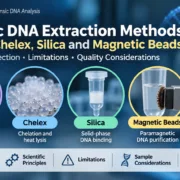
For a comparison with organic extraction, Chelex and silica columns, see our complete guide to forensic DNA extraction methods.
How magnetic bead DNA extraction works
Magnetic particles have a magnetically responsive core and a surface engineered to bind nucleic acids. Some systems use silica-coated particles under high-salt or chaotropic conditions; others use proprietary binding chemistry. Applying an external magnet immobilises the particles, enabling the liquid phase to be removed without centrifuging the DNA-binding material.
The magnetic field does not attract DNA directly. DNA is retained because it is associated with the bead surface under the selected buffer conditions. This distinction matters when explaining binding efficiency, washing and elution.
Magnetic bead extraction workflow
- Sample preparation and lysis: Biological material is digested or lysed to release DNA. Pretreatment varies for swabs, stains, sperm fractions and skeletal remains.
- DNA binding: Binding buffer and magnetic particles are added under conditions that promote DNA adsorption or association with the bead surface.
- Magnetic separation: A magnet retains the particles while unbound material is removed.
- Washing: One or more wash solutions remove proteins, salts and other contaminants. Inadequate washing can leave PCR inhibitors; excessive handling can reduce recovery.
- Elution: A suitable buffer releases DNA into a defined volume for quantification and downstream analysis.
Actual incubation times, mixing, wash volumes and elution conditions must follow the laboratory’s validated procedure and the specific kit instructions.
Why forensic laboratories use magnetic particles
Automation and throughput
Magnetic capture avoids repeated centrifugationCentrifugation is a process that uses centrifugal force to separate components of a mixture based on their sedimentation rate. The sample is placed in a tube, which is then spun at a high speed. The Read Full Definition and can be incorporated into robotic liquid-handling platforms. Automated workflows may standardise pipetting, processing times and batch documentation. However, a robot can still introduce cross-well contaminationContamination - The unwanted transfer of material from another source to a piece of physical evidence. The inadvertent touching of a weapon, thereby adding fingerprints to it is an example of evidence contamination. Read Full Definition, sample-placement errors or inadequate mixing; these risks must be addressed during validationValidation, often referred to as method validation, is a crucial process in the laboratory when introducing a new machine, technology, or analytical technique. It involves a series of systematic steps and assessments to ensure that Read Full Definition.
Purification and inhibitor removal
Wash steps can reduce contaminants that interfere with DNA amplification. Common forensic inhibitors include haem, textile dyes, humic substances and compounds introduced by extraction reagents. Bead purification is not guaranteed to eliminate every inhibitor, and an extract’s appearance or total DNA concentration cannot establish PCR suitability.
Concentration and sample recovery
Some systems permit relatively small elution volumes, useful for low-concentration evidence Evidence is any form of proof, such as objects, materials, or scientific findings, presented to establish or disprove a fact in a legal proceeding. It is used to reconstruct events and link or exclude individuals Read Full Definition. Yet concentration is not equivalent to recovery: DNA may be lost during binding, washes or elution. The proportion recovered can vary with starting quantity, substrate and fragment size. Laboratories should evaluate absolute amplifiable DNA recovery rather than relying only on final concentration.
Applications across forensic sample types
| Evidence type | Important considerations |
|---|---|
| Blood and saliva | Routine purification and inhibition control; protocol must be validated for stains and swabs. |
| Touch DNA | Low-template recovery, minimal elution volume, contamination and substrate effects. |
| Sexual-assault evidence | Sperm/non-sperm separation may be required before bead purification of each fraction. |
| Bone and teeth | Demineralisation, environmental inhibitors and short-fragment retention may require specialised protocols. |
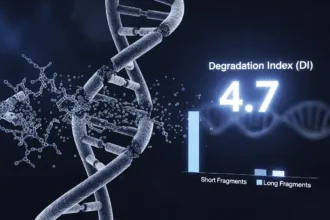
| Degraded material | Binding and wash conditions must preserve fragments relevant to the downstream assay. |
Magnetic beads versus silica spin columns
Both methods use solid-phase binding, washing and elution. Their principal practical distinction is how the solid phase is separated from the liquid: a magnet for magnetic particles and centrifugation or vacuum for many spin-column systems. Bead workflows are particularly convenient for automation, whereas columns may be straightforward for smaller manual batches. Neither method can be declared universally superior in yield, purity or forensic profile success.
Limitations and potential failure points
- Bead chemistry varies: Products differ in binding capacityThe amount of finished product that could be produced, either in one batch or over a defined period of time, and given a set list of variables. Read Full Definition, selectivity, fragment retention and elution behaviour.
- Low-template loss: Small absolute losses can matter when only trace DNA is present.
- Residual inhibitors: Wash performance depends on specimen and protocol.
- Bead or buffer carryover: Poor separation or incomplete reagent removal may affect downstream reactions.
- Automation risks: Plate layout, tip reuse policies, aerosol formation and robotic carryover require controls.
- Cost: Consumables, instrument maintenance, labour and repeat testing determine actual per-sample economics.
Compatibility with STR profiling and MPS
Forensic magnetic extraction systems are used to prepare DNA for PCR-based STR typing. Suitability for massively parallel sequencing (MPS/NGS) should be evaluated separately. Some library preparations require particular DNA fragment distributions or double-stranded molecules. Published comparative research has shown that extraction chemistry can influence the relative proportions of single- and double-stranded DNA; findings from one bead product should not be generalised to all systems.
Quality assurance and validation
Under the FBI Quality Assurance Standards for Forensic DNA Testing Laboratories, forensic DNA methods require internal validation before implementation. A magnetic extraction validation should use representative evidence and assess:
- Recovery and reproducibility across relevant DNA inputs and substrates.
- Low-template, degraded and inhibitor-rich material.
- Contamination, extraction blanks and robotic carryover.
- Performance of sperm and non-sperm fractions where differential extraction is used.
- Elution volume, qPCR metrics and downstream STR/MPS success.
- Sample identity, chain of custodyChain of custody - The process used to maintain and document the chronological history of the evidence. Documents record the individual who collects the evidence and each person or agency that subsequently takes custody of Read Full Definition and batch traceability.
Human-specific qPCR may help distinguish low DNA concentration from degradation or amplification inhibition, depending on the assay. Reagent blanks should accompany relevant extraction sets and be assessed through the applicable downstream testing conditions. See the SWGDAM guidance collection for validation and contamination-prevention resources.
Frequently asked questions
Do magnets pull DNA out of a sample?
No. The magnet captures magnetic particles to which DNA has bound chemically. It does not directly attract free DNA molecules.
Is magnetic bead extraction always better for touch DNA?
No. Trace-DNA recovery depends on the exact chemistry, substrate, starting material and validation. A smaller elution volume may increase concentration without improving the total amount recovered.
Can magnetic beads be used after differential extraction?
Yes, if validated. Sperm and non-sperm fractions can be purified using an appropriate magnetic system after the cell-separation steps.
Selected references
- National Institute of Justice. DNA Extraction and Quantitation for Forensic Analysts: Magnetic Beads.
- FBI. Quality Assurance Standards for Forensic DNA Testing Laboratories, effective July 2025.
- SWGDAM. Validation and related guidance.
- Forensic DNA extraction methods for human hard tissue: systematic review and meta-analysis. Forensic Science
 Discover the fascinating field of Forensic Science, the application of scientific principles to legal matters. This post delves into its many disciplines, from DNA analysis to crime scene investigation, its importance in the justice system, Read Full Definition International: Genetics. 2023.
- Effect of commonly employed forensic DNA extraction protocols on ssDNA/dsDNA proportion and DNA integrity.
- NIST. A Quantitative Method to Assess DNA Extraction Efficiency. 2026.