


Forensic DNA DNA, or Deoxyribonucleic Acid, is the genetic material found in cells, composed of a double helix structure. It serves as the genetic blueprint for all living organisms. Read Full Definition reporting is the final scientific step connecting laboratory observations to the questions being asked in an investigation or court. A well-written report distinguishes what was detected, what was inferred, what comparisons were possible and how much weight those comparisons carry. Terms such as inclusion, exclusion, inconclusive and uninterpretable are useful only when their meaning is defined and the limitations of the evidence
 Evidence is any form of proof, such as objects, materials, or scientific findings, presented to establish or disprove a fact in a legal proceeding. It is used to reconstruct events and link or exclude individuals Read Full Definition are communicated.
- Why precise reporting terminology matters
- Seven result terms analysts must distinguish
- Figure 1: what kind of result are we reporting?
- Interpreting DNA comparison outcomes
- Inclusion: what can a compatible DNA profile establish?
- Exclusion: when is a difference sufficiently reliable?
- Worked example 1: a supported exclusion, and a mistaken exclusion
- Inconclusive, uninterpretable and uninformative: different reasons, different wording
- Worked example 2: three phrases that do not mean the same thing
- Mixtures, partial profiles and low-template limitations
- Likelihood ratios: reporting evidential weight rather than guilt
- Worked example 3: an arithmetically reproducible RMP-based LR
- Figure 2: the transposed conditional in a forensic report
- Sub-source, source and activity-level propositions
- Elimination samples and contamination: report with appropriate limits
- What information should a forensic DNA report disclose?
- Reducing reporting errors and cognitive bias
- A final DNA reporting review checklist
- Frequently asked questions
- Scientific references and authoritative guidance
- Related Simply Forensic learning guides
DNA results can be persuasive, but neither a matching profile nor a large likelihood ratio establishes the activity that deposited the DNA. Conversely, failure to recover an allele is not always grounds for exclusion. This guide focuses on scientifically defensible report conclusions and wording, not on repeating the underlying statistical formulas. For detailed foundations, see our guides to DNA mixture statistics, mixture interpretation and probabilistic genotyping.
KEY LEARNING POINTS
- Inclusion means the reference is not excluded as a possible source or contributor under defined criteria; it is not a declaration of unique identity.
- Exclusion requires incompatibility supported by the data
 Information in analog or digital form that can be transmitted or processed. Read Full Definition and method, with plausible dropout and other limitations considered.
- Inconclusive, uninterpretable and no DNA profile obtained describe different situations and should not be collapsed into one vague outcome.
- A likelihood ratio is a comparison of probabilities of the evidence under alternative propositions—not the probability that a person is guilty.
- Reporting must describe the scope of inference, relevant assumptions, limitations and appropriate independent review.

Why precise reporting terminology matters
Historically, DNA reports have used terms such as “match”, “cannot exclude”, “included”, “not excluded”, “excluded” and “inconclusive”. These words are not necessarily interchangeable across laboratories or jurisdictions. The SWGDAM 2021 autosomal STR interpretation guidelines define inclusion as a comparison outcome in which a person cannot be excluded as a potential DNA contributor. Modern approaches often complement or replace a categorical comparison statement with a quantitative likelihood ratio, particularly for complex mixtures.
The NIST 2024 human-factors report cautions that the word “inconclusive” has been used for several fundamentally different outcomes. The OSAC Human Forensic DNA Reporting Appendix Exemplar (2025) offers example explanatory language and limitations, but is a technical guidance document, not a universally binding standard. Laboratories should define their terms in the reporting system and avoid language that makes weak evidence sound conclusive.
Seven result terms analysts must distinguish
| Term | Defensible meaning | What it must not imply |
|---|---|---|
| Inclusion / not excluded | The accepted comparison does not eliminate the person’s genotype as a possible source under stated criteria | That they necessarily contributed, were the only possible source or performed an alleged Alleged is a term used in legal contexts to describe an accusation or claim that has been made against an individual but has not yet been proven or confirmed. Read Full Definition activity |
| Exclusion | The relevant genotype is incompatible with the evidentiary results under the validated interpretation and assumptions | That no DNA from this person could ever have been present below detection |
| Inconclusive comparison | Insufficient information to reach a supported inclusion or exclusion conclusion under a specified method | That the tested item produced no DNA or that the person was excluded |
| Uninterpretable / unsuitable | Profile information cannot be used for a specified interpretation or comparison under validated criteria | That no biological material was present |
| No profile obtained | No qualifying DNA typing result was obtained using the stated method | That DNA is absent from the item in every possible quantity or form |
| Uninformative LR | For the stated propositions, LR = 1 gives equal probability to the results; values near 1 may have limited weight | That the electropherogram was necessarily uninterpretable |
| Elimination comparison | A comparison to a known person sampled for elimination or contaminationContamination - The unwanted transfer of material from another source to a piece of physical evidence. The inadvertent touching of a weapon, thereby adding fingerprints to it is an example of evidence contamination. Read Full Definition assessment | That a profile consistent with an elimination donor automatically proves where or when DNA was introduced |
A practical distinction is between the quality/suitability of a DNA result and the outcome or strength of a particular comparison. The same interpretable mixture might provide little support for either of two propositions while still being suitable for statistical evaluation. Equally, a partial profile may support a comparison at some loci while being uninformative at others.
Figure 1: what kind of result are we reporting?
FORENSIC DNA REPORTING · CONCEPTUAL DECISION PATHWAY
No qualifying profile
Describe the absence of an interpretable typing result, not the proven absence of biological material.
Unsuitable for comparison
Explain why the method does not support comparison, e.g. insufficient information or compromised data.
Suitable for comparison
Determine the supported comparison outcome and statistical weight under the validated procedure.
Interpreting DNA comparison outcomes
Inclusion: what can a compatible DNA profile establish?
In an apparently single-source result, an inclusionary comparison means that the known genotype is consistent with the interpreted evidentiary genotype. In a mixture, it may mean that the known genotype cannot be excluded from the set of possible contributors under the laboratory’s rules, not that the analystA designated person who examines and analyzes seized drugs or related materials, or directs such examinations to be done; independently has access to unsealed evidence in order to remove samples from the evidentiary material for Read Full Definition has individually separated its entire profile. A common reporting formulation is “The DNA results are consistent with the reference profile of X”, followed by the appropriate statistical evaluation and limitations.
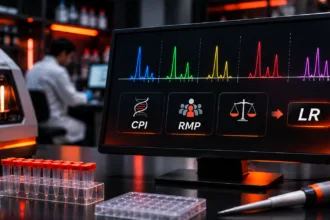
Compatibility is not unique attribution. A random match probability describes the frequencyFrequency is a fundamental concept in physics and wave theory. It refers to the number of times a specific point on a wave, such as a crest or trough, passes a fixed reference point in Read Full Definition of a resolved genotype under a population model; a combined probability of inclusion estimates the fraction of unrelated individuals whose genotypes would not be excluded by suitable mixture allele sets; and a likelihood ratio compares the probabilities of evidence under competing propositions. Those statistics answer different questions. See the worked CPI, RMP and LR guide rather than treating a generic “match” as its own measure of evidential weight.
For qualified inclusions, reports should provide or appropriately reference the statistical weight where required by the validated method and relevant standards. Inclusion is not a finding that a person touched an object at the time of the alleged event, and it does not by itself identify the body fluid containing the DNA.
Exclusion: when is a difference sufficiently reliable?
A well-supported exclusion arises when the person’s genotype is incompatible with the evidentiary observations under a validated interpretation that accounts for plausible missing alleles Alleles are different forms of a gene resulting from mutations or variations in the DNA sequence or gene expression. They can be dominant (expressed with one copy) or recessive (expressed only with two copies). Read Full Definition, artefacts and mixture complexity. For a high-quality, complete, clearly single-source genotype with multiple robust incompatible loci, exclusion may be straightforward. For a weak mixture, the absence of a person’s allele from the accepted set might reflect allelic dropout, masking under another contributor’s peak or a stutter-position ambiguity.
The statement must be scoped to the result and model. Exclusion as a deduced major contributor does not necessarily exclude the person as a possible low-level minor contributor. Conversely, a validated statistical model may evaluate an apparently incompatible profile and generate an LR supporting the alternative proposition without justifying the same categorical language as a full-profile exclusion.
The 2024 NIST human-factors report recommends transparent handling of reported exclusions, including the method and relevant assumptions. In particular, a forensic scientist should not reclassify an observed peak to manufacture compatibility or incompatibility with a known reference.
Worked example 1: a supported exclusion, and a mistaken exclusion
Scenario A — robust single-source comparison: An assumed clean, high-template synthetic profile yields genotype 10,12 at locus A locus is the precise position of a gene on a chromosome. Different alleles of the same gene occupy the same locus. Read Full Definition A; 14,16 at locus B; and 8,11 at locus C. A reference profile shows 10,13; 14,17; and 9,11. Assume the evidence is a single contributor, controls passed, the profile is well above validated stochastic limits, no unresolved artefacts are present, and there are no known exceptional genetic findings explaining the discordances.
| Synthetic locus | Evidence genotype | Reference genotype | Comparison |
|---|---|---|---|
| A | 10,12 | 10,13 | Discordant at 12/13 |
| B | 14,16 | 14,17 | Discordant at 16/17 |
| C | 8,11 | 9,11 | Discordant at 8/9 |
Under these deliberately strong assumptions, the reference is excluded as the source of the interpreted single-source profile. This conclusion addresses that profile—not every trace of DNA that might have been present in the item.
Scenario B — low-template ambiguity: A different evidentiary locus shows only allele 15 at 160 RFU. The reference individual is genotype 15,18. If dropout of a second allele is plausible, the non-detection of 18 cannot independently support an exclusion. A further mixture or probabilistic evaluation may be appropriate, depending on the whole profile and validated suitability criteria.
These examples show why the phrase “not present in the electropherogram” does not necessarily mean “genetically excluded.” They also show why decisions must be made from the whole profile, rather than selecting one locus after looking at a person of interest.
Inconclusive, uninterpretable and uninformative: different reasons, different wording
Inconclusive is sometimes used when an analyst cannot reach either inclusion or exclusion in a manual comparison. The reason may be a weak profile, complex mixture, unresolved dropout or other insufficient information. Uninterpretable more directly describes an evidentiary result judged unsuitable for a particular analysis. Uninformative can describe an LR of 1 under specified competing propositions, even when a valid comparison and statistical analysis were performed.
These differences matter to lawyers and investigators: a no-profile outcome may imply a need for additional sampling, while a neutral LR means that the reported observations have equal probability under the specific propositions—not that the laboratory failed to obtain data. NIST IR 8503 warns against an undefined “inconclusive” label that obscures why a comparison was not reported. However, laboratories still use varying terminology, so the article does not impose one universal reporting vocabulary.
Do not declare every LR close to 1 “inconclusive.” Some validated reporting systems employ defined categories or decision thresholds, but assigning a numerical “inconclusive zone” without scientific justification can hide evidence favoring one proposition. A neutral or low-weight LR, an unsuitable profile and a categorical exclusion should be documented distinctly.
Worked example 2: three phrases that do not mean the same thing
| Observation | Illustrative report language | Explanation |
|---|---|---|
| No qualifying STR profile after analysis | “No reportable autosomal STR profile was obtained from item Q1 using the stated method.” | Does not prove no DNA or biological material was present |
| Complex mixture unsuitable for a specified comparison | “The DNA results indicate a mixture, but insufficient reliable information is available for a comparison with the specified reference profile.” | Some DNA information is present; the method does not support the comparison |
| Valid evaluation gives LR = 1.0 | “Under the stated propositions and model, the DNA results provide equal support to the two propositions (LR = 1).” | The data were evaluated, but the relative evidential weight is neutral |
These are synthetic instructional statements, not approved laboratory report templates. In casework, some methods may report another qualified conclusion; do not replace authorized wording without validationValidation, often referred to as method validation, is a crucial process in the laboratory when introducing a new machine, technology, or analytical technique. It involves a series of systematic steps and assessments to ensure that Read Full Definition and local policy review.
Mixtures, partial profiles and low-template limitations
DNA mixtures need especially careful communication. Reporting a minimum number of contributors is different from proving an exact number; some individuals may share all their visible alleles or contribute too little DNA to appear. Where a major genotype is sufficiently deduced, the laboratory may compare that component separately, but that does not automatically determine the minor component. Where genotypes remain unresolved, a validated PG likelihood ratio may still evaluate the mixture as a whole.
Low-template profiles can exhibit pronounced heterozygote imbalance, allelic dropout or occasional unexpected peaks. A peak above the laboratory’s stochastic threshold does not necessarily show that a particular minor contributor’s alleles could not have dropped out when the peak is shared. Analytical and stochastic thresholds, stutter filters and mixture suitability criteria must be applied within their validated context.
Partial and degraded profiles can still contain useful information, but a report must identify what was not established. A reduced number of loci changes the discriminating power of the result. A reference can be consistent with all detected alleles while the data are insufficient to meaningfully distinguish that reference from many unrelated alternatives. No profile should be made to sound more complete than it is.
Likelihood ratios: reporting evidential weight rather than guilt
The likelihood ratio compares P(E|H₁) / P(E|H₂), where E is the observed DNA result and H₁ and H₂ are specified alternative propositions. A result greater than 1 favors H₁ relative to H₂; less than 1 favors H₂ in that orientation; exactly 1 is neutral. Importantly, LR is not P(H₁|E), the probability that H₁ is true after observing the evidence. Additional prior information would be required for that different probability.
A laboratory may choose source-level propositions such as “the POI and one unrelated unknown person contributed” versus “two unrelated unknown people contributed”. Results and assumptions may differ if one person is independently known to be a contributor or a close relative is a plausible alternative. A justified conditioning contributor must be defined in both propositions; allele positions shared by two donors cannot be physically subtracted from the mixture by label.
The SWGDAM Guidelines for Reporting Likelihood Ratios (2025) support expressing the numerical LR with its direction and using clear reporting conventions. A verbal scale can be helpful if it is defined, but must not replace the result with an unexplained adjective. LRs less than 1 may convey important weight in favor of the alternative, even if they do not equate to a categorical manual exclusion.
Worked example 3: an arithmetically reproducible RMP-based LR
Assume a perfect-detection single-source toy model at one autosomal STR locus. The evidence and reference genotype are both A/B. Hypothetical population frequencies are p(A) = 0.20 and p(B) = 0.10. Genotypes are assumed to follow Hardy–Weinberg proportions, contributors are unrelated and no dropout, artefacts, mutation or population-substructure correction is modeled.
Under H₁, the named reference individual with genotype A/B is the source, so P(E|H₁) = 1 in this idealized model. Under H₂, an unrelated randomly selected person is the source, so P(E|H₂) = 2 × 0.20 × 0.10 = 0.04. Therefore:
LR = 1 / 0.04 = 25 under these exact simplified propositions
Appropriate explanation: “Under the stated hypothetical model, the observed genotype is 25 times as probable if the reference individual is the source than if the source is an unrelated random person.” Incorrect explanation: “There is a 96% probability the reference person supplied the DNA.” The latter incorrectly converts the LR or RMP into a probability of the proposition. Real forensic profiles require more loci, suitable population data and laboratory-specific statistical procedures.
For a separate illustration, an LR of 0.25 (assumed output, not calculated from the example above) would mean the results are four times as probable under H₂ as H₁. That is direction of support under the selected propositions, not necessarily proof that the POI’s genotype cannot occur in the evidence.
Figure 2: the transposed conditional in a forensic report
STATISTICAL WEIGHT IS NOT PROBABILITY OF GUILT
What the DNA LR answers
P(E | H₁) / P(E | H₂)
How well the observations are predicted under two defined propositions
What it does not answer
P(H₁ | E)
Whether the proposition is true after considering DNA and all other evidence
Sub-source, source and activity-level propositions
Sub-source-level evaluation addresses whether DNA originated from a particular person. A source-level claim may also require identification of the type or provenance of biological material—for example, whether blood rather than a generic DNA trace came from someone. Activity-level propositions concern how, when or by which actions the material came to be on an item, such as direct handling, indirect transfer or earlier contact. These questions require different data and assumptions.
For example, a bloodstain yielding a profile consistent with a named person may support a proposition about whose DNA was present. It does not necessarily establish that they were injured during a particular incident. A touch-DNA profile associated with a person does not prove they handled an item at the relevant time. Transfer, persistence, background prevalence, recovery, substrate and alternative activities require a separate assessment.
The ISFG DNA Commission’s recommendations on (sub-)source propositions and the UK FSR interpretation and communication guidance (updated March 2026) emphasize clear framing of propositions at the level appropriate to the question. Source-level evidence must not be misrepresented as direct activity-level proof.
Figure 3: the levels of DNA reporting
FROM OBSERVED DNA TO CASE-LEVEL INTERPRETATION
Observations
Peaks, alleles, profile quality, controls and possible mixtures
Sub-source/source
How strongly the DNA results support one possible source over another
Activity level
How the material might have been deposited, transferred or persisted
Offence level
The alleged event and all evidence; not determined by DNA statistics alone
Elimination samples and contamination: report with appropriate limits
An elimination sampleElimination sample - material of a known source taken from a person who had lawful access to the scene/ evidence. Or A DNA sample collected from an individual not thought to be a suspect in Read Full Definition comes from someone whose DNA might be encountered for innocent reasons, such as an evidence handler, investigator or other known associate. Comparing these profiles can assist contamination investigations and interpretation. However, finding genetic compatibility with an elimination donor does not automatically prove when DNA was introduced or that no other contributing source exists. Where contamination has potentially compromised evidence, the report should not conceal its relevance.
The absence of matching signals in extraction or amplification negative controls cannot prove that no DNA was introduced at collection, transport or an earlier handling stage. The NIST human-factors review supports transparent documentation of decision points and the management of task-irrelevant contextual information. Reporting must separate observed facts, laboratory inferences and assumptions based on investigative information.
What information should a forensic DNA report disclose?
Exactly what must appear on the report face, in an appendix or in the accessible case record depends on laboratory policy, accreditationAccreditation – a process by which a laboratory must prove to an accrediting agency that their processes, equipment, and employees are competent, credible, and accurate. The accrediting agency will inspect the laboratory and observe its Read Full Definition, jurisdiction and the purpose of the document. The following is a practical review checklist rather than a claim that every jurisdiction mandates every entry on the same page.
| Report element | Why it matters |
|---|---|
| Case, item and specimen identifiers | Links conclusions to the correct exhibits, fractions and reference samples |
| Method and relevant analytical scope | Identifies what type of testing was performed and what data it generated |
| Observed DNA profile description | Distinguishes apparent single source, mixture, partial/no profile, and relative component information |
| Comparison outcome and scope | States whether the specified person is included, excluded or not evaluable under the used method |
| Statistic, propositions and population model | Communicates the evidential strength and assumptions without a misleading “match” label |
| Interpretation limitations | Explains material concerns about dropout, degradation, masking, contamination or model suitability |
| Software/method configuration as applicable | Allows independent review of PG models, versions, parameters and validation scope |
| Authorization and technical review | Documents responsible competent personnel and required review |
| Record availability and provenance | Provides traceability to notes, controls, supporting files, chain-of-custody records and case materials |
Some information may appropriately be maintained in the case record rather than repeated on the issued report. In the United States, the FBI Forensic DNA QAS effective July 1, 2025 provide applicable requirements for reports and review to laboratories within their scope. In England and Wales, the Forensic Science Regulator’s statutory Code of Practice, version 2, came into force October 2, 2025. These requirements do not automatically govern laboratories in other countries. ISO/IEC 17025:2017 establishes a broader competency, traceability and reporting framework within the laboratory’s applicable accredited scope.
Worked example 4: a structured report section for a complex mixture
Assume specimen Q3 yields an interpretable two-person autosomal STR mixture, but individual components cannot be completely deduced. A validated probabilistic-genotyping procedure was applied to the whole mixture. For teaching only, suppose the software outputs LR = 250 for these precisely stated propositions:
Result: An autosomal STR mixture was obtained from specimen Q3. The available data were evaluated using the laboratory’s validated mixture interpretation procedure.
Proposition H₁: The person of interest and one unrelated unknown individual contributed to the mixture.
Proposition H₂: Two unrelated unknown individuals contributed to the mixture.
Evidential weight: Under the specified models and assumptions, the observed DNA results are 250 times as probable under H₁ as under H₂ (LR = 250).
Limitations: This source-level comparison does not establish when, how or through which activity DNA was deposited. Other propositions, including those involving close relatives, were not evaluated in this hypothetical example.
The numerical LR is an assumed teaching output, not calculated from these sentences or represented as a real forensic case or a validated software result. A real report must identify its actual analytical configuration and method-supported assumptions. Even an LR of 250 does not establish that the person deposited material during the alleged offence.
Reducing reporting errors and cognitive bias
Interpretation decisions can be affected by knowledge of a suspect’s profile, an investigator’s expectations or a compelling narrative about the case. A science-led workflow should classify and assess evidentiary data before routine POI comparison, document necessary case information, and support independent technical review. NIST’s 2024 human-factors report provides 44 recommendations spanning data interpretation, reporting, training, case management and quality systems.
Interlaboratory variation is real: in a 2023 study of 134 participants from 67 laboratories, different laboratories sometimes disagreed about whether the same mixture was suitable for comparison and about its number of contributors. This was a study of laboratory practices and interpretation, not a universal DNA casework error rate (Hicklin et al., 2023). Reporting should be transparent enough for a reader to understand what was evaluated and what remained unresolved.
Common failures include reporting “match” without meaningful statistical weight; mistaking LR for a probability of guilt; converting the absence of a low-level allele into a definitive exclusion; silently discarding disputed peaks; omitting conditioning assumptions; or giving a DNA-level LR as proof of direct contact. The report should not hide scientifically relevant alternative propositions or a validated result favoring the alternative merely because it is inconvenient.
A final DNA reporting review checklist
- Verify the evidence record: item and specimen numbering, sample fractions, controls, profile type and correspondence to the correct reference samples.
- Separate findings from inferences: distinguish directly observed alleles and quantities from deduced contributors and assumptions.
- State comparison scope: single-source genotype, major component, whole mixture or loci/regions judged suitable.
- Choose the correct result label: inclusion, exclusion, unsupported comparison, no profile or quantitative LR outcome; explain any unusual terminology.
- Verify statistics: numerical calculations, population reference, NOC, propositions, conditioning, relatedness, method/version and software diagnostics where applicable.
- Include material limitations: low template, dropout, artefacts, unresolved donors, potential contamination, activity-level uncertainty and any omitted comparisons.
- Check the language: no probability of guilt, unjustified identification, unqualified attribution, or automatic equation of no DNA result with absence of DNA.
- Perform and record review: preserve the underlying data, decisions, notes and required technical review and authorization.
The final report should be understandable to an investigator or court without sacrificing scientific accuracyIn scientific and measurement contexts, "accuracy" refers to the degree of proximity or closeness between a measured value and the true or actual value of the measured quantity. Accuracy indicates how well a measurement reflects Read Full Definition. Clarity does not mean concealing assumptions or converting an evaluative result into a definitive declaration.
Frequently asked questions
What does inclusion mean in a forensic DNA report?
The individual is not excluded as a possible source or contributor under the stated method and data; it does not automatically mean the person was the donor or committed an activity. Appropriate evidential weight should accompany a relevant inclusion.
Does an exclusion mean absolutely no DNA from that person was present?
No. An exclusion applies to the interpreted result and comparison assumptions. Extremely low-level or unobserved DNA may be outside the assay’s ability to detect; a report cannot prove biological absence beyond its validated method.
What is the difference between inconclusive and uninterpretable?
Inconclusive often describes an unresolved comparison; uninterpretable describes data that are unsuitable for the relevant evaluation. Laboratories differ in terminology, so the reason and scope should be explained.
If no DNA profile is obtained, is the person excluded?
No. Failure to obtain a reportable profile does not support a genetic exclusion and does not prove that DNA or biological material was entirely absent.
Can a missing allele automatically exclude a reference individual?
Not when allelic dropout, peak masking or other relevant uncertainties remain plausible. Evaluate the whole profile using the laboratory’s validated criteria.
What does an LR of 1 mean?
For the specified competing propositions, the observed results are equally probable under both. The comparison is uninformative for that contrast, which is different from saying that no DNA was detected.
Does an LR less than 1 prove exclusion?
Not necessarily. It indicates support for the denominator proposition in the stated orientation; the laboratory may have separately validated criteria for a categorical exclusion, and those cannot be assumed solely from LR below 1.
Is a very large DNA LR proof of guilt?
No. An LR evaluates how probable DNA findings are under specified propositions. It does not itself establish guilt, direct contact, transfer mechanism or timing.
Must every DNA report list each software parameter?
No universal requirement says every parameter must appear on the report face. Reports and accessible case records must provide the information required by the applicable quality framework, supporting competent review and meaningful scrutiny.
Are SWGDAM and the UK FSR Code mandatory in every country?
No. Their authority and applicability depend on jurisdiction, accreditation and laboratory requirements. SWGDAM guidance is distinct from binding regulations; the UK FSR statutory Code applies within its defined scope in England and Wales.
Scientific references and authoritative guidance
View references and guidance (16)
- Scientific Working Group on DNA Analysis Methods (SWGDAM). Interpretation Guidelines for Autosomal STR Typing by Forensic DNA Testing Laboratories. 2021.
- SWGDAM. Guidelines for Reporting Likelihood Ratios. 2025.
- SWGDAM. Guidelines for the Use of Probabilistic Genotyping with Autosomal STR Typing Results. 2025.
- Butler JM, Iyer H, Press R, Taylor MK, Vallone PM, Willis S. DNA Mixture Interpretation: A NIST Scientific Foundation Review. NIST IR 8351. 2024.
- Expert Working Group on Human Factors in Forensic DNA Interpretation. Forensic DNA Interpretation and Human Factors: Improving Practice Through a Systems Approach. NIST IR 8503. 2024.
- OSAC Human Forensic Biology Subcommittee. Human Forensic DNA Reporting Appendix Exemplar. OSAC Technical Guidance Document 0009. August 2025.
- Federal Bureau of Investigation. Quality Assurance Standards for Forensic DNA Testing Laboratories. Effective July 1, 2025.
- Forensic ScienceDiscover the fascinating field of Forensic Science, the application of scientific principles to legal matters. This post delves into its many disciplines, from DNA analysis to crime scene investigation, its importance in the justice system, Read Full Definition Regulator. Code of Practice for Forensic Science Activities, Version 2. England and Wales; in force October 2, 2025.
- Forensic Science Regulator. Forensic Science Activities: Interpretation and Communication (FSR-GUI-0004). Updated March 2026.
- Forensic Science Regulator. DNA Mixture Interpretation (FSR-G-222). Guidance; accessible 2024 edition.
- Gill P, Hicks T, Butler JM, et al. DNA Commission of the ISFG: Assessing the Value of Forensic Biological Evidence. Part I: Evaluation of DNA Profiling Comparisons Given (Sub-)Source Propositions. Forensic Science International: Genetics. 2018;36:189–202.
- Hicklin RA, Richetelli N, Emerick BL, Bever RA, Davoren JM. Variation in Assessments of Suitability and Number of Contributors for DNA Mixtures. Forensic Science International: Genetics. 2023;65:102892.
- Hicklin RA, Richetelli N, Bever RA, Davoren JM. Inter-Laboratory Variation in Interpretations, Comparisons, and Statistical Analyses of DNA Mixtures. Journal of Forensic Sciences. 2025;70(4):1292–1314.
- Buckleton J, et al. Reporting the Value of Biological Findings Given Activity Level Propositions: A Discussion of Published Recommendations. Journal of Forensic Sciences. 2025.
- ENFSI. Guideline for Evaluative Reporting in Forensic Science. European Network of Forensic Science Institutes. 2015.
- International Organization for Standardization. ISO/IEC 17025:2017 — General Requirements for the Competence of Testing and Calibration Laboratories. 2017.

Related Simply Forensic learning guides
- Forensic DNA Mixture Interpretation: Major–Minor and Unresolved Mixtures
- Number of Contributors in Forensic DNA Mixtures
- Analytical and Stochastic Thresholds in Forensic DNA
- Allelic Dropout, Peak Height Balance and Low-Template DNA
- Forensic DNA Mixture Statistics: CPI, RMP and Likelihood Ratios
- Probabilistic Genotyping: Principles, Software and Validation