Research at a glance
DNA signal decline, STR profile persistence and soil microbial change in buried bloodstained fabric under indoor controlled conditions
Study summary
Bloodstained fabric buried in two soils under indoor conditions retained complete autosomal STR profiles across ten sampling points through 110 days.
Critical appraisal
- Limitations
- Controlled indoor burial does not establish a universal DNADNA, or Deoxyribonucleic Acid, is the genetic material found in cells, composed of a double helix structure. It serves as the genetic blueprint for all Read Full Definition persistence period; microbial shifts were not causally linked to DNA decline.
- Implications
- Buried textiles should be considered for DNA examination even after substantial time, with validated methods and cautious interpretation.
A bloodstained fabric recovered from soil may still yield a usable DNA profile long after burial. In an online 2026 study assigned to the February 2027 issue of Forensic Science International, researchers reported complete STR profiles at every sampled timepoint across a 110-day indoor burial experiment. The result is encouraging, but it is not a universal survival period for bloodstain DNA.
- How the burial experiment worked
- DNA signal declined without losing alleles
- Why soil type and microbial change matter
- Practical implications for evidence recovery
- The experimental question
- What an STR peak can tell us
- Why the decline was not linear
- Soil bacteria were observed, not shown to cause the loss
- Casework implications and limits
How the burial experiment worked
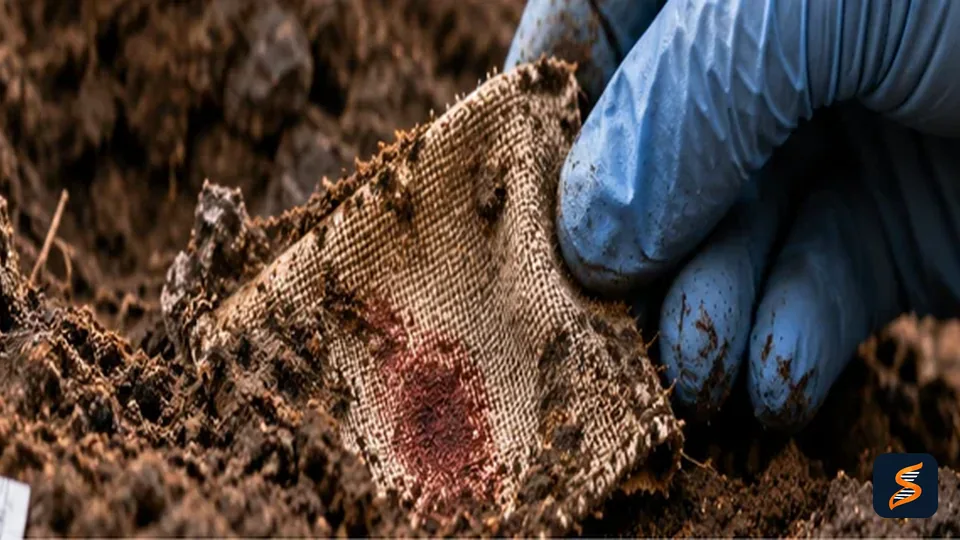
Menon and colleagues examined bloodstained cotton gauze buried in red and black soils under controlled indoor conditions. The study used shallow simulated burials and sampled material at ten timepoints. The team evaluated autosomal STR signal intensity, allele recovery and soil microbial community changes.
The experimental design deliberately limited environmental variability. It should therefore be read as a controlled model of concealed evidence, not as a field study of every outdoor burial scenario.
DNA signal declined without losing alleles
STR peak heights, expressed as relative fluorescence units (RFU), changed across the burial period. The trend was not a simple, steady decline: signal fell early, rose during an intermediate phase and dropped substantially later. Larger STR amplicons generally lost more signal than smaller markers, consistent with the effects of template degradation.
Despite declining peak heights, the authors reported complete STR profiles at every tested timepoint, with no observed allelic loss in the reported experimental profiles. Profile completeness is a separate measure from DNA quantity or peak intensity. A complete profile obtained from a controlled sample does not imply that every buried sample would produce an equally interpretable result.
Why soil type and microbial change matter
The researchers observed differences in signal retention between red and black soil and documented changes in bacterial communities using 16S rRNA sequencing. However, they did not establish a statistical relationship between microbial changes and DNA degradation. The microbial observations should not be presented as proof that particular bacteria caused the STR signal pattern.
Burial conditions may differ in moisture, temperature, microbial activity, soil chemistry, depth and exposure. These variables can change the fate of DNA and complicate comparisons with other studies.
Practical implications for evidence recovery
Investigators should not dismiss buried clothing or fabric as unsuitable for DNA examination merely because considerable time has passed. Proper documentation, substrate sampling, contamination control and laboratory triage remain important. Where degradation is suspected, the analyst should assess quantitative results, amplification suitability and the profile’s quality under validated procedures.
The study also illustrates why larger and smaller STR markers can behave differently during degradation. Related reading: DNA Extraction from Bone, Teeth and Degraded Remains and Forensic Evidence Recovery Sequence.
The experimental question
The study focused on bloodstained fabric concealed in shallow indoor soil rather than on exposed outdoor remains. Bloodstained fabrics were placed in red and black soil, with controls, and recovered across ten sampling timepoints over 110 days. The researchers examined autosomal STR signals and described changes in the bacterial community.
This distinction matters because indoor burial does not reproduce rainfall, solar radiation, large temperature fluctuations, insects or all the other processes affecting outdoor exhibits. It also differs from blood on nonporous surfaces, in water or inside a decomposing body.
What an STR peak can tell us
Capillary electrophoresis produces fluorescent signals for amplified STR alleles. Peak height, measured in relative fluorescence units, reflects the detected amplification product under the laboratory’s assay conditions. Lower RFU may indicate less amplifiable template, but signal strength is also influenced by sampling, extraction, amplification and electrophoresis.
An allele can remain detectable even when its peak height declines. This is why profile completeness and signal intensity are different endpoints. In the reported study, the researchers observed changes in signal over time but still obtained complete profiles at every timepoint.
The authors found that larger amplicons tended to lose signal more readily than smaller ones. This is consistent with fragmentation affecting long DNA targets disproportionately. The finding supports careful interpretation of size-dependent imbalance in compromised samples, without assuming that every decline reflects a single degradation mechanism.
Why the decline was not linear
The reported signal pattern included an early decline, an intermediate rise and a marked late decline. A simple statement that DNA loses a fixed percentage of its signal each day would therefore misrepresent the data.
The study used Mann–Whitney U testing, Spearman rank correlation and exponential regression to examine STR signal behaviour. The abstract does not establish a validated time-since-deposition equation. Investigators should not use the pattern to estimate how long an unknown bloodstain has been buried.
Soil bacteria were observed, not shown to cause the loss
The investigators also used 16S rRNA sequencing to describe soil microbial communities. The microbial composition changed during the burial period, but the researchers did not test a relationship between these changes and STR degradation. Concurrent observations do not demonstrate causation.
Microbial enzymes, moisture and soil chemistry are plausible influences in buried evidence, but their separate contributions would require controlled experiments. The study should be cited for what it measured, not for a mechanism it did not establish.
Casework implications and limits
For a recovered buried garment, the first practical step is to preserve its condition, document the recovery environment and avoid unnecessary handling or contamination. The laboratory can then select appropriate subsampling, DNA quantification, amplification and interpretation procedures.
A complete profile from this study does not guarantee recovery in a different case. Substrate composition, stain volume, prior washing, soil conditions, temperature, moisture, burial depth and elapsed time can all change the outcome. Negative or partial profiles must be evaluated under validated laboratory thresholds and reporting criteria.
How to read this research
Key Takeaways
Complete profiles were obtained throughout this specific controlled 110-day experiment despite reduced STR signal.
- The experiment used bloodstained cotton gauze in red and black soil under indoor conditions.
- Complete autosomal STR profiles were reported at all sampled timepoints up to 110 days.
- Peak heights changed nonlinearly, and larger amplicons generally showed greater signal loss.
- The results should not be used to promise DNA recovery from all buried fabrics or environments.
Frequently Asked Questions
Can DNA survive 110 days underground?
Yes, it did in the controlled conditions of this study. Survival and recoverability in other environments depend on multiple variables.
Does a lower RFU mean allelic dropout?
Not necessarily. Peak height can decline while all expected alleles remain detectable above the laboratory's validated thresholds.
Did soil microbes cause the observed DNA degradation?
The study described microbial community changes but did not test a causal relationship with DNA degradation.
References & Sources
Show referencesHide references
- Menon PV, et al. (2026 online; February 2027 issue). DNA signal decline, STR profile persistence and soil microbial change in buried bloodstained fabric under indoor controlled conditions. Forensic Science International. Source