Research at a glance
Forensic Identification of Fentanyl and its Analogs by Electrochemical-Surface Enhanced Raman Spectroscopy (EC-SERS) for the Screening of Seized Drugs of Abuse
Study summary
Electrochemical surface preparation enhanced Raman screening of fentanyl and selected analogues, including simulated mixtures with fentanyl at 1%.
Critical appraisal
- Limitations
- Laboratory proof of concept and simulated samples; substance identification in real casework requires validated confirmatory workflows.
- Implications
- Promising complementary screening research for complex seized-drug evidence.
Fentanyl can be present in a seized-drug mixture at a low proportion, while chemically similar analogues may produce overlapping analytical signals. That combination makes rapid screening difficult. A 2022 study in Frontiers in Analytical Science tested an approach that combines electrochemistry with surface-enhanced Raman spectroscopy (SERS) to improve sensitivity and compare the spectra of related compounds.
Colby E. Ott and colleagues described their method as electrochemical surface-enhanced Raman spectroscopy, or EC-SERS. Their work was supported by a forensic research context, but it should be read as a controlled analytical investigation rather than confirmation that EC-SERS is universally validated for routine forensic drug identification.
How EC-SERS works
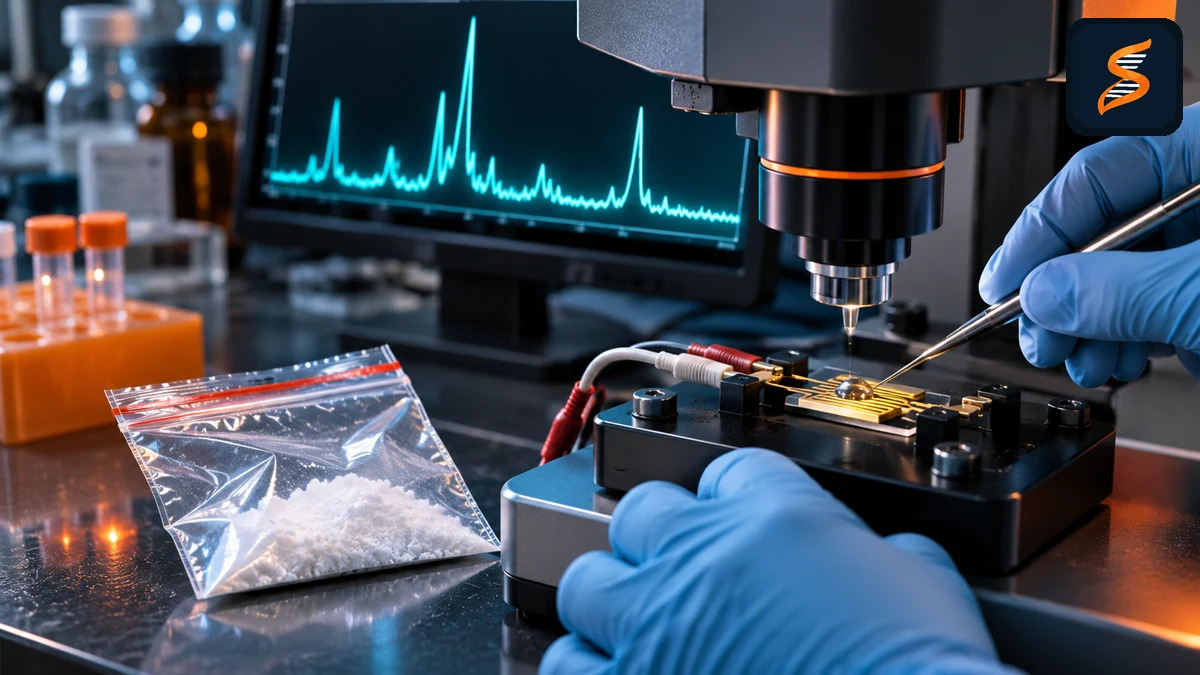
Ordinary Raman spectroscopy measures light scattered by molecules and provides bands associated with molecular vibrations. SERS can strengthen weak Raman signals when analytes interact with suitable metal surfaces. In EC-SERS, controlled electrical potentials are applied to prepare or modify the enhancing surface and influence how the target compound interacts with it.
The authors optimized a series of electrochemical pulses and tested the resulting spectral response. The intention was to achieve greater signal enhancement while retaining enough spectral information to distinguish structurally related fentanyl compounds.
Which compounds were examined?
The study included fentanyl and six related targets: acetyl fentanyl, methoxyacetyl fentanyl, furanyl fentanyl, acryl fentanyl, valeryl fentanyl and 4-ANPP. Several share much of their chemical structure, so the authors examined differences in particular Raman bands and their relative intensities, rather than assuming that every compound produces a wholly different spectrum.
The reported detection limits varied by analyte. For 4-ANPP the limit was 10 ng/mL; for fentanyl, acetyl fentanyl, methoxyacetyl fentanyl and valeryl fentanyl it was 100 ng/mL; for furanyl fentanyl it was 300 ng/mL, and for acryl fentanyl 500 ng/mL. These figures describe the experiment’s specific analytical conditions and should not be transferred directly to a different instrument or sample matrix.
What happened in drug mixtures?
Mixtures are an important practical test because seized substances may contain heroin, cocaine, methamphetamine and other materials. The researchers examined the influence of several commonly encountered compounds, including naltrexone and naloxone, and reported limited or no interference under the tested conditions.
In simulated mixtures where fentanyl was a minor component, the authors detected it, including at 5% and 1% mixture levels. That is a noteworthy proof-of-concept result. It does not establish error rates or detection performance across the full diversity of adulterants, packaging contaminants and real seized exhibits.
Screening is not confirmation
A screening result is useful for selecting further analysis or prioritizing a sample. A confirmatory drug identification must comply with the laboratory’s validated analytical scheme, reference material requirements and relevant standards. The presence of a SERS peak near an expected position is not, by itself, adequate grounds for an unqualified identification.
Chemically related compounds, substrate variability, spectral preprocessing and sample composition can all affect a classification. A casework validation would need reproducibility across batches, analyst and instrument variation, blind samples, mixtures, false-positive and false-negative performance, and decision criteria established in advance.
What is the practical value today?
The clearest implication is that electrochemical preparation may increase the usefulness of SERS for trace-level screening of fentanyl-class substances. It could complement established approaches where a laboratory has the appropriate equipment and validation evidence. Claims of universal field readiness or regulatory approval would go beyond this study.
For laboratories assessing the technique, a sensible question is not simply how low the detection limit can be in a prepared solution. It is whether the method can classify realistic mixed samples reproducibly and trigger confirmatory testing without encouraging overconfident interpretation. The 2022 study provides a valuable starting dataset, not the end of that evaluation.
Key Takeaways
What the study demonstrates and where its evidence ends.
- The EC-SERS research examined fentanyl plus six related compounds and found analyte-dependent sensitivity.
- The lowest reported detection limit was 10 ng/mL for 4-ANPP; fentanyl was reported at 100 ng/mL.
- Simulated mixtures containing only 1% fentanyl were detected under the study conditions.
- Results support further screening-method research, not replacement of validated confirmatory testing.
Frequently Asked Questions
Is EC-SERS the same as ordinary Raman spectroscopy?
No. EC-SERS uses electrochemically controlled metal-surface enhancement to strengthen Raman signals and modify analyte-surface interactions.
Can this method identify fentanyl in a mixture?
The study detected fentanyl in selected simulated mixtures, including 1% fentanyl. Broader casework performance must be validated.
Does a positive EC-SERS screen prove which substance is present?
Not by itself. A laboratory must follow validated identification and confirmation procedures before reporting a definitive result.
References & Sources
Show referencesHide references
- Ott CE, Perez-Estebanez M, Hernandez S, et al. (2022). Forensic Identification of Fentanyl and its Analogs by EC-SERS for the Screening of Seized Drugs of Abuse. Frontiers in Analytical Science, 2:834820. Source
- US Department of Justice, Office of Justice Programs. Research record for Ott et al. (2022). Source