Research at a glance
Insights Into Bloodstain Degradation and Time Since Deposition Estimation Using Electrochemistry
Study summary
Differential-pulse voltammetry was used to study electrochemical changes in experimental blood films over two weeks at five temperatures.
Critical appraisal
- Limitations
- Bovine blood, controlled electrode films, variability among blood donors; no validated casework clock.
- Implications
- A promising mechanism to explore within multi-method studies of bloodstain time since deposition.
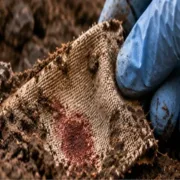
A bloodstain can help investigators reconstruct what happened at a scene. Determining when it was deposited is much harder. Its appearance and chemistry change with time, but temperature, humidity, light, the surface and the blood donor all influence those changes. There is no generally accepted method that can assign a reliable exact age to every bloodstain.
In June 2022, Mitchell Tiessen and colleagues published a study in Frontiers in Analytical Science that examined whether electrochemical signals from degrading hemoglobin could provide clues about a stain’s time since deposition (TSD). The findings are experimentally interesting, but they are preliminary. They do not amount to a forensic timestamp.
Why hemoglobin changes as a stain ages
Hemoglobin transports oxygen in red blood cells. After blood is deposited, oxidative reactions, drying and structural change modify its chemistry. Some of those changes affect electron-transfer reactions that can be measured at an electrode. Researchers therefore ask whether the evolving electrochemical response can be associated with elapsed time.
The study used differential pulse voltammetry (DPV), a technique that records current changes as an electrical potential is applied, alongside hydrodynamic voltammetry to investigate oxygen-reduction behavior. DPV can detect contributions from hemoglobin and its degradation products, although overlapping electrochemical signals complicate interpretation.
How the experiment was designed
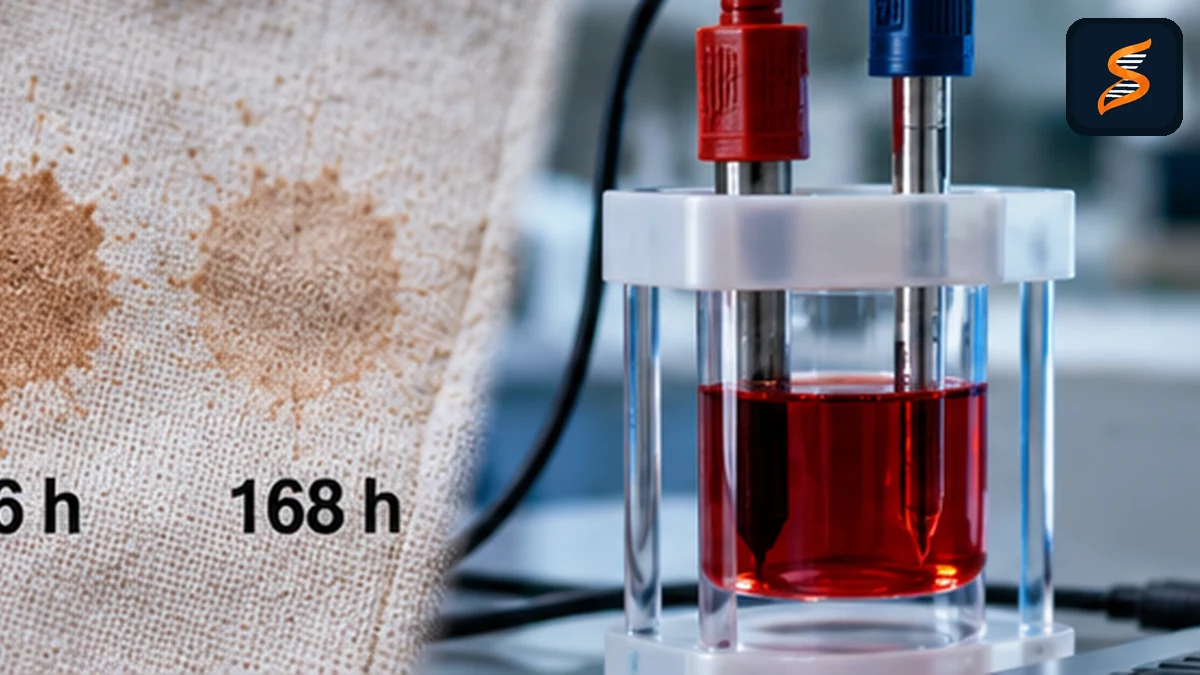
The team used bovine whole blood rather than human crime-scene samples. They prepared small blood films on glassy-carbon electrodes with a Nafion coating and examined them at multiple time points, from shortly after deposition through 336 hours (14 days). The temperature groups included −20°C, 3°C, 22°C, 30°C and 40°C, with humidity controlled in the experimental setup.
The investigators measured electrochemical peak positions, heights and areas, studied relationships with the logarithm of time and used linear mixed models to account for variation among biological samples. Additional experiments examined packed-cell-volume differences. This design allowed specific influences to be investigated, but it did not reproduce ordinary bloodstains collected from fabric, soil or painted surfaces.
What the researchers found
Seven of 27 electrochemical variables were significantly associated with elapsed time in their reported models, with p-values below 0.033. The signals were linked to oxygen reduction involving hemoglobin and oxidation of its degradation products. The result supports an association between bloodstain ageing and certain redox responses; it does not tell us how precisely a blind unknown sample could be dated.
The authors also observed a significant shift around 96 hours, with p below 0.043 across the studied temperature groups. This is an experimental change point, not a universal four-day boundary that an examiner could apply to a stain from an unknown scene.
Their rotating-electrode measurements suggested that older hemoglobin films changed how oxygen was reduced, with more evidence of peroxide formation. Such chemistry is a possible source of temporal information, but translating an electrode response into an elapsed-time estimate requires much more than identifying a trend.
Why the result cannot yet date evidence
The biological source matters. Different donors have different hematological properties, and samples deposited at different volumes or thicknesses may dry and age differently. The study found improved model behavior when biological variation was considered. A casework method would also have to account for water exposure, cleaners, sunlight, substrate effects and transfers after initial deposition.
A particularly important limitation is that the research created blood films directly on electrodes. Most forensic exhibits involve dried stains that must be collected or transferred before analysis. Sampling those stains adds uncertainty that the reported models did not validate.
Where this fits alongside other TSD methods
Investigators have also studied optical spectroscopy, RNA degradation, proteomics and other molecular changes to estimate bloodstain age. A technique can correlate with time under controlled conditions and still be unsuitable for casework if it lacks reliable prediction intervals on unknown samples. Combining independent measurements may improve performance, but such improvement must be demonstrated rather than assumed.
For practitioners, electrochemistry should be described as a developing research approach. It would require external validation, realistic mock exhibits, blind tests, specified decision rules and quantified uncertainty before use for evidential timing claims. A scientific result about oxidation is not the same as proving when an assault or another event took place.
How to interpret this study responsibly
The appropriate takeaway is modest but useful: hemoglobin chemistry contains measurable time-related information, and voltammetry can detect part of that change. The 2022 paper provides a framework for further method development. It does not establish an approved technique for saying that a questioned stain is 24, 48 or 96 hours old.
For related research, see Simply Forensic’s articles on bloodstain pattern analysis, RNA degradation in forensic evidence and DNA persistence in buried bloodstains. Those topics examine different evidential questions and should not be treated as interchangeable time-since-deposition methods.
Key Takeaways
The measured chemical change is not a courtroom-ready timestamp.
- Electrochemical responses from experimental hemoglobin films changed during a two-week ageing study.
- Seven of 27 variables were significantly associated with time; the work did not demonstrate forensic-level ageing accuracy.
- A shift around 96 hours is an experimental observation, not a universal dating cutoff.
- Bovine samples deposited on electrodes cannot stand in for the diversity of real bloodstain exhibits.
Frequently Asked Questions
Can an electrochemical test determine exactly when blood was deposited?
Not on the evidence of this study. The authors reported preliminary relationships between redox responses and ageing, not a validated casework timestamp.
Was human blood tested?
The principal experiments used bovine blood films on electrodes under controlled environmental conditions.
Does a significant correlation mean an accurate prediction?
No. A correlation or p-value does not establish blind-prediction accuracy, calibration, error rates or acceptable uncertainty for casework.
References & Sources
Show referencesHide references
- Tiessen M, Fruehwald HM, Easton EB, Stotesbury T. (2022). Insights Into Bloodstain Degradation and Time Since Deposition Estimation Using Electrochemistry. Frontiers in Analytical Science, 2:900483. Source