Research at a glance
Evaluating magnetic fingerprint powders: Impact of chemical composition, magnetization, and potential safety concerns
Study summary
Six commercial magnetic powders were chemically characterized and their print-development quality evaluated by seven examiners.
Critical appraisal
- Limitations
- Lead was detected in one powder; the study did not measure examiner exposure or establish that all powders contain lead.
- Implications
- Product-specific formulation, validation and workplace risk assessment should guide magnetic powder selection.
Magnetic fingerprint powders are familiar tools for developing latent fingermarks, but products sold for the same purpose may differ substantially in their chemical and physical properties. A November 2026 Journal of Forensic Sciences study compared six commercial powders and found that surface chemistry, magnetic behaviour and certain fillers were associated with differences in print quality. Lead was detected in one tested powder, raising a separate question about occupational exposure.
- What was examined
- Surface iron and magnetization influenced results
- Heavy-metal fillers and safety
- Choosing a powder for casework
- Why magnetic powders need chemical scrutiny
- How the six products were characterized
- Interpreting surface iron and magnetization
- What the lead finding does and does not show
- Practical laboratory review
What was examined
Knott and colleagues used several analytical methods to characterize six magnetic fingerprint powders, including X-ray photoelectron spectroscopy, scanning electron microscopy with energy-dispersive X-ray spectroscopy, infrared and Raman spectroscopy, powder diffraction and surface-area analysis. Seven latent print examiners assessed developed print quality under pristine and diminished conditions.
The combination of chemical characterization and examiner assessment is useful because a powder’s commercial label alone does not describe how its particles interact with fingermark residue.
Surface iron and magnetization influenced results
Powders with more surface-accessible iron were associated with better quality on pristine impressions. The authors also highlighted the value of moderate magnetization for particular applications. A powder that is strongly magnetic is not necessarily the most selective at the fingermark interface.
Print development depends on the substrate, residue, powder formulation, application technique and the condition of the impression. This study does not establish one universally superior powder for all scenes.
Heavy-metal fillers and safety
The investigators reported that fillers including lead and barium were associated with poorer selective adhesion, particularly for diminished impressions. Lead was detected in one of the six commercial powders studied. This is a reason to review material composition and exposure controls, not evidence that every magnetic powder contains lead or that all users experienced harmful exposure.
The study characterized products and discussed potential hazards; it did not measure individual examiner exposure doses or establish disease outcomes. Laboratories should assess current safety data sheets, relevant occupational guidance, ventilation, contamination control and personal protective equipment as part of a product-specific risk assessment.
Choosing a powder for casework
Selection should consider performance on relevant substrates and residues, compatibility with subsequent examinations, product composition and documented safety controls. Before a new formulation is introduced, the laboratory should verify its performance under its own operating conditions.
Fingerprint powdering may also interfere with other evidence opportunities. An examination plan should consider DNADNA, or Deoxyribonucleic Acid, is the genetic material found in cells, composed of a double helix structure. It serves as the genetic blueprint for all Read Full Definition, trace evidence and latent marks together. See Forensic Evidence Recovery Sequence and Nanoparticles for Fingerprints.
Why magnetic powders need chemical scrutiny
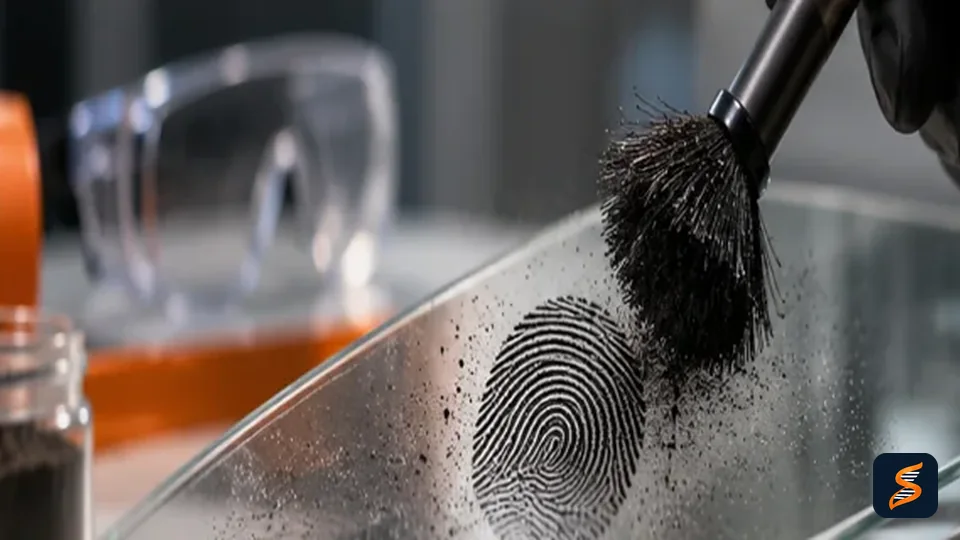
A magnetic applicator holds powder particles in a loose tuft that can be moved across a surface to develop latent ridge detail. The formulation’s particle chemistry and magnetic behaviour influence how readily the particles interact with fingermark residue and the surrounding substrate.
Two products both labelled magnetic fingerprint powder can therefore behave differently. Their relative effectiveness may change with the surface, the age and condition of the mark, application pressure and the amount of background adhesion.
How the six products were characterized
The researchers examined six commercial powders with a range of complementary methods. X-ray photoelectron spectroscopy assessed near-surface chemistry; scanning electron microscopy with energy-dispersive X-ray spectroscopy examined morphology and elemental composition. Raman and infrared spectroscopy, powder X-ray diffraction and surface-area analysis added information about material structure and properties.
Seven latent print examiners also evaluated developed impressions under pristine and diminished conditions. The combination of laboratory characterization with examiner observations helps connect the powder’s material properties to practical print development. It does not mean the findings establish an operational ranking for every commercial product or substrate.
Interpreting surface iron and magnetization
The study associated higher surface-accessible iron with improved development of pristine impressions. It also highlighted the role of moderate magnetization in particular applications. Surface accessibility and magnetic response are related to the way particles are presented to a residue-bearing surface; neither should be reduced to a claim that more iron or stronger attraction always produces better prints.
For diminished impressions, selective adhesion is especially important. Excessive background deposition can obscure ridge detail, while insufficient adhesion can leave useful residues undeveloped. A product assessment should therefore include both contrast and the continuity of ridge features.
What the lead finding does and does not show
The investigators detected lead in one of the six products and discussed heavy-metal fillers, including lead and barium, in relation to poorer selective adhesion. The presence of a hazardous constituent creates a reason for product-specific occupational risk assessment.
However, chemical detection is not the same as demonstrating an exposure dose or a health outcome. The study did not establish that all magnetic powders contain lead, that examiners were harmed, or that every powder should be withdrawn. The appropriate response is to examine the current formulation, manufacturer documentation and applicable workplace exposure controls.
Practical laboratory review
Before selecting or replacing a powder, a laboratory should document the surfaces and impression conditions on which performance was tested. It should consider examiner consistency, background staining, subsequent DNA or trace examinations, handling and cleaning procedures, and the need for appropriate personal protection.
Product safety information should be checked against the actual batch and supplier. Where hazardous elements are suspected, laboratories may consider independent characterization and a review of ventilation, dust-control and waste procedures. The decision should follow a documented risk assessment, not a generalization from one tested product.
How to read this research
Key Takeaways
Powder composition affects development quality, and product-specific chemical safety deserves attention.
- Six commercial magnetic powders were characterized and seven examiners evaluated print quality.
- Surface-accessible iron was associated with better pristine print development in tested conditions.
- Lead was detected in one tested powder; this does not establish that all magnetic powders contain lead.
- Laboratories should assess both validated performance and product-specific occupational exposure controls.
Frequently Asked Questions
Are magnetic fingerprint powders dangerous?
Risk depends on the product's composition and actual exposure. The study identified a potential hazard in one powder, not measured harm across all products.
Does stronger magnetization always improve fingerprintsFingerprint, impression made by the papillary ridges on the ends of the fingers and thumbs. Fingerprints afford an infallible means of personal identification, because the Read Full Definition?
No. The researchers highlighted a balance involving magnetization and accessible surface iron.
Should a laboratory stop using all magnetic powders?
The study does not support a blanket ban. It supports reviewing the specific product's composition, safety documentation and validated performance.
References & Sources
Show referencesHide references
- Knott HA, et al. (2026). Evaluating magnetic fingerprint powders: Impact of chemical composition, magnetization, and potential safety concerns. Journal of Forensic Sciences. Source