News analysis | Facility commissioned 18 November 2026 | Accra, Ghana
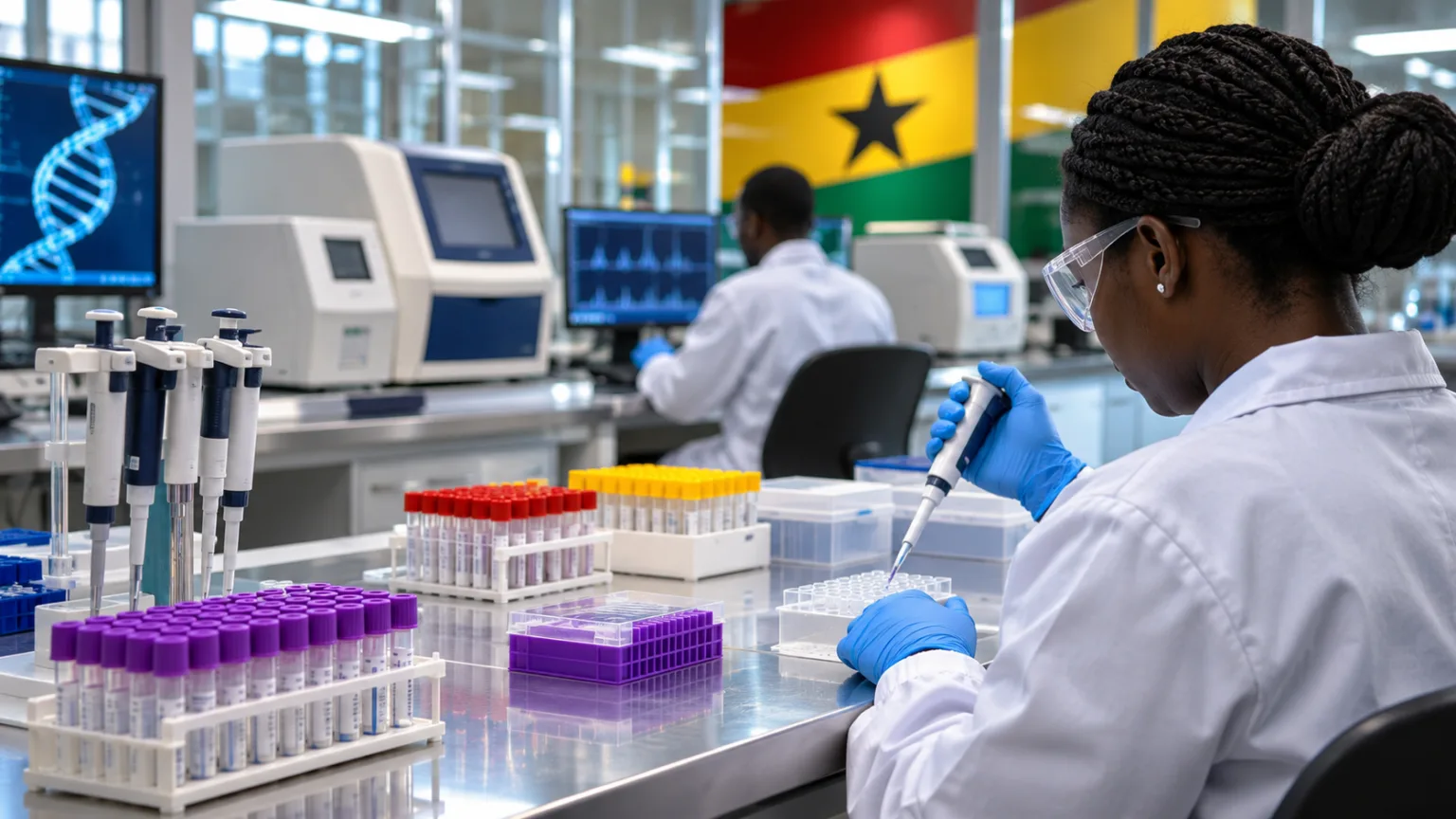
Ghana has commissioned a National Human DNADNA, or Deoxyribonucleic Acid, is the genetic material found in cells, composed of a double helix structure. It serves as the genetic blueprint for all Read Full Definition Identification Laboratory at the Noguchi Memorial Institute for Medical Research, University of Ghana. The facility is intended to support identification of human remains, criminal investigations and scientific training. Its establishment follows a national disaster that exposed the difficulty of obtaining timely domestic DNA identification.
News at a Glance
- Commissioned
- 18 November 2026
Official commissioning date
- Location
- Noguchi Institute, Ghana
University of Ghana, Legon
- Status
- Commissioned
Full service scope and accreditation unverified
Key Takeaways
The facility is commissioned; clinical and forensic service capabilities require continued verification.
- Ghana commissioned a national human DNA identification facility at the University of Ghana's Noguchi institute on 18 November 2026.
- Officials cited the 2025 helicopter crash and overseas identification testing as a motivation.
- Expected applications include disaster victim identification, investigations, kinship testing and training.
- Commissioning does not independently establish accreditation, routine throughput or all validated forensic casework capabilities.
What has been announced?
President John Dramani Mahama commissioned the laboratory on 18 November 2026, alongside separate mRNA and protein research facilities. Ghana’s National Vaccine Institute confirmed the new DNA facility in an announcement dated 19 November. A Ghana News Agency report subsequently described the installed DNA analysis equipment and its intended contribution to identification services.
Why the laboratory was established
Officials linked the investment to the 6 August 2025 helicopter crash in Ghana, when samples needed to be sent to South Africa for victim identification. Sending material abroad can introduce transportation, coordination and administrative delays. Domestic capability could reduce reliance on overseas facilities when sufficiently trained staff, validated workflows, maintenance, consumables and quality oversight are in place.
Potential forensic applications
- Disaster victim identification (DVI): Comparison of DNA profiles from recovered remains with suitable reference samples.
- Criminal investigation: Human identification testing and, depending on validated services, analysis of DNA-bearing biological evidence.
- Kinship and unidentified remains: Biological relationship comparisons where appropriate reference samples and legal authority are available.
- CapacityThe amount of finished product that could be produced, either in one batch or over a defined period of time, and given a set list Read Full Definition development: Training, research partnerships and domestic specialist expertise.
Commissioning is not the same as accreditation
The commissioning and equipment installation are documented. However, available announcements do not establish the full list of validated assays, casework throughput, external proficiency-testing performance or ISO/IEC 17025 accreditation status. Those details should be confirmed before describing the laboratory as fully accredited or assuming all services are routinely available.
What determines whether the investment succeeds?
Forensic DNA capacity depends on more than sequencers or amplification instruments. Sustainable operation requires secure evidence intake, chain of custody, extraction controls, appropriate analytical thresholds, validated interpretation procedures, contamination monitoring, technical review, consumable procurement and independent quality assurance. For disaster response, a clear system for reference sample acquisition, reconciliation and communication with families is just as important.
The wider significance
A domestically supported DNA identification capability can improve national readiness for mass-fatality incidents and strengthen opportunities for forensic education. The immediate development worth reporting is the creation and commissioning of the facility; its longer-term success will need to be measured through documented casework capability, quality systems and accessible services.
Readers can explore our background article on the development of DNA profiling and the forensic science topic directory.
What would make the new capacity measurable?
The most useful follow-up will be operational evidence: which tests the laboratory accepts, which methods have undergone validation, who performs technical review, how long typical submissions take and what independent quality assessments have been completed. For victim identification, the laboratory will also need clear procedures for collecting family-reference samples, handling fragmented or degraded remains, documenting comparisons and communicating conclusions sensitively. These procedures cannot be inferred from an equipment announcement.
A 20 November Ghana News Agency report attributed the equipment installation to ADB Ghana Medical Systems Group in partnership with Thermo Fisher Scientific UK. That helps identify the technology partnership, but it does not independently prove which assays, interpretation software or accreditation scope are operational. Those details deserve a later technical update once the laboratory makes them public.
Frequently Asked Questions
Frequently Asked Questions
When was the facility commissioned?
On 18 November 2026, according to Ghanaian government and news-agency reporting.
Where is it located?
At the Noguchi Memorial Institute for Medical Research, University of Ghana, Legon.
Is it accredited to ISO/IEC 17025?
The reviewed commissioning sources do not establish accreditation status; this needs separate confirmation.
References
References & Sources
Show referencesHide references
- National Vaccine Institute, Ghana. President Mahama commissions state-of-the-art DNA, mRNA and protein laboratories for forensics and vaccine development. 19 November 2026. Source
- Ghana News Agency. Mahama inaugurates vaccine R&D laboratories, DNA laboratory. 19 November 2026. Source
- Ghana News Agency. ADB Ghana installs DNA equipment at Noguchi to strengthen human identification. 20 November 2026. Source