

Detecting ignitable liquid residue in fire debris is not the same as proving arson"Arson" is a criminal act involving intentionally and unlawfully setting fire to buildings, structures, or other property types. It is a serious offense and is considered a crime in most legal jurisdictions. Here are key Read Full Definition. A laboratory may find chemical features consistent with a particular class of ignitable liquid, but whether a fire was intentionally set is a separate investigative question requiring the scene history, fire dynamics and other evidence Evidence is any form of proof, such as objects, materials, or scientific findings, presented to establish or disprove a fact in a legal proceeding. It is used to reconstruct events and link or exclude individuals Read Full Definition.
- What is fire debris evidence?
- Choosing samples at the fire scene
- How are ignitable liquid residues extracted?
- What does GC-MS measure?
- Current standard: ASTM E1618-25
- What factors complicate interpretation?
- Can a positive result prove a fire was intentionally set?
- Example: charred carpet near a doorway
- Frequently asked questions
- Can laboratory analysis identify an exact brand of gasoline?
- Does a negative fire debris test exclude arson?
- Is fire pattern interpretation the same as chemical testing?
- Primary standards and further reading
Fire debris analysis is a specialized area of forensic chemistry. This guide covers evidence handling, extraction and gas chromatography–mass spectrometry (GC-MS), as well as the factors that make the interpretation of a burned sample difficult.
What is fire debris evidence?
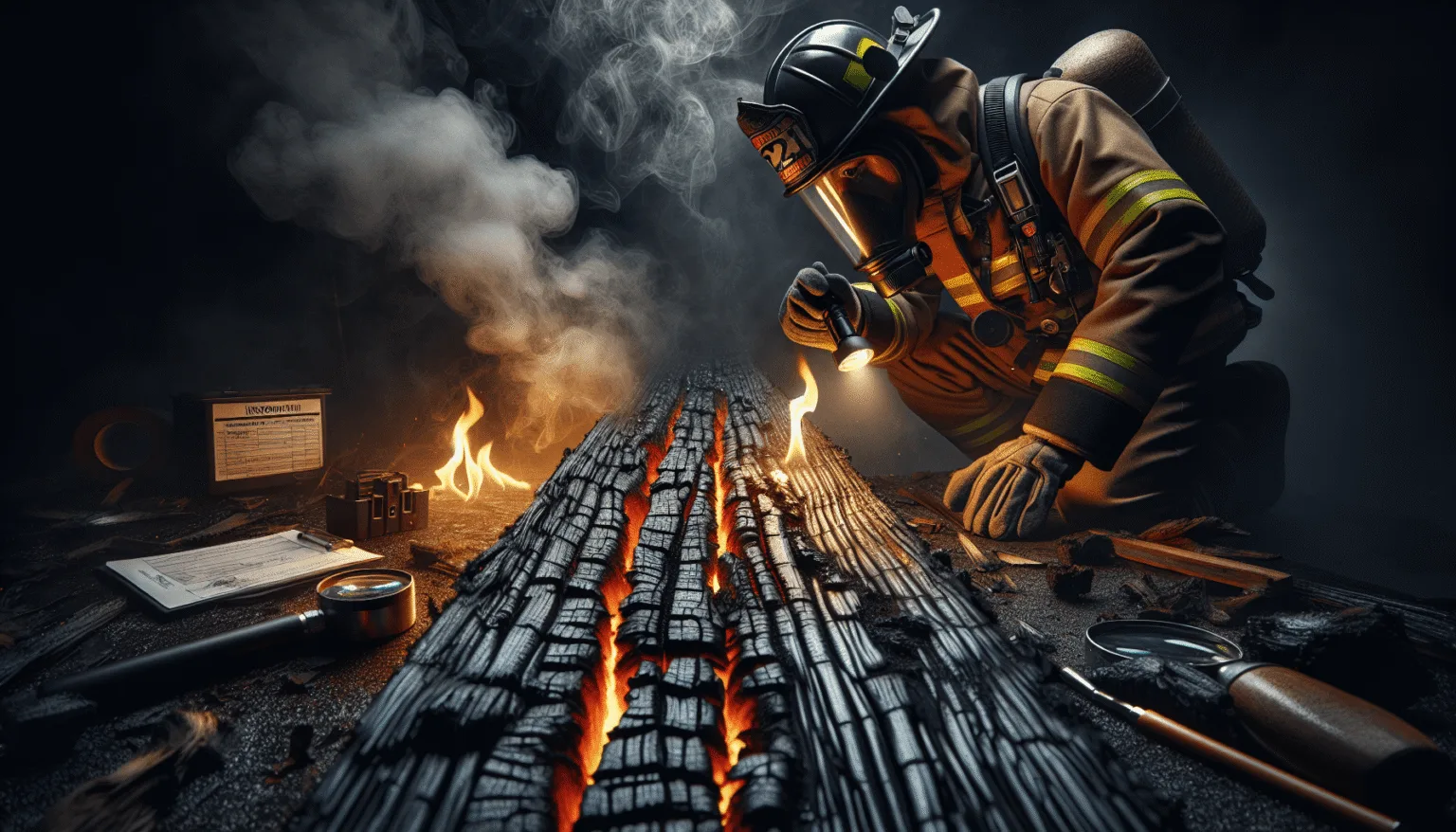
Fire debris is material recovered from a fire scene for laboratory examination. It can include burned flooring, textiles, charred wood, carpet, furnishings, soil and other porous or nonporous materials. Investigators may ask whether a sample contains residues of products such as gasoline, petroleum distillates or other ignitable liquids.
Most scenes contain many compounds even before burning. Heat can destroy molecules, create new pyrolysis products and change the relative proportions of surviving compounds. This is why a single peak in a chromatogram cannot be treated as a definitive chemical fingerprint of an accelerant.
Choosing samples at the fire scene
Sampling decisions are informed by a fire scene investigation, not by laboratory instruments alone. Investigators consider the fire’s origin, observed patterns, witness information, possible accidental ignition sources and potential alternative explanations.
- Document the location and nature of each recovered item before removal.
- Collect material using methods designed to preserve potential volatileIn scientific and chemical contexts, the term "volatile" describes a substance that has the propensity to evaporate or change from a liquid state to a gaseous state readily at normal or room temperatures. Volatility is Read Full Definition residues and prevent cross-contaminationCross-contamination - The unwanted transfer of material between two or more sources of physical evidence. For example, improperly collecting biological evidence such as blood could lead to one sample mixing with another sample and contaminating Read Full Definition.
- Use appropriate clean containers and secure seals according to the applicable laboratory procedure.
- Collect comparison or control material where useful to assess substrate contributions.
- Document sampling sequence, handling and continuity.
Packaging that permits excessive loss of volatile compounds can reduce analytical value. Collection protocols should follow the applicable standards and laboratory procedures rather than a generic online checklist.
How are ignitable liquid residues extracted?
The laboratory must first separate analytes of interest from the debris matrix. Extraction methods can involve headspace concentration onto an adsorbent material, solvent extraction, or other validated approaches. The choice depends on sample type, expected concentration, laboratory instrumentation and the limits of the method.
Materials heated in a fire may contain large amounts of unrelated pyrolysis products. The resulting extract can therefore be chemically complex, and investigators should not interpret the absence of detectable liquid as proof that no ignitable liquid was ever present.
What does GC-MS measure?
Gas chromatography (GC) separates compounds in a mixture according to their interactions with the analytical system. Mass spectrometry (MS) generates spectra that help characterize the separated components. Examiners interpret the chromatographic profile, extracted ionAn ion is a type of chemical species that results from the unequal number of electrons and protons in an atom or molecule. This imbalance in charge gives ions an electric charge, either positive or Read Full Definition data Information in analog or digital form that can be transmitted or processed. Read Full Definition and compoundIn scientific terminology, a "compound" refers to a substance formed by the combination of two or more different elements or molecules. These elements or molecules can be chemically bonded together to create a new substance Read Full Definition patterns in comparison with reference information and validated criteria.
Gasoline, for example, contains many compounds rather than one universally decisive chemical marker. Burning and weathering may preferentially remove volatile components. Plastic, wood, adhesives and other substrates may produce interfering patterns. A laboratory therefore interprets the evidence as a chemical assemblage, not a simple yes/no colour test.
Current standard: ASTM E1618-25
As of October 2026, NIST’s OSAC Standards Library lists ANSI/ASTM E1618-25, Standard Test Method for Ignitable Liquid Residues in Extracts from Fire Debris Samples by Gas Chromatography-Mass Spectrometry. The 2025 edition supersedes ASTM E1618-19. Laboratories should verify which edition their methods reference, assess the implications of updates and follow the version required by their quality system.
The OSAC catalogue also lists ASTM E1386-23 for solvent extraction, alongside other documents addressing sample preparation. These standards govern different aspects of the process and should not be presented as interchangeable.
What factors complicate interpretation?
| Factor | Potential consequence |
|---|---|
| Weathering or evaporation | Changes the proportions of compounds remaining |
| Burning and pyrolysis | Destroys some analytes and generates interfering products |
| Substrate composition | Can produce chemicals similar to components of an ignitable liquid |
| Cross-contamination | Can introduce residues unrelated to the sampled fire location |
| Improper packaging or storage | Can affect recovery of volatile compounds |
| Sampling location | May not capture the material most relevant to the fire’s origin |
Can a positive result prove a fire was intentionally set?
No. An ignitable liquid might be present for an ordinary lawful purpose, introduced after a fire, or connected to accidental events. Its presence must be evaluated alongside scene observations and alternative explanations. Conversely, deliberate fires do not always involve ignitable liquids, and intense burning can prevent detection of residues that were once present.
The laboratory provides analytical findings. Determining fire cause and manner requires synthesis of several evidence sources; it cannot be reduced to whether a chromatogram contains a target pattern.
Example: charred carpet near a doorway
A laboratory receives sealed fire debris from a carpet section close to a damaged doorway. The extract shows a pattern that the analystA designated person who examines and analyzes seized drugs or related materials, or directs such examinations to be done; independently has access to unsealed evidence in order to remove samples from the evidentiary material for Read Full Definition judges consistent with a petroleum-derived ignitable liquid class. The finding may justify further investigation, but the report should not claim that the liquid was deliberately poured or that a suspect caused the fire. Background products, fire dynamics, contaminationContamination - The unwanted transfer of material from another source to a piece of physical evidence. The inadvertent touching of a weapon, thereby adding fingerprints to it is an example of evidence contamination. Read Full Definition controls and case history need evaluation.
Frequently asked questions
Can laboratory analysis identify an exact brand of gasoline?
Often the defensible result concerns a class or general chemical profile rather than a unique commercial product or source. Formulation variation, evaporation, mixing and substrate contributions limit specificityIn the context of laboratory equipment or analytical techniques, the term "specific" describes the capability of a machine or method to accurately and selectively detect particular molecules or substances while minimizing interference from others. Specificity Read Full Definition.
Does a negative fire debris test exclude arson?
No. A negative finding concerns the submitted sample and the analytical method’s ability to detect residues. It does not establish the cause of a fire.
Is fire pattern interpretation the same as chemical testing?
No. Fire patterns are part of scene investigation. GC-MS analyses samples for chemical components. Neither substitutes for a systematic origin-and-cause investigation.
Read Simply Forensic’s existing fire investigation overview and trace evidence guide for context.
Primary standards and further reading
- NIST OSAC: ANSI/ASTM E1618-25, GC-MS examination of ignitable liquid residues.
- NIST OSAC Registry: ASTM E1386-23 and other fire debris preparation standards.
- NIST OSAC Lexicon: definition of origin in fire investigation, drawing on NFPA 921.
This is an educational overview; consult current standards, validated laboratory methods and fire-scene investigation procedures for casework.