

Soil on a shoe, tool or vehicle can provide useful investigative information, but its appearance alone does not identify a unique place. Forensic geology examines geological materials in connection with legal questions. Soil, sediment, rock fragments, minerals and manufactured mineral products can be compared to samples from potential sources.
- What is forensic geology?
- What does soil contain?
- Where do investigators find geologic trace evidence?
- How is soil evidence collected and preserved?
- How do laboratories compare soils?
- What does current research show?
- Case example: mud recovered from a vehicle
- Can forensic soil identify one precise geographic location?
- How forensic geology connects to other disciplines
- Scientific references
Unlike a human DNA DNA, or Deoxyribonucleic Acid, is the genetic material found in cells, composed of a double helix structure. It serves as the genetic blueprint for all living organisms. Read Full Definition profile, soil is a heterogeneous mixture. A handful collected from one square metre may differ from another nearby sample. The examiner’s task is therefore not simply to find two samples with the same colour but to investigate their composition, variability and circumstances of transfer.
What is forensic geology?
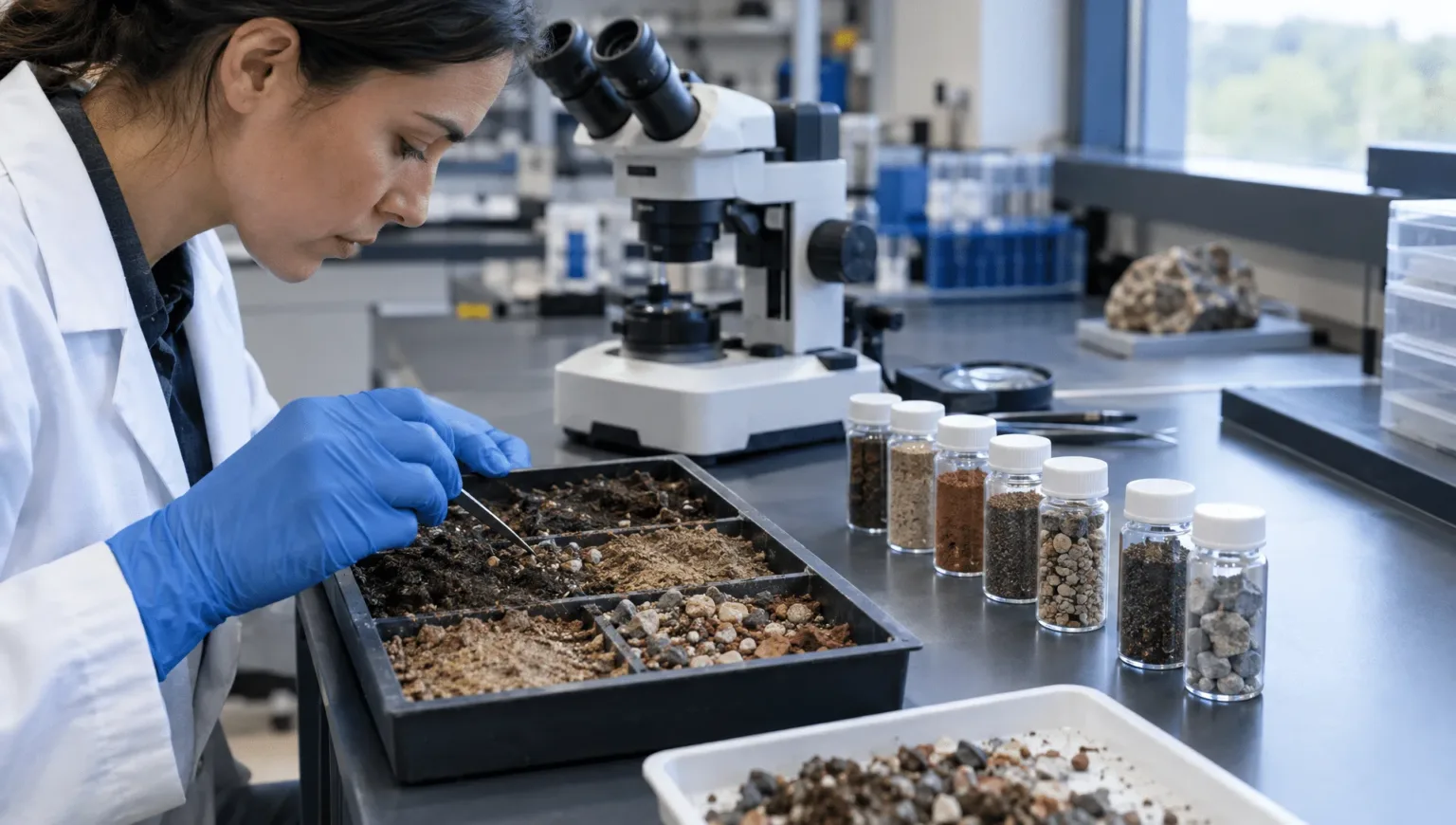
Forensic geology applies earth-science methods to geologic evidence Evidence is any form of proof, such as objects, materials, or scientific findings, presented to establish or disprove a fact in a legal proceeding. It is used to reconstruct events and link or exclude individuals Read Full Definition. The most familiar application is soil comparison: investigators recover material from a questioned item and collect reference samples from relevant locations. Other examples include sand, sediment, gravel, stone, building minerals, dust and distinctive industrial mineral products.
Geological evidence may help investigate contact between an item and a location, assess whether samples can be differentiated, or guide searches. Interpretation must consider how common or variable the observed characteristics are.
What does soil contain?
Soil commonly includes mineral particles, organic matter, moisture, microorganisms and human-made materials. Clay, silt and sand refer to particle-size fractions, not interchangeable mineral species. Quartz, feldspar and many other minerals can be widespread. Local conditions, underlying geology, land use, seasonal change, construction and pollution affect soil composition.
A soil assemblage may be distinctive in a particular comparison set, but that is not the same as proving the sample could only have originated at one location.
Where do investigators find geologic trace evidence?
- Shoe soles and tread grooves, where material can lodge during walking.
- Vehicle tyres, wheel arches and undercarriages.
- Tools, shovels, clothing and bags.
- Objects buried, dragged or stored outdoors.
- Dust accumulations on objects or indoor surfaces.
Collection should be documented in situ, with attention to avoiding mixing material from unrelated surfaces. NIST’s forensic soil collection training initiative, developed with partners including FBI geological expertise, specifically addresses recovery as well as the evidential value of such material.
How is soil evidence collected and preserved?
- Record context: photograph soil deposits and the object before sampling. Note position, visible layers and likely exposure paths.
- Use appropriate tools: recover questioned deposits separately with clean, suitable collection equipment.
- Take representative known samples: a single reference scoop may not capture within-site variation. Sampling strategy depends on the question, surface extent and expected heterogeneity.
- Prevent cross-contaminationCross-contamination - The unwanted transfer of material between two or more sources of physical evidence. For example, improperly collecting biological evidence such as blood could lead to one sample mixing with another sample and contaminating Read Full Definition: keep exhibits and reference locations separate and document tool cleaning or changes.
- Choose appropriate packaging: manage moisture and biological change, considering evidence type, safety and laboratory SOPs.
These are general principles rather than a universal collection protocol. Surface heterogeneity, transport and later deposition must be considered when evaluating a comparison.
How do laboratories compare soils?
| Method | What it examines | Important limitation |
|---|---|---|
| Visual examination and colour measurement | Colour, texture and macroscopic inclusions | Moisture and illumination affect apparent colour |
| Particle-size and microscopy | Grain size, morphology and mineral assemblages | Subsampling and observer variation matter |
| Polarized light microscopy | Optical properties supporting mineral identification | Some minerals are difficult to distinguish in mixtures |
| X-ray diffraction (XRD) | Crystalline phases in suitable material | Mixture complexity and minor components affect detection |
| XRF or SEM-EDS | Elemental signals, sometimes particle-level chemistry | Elements do not always identify a unique mineral phase |
| Spectroscopy or mass spectrometry | Selected molecular or elemental characteristics | Preparation, matrix effects and method validationValidation, often referred to as method validation, is a crucial process in the laboratory when introducing a new machine, technology, or analytical technique. It involves a series of systematic steps and assessments to ensure that Read Full Definition remain important |
No single method is automatically appropriate for every soil. The question, available sample, expected variation and laboratory validation determine the analytical sequence.
What does current research show?
A 2025 National Institute of Justice research report by Kelly Meiklejohn assessed additional quantitative approaches for surface-soil comparisons. The project investigated whether combining approaches, including colour measurement and mineral information, could improve differentiation. Its value is methodological: comparison performance depends on the sampled settings, analytical features and validation design. Reported performance from that project must not be treated as a universal error rate for forensic soil evidence.
A separate NIJ-supported 2025 feasibility study explored environmental DNA from bacteria, fungi, plants and arthropods associated with geologic material. This offers a possible complement to inorganic analyses, not an established replacement for conventional soil examination.
Case example: mud recovered from a vehicle
A vehicle is suspected of having entered a particular construction site. Deposits in the wheel arches are compared with known samples taken from several points on the site and from nearby roads. Some mineral, colour and particle-size features correspond. Other deposits in the same wheel arch differ.
A responsible interpretation considers whether multiple locations contributed to the deposits, how representative the site sampling was and whether similar materials occur locally. The observations may be consistent with contact, but soil evidence alone cannot show exactly when the vehicle visited a location or identify its driver.
Can forensic soil identify one precise geographic location?
Sometimes a distinctive assemblage can strongly narrow candidate sources, especially with well-characterized background material. Yet environmental mixtures vary across short distances and can be transported or mixed. The evidential strength depends on the alternative propositions and empirical support. Claims of a uniquely identified site are usually too strong without a defensible basis.
How forensic geology connects to other disciplines
Soil examination overlaps with forensic palynology, which examines pollen and spores, and with trace evidence analysis. These approaches can provide complementary information but must be interpreted in relation to their own limitations.
Scientific references
- Meiklejohn, K. A. (2025). Assessment of the Added Value of New Quantitative Methodologies for the Analysis of Surface Soils in Forensic Soil Comparisons. NIJ.
- NIST (2020). Forensic Soil Evidence Collection Training Video Now Available.
- Tiedge, Love and Meiklejohn (2025). eDNA from organisms associated with geologic evidence: feasibility study.