


DNA DNA, or Deoxyribonucleic Acid, is the genetic material found in cells, composed of a double helix structure. It serves as the genetic blueprint for all living organisms. Read Full Definition extraction from bone and teeth is a specialised forensic process used when soft tissues are absent, severely decomposed or unsuitable for genetic analysis. Mineralised tissues can protect DNA, but their dense structure, low recoverable template and environmental contaminants make extraction challenging. Successful processing depends on appropriate specimen selection, controlled preparation, demineralisation, lysis, purification and downstream testing.
- Why are bone and teeth challenging sources of forensic DNA?
- Bone versus teeth: what should the laboratory consider?
- Conceptual workflow for skeletal DNA extraction
- Why demineralisation matters
- Choosing the DNA purification method
- Recovering short and highly degraded DNA
- STR, Y-STR, mitochondrial DNA and MPS: which test follows extraction?
- Common inhibitors and extraction failures
- Preventing contamination in skeletal DNA analysis
- Validation and quality assurance
- Frequently asked questions
- Are teeth always better than bones for forensic DNA?
- Why is EDTA used before DNA extraction?
- Can DNA be recovered from very old skeletal remains?
- Does a failed STR profile mean no human DNA was recovered?
- Selected scientific references
This article focuses on laboratory recovery of DNA from skeletal remains. For the wider chemistry of organic, silica and magnetic methods, see our forensic DNA extraction methods guide.
Why are bone and teeth challenging sources of forensic DNA?
Bone and dental tissues contain a mineral phase dominated by hydroxyapatite and an organic matrix that includes collagen. DNA may be retained within or associated with these structures. After death, microbial activity, moisture, temperature fluctuations, soil chemistry and time can reduce the quantity and integrity of recoverable DNA. The outcome varies markedly among individuals, anatomical elements and burial environments.
For more on specimen preservation, read how taphonomy shapes mitochondrial DNA recovery. Our separate article on selecting bones for DNA analysis examines the sampling question.
Bone versus teeth: what should the laboratory consider?
| Specimen | Potential advantages | Important limitations |
|---|---|---|
| Dense cortical bone | Mineralised structure may protect DNA from some environmental exposure | Variable preservation; destructive sampling and demineralisation may be needed |
| Petrous temporal bone | Dense regions can retain endogenous DNA in some compromised remains | Sampling is destructive and must be justified by identification and conservation priorities |
| Tooth root and dentine | Dental tissues may preserve DNA when soft tissue is lost | Recovery varies by tooth, root condition and environmental history |
| Dental pulp | Can be a protected cellular source in sufficiently preserved teeth | May be absent or degraded in older or damaged remains |
There is no universal rule that one bone or tooth always produces the most useful DNA. Sampling decisions should consider preservation, anatomical availability, previous testing, destructive impact and the laboratory’s validated method.
Conceptual workflow for skeletal DNA extraction
- Document and assess: Verify the specimen identity, chain of custodyChain of custody - The process used to maintain and document the chronological history of the evidence. Documents record the individual who collects the evidence and each person or agency that subsequently takes custody of Read Full Definition, condition and sampling plan.
- Control surface contaminationContamination - The unwanted transfer of material from another source to a piece of physical evidence. The inadvertent touching of a weapon, thereby adding fingerprints to it is an example of evidence contamination. Read Full Definition: Apply an appropriately validated surface-cleaning or sampling strategy. Environmental and handling DNA can be present on external surfaces.
- Access internal material: Section or pulverise the selected tissue using controlled, cleaned equipment and documented procedures.
- Demineralise: Use a validated chelating treatment, commonly involving EDTA, to reduce the mineral matrix and facilitate DNA release.
- Lyse and digest: Apply appropriate lysis chemistry and protein digestion to release DNA from the remaining material.
- Purify and concentrate: Use a validated silica, magnetic or other extraction procedure selected for the specimen and intended DNA targets.
- Quantify and analyse: Evaluate human DNA quantity, degradation and inhibition before choosing STR, mitochondrial DNA or sequencing workflows.
These are conceptual stages, not an operational SOP. Sample mass, pretreatment, digestion, reagent composition and incubation conditions must be established for the laboratory’s method.
Why demineralisation matters
EDTA binds calcium ions and helps disrupt the mineral component of bone and teeth. This can improve access to DNA associated with the tissue matrix. However, incomplete demineralisation may limit recovery, while unnecessary processing and repeated transfers may increase loss or contamination risk. The appropriate treatment depends on tissue type and extraction chemistry.
Choosing the DNA purification method
Silica-based purification
Silica workflows bind nucleic acids under defined buffer conditions and allow washing and elution. Specialised protocols may improve recovery of short DNA fragments from degraded skeletal material. Binding conditions, fragment retention and final volume require validationValidation, often referred to as method validation, is a crucial process in the laboratory when introducing a new machine, technology, or analytical technique. It involves a series of systematic steps and assessments to ensure that Read Full Definition. See our silica extraction guide.
Magnetic bead-based purification
Magnetic systems can simplify wash and separation steps and may be compatible with automation. Bead chemistry varies, so performance for fragmented DNA and inhibitor-rich skeletal extracts must be evaluated product by product. See magnetic bead extraction.
Organic extraction
Phenol-chloroform approaches can recover DNA after suitable tissue digestion, but require hazardous-solvent controls and multiple handling steps. They are not automatically superior for severely fragmented samples. See organic DNA extraction.
Recovering short and highly degraded DNA
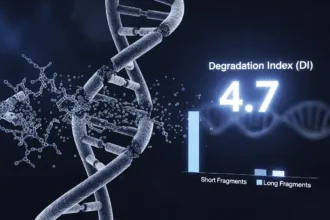
DNA fragmentation can reduce the success of conventional STR assays, particularly when target regions are longer than the surviving molecules. Short-amplicon STR systems, mitochondrial DNA assays and suitable massively parallel sequencing methods may provide alternatives. These technologies answer different identification questions and have different sensitivityIn the context of laboratory equipment or analytical techniques, the term "sensitive" describes the capability of a machine or method to detect even very small amounts or concentrations of a substance. Sensitivity is a quantitative Read Full Definition, contamination and interpretation requirements.
Extraction chemistry matters because binding and washing can preferentially retain or lose DNA of different lengths. An extraction procedure validated on intact reference DNA should not be assumed suitable for highly fragmented skeletal DNA.
STR, Y-STR, mitochondrial DNA and MPS: which test follows extraction?
| Approach | Potential value | Interpretive limitation |
|---|---|---|
| Autosomal STRs | Individualisation and kinship comparison when sufficient nuclear DNA survives | Degradation and low template can cause allele Alleles are different forms of a gene resulting from mutations or variations in the DNA sequence or gene expression. They can be dominant (expressed with one copy) or recessive (expressed only with two copies). Read Full Definition dropout |
| Y-STRs | Male-lineage information in suitable cases | Paternally related males may share haplotypes |
| Mitochondrial DNA | Useful where nuclear DNA is limited and maternal-lineage comparison is available | Generally less individualising than informative autosomal STR profiles |
| MPS/NGS | Can support targeted short-fragment sequencing and additional marker systems | Library preparation, authenticationVerifying the identity of a user, process, or device, often as a prerequisite to allowing access to resources in an information system. Read Full Definition and bioinformatics require validation |
Common inhibitors and extraction failures
Humic substances, mineral-associated compounds, collagen-derived material and other environmental contaminants may reduce amplification efficiency. Failure to obtain a profile may result from insufficient human DNA, fragmentation, inhibition, contamination or a combination of factors. Human-specific qPCR with appropriate internal controls and degradation targets can help guide subsequent analysis, although no single metric fully explains all failures.
Preventing contamination in skeletal DNA analysis
Human remains may carry DNA from excavators, handlers, laboratory staff or other specimens. Use controlled pre-PCR work areas, appropriate personal protective equipment, cleaned instruments, reagent blanks and documented sample handling. When possible, assess the implications of contamination through relevant controls and replicate or independent testing strategies. A negative blankSpecimen or sample not containing the analyte or other interfering substances. Read Full Definition does not prove that every possible contamination event has been excluded.
Validation and quality assurance
Validation should use representative bones and teeth, varying DNA input and degradation, relevant inhibitors and realistic contamination challenges. Assess recovery, repeatability, downstream profile success, fragment retention and any effects of automation or changes in sample preparation. The FBI Quality Assurance Standards for Forensic DNA Testing Laboratories and SWGDAM guidance provide relevant quality frameworks. For a dedicated discussion, read our DNA extraction validation and quality control guide.
Frequently asked questions
Are teeth always better than bones for forensic DNA?
No. Recovery depends on tissue preservation, environmental exposure, sampling strategy and the validated extraction procedure.
Why is EDTA used before DNA extraction?
It chelates calcium and helps demineralise the hard tissue matrix, facilitating access to retained DNA.
Can DNA be recovered from very old skeletal remains?
Sometimes. Success depends on preservation, contamination, extraction chemistry and the sensitivity of the intended assay. Age alone cannot predict the result.
Does a failed STR profile mean no human DNA was recovered?
No. DNA may be present but too fragmented, too limited or too inhibited for the STR assay used. Other validated targets may be considered.
Selected scientific references
- Higgins D, Austin JJ. Teeth as a source of DNA for forensic identification of human remains: A review. Science & Justice. 2013.
- Dabney J et al. Complete mitochondrial genome sequence of a Middle Pleistocene cave bear reconstructed from ultrashort DNA fragments. PNAS. 2013. (Relevant to short-fragment recovery chemistry.)
- FBI. Quality Assurance Standards for Forensic DNA Testing Laboratories. Effective July 2025.
- SWGDAM. DNA validation and interpretation guidance.
- Butler JM. Advanced Topics in Forensic DNA Typing: Methodology.