

Silica-based DNA DNA, or Deoxyribonucleic Acid, is the genetic material found in cells, composed of a double helix structure. It serves as the genetic blueprint for all living organisms. Read Full Definition extraction is a solid-phase purification method widely used in forensic DNA laboratories. Under suitable chemical conditions, DNA binds to a silica surface, contaminants are washed away, and purified DNA is eluted for quantification, STR profiling or sequencing. Its value lies in combining DNA recovery with cleanup, but extraction efficiency is influenced by sample type, fragment length, binding conditions and elution.
- Scientific principle: why does DNA bind to silica?
- Silica spin-column extraction: step-by-step principle
- Silica columns versus silica particles
- Forensic applications by sample type
- Bloodstains and buccal samples
- Touch DNA and trace evidence
- Sexual-assault evidence
- Bone, teeth and degraded remains
- Advantages of silica-based extraction
- Limitations and troubleshooting considerations
- Incomplete DNA binding
- Loss of short or damaged fragments
- Wash-buffer carryover
- Inhibitor persistence
- Recovery versus concentration
- Silica extraction versus Chelex and organic extraction
- STR profiling and MPS/NGS compatibility
- Validation and quality assurance
- Frequently asked questions
- Does silica permanently bind DNA?
- Does silica extraction remove every PCR inhibitor?
- Is silica extraction better than magnetic beads?
- Is a smaller elution volume always better?
- Selected scientific references
For an overview of the main techniques, read our comparison of forensic DNA extraction methods.
Scientific principle: why does DNA bind to silica?
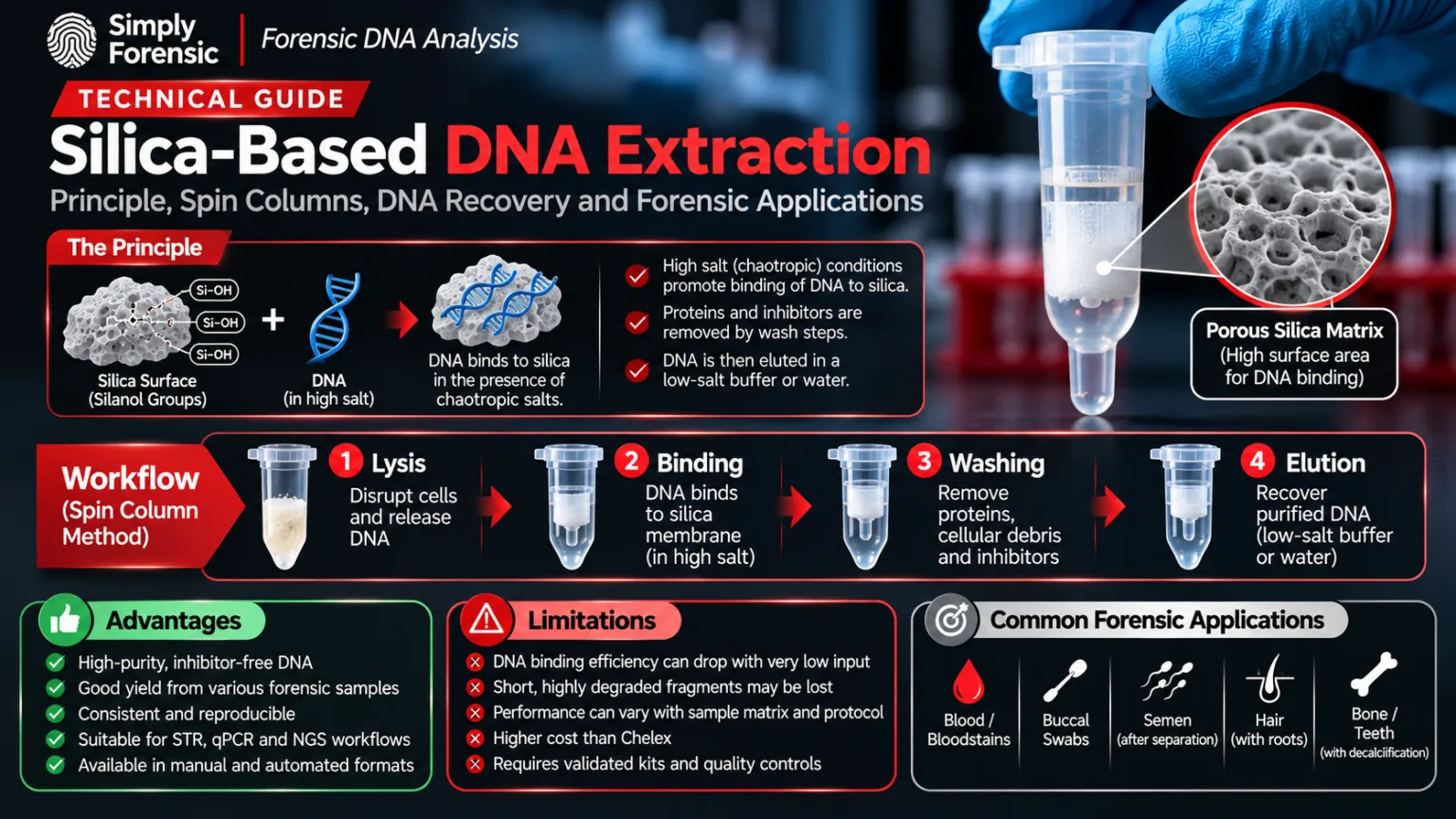
DNA and silica are both normally negatively charged in aqueous solution, so their interaction is not simply electrostatic attraction. In the presence of appropriately formulated high-salt or chaotropic binding buffers, hydration and interfacial interactions change, enabling nucleic acids to adsorb to silica. Many commercial methods use guanidinium salts and alcohol-containing conditions to promote binding. Once contaminants have been washed away, low-ionic-strength elution conditions release DNA from the surface.
The foundational work of Boom and colleagues established a rapid silica-based approach to nucleic-acid purification. Modern forensic spin columns and silica-particle systems adapt this principle with sample-specific buffers and purification steps.
Silica spin-column extraction: step-by-step principle
- Sample preparation and lysis: A stain, swab, tissue or other specimen is treated with appropriate lysis chemistry, often including detergent and proteinase K. Bone and teeth require additional pretreatment such as demineralisation.
- Binding: The lysate is combined with the validated binding buffer and transferred to a silica membrane. Under the prescribed chemical conditions, DNA adsorbs to the silica.
- Washing: Wash solutions remove proteins, salts and many substances that could interfere with PCR or library preparation. Wash effectiveness depends on the sample and kit.
- Drying or residual wash removal: Remaining wash solution, particularly alcohol, is reduced as directed by the protocol because carryover can inhibit downstream reactions.
- Elution: DNA is released into water or a low-salt buffer. The elution volume affects final concentration but does not, by itself, determine total DNA recovery.
- Assessment: Human-specific qPCR and downstream assays evaluate how much usable DNA was recovered and whether degradation or inhibition is evident.
This description is educational. Exact reagent volumes, centrifugationCentrifugation is a process that uses centrifugal force to separate components of a mixture based on their sedimentation rate. The sample is placed in a tube, which is then spun at a high speed. The Read Full Definition conditions and incubation times must follow a laboratory-validated procedure.
Silica columns versus silica particles
| Format | How separation occurs | Operational considerations |
|---|---|---|
| Silica spin column | DNA binds a membrane while liquid passes through by centrifugation or vacuum | Convenient manual workflow; loading capacityThe amount of finished product that could be produced, either in one batch or over a defined period of time, and given a set list of variables. Read Full Definition and centrifugation steps matter |
| Silica particles or slurry | DNA adsorbs to dispersed silica and particles are separated by the specified protocol | May offer different contact area and recovery characteristics; separation steps must be controlled |
| Silica-coated magnetic beads | DNA binds silica-coated particles retained with a magnet | Combines silica binding chemistry with magnetic separation and automation |
Not all magnetic-bead systems use silica surfaces. The phrase “magnetic extraction” describes a separation mechanism, whereas “silica-based extraction” describes a binding surface and chemistry. For more detail, see magnetic bead-based DNA extraction.
Forensic applications by sample type
Bloodstains and buccal samples
Silica columns are practical for many routine samples because binding and wash steps can reduce proteins and other contaminants. Blood-associated inhibitors such as haem may nevertheless remain, so extraction success must be assessed using appropriate quantification and amplification controls.
Touch DNA and trace evidence
Low-template evidence Evidence is any form of proof, such as objects, materials, or scientific findings, presented to establish or disprove a fact in a legal proceeding. It is used to reconstruct events and link or exclude individuals Read Full Definition is sensitive to losses during binding, transfer, washing and elution. A small elution volume can increase DNA concentration but cannot recover molecules lost earlier in the process. Method validationValidation, often referred to as method validation, is a crucial process in the laboratory when introducing a new machine, technology, or analytical technique. It involves a series of systematic steps and assessments to ensure that Read Full Definition should assess low-input recovery on representative substrates, not merely performance on clean reference samples.
Sexual-assault evidence
Silica purification may be applied to sperm-enriched and non-sperm fractions after differential extraction. The selective cell-separation step and the subsequent DNA purification step have different purposes. Neither guarantees a single-source profile.
Bone, teeth and degraded remains
Hard tissues often require demineralisation and specialised digestion before DNA purification. Environmental exposure can produce short DNA fragments and substantial inhibitors. Silica protocols may be adapted to retain smaller fragments, but conventional column recovery should not be assumed to capture every fragment length equally. The appropriate approach depends on the specimen and downstream STR, mitochondrial DNA or sequencing assay.
Advantages of silica-based extraction
- Purification: Multiple washes can reduce proteins, salts and many PCR inhibitors.
- Small-volume elution: Concentrated eluates may be useful for low-level evidence, subject to actual recovery.
- Standardisation: Commercial columns and buffers support repeatable processing when used within validated limits.
- Versatility: Specialised protocols exist for stains, swabs, tissue, bone and teeth.
- Downstream utility: Appropriate silica extracts can support STR typing, qPCR and sequencing library preparation.
Limitations and troubleshooting considerations
Incomplete DNA binding
Binding depends on salt and alcohol composition, pH, loading volume, membrane capacity and specimen matrix. Deviations can cause DNA to pass into the flow-through rather than remain on the silica.
Loss of short or damaged fragments
Fragment recovery is protocol-dependent. Some binding conditions favour particular fragment sizes, making specialised methods important for highly degraded or ancient-type forensic samples.
Wash-buffer carryover
Residual ethanol or other wash constituents can interfere with PCR or library preparation. Adequate removal is important, but excessive drying or other protocol deviations may also affect elution.
Inhibitor persistence
Silica extraction is not guaranteed to remove all inhibitors. A failed amplification may reflect low template, degradation, inhibition or another issue. Human-specific qPCR with suitable internal controls helps distinguish some of these possibilities.
Recovery versus concentration
DNA concentration is measured per unit volume. Total recovered DNA is concentration multiplied by eluate volume, while amplifiable recovery may be lower than total DNA measured by nonspecific methods. Comparing methods requires attention to both yield and downstream profile quality.
Silica extraction versus Chelex and organic extraction
Chelex uses chelation and heat to produce a relatively crude DNA-containing supernatant. Organic extraction separates proteins and DNA through solvent-based phase partitioning. Silica extraction binds DNA to a solid surface, washes contaminants away and then elutes the DNA. Silica offers convenient purification, but every binding and elution stage introduces possible recovery loss. See our guide to Chelex 100 DNA extraction.
STR profiling and MPS/NGS compatibility
Silica-column extracts are widely used in PCR-based STR workflows. They may also be suitable for massively parallel sequencing (MPS), but library-preparation success depends on fragment length, strandedness, quantity and residual inhibitors. A method validated for STR amplification is not automatically validated for every sequencing platform. Comparative research has found that some tested silica-column protocols retain a substantial double-stranded DNA fraction, but findings are protocol-specific.
Validation and quality assurance
The FBI Quality Assurance Standards for Forensic DNA Testing Laboratories require internal validation before forensic DNA methods are implemented. A silica-extraction validation should include representative substrates and sample types, low-template and degraded material, inhibition challenges, reproducibility, contaminationContamination - The unwanted transfer of material from another source to a piece of physical evidence. The inadvertent touching of a weapon, thereby adding fingerprints to it is an example of evidence contamination. Read Full Definition and extraction blanks, recovery across relevant fragment sizes, elution volumes, and performance with the intended downstream assays.
Laboratories must preserve evidence identification, fraction and extract traceability, reagent blankSpecimen or sample not containing the analyte or other interfering substances. Read Full Definition records and repeat-processing history. SWGDAM publications provide relevant validation and interpretation guidance.
Frequently asked questions
Does silica permanently bind DNA?
No. Under appropriately selected low-salt elution conditions, DNA is released from the silica surface.
Does silica extraction remove every PCR inhibitor?
No. It removes many contaminants, but performance depends on the matrix and method. Residual inhibition should be assessed using validated controls.
Is silica extraction better than magnetic beads?
Not universally. Some magnetic beads are themselves silica-coated. Their main distinction may be how the DNA-binding surface is manipulated, not the underlying binding chemistry.
Is a smaller elution volume always better?
No. It may increase DNA concentration, but the total recovery and compatibility with downstream analysis must also be evaluated.
Selected scientific references
- Boom R et al. Rapid and simple method for purification of nucleic acids. Journal of Clinical Microbiology. 1990.
- FBI. Quality Assurance Standards for Forensic DNA Testing Laboratories. Effective July 2025.
- SWGDAM. Publications and validation guidance.
- Forensic DNA extraction methods for human hard tissue: systematic review and meta-analysis. Forensic Science
 Discover the fascinating field of Forensic Science, the application of scientific principles to legal matters. This post delves into its many disciplines, from DNA analysis to crime scene investigation, its importance in the justice system, Read Full Definition International: Genetics. 2023.
- Effects of forensic DNA extraction protocols on single- and double-stranded DNA and DNA integrity.