


Forensic DNA DNA, or Deoxyribonucleic Acid, is the genetic material found in cells, composed of a double helix structure. It serves as the genetic blueprint for all living organisms. Read Full Definition extraction validationValidation, often referred to as method validation, is a crucial process in the laboratory when introducing a new machine, technology, or analytical technique. It involves a series of systematic steps and assessments to ensure that Read Full Definition establishes whether a particular extraction procedure can consistently recover DNA suitable for the intended forensic analysis. A method that produces DNA from a clean reference swab may not perform adequately on trace, inhibited or degraded casework samples. Laboratories therefore need documented performance studies, defined acceptance criteria and ongoing quality controlQuality control (QC) refers to a series of activities and measures conducted on individual laboratory tests or analyses to verify and ensure the accuracy and reliability of the results. QC is a reactive approach that Read Full Definition before relying on an extraction procedure in forensic casework.
- What standards apply to forensic DNA extraction?
- Define the intended use before validation
- Core extraction validation studies
- Extraction efficiency: yield is not the whole answer
- Sensitivity and low-template recovery
- Inhibition, degradation and purity
- Contamination monitoring and extraction blanks
- Validating automated DNA extraction
- Routine extraction quality control
- Acceptance criteria and documentation
- When does an extraction method need additional validation?
- Practical validation checklist
- Frequently asked questions
- Is a high DNA yield sufficient to validate extraction?
- Can a kit manufacturer’s validation replace internal laboratory validation?
- Do extraction blanks prove that a batch is contamination-free?
- Does switching from manual to automated extraction require evaluation?
- Further reading and references
Extraction validation is distinct from routine quality control: validation establishes a method’s demonstrated capabilities and limitations, while quality control monitors whether the implemented procedure continues to operate within its validated conditions. For an introduction to extraction chemistry, see our guide to forensic DNA extraction methods.
What standards apply to forensic DNA extraction?
In the United States, the FBI Quality Assurance Standards for Forensic DNA Testing Laboratories, effective 1 July 2025, require internal validation before a forensic DNA analytical procedure is implemented. SWGDAM publications provide additional validation and quality guidance. ISO/IEC 17025 addresses laboratory competence and the validity of results within an accredited quality-management framework.
These sources should be consulted in their current applicable versions. The precise"Precise" refers to the degree of closeness or consistency between multiple measurements or values taken under the same conditions. It indicates how well these measurements agree with each other, regardless of whether they are accurate Read Full Definition study design and acceptance limits must reflect the laboratory’s method, scope, instruments and regulatory or accreditationAccreditation – a process by which a laboratory must prove to an accrediting agency that their processes, equipment, and employees are competent, credible, and accurate. The accrediting agency will inspect the laboratory and observe its Read Full Definition obligations; there is no universal percentage DNA recovery that automatically validates every extraction method.
Define the intended use before validation
A validation plan should identify the extraction chemistry, instruments, specimen types, relevant substrates, DNA input range, elution conditions and downstream assays. A workflow intended for routine buccal references should not be presumed suitable for bone, heavily degraded stains or trace DNA without supporting studies. Manual and automated implementations may have different handling and contaminationContamination - The unwanted transfer of material from another source to a piece of physical evidence. The inadvertent touching of a weapon, thereby adding fingerprints to it is an example of evidence contamination. Read Full Definition risks.
Core extraction validation studies
| Study | What to assess | Why it matters |
|---|---|---|
| Recovery efficiency | Amplifiable DNA recovered relative to known or estimated starting material | Identifies method- and matrix-dependent losses |
| SensitivityIn the context of laboratory equipment or analytical techniques, the term "sensitive" describes the capability of a machine or method to detect even very small amounts or concentrations of a substance. Sensitivity is a quantitative Read Full Definition | Performance across low and decreasing DNA inputs | Defines practical low-template capabilities and variability |
| Reproducibility | Independent extractions across days, operators or instruments as appropriate | Assesses repeatability and intermediate precision |
| Inhibition | Representative inhibitor-rich specimens and downstream amplification | Establishes cleanup performance and limitations |
| Contamination | Extraction blanks, batch arrangement and carryover challenges | Evaluates unintended DNA transfer |
| Robustness | Representative evidence Evidence is any form of proof, such as objects, materials, or scientific findings, presented to establish or disprove a fact in a legal proceeding. It is used to reconstruct events and link or exclude individuals Read Full Definition types, substrates and permitted operating conditions | Defines the method’s applicable range |
| Downstream suitability | qPCR, STR and/or sequencing outcomes | Tests fitness for the actual analytical purpose |
Extraction efficiency: yield is not the whole answer
Where the input amount is sufficiently known, a basic recovery estimate is:
DNA recovery (%) = (recovered DNA amount ÷ estimated input DNA amount) × 100.
This estimate requires care. The nominal number of cells does not necessarily equal the amount of recoverable DNA, especially for damaged, degraded or incompletely sampled material. Eluate concentration alone is insufficient: total recovered quantity also depends on elution volume. Human-specific qPCR and the success of downstream STR amplification may be more relevant to casework than total nucleic acid measurements.
Published comparative work shows that recovery can vary by extraction chemistry, sample matrix and starting amount. A laboratory should avoid declaring one method superior based on a single specimen or concentration measurement.
Sensitivity and low-template recovery
Use a representative dilution series or carefully prepared low-input samples to characterise recovery variability and downstream profile success. At low input, stochastic sampling of DNA molecules and handling losses can substantially affect results. Record the frequencyFrequency is a fundamental concept in physics and wave theory. It refers to the number of times a specific point on a wave, such as a crest or trough, passes a fixed reference point in Read Full Definition and quality of successful profiles, not merely whether a qPCR instrument detects DNA. A limit of detection, where defined, must be linked to a specific measurement and decision criterion.
Inhibition, degradation and purity
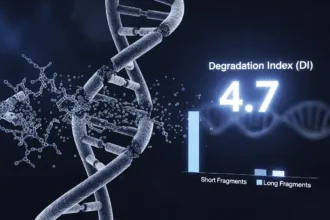
Extraction may co-recover haem, humic substances, dyes, calcium or chemical residues that impair PCR. Human-specific qPCR assays with internal PCR controls can provide evidence of inhibition; assays with short and long targets can also support degradation assessment. A degradation index is not a direct measure of inhibitor concentration. Laboratories should interpret the qPCR targets and internal control together and validate any thresholds used to trigger dilution, cleanup or re-extraction.
For STR or MPS applications, examine actual downstream performance. Some procedures preferentially retain particular DNA fragment sizes, which can be consequential for skeletal remains or degraded material.
Contamination monitoring and extraction blanks
Extraction blanks or reagent blanks monitor DNA introduced through reagents, equipment, handling and processing. Their placement, number and downstream testing must follow applicable standards and laboratory procedures. A negative blankSpecimen or sample not containing the analyte or other interfering substances. Read Full Definition result supports the absence of detectable contamination under the conditions tested; it cannot prove that contamination was impossible.
Contamination studies should also address adjacent wells, sample-to-sample transfer, high-template samples next to low-template samples, shared instruments and cleaning procedures. Include relevant controls and record how unexpected blank results affect affected batches.
Validating automated DNA extraction
Automated platforms introduce variables beyond extraction chemistry: liquid-handler calibrationThe act of checking or adjusting (by comparison with a standard) the accuracy of a measuring instrument. Operation that, under specified conditions, in a first step, establishes a relation between the quantity values with measurement Read Full Definition, pipetting precision, tip and deck configuration, sample tracking, plate maps, mixing, magnetic capture or vacuum separation, and possible cross-well carryover. A validated manual kit protocol cannot automatically be treated as equivalent to a robotic adaptation.
Challenge the intended instrument configuration with representative samples, including high- and low-input material, and evaluate both DNA recovery and contamination. Document software versions, programmed methods, consumables and approved configuration changes.
Routine extraction quality control
- Reagent blanks: Monitor unintended DNA introduction during processing.
- Appropriate positive or process controls: Confirm expected recovery where required by the laboratory’s procedure.
- Quantification controls: Verify the qPCR assay and evaluate possible inhibition or degradation using validated metrics.
- Equipment checks: Monitor instruments, maintenance, pipetting and environmental controls.
- Batch review: Evaluate controls, unexpected results, deviations and any required repeat analysis before releasing results.
- Trend monitoring: Investigate recurring low yields, blank findings or changes in instrument performance.
Acceptance criteria and documentation
Set study-specific acceptance criteria before reviewing the final validation results, where feasible. Criteria may address contamination, profile quality, repeatability, minimum recoverable input, inhibitor tolerance or successful processing of relevant substrates. They should be scientifically justified and achievable within the intended scope. Avoid copying numerical thresholds from unrelated laboratories or assays.
The validation record should preserve the approved plan, materials, methods, raw data Information in analog or digital form that can be transmitted or processed. Read Full Definition, calculations, deviations, limitations, conclusions, technical review and implementation authorisation. Controlled SOPs, training, competency records and change-control documentation link the validation to routine operations.
When does an extraction method need additional validation?
Changes to kit chemistry, extraction instruments, lysis conditions, elution volume, automation scripts or intended specimen types may affect performance. A documented change assessment should determine whether targeted studies or more extensive revalidation are needed. The required extent depends on the potential impact and applicable standards.
Practical validation checklist
- Define the intended evidence types, input range and downstream assays.
- Identify the exact kit, chemistry, instrument and protocol version.
- Approve study design, controls and acceptance criteria.
- Test representative clean, trace, degraded and inhibitor-rich specimens.
- Assess recovery, reproducibility, contamination and downstream profile quality.
- Evaluate method limitations and document any failed or inconclusive results.
- Obtain technical review and implementation approval.
- Establish ongoing QC, maintenance and change-control requirements.
Frequently asked questions
Is a high DNA yield sufficient to validate extraction?
No. Validation must also address the method’s intended use, inhibition, contamination, reproducibility and downstream suitability.
Can a kit manufacturer’s validation replace internal laboratory validation?
No. Manufacturer studies may inform the plan, but laboratories must establish performance under their own applicable conditions and quality requirements.
Do extraction blanks prove that a batch is contamination-free?
No. They monitor detectable contamination within the tested process. A negative blank does not exclude every possible contamination event.
Does switching from manual to automated extraction require evaluation?
Yes. Automation may alter recovery, carryover and tracking risks, so the adapted workflow requires an appropriate documented validation or change assessment.
Further reading and references
- FBI. Quality Assurance Standards for Forensic DNA Testing Laboratories. Effective 1 July 2025.
- SWGDAM. Publications and validation guidance.
- ISO/IEC 17025:2017. General requirements for the competence of testing and calibration laboratories.
- Butler JM. Advanced Topics in Forensic DNA Typing: Methodology.
Explore the extraction series: organic extraction, Chelex, silica, magnetic beads and differential extraction.