

Forensic DNA DNA, or Deoxyribonucleic Acid, is the genetic material found in cells, composed of a double helix structure. It serves as the genetic blueprint for all living organisms. Read Full Definition quantification using real-time PCR (qPCR) estimates amplifiable human nuclear DNA, detects Y-chromosome targets, and provides indicators of DNA degradation and PCR inhibition. These measurements guide decisions before autosomal STR, Y-STR or massively parallel sequencing (MPS) analysis. Importantly, qPCR measures particular amplifiable targets, not every DNA moleculeA molecule is a fundamental unit of matter composed of two or more atoms that are chemically bonded together. It is the smallest possible amount of a particular substance that retains all of the unique Read Full Definition present in an extract.
- How real-time PCR measures forensic DNA
- Human autosomal and male-specific DNA targets
- Degradation index: what short and long targets reveal
- PCR inhibition and the internal PCR control
- Interpreting common forensic qPCR patterns
- From qPCR results to STR, Y-STR and MPS
- Four casework examples
- Validation, controls and quality assurance
- Frequently asked questions
- What does forensic qPCR actually measure?
- Are Cq and Ct interchangeable?
- Can degradation index values be compared between kits?
- Can a high degradation index reflect inhibition?
- Does dilution repair degraded DNA?
- Related Simply Forensic guides
- References and further reading
How real-time PCR measures forensic DNA
Unlike end-point PCR, qPCR monitors fluorescence during amplification. Sequence-specific primers and fluorescent probes detect selected genomic targets. The quantification cycle (Cq, also termed Ct) is the cycle at which fluorescence crosses a defined threshold. Higher starting target concentrations generally produce earlier Cq values, but Cq alone is not a DNA concentration.
Forensic assays usually estimate concentration from a standard curve prepared using DNA standards with assigned concentrations. Cq is plotted against logarithmic concentration; unknowns are interpolated within the validated quantitative range. Laboratories assess standard-curve slope, amplification efficiency, linearity, controls and preparation accuracyIn scientific and measurement contexts, "accuracy" refers to the degree of proximity or closeness between a measured value and the true or actual value of the measured quantity. Accuracy indicates how well a measurement reflects Read Full Definition. A high R² alone does not establish an unbiased calibrationThe act of checking or adjusting (by comparison with a standard) the accuracy of a measuring instrument. Operation that, under specified conditions, in a first step, establishes a relation between the quantity values with measurement Read Full Definition.
The limit of detection differs from the limit of quantification: a target may be detected even when its amount cannot be estimated reliably. At low template levels, stochastic sampling makes the aliquotIn the forensic context, the concept of "aliquot" remains applicable but with specific relevance to handling and analyzing forensic samples and evidence. Here's how aliquots are used in forensic investigations: • Evidence Preservation: In forensic Read Full Definition used for qPCR an imperfect representation of the aliquot subsequently amplified for STR typing. Independent reference materials, including NIST SRM 2372a, can support evaluation of quantification standards.
Human autosomal and male-specific DNA targets
Autosomal human targets
Human autosomal targets estimate nuclear DNA potentially available for autosomal STR amplification. Modern systems may use multicopy targets to improve sensitivityIn the context of laboratory equipment or analytical techniques, the term "sensitive" describes the capability of a machine or method to detect even very small amounts or concentrations of a substance. Sensitivity is a quantitative Read Full Definition. The reported concentration reflects the assay’s particular amplifiable sequences; severely fragmented molecules lacking an intact target, and mitochondrial DNA without a separate mtDNA assay, are not fully represented.
Y-chromosome targets
Male-specific qPCR targets are useful in evidence Evidence is any form of proof, such as objects, materials, or scientific findings, presented to establish or disprove a fact in a legal proceeding. It is used to reconstruct events and link or exclude individuals Read Full Definition containing abundant female DNA and comparatively little Y-target DNA, including some sexual-assault samples. A high autosomal estimate alongside a low Y-target estimate may justify considering differential-extraction fractions or validated Y-STR workflows. However, an autosomal:Y concentration ratio is not an exact male:female cell ratio and does not establish contributor number. Detecting a Y target is not a comprehensive determination of biological sex; failure to detect it does not exclude a low-level male component.
Degradation index: what short and long targets reveal
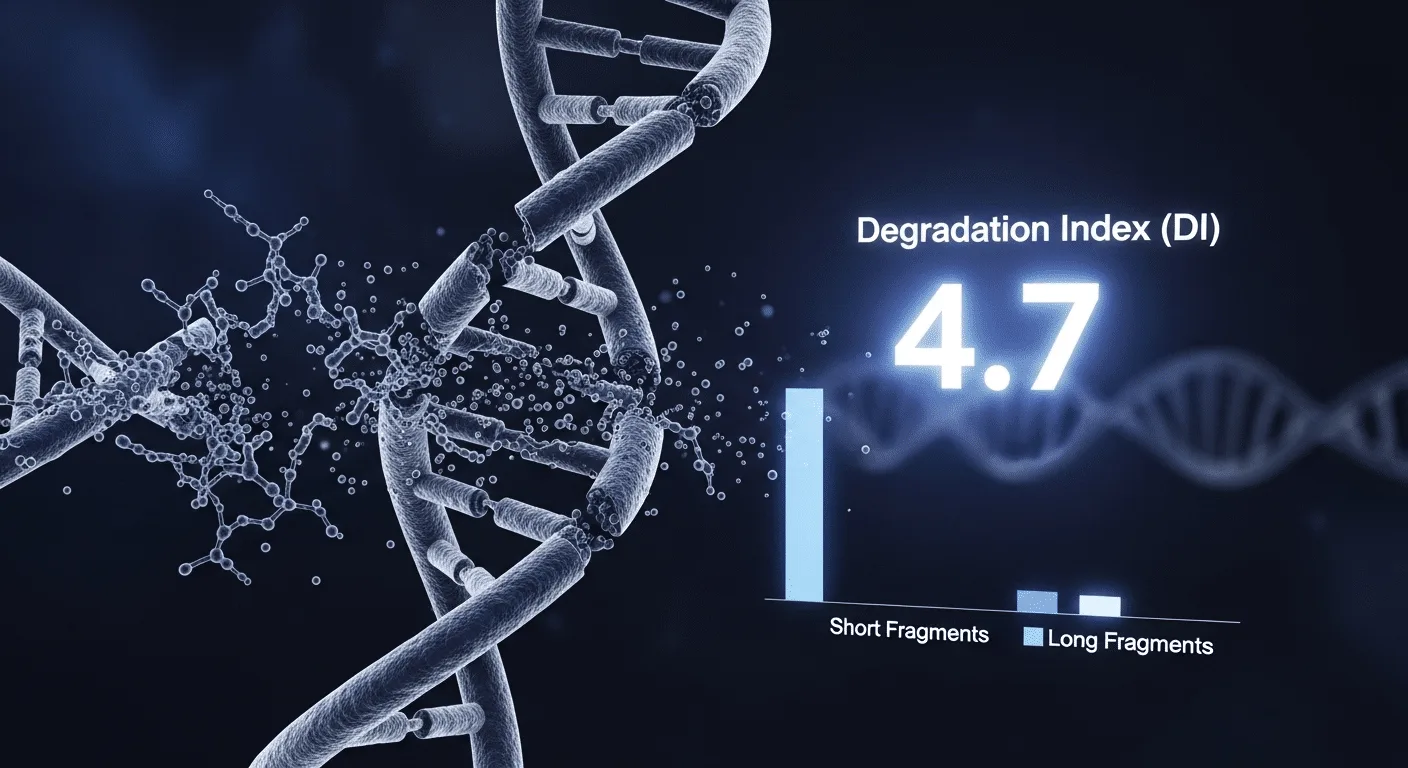
Fragmentation generally reduces recovery of longer DNA targets before shorter ones. Forensic assays compare short- and longer-amplicon target measurements to generate a degradation index (DI) or related ratio. A relatively high short-target concentration with a much lower long-target concentration supports degradation, especially when internal control behaviour is normal.
There is no universal DI cutoff. Quantifiler Trio, PowerQuant and other systems differ in target loci A locus is the precise position of a gene on a chromosome. Different alleles of the same gene occupy the same locus. Read Full Definition, amplicon sizes, copy numbers and calculation conventions. Numerical DI thresholds must be interpreted according to the particular kit and laboratory validationValidation, often referred to as method validation, is a crucial process in the laboratory when introducing a new machine, technology, or analytical technique. It involves a series of systematic steps and assessments to ensure that Read Full Definition; values should not be directly compared across platforms. DI is an indirect integrity indicator, not a fragment-size distribution measurement or guarantee of success at individual STR loci.
PCR inhibition and the internal PCR control
Inhibitors interfere with amplification rather than simply reducing DNA fragment length. Potential sources include haem-associated compounds, humic substances, melanin, calcium-rich material, textile dyes and residual extraction chemicals. Many qPCR kits incorporate an internal PCR control (IPC) at a consistent template amount. A delayed or absent IPC signal relative to validated expectations suggests inhibition.
DI and IPC must be interpreted together. Inhibition can affect different amplicons unequally and can artificially elevate a degradation ratio. Degradation and inhibition can coexist. Conversely, a normal IPC does not prove that all human targets or downstream STR reactions are completely free from inhibitory effects.
Interpreting common forensic qPCR patterns
| qPCR finding | Possible interpretation | Validated next step |
|---|---|---|
| Human targets quantifiable; low assay-specific DI; IPC normal | Relatively intact, amplifiable DNA | Normalise to validated STR input |
| Short target present; long target markedly reduced; IPC normal | Degradation more likely | Consider shorter targets or suitable validated MPS strategy |
| Human signal reduced; IPC delayed | Inhibition suspected | Evaluate dilution, cleanup or re-extraction |
| High DI and abnormal IPC | Degradation and inhibition may coexist | Investigate both; cleanup cannot restore fragmented DNA |
| High autosomal estimate; low Y-target estimate | Possible female-rich mixture | Assess Y-STR or mixture-specific workflow |
| Very low signal near assay limits | Greater quantitative and sampling uncertainty | Apply low-template validation criteria |
From qPCR results to STR, Y-STR and MPS
Quantification informs template input rather than dictating a universal input mass. Too much DNA can produce over-amplification effects; too little increases stochastic imbalance and dropout. The correct target depends on the STR kit, reaction conditions and laboratory validation. A concentrated extract may require dilution. Dilution can also reduce inhibitors, but simultaneously reduces template molecules; low-level samples may instead benefit from validated cleanup or re-extraction where material permits.
For Y-STR analysis, the Y-target estimate can be more informative than total autosomal DNA when the relevant component is minor. It still cannot predict the number of male contributors or guarantee a complete haplotype. For MPS, qPCR informs input, but library preparation may also depend on fragment size, double-stranded integrity and target accessibility.
Four casework examples
- Clean blood reference: Quantifiable autosomal DNA, normal IPC and low assay-specific DI support routine normalisation to the validated STR input.
- Aged skeletal material: Short target measurable, long target depleted and normal IPC support prioritising a degradation-tolerant, validated typing approach.
- Bloodstained denim: Low human signal with delayed IPC suggests possible substrate-associated inhibition. Evaluate dilution or purification rather than automatically increasing extract volume.
- Sexual-assault mixture: Abundant autosomal DNA with a small Y-target estimate may support male-targeted processing or Y-STR testing, without implying an exact contributor ratio.
Validation, controls and quality assurance
Forensic laboratories must internally validate analytical procedures for their intended applications. Relevant qPCR studies address sensitivity, quantitative range, precision, specificityIn the context of laboratory equipment or analytical techniques, the term "specific" describes the capability of a machine or method to accurately and selectively detect particular molecules or substances while minimizing interference from others. Specificity Read Full Definition, calibration, degradation, inhibition, mixtures and representative evidence matrices. Run acceptance should consider standards, efficiency, positive and negative controls, reagent blanks and IPC performance. Small contaminationContamination - The unwanted transfer of material from another source to a piece of physical evidence. The inadvertent touching of a weapon, thereby adding fingerprints to it is an example of evidence contamination. Read Full Definition signals deserve particular scrutiny in low-template casework.
The FBI Quality Assurance Standards effective 1 July 2025, SWGDAM validation guidance and ANSI/ASB Standard 116 provide relevant quality and competency context. Quantification results should not be overinterpreted as proof of contributor identity, exact cellular mixture proportions or absence of inhibition.
Frequently asked questions
What does forensic qPCR actually measure?
It estimates DNA containing the assay’s amplifiable human target sequences, rather than all nucleic acid in an extract.
Are Cq and Ct interchangeable?
They generally refer to a threshold-crossing cycle, but interpretation depends on the assay’s calibration and efficiency.
Can degradation index values be compared between kits?
Not directly. Target design and calculations differ; interpret each result using assay-specific validation.
Can a high degradation index reflect inhibition?
Yes. Inhibitors may disproportionately affect longer targets; examine IPC and other run information.
Does dilution repair degraded DNA?
No. It may reduce inhibitor concentration but cannot restore fragmented molecules.
Related Simply Forensic guides
For the preceding processing stage, read Forensic DNA Extraction Methods and DNA Extraction Validation and Quality Control. For purification chemistry, see Magnetic Bead-Based DNA Extraction and Silica-Based DNA Extraction.