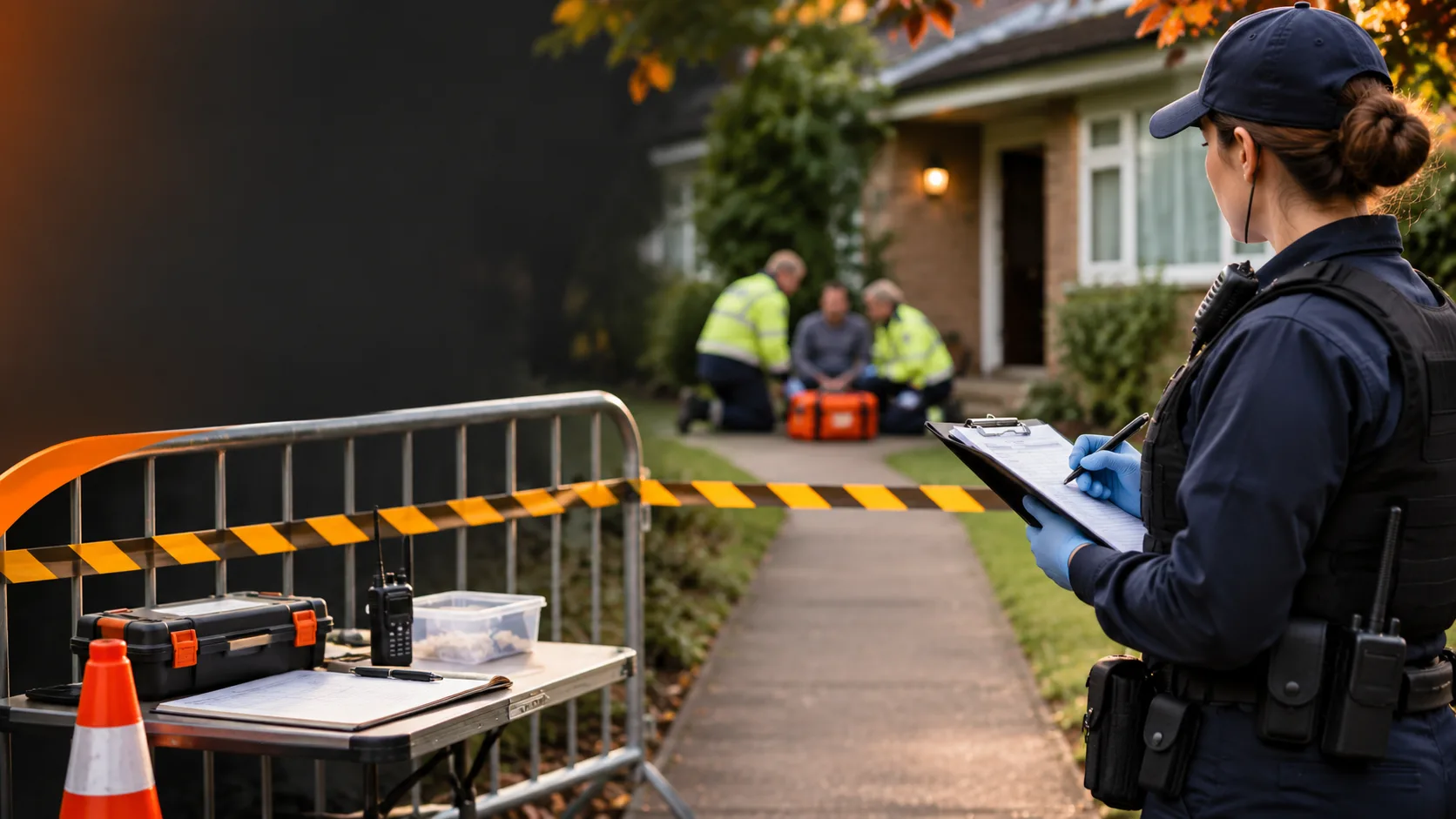
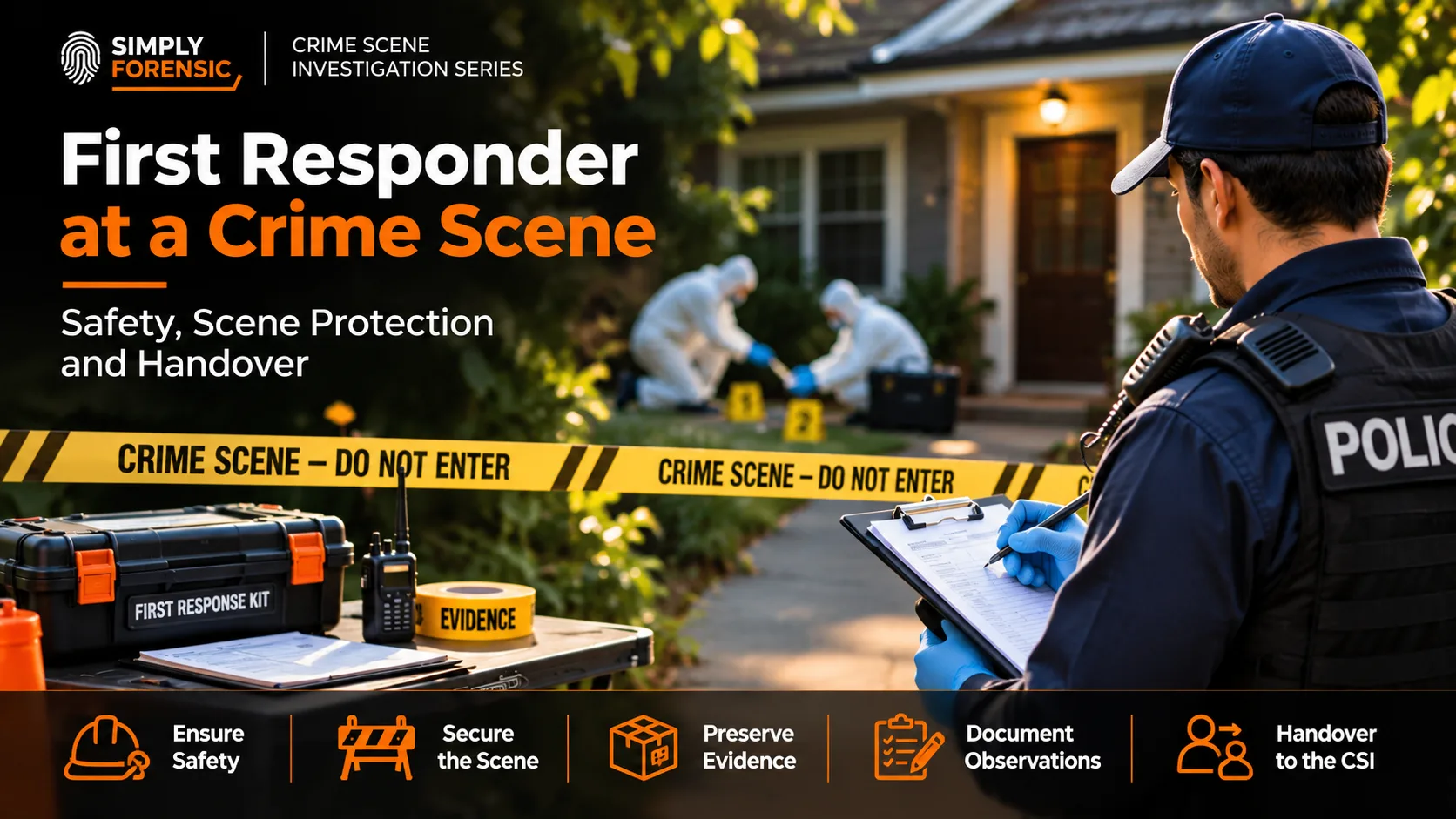
The first responderFirst responders - The initial responding law enforcement officer(s) and/or other public safety official(s) or service provider(s) arriving at the scene prior to the arrival of the investigator(s) in charge. Read Full Definition at a crime scene is responsible for protecting people and the scene during the period before full forensic examination begins. The first officer may witness conditions that will never exist again: an open door before it is secured, where a casualty was lying before emergency treatment, a trail of fragile marks before rainfall, or the movement of people through the location. These observations matter, but the first duty is not to recover every piece of evidence Evidence is any form of proof, such as objects, materials, or scientific findings, presented to establish or disprove a fact in a legal proceeding. It is used to reconstruct events and link or exclude individuals Read Full Definition. It is to act lawfully and safely, preserve what can reasonably be protected, and leave a reliable record for subsequent investigators.
- What is the role of the first responder at a crime scene?
- First-response priorities: the practical sequence
- 1. Initial approach: observations before intervention
- 2. Prioritize scene safety and emergency assistance
- 3. Establish boundaries and control access
- 4. Protect transient and vulnerable physical evidence
- 5. Reduce contamination from responder movement and equipment
- 6. Manage people and preserve observations
- 7. The first-responder handover: what the investigator needs to know
- Three hypothetical first-response scenarios
- First responder checklist before leaving the scene
- Common first-response mistakes
- Frequently asked questions
- Related Simply Forensic learning guides
- References and official guidance
This practical guide explains initial response priorities, scene safety, emergency care, scene cordons, entry logs, contaminationContamination - The unwanted transfer of material from another source to a piece of physical evidence. The inadvertent touching of a weapon, thereby adding fingerprints to it is an example of evidence contamination. Read Full Definition precautions, the transfer of responsibility, and a structured handover. It includes two working templates, three hypothetical examples, frequently asked questions and current authoritative references.
What is the role of the first responder at a crime scene?
A first responder may be an attending police officer, fire service member, paramedic or other authorized person. Their responsibilities vary. For this article, first responder primarily describes the first attending law-enforcement officer tasked with preserving the scene until investigators arrive. The responding officer’s immediate decisions help establish the condition of the location at the time of police arrival; later forensic specialists perform examination, systematic recovery and interpretation.[1][2]
There are two useful, distinct published forensic documents. ANSI/ASB Best Practice Recommendation 160-24 addresses initial response by law-enforcement officers. ANSI/ASB Standard 195-25 addresses initial response by crime scene investigators, who may arrive after initial police action. These documents are not interchangeable and are not automatically mandatory law in every jurisdiction.[2][3]
| Initial responding officer | Arriving scene investigator |
|---|---|
| Recognizes immediate threats and requests assistance | Receives and reassesses existing safety information |
| Protects life and facilitates emergency treatment | Records relevant changes caused by emergency activities |
| Establishes initial cordons and access controls | Determines forensic examination boundaries and strategy |
| Documents initial conditions and persons present | Systematically documents and examines areas of interest |
| Guards vulnerable traces without unnecessary handling | Plans and carries out appropriate recovery and submission |
| Briefs and transfers scene responsibility | Accepts the scene, identifies gaps and documents decisions |
First-response priorities: the practical sequence
Identify immediate threats
Support urgent medical response
Secure a provisional perimeter
Protect and document observations
Brief and transfer responsibility
Note: These actions may overlap. Emergency treatment and hazard control are not delayed for documentation.
The following five priorities summarize the first phase. They are not a rigid order that prevents safety, medical treatment and access control from happening together.
- Safety: assess hazards and protect the public and responders before entering an unsafe environment.
- Emergency care: request and facilitate urgent medical assistance where necessary.
- Scene control: establish a provisional boundary, restrict nonessential access and identify affected people.
- Preservation and documentation: record initial conditions and protect vulnerable material without creating unnecessary disturbance.
- Formal handover: communicate the scene history, outstanding threats and recorded actions to the person taking responsibility.[1][2][7]
1. Initial approach: observations before intervention
Review the dispatch message where available: incident location, reported events, persons involved, information sources and known hazards. Note the time of attendance. On approach, observe without prematurely assigning meaning. Relevant observations include vehicles arriving or departing, open doors, broken objects, lighting, weather, people leaving, smoke, water or environmental conditions that may affect evidence.
When safe, record what was seen and from where. Keep three distinct categories: direct observation, what another person reported, and the responder’s inference. For example, finding a broken window does not establish who broke it or when it was broken. A brief contemporaneous note can preserve information more reliably than a reconstructed memory written much later.[1][6]
2. Prioritize scene safety and emergency assistance
Crime scenes may contain moving traffic, electrical hazards, unstable structures, firearms, fire, smoke, hazardous chemicals or biological exposures. Safety measures must be appropriate to actual risks. A routine pair of forensic gloves does not provide protection from all chemical or physical hazards. Where specialist hazards are suspected, restrict access and request qualified assistance instead of improvising entry or collection.[1][6]
Once safety permits, ensure that urgent medical needs receive attention. The medical team may need to move furniture, cut clothing or alter the position of a casualty. Such actions may be necessary, and medical intervention must not be delayed to preserve the original scene. When practical, inform responders of visible hazards and nearby potential evidence so avoidable damage can be reduced.
After emergency actions, document what was changed: which items were moved, where the injured person was originally seen, the medical team’s movements, any personal effects transferred, and the destination to which a casualty was taken if known. Respect medical privacy and local law. Evidence removed during treatment should only be collected or transferred by authorized personnel with a clear record.[1][2]
3. Establish boundaries and control access
Controls entry and protects people and potentially relevant areas
Defined after assessment; actual location and scope may change
An initial scene boundary creates protected space for safety and possible evidence. It is not identical to the eventual forensic examination area. The latter is determined by the responsible forensic investigator after evaluating the evidence and investigative needs. The UK Forensic Science Discover the fascinating field of Forensic Science, the application of scientific principles to legal matters. This post delves into its many disciplines, from DNA analysis to crime scene investigation, its importance in the justice system, Read Full Definition Regulator’s August 2026 Issue 2 incident-scene guidance stresses documenting examination scope and the relationship between that scope and scene control.[4]
Start with enough protected space to account for possible approaches, departure routes, displaced objects, outdoor traces and secondary areas; reassess rather than assume all activity occurred around the most obvious object. Use fixed boundaries, barriers and appropriate personnel when suitable. Initial cordons must remain proportionate to the risk, available resources and legal authority.
Entry points and approach routes
Where feasible, define one controlled entry and identify a route that limits unnecessary movement through sensitive surfaces. A footprint in soil, an impression on a wet floor or a small fragment near a doorway can be affected by the responders’ own movements. Necessary entry for rescue takes priority; the route and actions can be documented afterward.
Who should be recorded in the scene log?
Record all identifiable people entering or leaving after log control begins, including police, emergency medical personnel, fire services, specialists and authorized support staff. Relevant fields include identity or role, organization, time in, time out, purpose of attendance and any significant area entered or item moved. A scene log documents access and responsibility. It does not prove that nobody entered before the perimeter was established.
| Scene access log field | Example entry type |
|---|---|
| Person or service | Name or unit identifier and agency |
| Entry and exit | Time, including how it was recorded |
| Reason for attendance | First aid, scene security, hazardous-material response, examination |
| Location entered | Room, hallway, garden or vehicle, when relevant |
| Changes made | Furniture moved, barrier opened, window broken for access |
| Record keeper | Who maintained and transferred the log |
4. Protect transient and vulnerable physical evidence
Rain, wind, heat, foot traffic, animal activity, moving vehicles or deliberate interference can quickly change physical traces. The responder should recognize what is at risk and, when authorized and safe, protect the area until specialist collection is possible. Examples include isolating a visible footwear impression from pedestrian traffic or requesting a controlled shelter for an outdoor trace. Do not apply an unvalidated collection or treatment method merely because a trace may be lost.[1][4]
Where urgent protection alters a scene, note its original condition and the reason for intervention. When taking photographs from a safe location, record their time and preserve originals according to agency policy. Photographing an item does not replace collecting it if later recovery is lawful and appropriate.
For specialist collection, packaging and storage procedures, refer to the companion Crime Scene Investigation guide and DNA evidence collection guide.
5. Reduce contamination from responder movement and equipment
Not all disturbances are intentional. Gloves, shoes, radios, medical bags, vehicles and clothing can transfer biological material or particles. Minimize unnecessary touching; avoid eating, smoking or placing personal items in protected spaces. Change gloves when the task or contact history creates a risk and keep used tools away from clean supplies. Do not assume that a visibly clean glove or shoe is free from trace material.[5]
When linked scenes are involved, the order in which personnel attend locations may matter. Record personnel movements and keep evidence from different origins properly separated. Scene security officers who are not trained in specialized forensic sampling should generally protect the material and request assistance rather than conduct opportunistic recovery.
Detailed controls are covered in Forensic DNA Contamination Control. The aim is to reduce avoidable cross-transfer, not to claim that the entire scene is sterile or that background material can be distinguished by appearance alone.
6. Manage people and preserve observations
Identify witnesses and those who attended before police arrived. Obtain immediate safety information and record spontaneous statements in accordance with local procedure. Where lawful and practicable, keep relevant witnesses apart to reduce influence on one another’s accounts, while providing appropriate safeguarding and support.
Do not assume the ability to detain, search, require elimination DNA DNA, or Deoxyribonucleic Acid, is the genetic material found in cells, composed of a double helix structure. It serves as the genetic blueprint for all living organisms. Read Full Definition samples or compel interviews solely because a person was near the location. Legal authority, consent and procedures differ between jurisdictions. If a responder observes anyone moving evidence or changing an object, record who acted, what was done, and whether the condition was directly seen or learned from a report.[1][2]
7. The first-responder handover: what the investigator needs to know
Observations and actions
Receipt and reassessment
Document who relinquished and who accepted responsibility, and when. Physical evidence transfers need separate custody records.
Handover is more than saying the scene is secure. A structured oral briefing, supported by notes and logs, helps the arriving investigator understand the environment before proceeding. The briefing should distinguish original observations from reports, document known changes and identify uncertain facts. The transfer of scene management does not automatically mean that every evidence item changes custody; physical evidence transfers require their own appropriate records.[3][4]
Use the following as an adaptable handover template.
| Handover field | Information to give |
|---|---|
| Incident and response | Call details, location, dispatch/arrival time and reporting source |
| Original scene observations | Doors, lights, conditions, vehicles, people and items observed on arrival |
| Safety status | Known hazards, specialist services, unresolved threats and restricted access |
| Emergency actions | Medical care, rescue routes, relocated casualties, objects moved and by whom |
| Access control | Current boundary, entry point, guard arrangements and scene log |
| Potential vulnerable traces | Where identified and any interim protection measures |
| People and initial accounts | Responders, witnesses, suspects, relevant statements and sources |
| Evidence already handled | Items collected or transferred, identity, location and custody documentation |
| Unresolved information | Missing times, unknown entries, weather exposure, contamination incidents |
| Transfer record | Who gave and accepted the briefing, and date/time of transfer |
Do not quietly erase discrepancies. If one responder believes a door was open and another recalls it closed, record the source and timing of each observation. Disagreement can be informative when the event’s chronology is later assessed.
Three hypothetical first-response scenarios
Scenario 1: An injured person must be moved before photography
Situation: A person is found unconscious beside a table. Emergency personnel begin treatment and move the table to gain access. Priority: life-saving medical assistance. Appropriate action: support access, make an initial mental or written note when feasible, record the medical team’s identity and actions afterward, and explain the scene changes in handover. Limitation: the later position of the table cannot be treated as its untouched original position.
Scenario 2: Rain threatens a footwear impression near the entrance
Situation: A distinct impression is visible in mud as rain begins. Priority: preserve a potentially transient trace without compromising personnel safety. Appropriate action: restrict movement, document the impression from a safe location, request suitable protective measures and a trained examination team. Limitation: a first responder cannot infer whose footwear made the impression or when from visual appearance alone.
Scenario 3: Unlogged personnel attended before the first police officer
Situation: A fire crew arrived before police and walked through a room later identified as evidentially important. Priority: establish a traceable account rather than pretending the scene was untouched. Appropriate action: obtain names, routes and relevant actions from authorized personnel, record uncertainty in movement times, and notify the scene manager. Limitation: the presence of a responder creates a possible transfer route but does not prove that specific forensic material was introduced.
All examples are hypothetical and designed for training. They are not universal operating instructions or reconstructions of actual cases.
First responder checklist before leaving the scene
- Have urgent medical and safety requirements been addressed?
- Were dispatch and arrival times recorded?
- Were key original observations and subsequent changes distinguished?
- Are provisional boundaries and controlled entry points documented?
- Does the scene access log identify known attendees and significant actions?
- Were weather-exposed or vulnerable traces protected or referred to specialists?
- Were unnecessary scene contact and potential contamination minimized?
- Are any seized or transferred items recorded through appropriate evidence documentation?
- Were statements, personnel movements and discrepancies preserved accurately?
- Does the incoming investigator know the unresolved hazards and uncertainties?
- Is the transfer of responsibility recorded with identities and times?
Common first-response mistakes
Frequent mistakes include narrowing a boundary to only the most visible object, postponing life-saving care for photographs, failing to identify who moved evidence, assuming that all personnel wearing uniforms are contamination-neutral, and issuing a handover that omits safety hazards or significant scene changes. A second problem is confusing the investigator’s later reconstruction with the first officer’s direct observations.
Another misconception is that scene tape alone guarantees integrity. Boundaries require staffing, communication and records. Even a well-managed scene may contain pre-existing background traces, damage or legitimate changes caused by emergency response. Good practice is defensible documentation of what was and was not controlled.[1][4][5]
Frequently asked questions
What is the first priority when police arrive at a crime scene?
Protecting life and managing immediate safety risks take priority. Evidence is preserved to the extent that it does not delay necessary rescue or expose people to unreasonable danger.
Can first responders move objects at a crime scene?
Yes when justified by safety, rescue or another lawful urgent need. They should avoid unnecessary movement and accurately record changes made, by whom and when.
Is crime scene tape enough to secure a location?
No. Scene control requires suitable boundaries, supervision, restricted entry where appropriate, a plan for access and an accurate record of known movements.
What is the difference between a scene cordon and a forensic examination boundary?
A cordon is an operational access and safety control. The forensic examination boundary is the area selected for examination after case-specific evaluation; these areas may not be identical.
Should an officer collect DNA before the CSI team arrives?
Not solely because DNA may be present. Collection requires appropriate authority, training and procedures. Protecting and documenting a sensitive item may be preferable to an untrained recovery.
What should be included in the first responder handover?
Give response times, initial observations, known people and movements, safety hazards, emergency interventions, existing boundaries, access logs, evidence already handled, and unresolved uncertainties.
Are first responders and crime scene investigators governed by the same standard?
No. ANSI/ASB BPR 160-24 addresses first attending law enforcement officers; ANSI/ASB Standard 195-25 addresses the initial response of scene investigators. Their local adoption and legal status vary.
Does a medical team moving a casualty invalidate forensic evidence?
No automatic conclusion follows. The medical intervention is documented and considered when evaluating the scene and any later scientific findings.
Related Simply Forensic learning guides
- Crime Scene Investigation: A Comprehensive Guide
- Crime Scene Documentation: Notes, Photography and Sketching
- The 12 Critical Steps of Crime Scene Processing
- Forensic DNA Contamination Control
- Chain of Custody in Legal Proceedings
References and official guidance
Research review: 14 November 2026. These sources include best-practice recommendations, published standards and guidance documents. Legal and operational applicability must be determined locally.
- National Institute of Justice. Crime Scene Investigation: A Guide for Law Enforcement (2013).
- ANSI/ASB Best Practice Recommendation 160-24. Initial Response at Scenes by Law Enforcement Officers (2024).
- ANSI/ASB Standard 195-25. Scene Response: Initial Response by Scene Investigators (2025).
- Forensic Science Regulator. Incident Scene Examination, FSR-GUI-0006, Issue 2 (August 2026).
- Forensic Science Regulator. Contamination Controls: Scene of Crime, FSR-GUI-0016 (2023).
- National Institute of Justice. Crime Scene Investigation: Guides for Law Enforcement (2017 explanatory resource).
- National Institute of Justice. Crime Scene Investigation: A Reference for Law Enforcement Training (2004).
- Forensic Science Regulator. Forensic Science Activities: Statutory Code of Practice, Version 2 (2025), England and Wales.
Educational notice: This material does not replace emergency response training, occupational safety requirements, legal authority, force policy, specialist procedures or locally adopted scene-examination SOPs.