


Organic DNA DNA, or Deoxyribonucleic Acid, is the genetic material found in cells, composed of a double helix structure. It serves as the genetic blueprint for all living organisms. Read Full Definition extraction using phenol-chloroform is a long-established method for recovering DNA from biological specimens. It relies on cell lysis, protein digestion and liquid–liquid phase separation: DNA is retained predominantly in an aqueous phase while many proteins and lipids partition into an organic phase or accumulate at the interface. Organic extraction remains scientifically important in forensic DNA analysis, but it requires careful handling of hazardous chemicals and rigorous control of contaminationContamination - The unwanted transfer of material from another source to a piece of physical evidence. The inadvertent touching of a weapon, thereby adding fingerprints to it is an example of evidence contamination. Read Full Definition and sample loss.
- Scientific principle of phenol-chloroform extraction
- Role of the principal reagents
- Organic DNA extraction workflow
- Advantages of organic DNA extraction
- Limitations and risks
- Chemical hazards
- Multiple transfers and sample loss
- Residual organic solvents and PCR inhibition
- Labour and throughput
- Applications to forensic evidence
- Organic versus Chelex, silica and magnetic extraction
- STR profiling, MPS and DNA integrity
- Quality assurance and validation
- Frequently asked questions
- Which phase contains DNA after phenol-chloroform extraction?
- Does phenol-chloroform always yield the purest DNA?
- Why can organic extraction inhibit PCR?
- Is organic extraction suitable for forensic MPS?
- Selected references
For a broader overview, see our comparison of forensic DNA extraction methods, including Chelex, silica columns and magnetic beads.
Scientific principle of phenol-chloroform extraction
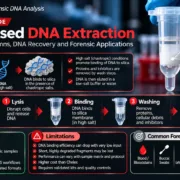
Cellular and nuclear membranes are disrupted with an appropriate lysis buffer, frequently containing a detergent such as sodium dodecyl sulfate (SDS). Proteinase K helps digest proteins, including those associated with chromatin. After digestion, phenol and chloroform are introduced under controlled conditions to separate nucleic acids from other cellular constituents.
Following mixing and centrifugationCentrifugation is a process that uses centrifugal force to separate components of a mixture based on their sedimentation rate. The sample is placed in a tube, which is then spun at a high speed. The Read Full Definition, a typical DNA-oriented extraction using appropriately buffered phenol produces three regions:
- Upper aqueous phase: Contains most of the recovered DNA under the selected extraction conditions.
- Interphase: Often contains denatured proteins and cellular debris.
- Lower organic phase: Contains phenol-chloroform and many extracted hydrophobic components.
Phase distribution depends on reagent formulation and pH. In particular, acidic phenol conditions used for some RNA workflows should not be confused with buffered phenol conditions chosen to retain DNA in the aqueous phase.
Role of the principal reagents
| Reagent | Role in extraction | Consideration |
|---|---|---|
| SDS or other detergent | Disrupts membranes and helps solubilise proteins | Residual detergent may interfere with downstream reactions |
| Proteinase K | Digests proteins and helps release DNA | Digestion efficiency varies by specimen |
| Buffered phenol | Denatures proteins and promotes separation from nucleic acids | Corrosive and hazardous; residual phenol can inhibit PCR |
| Chloroform | Improves phase separation and removes hydrophobic contaminants | Hazardous solvent requiring appropriate controls |
| Isoamyl alcohol, in some formulations | Helps reduce foaming and improve handling of the organic mixture | Not used identically in every protocol |
| Alcohol and salt, if precipitation is used | Concentrate and recover DNA after phase separation | Precipitation and washing can cause DNA loss |
Organic DNA extraction workflow
- Sample preparation: Document and label the biological evidenceBiological evidence - physical evidence such as bodily fluids that originated from a human, plant or animal. Read Full Definition; select an appropriate cutting, swab, tissue or other specimen according to the laboratory SOP.
- Cell lysis and digestion: Apply validated detergent and proteinase K treatment to release DNA and digest cellular proteins.
- Organic extraction: Add the prescribed phenol-chloroform reagent and mix according to the validated procedure.
- Phase separation: Centrifuge to produce aqueous and organic layers with an intervening interface.
- Aqueous-phase recovery: Carefully transfer the upper DNA-containing layer without disturbing the interface or carrying over organic solvent.
- Further cleanup or concentration: Use an additional chloroform wash, precipitation, filtration or other validated step where required.
- Quality assessment: Quantify the recovered human DNA and assess its suitability for STR typing or sequencing.
This is a conceptual explanation, not an operational SOP. Incubation conditions, solvent ratios, extraction repetitions and precipitation procedures must be established through laboratory validationValidation, often referred to as method validation, is a crucial process in the laboratory when introducing a new machine, technology, or analytical technique. It involves a series of systematic steps and assessments to ensure that Read Full Definition.
Advantages of organic DNA extraction
- Established chemistry: The mechanism and limitations are well characterised in molecular biology and forensic practice.
- Potential recovery of long DNA molecules: When starting material is sufficiently preserved and handling is gentle, organic extraction can retain high-molecular-weight DNA.
- Effective protein separation: Phase partitioning can remove substantial proteinaceous material.
- Flexible pretreatment: Digestion can be adapted for different specimen types under validated protocols.
- Downstream applications: Appropriately purified extracts may support STR amplification or sequencing.
These advantages are conditional. Organic extraction does not automatically produce the highest DNA yield or greatest purity for every forensic sample.
Limitations and risks
Chemical hazards
Phenol can cause serious chemical burns, and chloroform presents significant exposure hazards. Work requires suitable engineering controls, chemical-resistant personal protective equipment, approved waste management and training under institutional safety procedures. Phenol-chloroform should never be treated as an ordinary low-risk laboratory reagent.
Multiple transfers and sample loss
Moving the aqueous phase between tubes increases opportunities for loss, misidentification and cross-contaminationCross-contamination - The unwanted transfer of material between two or more sources of physical evidence. For example, improperly collecting biological evidence such as blood could lead to one sample mixing with another sample and contaminating Read Full Definition. With trace DNA, even small losses can affect profile completeness.
Residual organic solvents and PCR inhibition
Carryover of phenol or other extraction reagents can interfere with DNA polymerase activity. A high apparent DNA concentration is therefore not proof that an extract is suitable for amplification.
Labour and throughput
Manual digestion, mixing, phase recovery and cleanup can make organic extraction less attractive than automated solid-phase systems for large routine batches. Total cost must account for labour, hazardous waste and repeat testing rather than reagent price alone.
Applications to forensic evidence
Blood, saliva and tissue
Organic extraction can recover DNA from these specimen types, although routine laboratories may prefer silica or magnetic systems where validated purification and throughput advantages justify their use.
Semen and sexual-assault evidence
Traditional sperm/non-sperm differential extraction may incorporate organic purification after selective lysis and fraction separation. Differential DNA extraction is a cell-separation strategy, not synonymous with phenol-chloroform purification. The resulting fractions can contain DNA from multiple contributors.
Bone, teeth and compromised samples
Hard tissue requires specialised pretreatment, frequently including demineralisation. Organic extraction may be used in validated workflows, but the recovery of short fragments, removal of environmental inhibitors and compatibility with downstream assays must be compared against alternatives. No one chemistry is universally optimal for skeletal remains.
Organic versus Chelex, silica and magnetic extraction
Chelex primarily chelates metal ions and uses heat to generate a DNA-containing supernatant; it offers speed but less extensive purification. Silica captures DNA on a solid surface for washing and elution. Magnetic-bead systems capture DNA on functionalised particles and allow magnetic separation, facilitating automation. Organic extraction instead uses solvent-driven phase partitioning. Each approach has distinct recovery, inhibitor-removal, safety and handling trade-offs.
Read the individual guides on Chelex 100 extraction, silica-based extraction and magnetic bead extraction.
STR profiling, MPS and DNA integrity
Organic extraction can produce PCR-compatible DNA after adequate cleanup and may preserve relatively long double-stranded molecules. This can be relevant to sequencing workflows that require double-stranded DNA. However, successful STR amplification does not establish compatibility with every massively parallel sequencing library protocol. Laboratories should assess fragment distribution, inhibitors and downstream performance directly.
Quality assurance and validation
The FBI Quality Assurance Standards for Forensic DNA Testing Laboratories require internally validated analytical procedures and appropriate quality controls. Organic extraction validation should address representative evidence Evidence is any form of proof, such as objects, materials, or scientific findings, presented to establish or disprove a fact in a legal proceeding. It is used to reconstruct events and link or exclude individuals Read Full Definition types, low-input recovery, degradation, inhibition, reagent blanks, reproducibility, cross-contamination, storage, downstream STR performance and solvent carryover. Relevant SWGDAM guidance should also be consulted.
Maintain traceability of every specimen, extract, transfer and re-extraction. Human-specific qPCR, where available, can provide information about amplifiable DNA, degradation and inhibition, depending on the assay.
Frequently asked questions
Which phase contains DNA after phenol-chloroform extraction?
Under appropriately buffered DNA extraction conditions, most DNA remains in the upper aqueous phase. Phase behaviour depends on pH and reagent composition.
Does phenol-chloroform always yield the purest DNA?
No. Purity depends on the specimen, phase recovery, residual solvents and subsequent cleanup. Other validated extraction methods may perform better for particular evidence types.
Why can organic extraction inhibit PCR?
Residual phenol, salts or other reagents may interfere with amplification if carried into the final extract.
Is organic extraction suitable for forensic MPS?
It can be, provided the particular extraction and library-preparation combination is validated for the intended specimens and assay.
Selected references
- Sambrook J, Russell DW. Molecular Cloning: A Laboratory Manual. Cold Spring Harbor Laboratory Press.
- Butler JM. Advanced Topics in Forensic DNA Typing: Methodology.
- FBI. Quality Assurance Standards for Forensic DNA Testing Laboratories, effective July 2025.
- SWGDAM. Publications and validation guidance.
- Forensic DNA extraction methods for human hard tissue: systematic review and meta-analysis. Forensic Science
 Discover the fascinating field of Forensic Science, the application of scientific principles to legal matters. This post delves into its many disciplines, from DNA analysis to crime scene investigation, its importance in the justice system, Read Full Definition International: Genetics. 2023.